Kyanite lives a double life. Walk into a crystal shop and it's sold as a calming, “self-cleansing” blue stone that supposedly never needs to be recharged. Walk into a ceramics or spark-plug factory and it's a bulk industrial mineral, ground up and fired into kiln bricks. Both trades want the same rock — for completely different reasons. Here's what kyanite actually is, the genuinely strange mineral property both worlds depend on, and how to buy, wear, and care for it without cracking it.
What Kyanite Actually Is
Kyanite takes its name from the Greek kyanos, meaning “blue” — the same root that gives us “cyan.” Chemically it's a simple aluminum silicate, Al₂SiO₅, the same formula shared by two other minerals, andalusite and sillimanite, that form under different pressure and temperature conditions from the exact same ingredients. It's one member of a broader family covered in our guide to gemstone meanings.
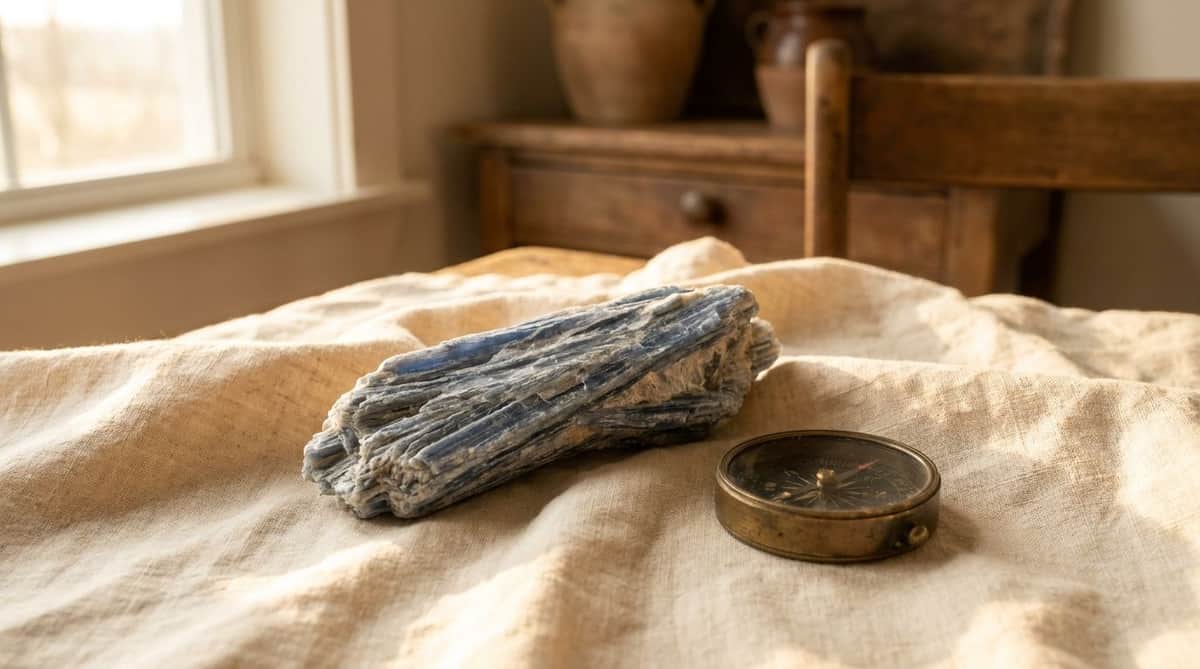
It crystallizes in the triclinic system, almost always as long, flattened, blade-like crystals — which is exactly why an old mineralogical synonym for kyanite is “disthene,” Greek for “two strengths.” That name describes a real, measurable property covered in the next section.
Blue is by far the most common and most valuable color for gem-quality material, but kyanite also occurs white, gray, green, and colorless, with rare orange material recently found in Tanzania. It forms only in metamorphic rock — typically schist and gneiss — created when high pressure alters clay minerals in sedimentary rock. Gem-quality deposits are mined in Nepal's Kali Gandaki region (discovered in 1995 and now prized for a blue that rivals fine sapphire), Brazil, Kenya's Umba Valley, Switzerland, Russia, and the Appalachian belt of North Carolina, Virginia, and Georgia in the U.S.
Properties: Physical, Mental, and Metaphysical
Physical Properties
Kyanite's defining trait is directional hardness — anisotropy — and it's one of the few gem minerals where this is dramatic enough to matter to an ordinary buyer. Measured along the length of a blade (parallel to the c-axis), kyanite sits at roughly 4 to 4.5 on the Mohs scale. Measured across the blade, on the same crystal, it jumps to roughly 6 to 7. A steel knife blade (about 5.5) will scratch kyanite lengthwise but not crosswise. It also has perfect cleavage in one direction, specific gravity of about 3.65 to 3.69, and a refractive index of 1.71 to 1.74.
Mental & Emotional Properties
In crystal-healing traditions, kyanite is described as a calming stone associated with clear, honest communication — often linked to the throat chakra. That's a belief from those traditions, not a documented physical effect.
Metaphysical Properties
Kyanite is probably best known in wellness circles for one specific claim: that it “never needs cleansing” because it doesn't hold or accumulate negative energy the way other crystals supposedly do, and can even be used to “clear” other stones laid next to it. There's no physical mechanism behind that claim — it's a belief within crystal-healing practice, not a measurable property, and it shouldn't be confused with the real anisotropic hardness described above.
The Real Science Behind Kyanite's Two Hardnesses
Anisotropic hardness is real, testable mineralogy, not folklore. It happens because kyanite's atomic structure isn't uniform in every direction: aluminum-oxygen octahedra are packed into chains that run one way through the crystal, and how tightly those chains resist being scratched depends on which face and direction you're testing. Cut a facet the “easy” way and a lapidary can shape it efficiently; cut across the grain and the same tool barely touches it. That difficulty, combined with the mineral's perfect cleavage, is exactly why kyanite has a reputation among gem cutters as one of the hardest stones to facet cleanly, despite parts of it being relatively soft.
That same structural behavior has a genuinely important industrial use: kyanite is mined in bulk (mostly the non-gem grade) to manufacture refractory bricks, mortars, and kiln furniture for high-temperature furnaces, and as a strengthening additive in high-grade porcelain, spark plug insulators, brake shoes, clutch facings, and the binding agent in some abrasive grinding wheels. One more unusual trait manufacturers rely on: heated kyanite can expand to nearly twice its original volume, a property that's deliberately engineered around in some of those products rather than treated as a defect.
None of that industrial chemistry proves the “never needs cleansing” metaphysical claim from the section above — the two are unrelated. What it does prove is that kyanite's directional hardness is one of the more scientifically interesting properties of any stone sold as jewelry.
How to Tell Real Kyanite from Its Lookalikes
Kyanite's saturated blue gets it confused with a few other stones, especially in loose, unset material sold online.
Blue sapphire is the big one — both are blue and can look similar in a photo. But sapphire is corundum, a uniform 9 on the Mohs scale in every direction with no cleavage at all, while kyanite is much softer and directional, with a cleavage plane along which it can split. A jeweler can usually separate them instantly with a refractometer or by testing hardness in two directions.
Dyed blue howlite or magnesite is the budget imitation, sold to mimic turquoise, lapis, and sometimes kyanite. Both are much softer overall (roughly 3 to 3.5) with no directional hardness difference, and dye often pools visibly in the stone's natural surface cracks under magnification.
Blue quartz and dumortierite quartz are the other common mix-up — both are a uniform 7 on the Mohs scale with no cleavage plane, unlike kyanite's split-along-a-line behavior.
Hardness testing on kyanite specifically has to be done in two directions to mean anything — a single scratch test can make it look softer or harder than it is depending on where you press.
How to Wear and Care for Kyanite Jewelry
Kyanite's low hardness in one direction plus its perfect cleavage make it a genuinely fragile choice for a ring meant for daily wear — a hard knock at the wrong angle can chip or split it along that plane. That's why most kyanite jewelry uses cabochons, tumbled beads, or raw blade-like pieces rather than faceted stones, and why it suits earrings, pendants, and occasional-wear bracelets better than a ring you'll wear at the gym. If you like the idea of a gemstone bead worked into a personal piece, browse our personalized bracelets for settings where a stone like this sits protected rather than exposed.
Clean it the gentle way: a soft cloth with mild soap and lukewarm water, dried immediately. Skip ultrasonic and steam cleaners entirely — the vibration and heat are exactly the conditions that can open up a cleavage crack. Our general guide to cleaning a gemstone ring covers the same gentle-cleaning principles for stones that don't tolerate aggressive methods. Store kyanite separately from harder stones so it doesn't get scratched in a jewelry box, and avoid sudden temperature swings — a hot shower right after a cold car isn't worth the risk.
Frequently Asked Questions
Is kyanite a birthstone?
No. Kyanite isn't one of the twelve official modern or traditional birthstones covered in our birthstones-by-month guide, though its blue color puts it in the same general family as September's sapphire.
Can kyanite get wet?
A brief rinse under the tap is fine, but don't soak it and never put it through an ultrasonic or steam cleaner — the vibration and heat can open a crack along its cleavage plane.
Is kyanite the same as sapphire?
No, even though both are prized in a similar blue. Sapphire is corundum at a uniform hardness of 9 with no cleavage; kyanite is aluminum silicate with directional hardness of roughly 4 to 7 and a perfect cleavage plane, which makes it noticeably softer and more fragile overall.
Why does kyanite have two different hardnesses?
Because its atomic structure isn't the same in every direction — the aluminum-oxygen chains that make up the crystal run one way through it, so a scratch test gives a different result depending on whether you test along the blade or across it. It's a real, measurable property, not a marketing claim.
Is kyanite rare or expensive?
As a mineral, no — it's common in metamorphic rock worldwide. But clean, facetable, gem-grade blue material is genuinely scarce, and its directional hardness makes it difficult and slow to cut without cracking. That combination means well-cut gem-quality kyanite can cost more per carat than mid-tier sapphire, even though the raw mineral itself isn't geologically rare.