“Jasper” sounds like it should name one specific stone, and it doesn't. Red jasper, yellow jasper, picture jasper, ocean jasper, mookaite: all of them are jasper, and none of them look much alike. What actually ties the family together isn't color or origin, it's a shared microscopic structure that Egyptian carvers were already shaping into seals more than three thousand years ago. Here's what jasper actually is, where its long history and many faces come from, and how to avoid paying for a dyed substitute.
What Jasper Actually Is
Jasper is an opaque, fine-grained variety of chalcedony — itself a cryptocrystalline (technically microcrystalline) form of quartz, meaning it's built from quartz crystals too small to see without a microscope, packed densely together rather than growing as one large, clear crystal the way amethyst or citrine do. That dense packing is exactly what makes jasper opaque instead of see-through, and it's also what makes the stone tough: jasper sits at 6.5–7 on the Mohs hardness scale, hard enough to resist scratching from a steel knife or a piece of glass — a genuinely useful way to catch a soft, fake substitute, which we'll come back to later.
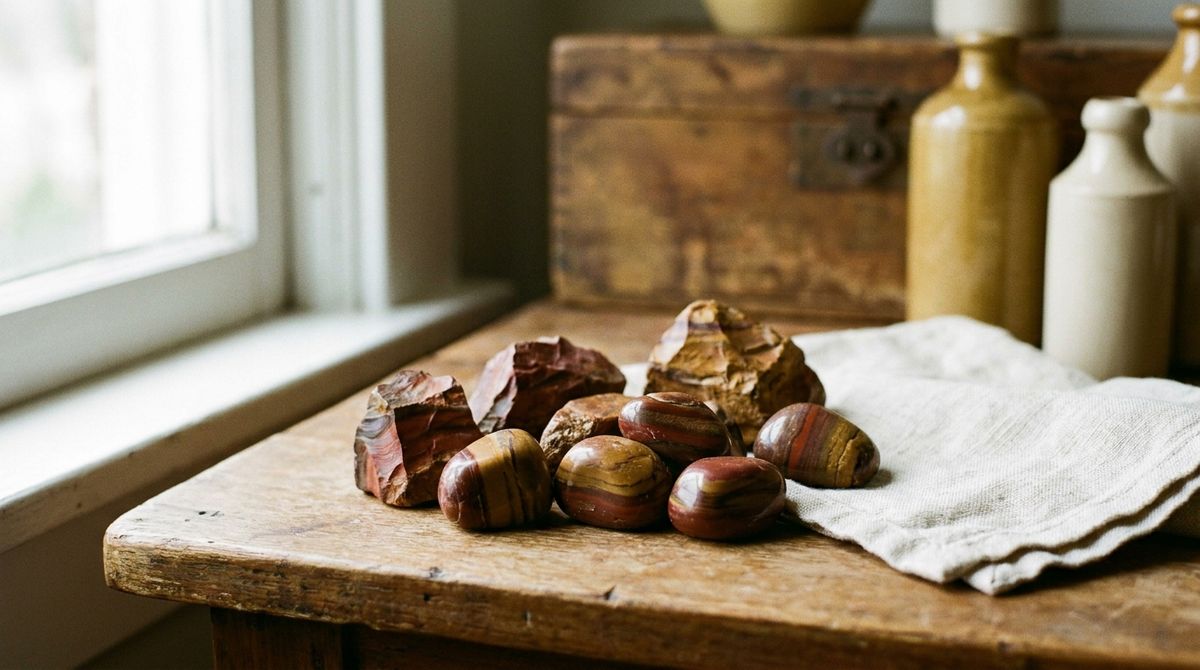
Jasper's color comes almost entirely from what got mixed into the silica while it formed, not from the quartz itself, which is naturally colorless. Iron oxide is the most common culprit, staining jasper red, brown, or yellow depending on its oxidation state; manganese oxide and other trace minerals are behind the greens, blacks, and banded or spotted patterns that give individual varieties their names. (Our Mohs hardness scale guide has the full ranking if you want to see where jasper sits next to other stones.)
Where the Name Comes From
The word “jasper” traces through Old French jaspre and Latin iaspis to the Greek iaspis — but Greek almost certainly borrowed the word rather than coining it. Etymologists trace the root further back to a Semitic source, comparable to Hebrew yashpeh and Akkadian yashupu, which suggests the name (and probably early trade in the stone) moved west out of the ancient Near East long before it reached Greek and Latin.
That earlier history creates a real identification problem for anyone reading ancient texts. The Roman naturalist Pliny the Elder described “iaspis” as often green and sometimes even transparent — nothing like the opaque, usually red-brown jasper sold today. Most gemologists now think the word was applied loosely in antiquity to a range of green and banded stones, possibly including what we'd now call chalcedony, agate, or even nephrite jade, rather than exclusively the mineral that carries the name now. Worth keeping in mind whenever “jasper” shows up in a very old source — the label and the mineral haven't always matched.
A Stone With an Ancient Résumé
Whatever exactly the ancients meant by the word, jasper (or a stone very like it) has been carved and worn for millennia. Egyptian artisans cut it into scarabs, amulets, and seals, favoring the brown and red varieties that occurred naturally in the desert sands. Jasper takes an engraved seal's detail well and holds a sharp edge, which made it a practical choice for that job, not only a decorative one.
The stone also appears twice in the Bible. Exodus 28:20 lists jasper among the twelve gems set into the breastplate worn by Aaron, the first high priest, one stone per tribe of Israel. Centuries later, the Book of Revelation names jasper as the material of the wall around the New Jerusalem and compares the throne itself to the stone — a detail that has made jasper a recurring motif in later Christian iconography, regardless of what the original Hebrew or Greek word actually referred to mineralogically.
One Name, Many Stones
Unlike a single mineral species such as emerald or amethyst, “jasper” is a category: geologists group any opaque, impurity-rich chalcedony under the name, regardless of exactly where it's mined — current sources range from Oregon in the U.S. to Madagascar and Western Australia — or how it formed. That's why the named varieties look so different from each other.
Red jasper gets its color from hematite (iron oxide) inclusions and is the most common variety worldwide. Yellow jasper forms with goethite, a different iron oxide, instead. Picture jasper (also sold as Biggs jasper, after the Biggs, Oregon deposit) develops the banded, landscape-like patterns its name describes when iron and manganese oxides settle into distinct layers as the stone forms.
Ocean jasper, mined at a single, now largely depleted coastal site near Marovato, Madagascar, is technically an orbicular jasper: its circular patterns form when quartz and feldspar crystallize outward from a center point inside silica-rich volcanic rock. Mookaite comes only from Western Australia and leans toward a cream-to-burgundy, watercolor-like blend of color rather than sharp banding. Kambaba jasper is the odd one out — some sources classify its green, orb-covered stone as a fossilized stromatolite (a structure built by ancient blue-green algae), while others argue it's an orbicular rhyolite with no fossil origin at all. That's a genuine, unresolved disagreement over how the material should be classified, not a settled fact either way.
Bloodstone, also called heliotrope, is arguably the most historically significant jasper variety of all — a dark green stone flecked with red that Roman soldiers reportedly carried into battle, and the traditional March birthstone alongside modern aquamarine. We've covered its full backstory in our bloodstone guide. Jasper's closest chalcedony relative is agate, which shares the same quartz chemistry but forms translucent bands instead of jasper's opaque fill — worth reading our agate guide if you want the full family picture.
The Meaning of Jasper: Physical, Mental, and Metaphysical
Modern crystal-shop language tends to sum jasper up in one phrase — “the Supreme Nurturer” — but it's worth separating what the stone can verifiably do from what tradition claims about it.
Physical
There is no clinical evidence that jasper affects the body, and it should not be treated as having any medical or therapeutic effect. What's physically true about jasper is more mundane but still useful: its hardness and toughness make it a low-maintenance stone for daily-wear jewelry, and because every piece's pattern comes from its own mix of mineral impurities, no two pieces of a banded or orbicular variety are ever quite identical.
Mental
In crystal-lore tradition, jasper is described as calming and steadying rather than energizing — the opposite pitch from a brighter stone like citrine. That's a belief drawn from folklore and personal practice, not a scientifically measured effect, but it's consistent across most sources describing the stone's traditional use.
Metaphysical
The “Supreme Nurturer” title is a genuinely long-standing one in crystal-healing writing, tied to jasper's association with steady, sustained emotional support rather than sudden change. Within that same tradition, individual varieties are often given more specific attributions — red jasper for grounding and vitality, ocean jasper for emotional calm — none of which are verified claims, only a lore that's stayed consistent for a long time.
How to Tell Real Jasper From a Fake
Because jasper is cheap and widely sold, dyed and synthetic look-alikes are common in bead and jewelry markets. A few checks catch most of them:
Hardness: real jasper resists scratching from glass or a steel knife blade. If a knife scratches it easily, it's very likely resin or plastic. Color: dyed agate or quartzite standing in for jasper often shows unnaturally bright, “acidic” colors — hot pink, vivid purple, saturated lemon yellow — that natural jasper's iron- and manganese-driven palette doesn't produce; genuine jasper stays in muted, earthy tones. Opacity: jasper is opaque all the way through. If light passes through the edges, or you can see distinct, translucent banded layers, you're more likely holding dyed agate. Weight and temperature: real stone feels substantial for its size and warms slowly against skin; plastic feels noticeably light and warms almost immediately. For loose beads (not finished jewelry you want to keep pristine), a cotton swab dipped in a little acetone or nail polish remover, rubbed gently on the surface, will pick up color if the piece has been dyed.
Wearing and Caring for Jasper
Jasper's hardness makes it a genuinely low-maintenance stone for rings, bracelets, and pendants worn every day. Clean it with mild soap, warm water, and a soft cloth — our general gemstone ring cleaning guide covers the same routine in more detail. Skip ultrasonic cleaners and harsh chemicals on cheaper banded or orbicular varieties (ocean and picture jasper beads in particular), since some are dyed or wax-treated to deepen their color, and heat or solvents can strip that treatment. If you're shopping for a piece with real history behind the stone rather than an invented one, jasper works well as an accent in a personalized necklace alongside a birthstone or engraved pendant.
Frequently Asked Questions
Is jasper a birthstone?
Jasper itself isn't one of the twelve modern birthstones. Its close relative bloodstone, however, is the traditional March birthstone, paired with aquamarine as the modern choice.
What's the difference between jasper and agate?
Both are varieties of chalcedony with identical quartz chemistry. Agate is defined by its translucent, often colorful banding, while jasper is opaque throughout because it carries a higher concentration of mineral impurities.
Can jasper get wet?
Real jasper's hardness and non-porous structure make brief water exposure safe for cleaning. Dyed varieties — common in ocean and picture jasper beads — can bleed color if soaked, so a quick rinse rather than a long soak is the safer habit.
What color is real jasper?
Most commonly red, yellow, brown, or green, driven by iron and manganese impurities. True blue jasper is rare enough that a strongly saturated blue “jasper” bead is worth checking for dye before you buy it.