Bloodstone is one of the few gemstones with two competing origin legends that flatly contradict each other — one from ancient Rome, one from medieval Christian Europe — and both still get repeated today as though they're settled history. The mineral underneath both stories is a dark green, cryptocrystalline quartz that costs a few dollars a carat and has been carved into seals, signet rings, and religious icons for at least four thousand years. Here's what's actually documented, and what's folklore dressed up as fact.
What Bloodstone Actually Is
Bloodstone — also called heliotrope — is a variety of chalcedony, the same cryptocrystalline form of quartz that produces agate, carnelian, and onyx, all part of the same broad family covered in our guide to different gemstones and what they mean. Its chemical formula is the same as ordinary quartz, SiO₂, with a specific gravity around 2.61 and a vitreous, waxy luster when polished. On the Mohs hardness scale it sits at 6.5 to 7 — harder than glass, roughly on par with quartz itself, and durable enough for daily-wear jewelry without the fragility of a stone like opal or pearl.
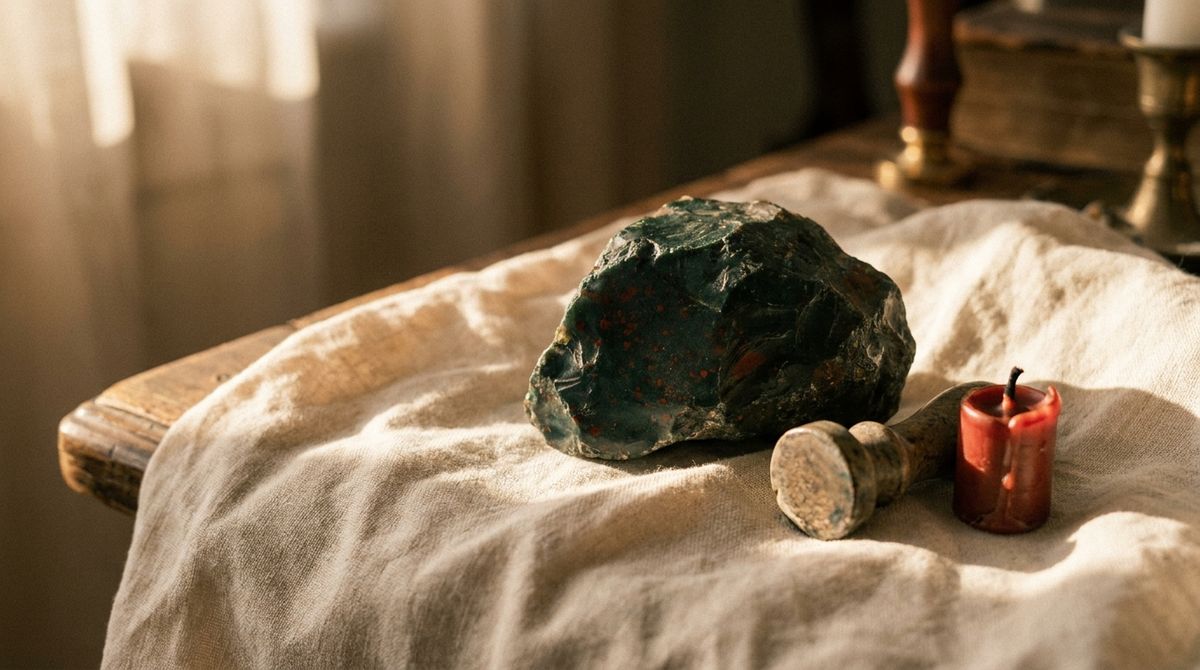
The base color is a deep, opaque green, and the ‘blood’ in the name comes from flecks of red running through it — not dye, but inclusions of hematite and red jasper trapped in the quartz as it formed. That color combination is also why the stone carries its own weight of symbolism, the same way any gemstone's hue does. No two pieces show quite the same pattern of spotting, which is part of why it was prized for carving: each finished piece looked genuinely singular.
Where Bloodstone Comes From
The material most gemologists consider ‘true’ bloodstone — with the classic dark green base and vivid red spotting — comes primarily from the Deccan Traps region of India, a vast volcanic plateau that also produces much of the world's agate. Additional deposits have been worked in Brazil, Australia, South Africa, Bulgaria, the Czech Republic, Italy, Nova Scotia, and Scotland's Isle of Rum, along with several sites in the United States. Because the material forms wherever silica-rich fluids move through iron-bearing volcanic rock, deposits tend to cluster near old lava fields rather than in a single geographic center the way some gemstones do.
From Mars to the Martyr: Two Origin Stories, Neither One Verifiable
Bloodstone's two defining legends come from completely different worldviews, centuries apart, and neither can be traced to a documented original source — which is exactly why they're worth separating from the stone's actual, provable history.
In ancient Rome, the stone was associated with Mars, the god of war, and came to be called the ‘March stone’ — a connection that predates the Christian calendar entirely and has nothing to do with spring or the modern birthstone system.
Centuries later, medieval Christian tradition told a very different story: that bloodstone's red spots formed when drops of Christ's blood fell onto a bed of green jasper at the foot of the cross during the crucifixion. That legend gave the stone its most enduring nickname, the ‘Martyr's Stone,’ and medieval and Renaissance carvers leaned into it directly — bloodstone was a favored material for carving crucifixion scenes and images of Christian martyrs, a use documented well into the Renaissance. Neither story is a claim this article can verify as historical fact; both are documented as legend, and both explain why a stone this common ended up this loaded with meaning.
March's Other Birthstone
Bloodstone holds official status as a birthstone for March, alongside the far more famous aquamarine — a pairing confirmed by both the American Gem Society and the International Gem Society, and one of twelve pairings covered in our guide to birthstones by month. Where aquamarine got that slot for its pale blue color evoking the sea, bloodstone's claim runs through the older Roman ‘March stone’ association above: by the time modern birthstone lists were formalized in the 20th century, the Rome-to-Mars-to-March connection was well enough established that bloodstone kept its seat, even as its instantly recognizable, water-clear rival became the month's headline stone.
Physical, Mental, and Metaphysical: What People Say About It
Physical: at 6.5 to 7 on the Mohs scale, bloodstone is hard enough for rings, bracelets, and other jewelry that takes daily knocks, which is part of why it turns up historically in seals and signet rings meant to be worn and used, not just displayed.
Mental: in crystal-healing traditions, bloodstone is described as a grounding stone associated with courage, resilience, and clear-headed decision-making under pressure — beliefs with no scientific basis, offered here as the tradition itself frames them, not as verified claims.
Metaphysical: the same traditions most often pair bloodstone with the root and heart chakras and link it primarily to Aries, per its old Roman Mars association, with Pisces, Cancer, Leo, and Sagittarius sometimes included as secondary signs depending on the source. A related and much older folk belief — that bloodstone could stop bleeding or purify the blood when worn or carried — shows up repeatedly in medieval and Renaissance sources and is almost certainly why the stone became linked to blood in the first place, well before the crucifixion legend attached to it. None of this is medically supported; it's presented here as documented folklore, not health advice.
Bloodstone in History: Seals, Signets, and Sacred Carvings
Long before it was jewelry-store inventory, bloodstone was a working material. Babylonian carvers used it for cylinder seals, and ancient Egyptians carved it into amulets, believing in its protective and healing properties. Its combination of hardness, fine grain, and dark color made it a favorite for intaglio work — designs carved into the surface, most often used as a signet: pressed into wax to seal and authenticate documents. Noblemen across medieval and Renaissance Europe wore bloodstone signet rings for exactly this purpose, and the same qualities that made it useful for practical stamps made it just as suited to devotional carving — hence its long association with crucifixion scenes and images of Christian martyrs described above.
How to Tell Real Bloodstone From an Imitation
Genuine bloodstone is opaque to only slightly translucent at the edges, with red flecks that look genuinely random — some larger, some barely visible, no two clustered in quite the same pattern. Dyed imitations, usually made from cheaper green chalcedony or glass, tend to give themselves away with red spotting that's too uniform, too saturated, or sits right at the surface rather than appearing to run through the stone. A jeweler's loupe makes the difference easy to spot: natural inclusions have soft, slightly blurred edges, while dye sits in sharp, printed-looking dots.
Weight and hardness are useful backup checks. Bloodstone should feel notably heavier than a glass or plastic imitation of the same size, and it will scratch glass rather than the other way around, consistent with its 6.5–7 Mohs rating. Price is also a signal: bloodstone is an affordable, abundant stone, so an unusually low price on something marketed as ‘rare’ bloodstone is itself a reason to ask more questions, not a bargain to trust blindly.
Caring for Bloodstone Jewelry
Bloodstone's 6.5–7 hardness makes it fairly forgiving for everyday jewelry, but it's still a porous, opaque stone that benefits from simple care rather than aggressive cleaning, along the same lines as our general guide to cleaning a gemstone ring. Warm water with a small amount of mild dish soap and a soft brush is enough to lift dust and oils from the grooves of a carved or textured piece; rinse thoroughly and dry with a soft cloth rather than letting it air-dry with soap residue. Avoid ultrasonic cleaners and steam cleaning — the alternating heat and vibration can stress natural inclusions and fractures that aren't always visible to the eye — and keep it away from harsh chemicals like chlorine or ammonia-based cleaners, which can dull the polish over time. Store it separately from harder stones like diamond or sapphire, which can scratch bloodstone's surface even though bloodstone itself is hard enough to scratch softer materials.
Bloodstone's deep, near-black green reads well against warm metal tones, which is part of why it turns up so often set in yellow gold rather than white metals — something worth keeping in mind if you're browsing our personalized necklace collection for a stone with some genuine history behind it rather than a purely decorative one.
Frequently Asked Questions
Is bloodstone a real birthstone?
Yes. Bloodstone is an official birthstone for March, listed alongside aquamarine by both the American Gem Society and the International Gem Society.
What causes bloodstone's red spots?
The red flecks are inclusions of hematite and red jasper trapped in the chalcedony as it formed — not dye or artificial color. That's also the basis for its alternate name, heliotrope.
Is the crucifixion legend about bloodstone true?
It can't be verified as history. It's a documented medieval Christian legend — that the red spots formed from Christ's blood falling on green jasper at the crucifixion — which is why bloodstone is also called the ‘Martyr's Stone,’ but there's no historical record confirming the story itself, only records of the legend being told and repeated.
How hard is bloodstone, and is it durable enough for rings?
Bloodstone measures 6.5 to 7 on the Mohs hardness scale, close to quartz, which makes it durable enough for rings, bracelets, and other jewelry worn daily — provided it's stored separately from harder stones like diamond or sapphire that could scratch it.
How do you clean bloodstone jewelry?
Warm water, a mild soap, and a soft brush are enough for routine cleaning. Skip ultrasonic and steam cleaners, and keep bloodstone away from harsh chemical cleaners, which can dull its polish over time.