
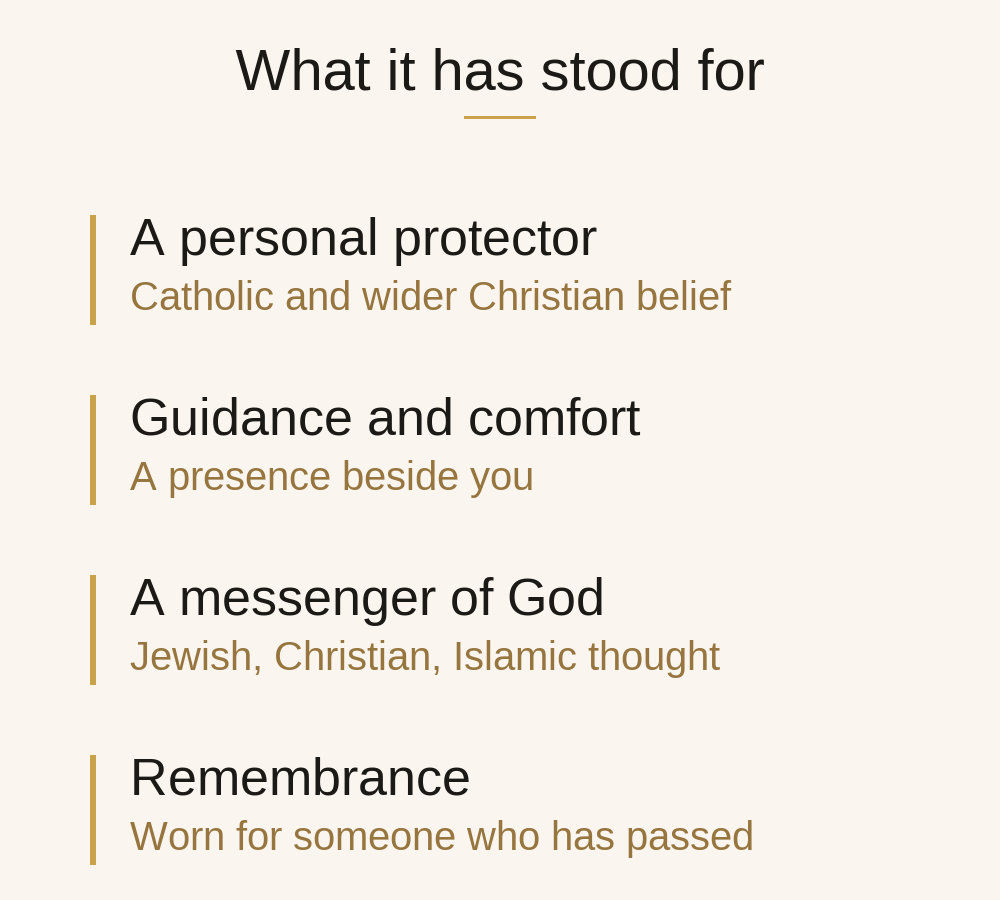
A guardian angel is, in many religious traditions, a spiritual protector thought to watch over one person. It is most closely tied to Catholic and wider Christian belief, though related ideas of angels who guard and accompany people appear in Jewish and Islamic tradition too. As a symbol it stands for protection, guidance and comfort.
Below: the short answer, where the belief comes from, what Christian tradition says, how other traditions see it, what wings and halos stand for, a timeline of dated facts, and how it compares with similar symbols.
At a glance
- A guardian angel is traditionally a personal protector, one angel for one person, in Catholic and many other Christian traditions.
- The Roman Catholic calendar keeps a Feast of the Guardian Angels on 2 October.
- Related ideas of angels who guard and accompany people exist in Jewish and Islamic tradition, with different details.
- In images it is shown with wings and a halo, and as jewelry it is worn for protection, faith or remembrance.
What does a guardian angel mean?
It means a protector who is close by. In the traditions that hold the belief, a guardian angel is a spiritual being given the task of guarding, guiding and praying for one particular person through life. Believers do not usually picture it as a ruler or a judge, but as a quiet companion.
In short: protection, guidance and comfort, often from a presence that is felt rather than seen. Beliefs differ between and within traditions, and many people use the image without holding any one doctrine. The sections below take the main traditions in turn and note where they differ.
Where the belief comes from
The idea that a person has a protecting spirit is old and widespread, and it does not belong to one religion. Ancient Greek writing describes a personal spirit, called a daimon, tied to each person, and some writers compare it with the later guardian angel. Whether one grew out of the other is a matter of debate.
In the Jewish and Christian scriptures, angels appear as messengers and protectors. The word "angel" itself comes from a Greek word meaning messenger. A psalm speaks of angels being given charge to guard a faithful person, and a New Testament passage speaks of the angels of children. These passages are the usual starting points for the later belief in a personal guardian.
Guardian angels in Christian tradition
Early Christian writers discussed the idea that each believer has an angel, and over the centuries it became a familiar part of Catholic teaching and devotion. In that teaching a guardian angel is given from the beginning of a person's life and stays with them. Many Catholic households know a short children's prayer addressed to one's guardian angel.
The Roman Catholic Church keeps the Feast of the Guardian Angels on 2 October. It began as a local observance and was extended to the whole Church in 1670, which is the date usually given. Some other Christian traditions also honor angels, though they place less emphasis on a personal guardian, and Protestant views vary.
Jewish, Islamic and other views
Judaism. Jewish tradition speaks of angels as God's messengers who can accompany and protect people. A well-known Friday-night song welcomes the "ministering angels" into the home at the start of the Sabbath. Jewish tradition does not teach one fixed doctrine of a single personal guardian, and views differ between communities.
Islam. Islamic tradition describes angels assigned to each person. Some are traditionally understood to guard a person by God's command, and two others are said to record a person's deeds. Angels are an article of faith in Islam, and the details are discussed in the tradition's own teaching.
Other ideas. Many cultures describe an ancestor, spirit or personal helper who looks after a person. These are separate beliefs with their own names and stories, and they should not be folded into the Christian angel. In everyday speech, "my guardian angel" is also used loosely for someone who protected or helped you, or for a loved one who has died.
Wings, halo and how angels are drawn
In the earliest Christian art, angels were often shown as ordinary young men without wings. From about the 4th century the winged angel became the familiar image, and the halo followed a little later. Together they make the picture most people mean today.
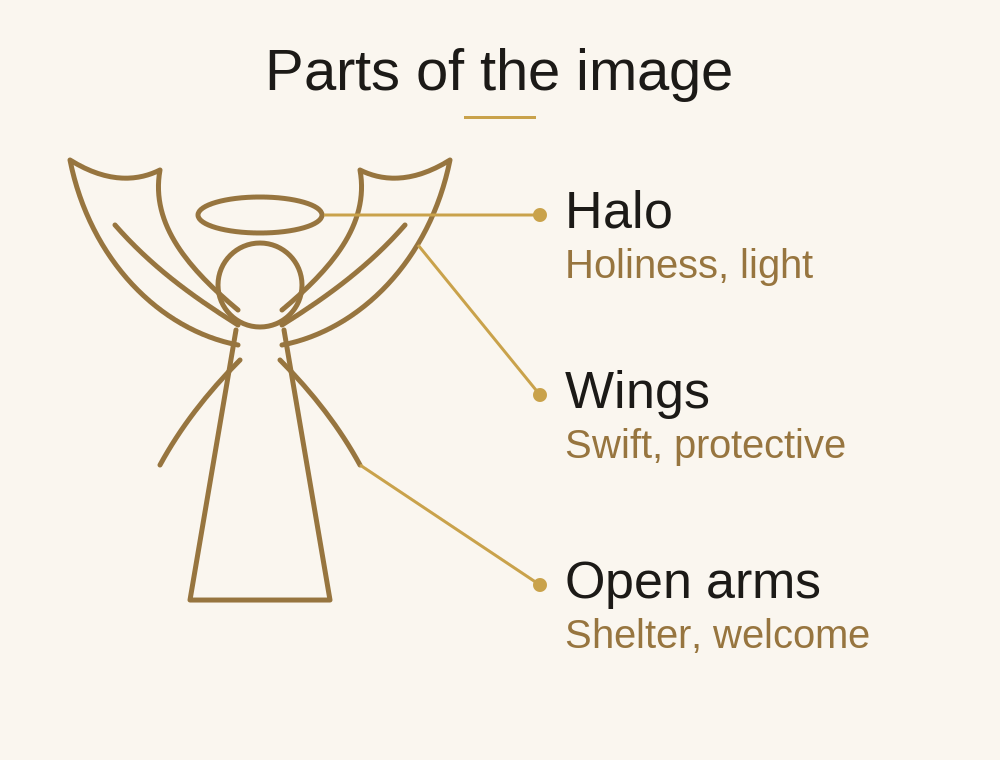
- Wings. Traditionally a sign that an angel is a swift messenger between heaven and earth, and, for many viewers, of protection, since wings can shelter. Winged figures were already known in the ancient Near East and in Greek art.
- Halo. A circle of light around the head, used in Christian art to mark holiness. Circles of light around heads were used in Roman art before they were adopted by Christians.
- Pose. Many guardian-angel pictures show the angel with open or sheltering arms, or leading a child. This is a convention of the art, not a rule of doctrine.
Often confused with
Several symbols sit close to the guardian angel, and each has its own story.
- Angel wings: wings alone, usually read as protection and remembrance of a loved one.
- Angel numbers: repeating number patterns that some people read as messages from angels, a modern idea rather than a traditional doctrine.
- Feather: a feather that turns up unexpectedly is often read, as popular belief, as a sign that someone is thinking of you.
- Hamsa hand: a protective hand from Middle Eastern tradition, with no angel in it.
- Evil eye: a charm that turns away envy, a separate kind of protection.
The table puts them side by side.
| Symbol | Shape | Traditionally read as |
|---|---|---|
| Guardian angel | Winged, haloed figure | A personal protector and guide |
| Angel wings | A pair of wings | Protection; remembrance |
| Feather | A single feather | A sign of someone near, in popular belief |
| Hamsa hand | Open hand, often with an eye | Protection and blessing |
| Evil eye | An eye, usually blue | Turning away envy |
How people wear it today
Guardian-angel jewelry takes a few familiar forms: a pendant or medal showing an angel, often with a child; a charm for a bracelet; or a simple pair of wings. People choose it for protection when travelling, as a gift for a child or at a baptism or confirmation, as a sign of faith, or as remembrance of someone who has died. Catholic families often give angel medals to children, but the symbol is worn by people of every background.
When choosing jewelry, look for a piece whose metal is described plainly, such as 316L stainless steel with a gold-plated, rose gold-plated or silver-tone plated finish, rather than vague "gold" or "silver" wording. Genuine stainless steel is nickel-safe.
A guardian angel is tradition's gentlest picture of protection: the sense of being looked after, wherever you go.
Frequently Asked Questions
What does a guardian angel symbolize?
Traditionally a personal protector, guide and comfort. In Catholic belief one angel is given to each person from the start of life, and as a symbol it stands for being watched over and not alone.
When is the Feast of the Guardian Angels?
The Roman Catholic calendar keeps it on 2 October each year. It was extended to the whole Catholic Church in 1670, the date usually given.
Do other religions have guardian angels?
Similar ideas exist, with different details. Islamic tradition speaks of angels assigned to each person, and Jewish tradition describes angels who accompany and protect, though neither is the same as the Catholic doctrine of one personal guardian.
What do the wings and halo mean?
Wings are traditionally a sign of a swift messenger and, for many, of protection. The halo is a circle of light marking holiness. Wings became standard in Christian art from about the 4th century, and the halo followed a little later.
What is the difference between a guardian angel and angel wings?
A guardian angel is a whole figure, a personal protector. Angel wings are just the wings, usually worn for protection or in memory of a loved one. The two overlap, and many people wear either for the same reasons.
Is it appropriate to wear guardian-angel jewelry?
Yes, people of many backgrounds wear it for protection, faith or remembrance. For Catholic wearers it often carries a specific religious meaning, so it helps to know that other wearers may read it more broadly.