A St Michael medal is a small devotional medal showing the archangel Michael, traditionally read as a sign of protection. In Catholic tradition he is the defender against evil and the patron of soldiers and police officers, which is why the medal is so often linked with people who work in harm's way.
Below: what the medal shows, who Michael is, a timeline of approximate dates, the meaning of the sword, scales and dragon, his feast day, how the medal differs from similar ones, and how people wear it.
At a glance
- The medal shows the archangel Michael, often with wings, a sword and a dragon under his feet.
- In Catholic tradition he is the patron of soldiers and police officers, and a defender against evil.
- His feast day is September 29, also called Michaelmas.
- The name is traditionally explained as the Hebrew question "Who is like God?"
What does a St Michael medal mean?
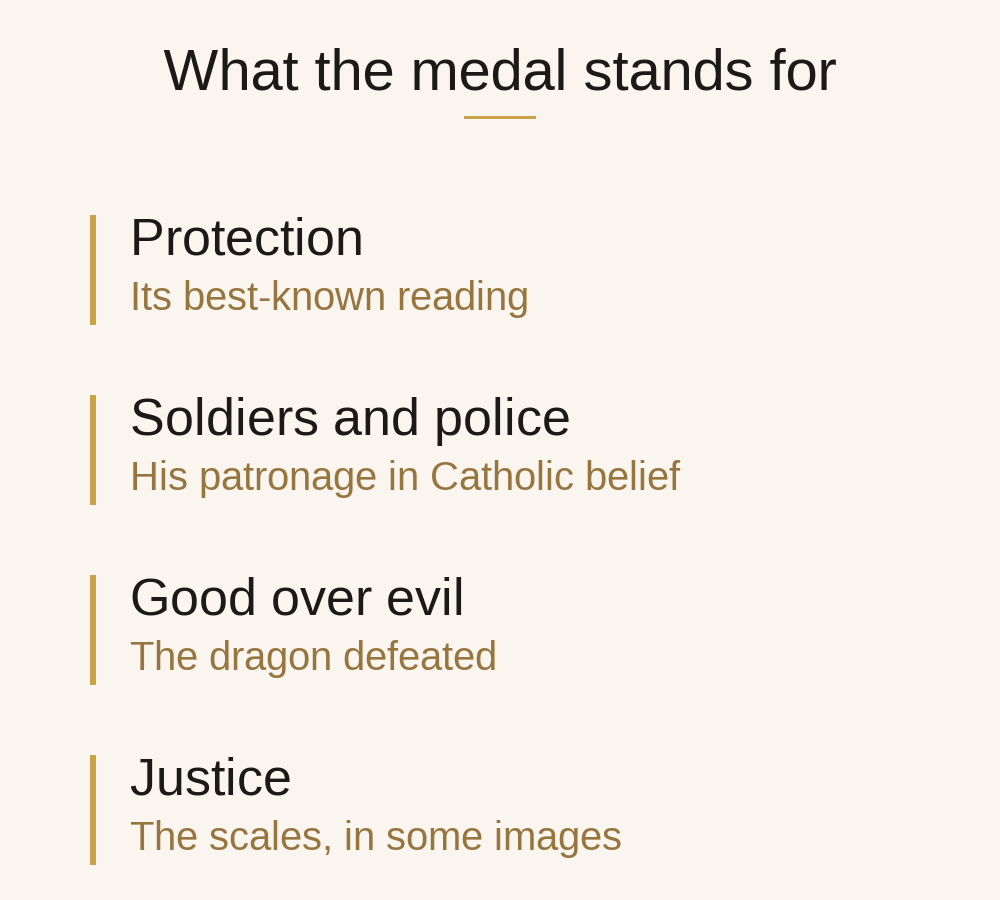
In short: a request for protection, and a sign of courage. Michael is the angel most often pictured as a warrior. A medal with his image is traditionally worn to ask for his protection, and as a reminder that good is meant to win over evil.
The reading belongs to faith and tradition, not to anything that can be measured. This guide presents it that way. It makes no medical claim and does not promise any result. For many wearers the medal is simply a personal keepsake, given by family or chosen for the person it reminds them of.
Who is the archangel Michael?
An archangel is traditionally a chief angel, one with a special task. Michael is named in Jewish, Christian and Islamic tradition. His name is usually explained as the Hebrew question "Who is like God?", read as a statement that nothing compares with the divine.
In Jewish tradition he is a protector of the people. In Christian tradition he is the leader of the angels, and a passage of scripture describes him and his angels driving out a dragon, which the tradition reads as the devil. In Islamic tradition he is known as Mikail and is linked with provision and rain.
Details differ between traditions and between churches, so treat each as one account of a figure with a long history. The medal draws mostly on the Christian picture: the warrior angel.
Patron of soldiers and police
In Catholic tradition a patron saint is a heavenly figure believed to watch over a place, a group or a line of work. Michael is counted as patron of soldiers, because he is pictured as a warrior, and of police officers, because he is seen as a defender of the weak.
He is also named in tradition as a patron of many other groups, and different countries and cities have their own devotion to him. His medal is therefore common among people in the military and in law enforcement, and among their families, who may carry one as a wish for a safe return.
None of this is a guarantee of safety. It is a tradition of prayer and hope, and people hold it with different degrees of belief.
In tradition, the medal is a request for protection, not a promise of it.
The sword, the scales and the dragon
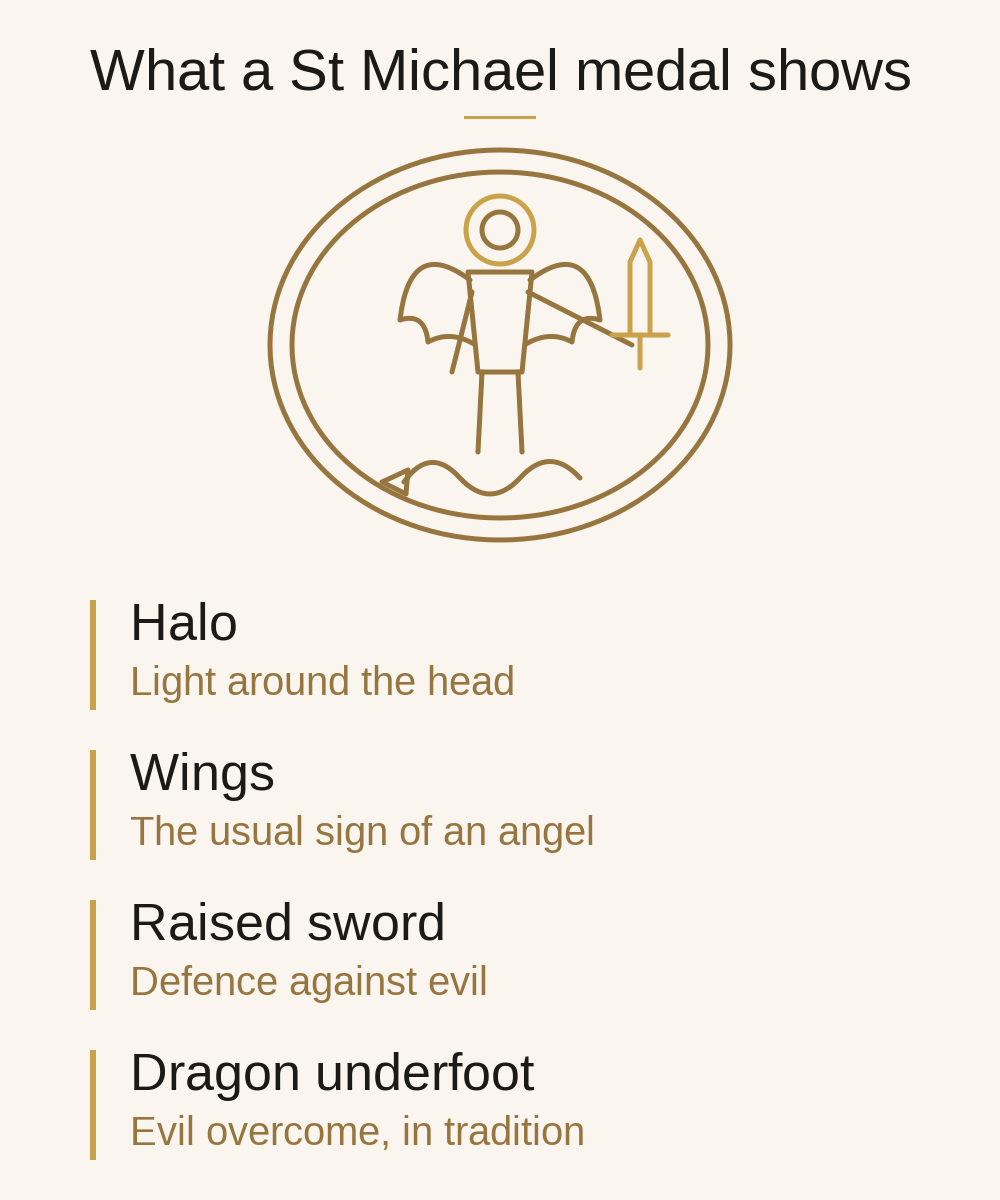
Most St Michael medals use a few repeating images. Each one has a traditional reading.
- Wings. The usual sign of an angel. They mark him as a messenger from heaven. For more on this image, see angel wings necklace meaning.
- Sword (or spear). Defence against evil. He is shown raised, ready to strike.
- Dragon or serpent underfoot. Evil overcome. The dragon is read as the devil, trampled and defeated.
- Scales. In some older images Michael holds a pair of scales, tied to the idea of weighing souls and to justice. Not every medal includes them.
- Armor, shield or banner. Signs of his role as the leader of the angels.
- Halo. A ring of light around the head, the usual mark of a holy figure.
Many medals also carry a short inscription asking for his protection. The words vary by maker and by language.
The feast day: September 29
Michael's feast day is September 29, long known as Michaelmas. For many centuries it was a notable date in the year in parts of Europe. Today, in the Catholic calendar, the day is shared with the archangels Gabriel and Raphael.
Some people choose to give or receive a medal around that date, or on a birthday or other milestone. There is no rule. The medal is often blessed by a priest, and that is a Catholic custom rather than a requirement for wearing one.
St Michael, St George and other medals
Several devotional medals look alike at first glance. They differ in who is shown and what they are traditionally worn for.
- St George is also shown fighting a dragon, but as a soldier on horseback and without wings. He is a martyr, not an angel.
- St Christopher is shown carrying a child across water, and is traditionally the patron of travelers.
- Guardian angel medals show a gentler angel watching over a child, rather than a warrior.
- Wings and feathers on their own are covered in feather symbol meaning.
The table puts them side by side.
| Medal | What it shows | Traditionally read as |
|---|---|---|
| St Michael | A winged warrior with a sword, over a dragon | Protection, courage, patron of soldiers and police |
| St George | A soldier on horseback spearing a dragon, no wings | Courage and faith under trial |
| St Christopher | A figure carrying a child through water | Safe travel |
| Guardian angel | A gentle winged figure watching over a child | Everyday protection and care |
The simplest way to remember it: if the figure has wings and a sword, it is Michael. If the figure has no wings and rides a horse, it is George.
How people wear it
The St Michael medal is worn on a chain at the neck, pinned inside a uniform, kept in a pocket, or attached to a keychain. Some people wear it every day, and others keep it for a particular time, such as a posting or a long trip. A medal is often a gift, and many people value the reason it was given more than the design.
Medals come in several shapes, most often an oval or a round disc. If you want a similar piece in modern jewelry, look for a metal that is described plainly, such as 316L stainless steel with a gold-plated, rose gold-plated or silver-tone plated finish, rather than vague "gold" or "silver" wording. Genuine stainless steel is nickel-safe.
For a wider look at medals and coins worn as pendants, see medallion necklace trend. For the cross, another common Christian symbol, see different types of crosses and their meanings.
Whatever the medal shows, its meaning is the same one tradition gives it: a quiet wish to be protected, and the courage to stand up for what is right.
Frequently Asked Questions
What does a St Michael medal symbolize?
Traditionally it stands for protection and courage. It shows the archangel Michael, the warrior angel who defeats evil in Christian tradition, and it is worn to ask for his protection. It is a matter of faith and tradition, not a guarantee.
Why is St Michael the patron of police and soldiers?
In Catholic tradition he is pictured as a warrior who defends others against evil, so soldiers look to him as their patron. Police officers have taken him as theirs for a similar reason, as a defender of the weak. These are traditions of devotion, and different countries have their own customs.
What is the dragon on the medal?
The dragon, or serpent, is traditionally read as the devil or as evil in general. Michael is shown standing over it with his sword raised, a picture of good overcoming evil. Some medals show it small and others show it as a large coiled shape.
When is St Michael's feast day?
September 29, also called Michaelmas. In the Catholic calendar today it is shared with the archangels Gabriel and Raphael. People sometimes give or bless a medal around that date, but there is no rule about it.
Do you have to be Catholic to wear a St Michael medal?
No. The medal comes from Catholic devotion, and many wearers are Catholic, but anyone may wear one. Some choose it for its meaning of protection or courage, or because someone they love gave it to them. Wearing it with understanding of where it comes from is a good practice.
What is the difference between St Michael and St George?
Michael is an archangel, shown with wings, a sword and a dragon underfoot. George is a martyr and soldier, shown on horseback with no wings, spearing a dragon. Both are linked with courage, but they are different figures with different feast days.