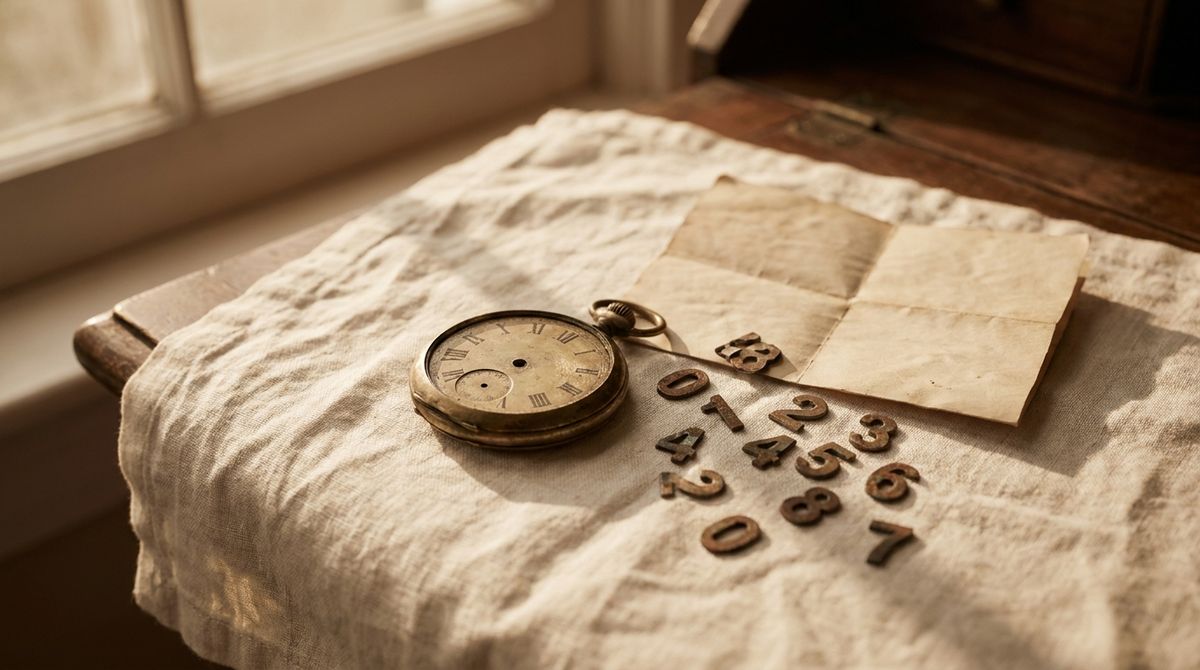
You look up at 11:11. The receipt comes to $2.22. The car ahead of you ends in 333. Once a number has your attention it seems to follow you everywhere — and for a great many people that feeling now has a name. Angel numbers are repeating sequences said to carry a message. This is where the idea genuinely comes from, what each sequence is supposed to mean, and why your brain is so unreasonably good at spotting them.
Where the idea actually comes from
The belief that numbers carry meaning is ancient and serious. Pythagoras taught that number was the organising principle of reality. Kabbalistic gematria assigns numeric values to Hebrew letters so that words sharing a sum are read as related. Chinese numerology treats eight as fortunate and four as unlucky because of what those numbers sound like when spoken. None of that is new, and none of it is fringe.
What is new is the phrase angel numbers and the specific meanings pinned to 111, 222 and the rest. Those trace to one modern source: Doreen Virtue's 2005 book Angel Numbers and its 2008 follow-up, which set out the number-by-number readings that almost every article on the subject still repeats. Virtue has since publicly renounced the New Age teachings she built her career on — a detail the sites quoting her lists tend to leave out. It is worth knowing before treating any single interpretation as authoritative.
Why you keep seeing them
There is a well-documented reason a number starts appearing everywhere the moment you start looking for it. Psychologists call it the frequency illusion, or the Baader-Meinhof phenomenon: once something is salient to you, your attention filters for it and your memory keeps the hits while quietly discarding the misses. You glanced at the clock a hundred times today. You remember the one that read 11:11.
That explains the seeing. It does not settle the meaning, and it is not offered here as a debunking. Most people who wear a number were never looking for proof. They are marking something — a date, a loss, a decision, a stretch of time they came through — and the number is the shorthand. That is closer to how people have always used symbols than to how they use evidence.
What each sequence is said to mean
111 — beginnings and attention
Read as the signal that a new chapter is opening and that your thoughts are unusually quick to become real, so it is worth noticing what you are actually thinking about. Of all the sequences, 1111 is the one people report seeing most, almost certainly because clocks show it twice a day.
222 — patience and balance
Taken as confirmation that something already set in motion is growing, but has not surfaced yet. In Virtue's original phrasing, newly planted ideas are beginning to grow into reality and need continued watering. It is generally read as a call for patience rather than action, and often as a sign about a partnership or relationship.
333 — creativity and support
Associated with expression, creative work and the sense of being accompanied rather than alone in it. Virtue tied 333 to the presence of ascended masters; in general usage it has softened into a nudge to make the thing you have been putting off.
444 — stability and protection
The steadiest of the sequences, and the one most often described as reassuring. Four carries the structural associations already present in older symbolism — four walls, four directions, four seasons. It is usually read as: the ground under you is solid, keep going.
555 — change, whether or not you asked for it
Read as a significant change arriving, and pointedly not as a promise that the change will feel good at the time. Of the common sequences it is the one most often interpreted as a warning to hold plans loosely.
777, 888 and 999
Seven carries its long-standing associations with luck and with inner knowledge, and is usually read as being on the right path. Eight, echoing the Chinese association with prosperity, is read as abundance or as a cycle paying off. Nine, the last single digit, is read as completion — something finishing so that the next thing can start.
Wearing a number
A number you keep seeing is easy to carry, which is much of the appeal. Three digits sit comfortably on a small pendant, and unlike a name they mean nothing to anyone who has not been told — which is why people who would never wear a slogan will happily wear 444. An engraved disc necklace holds a short sequence cleanly on the front or hidden on the back, and bar necklaces suit longer strings like 1111 or a full date read as numbers. If the number is standing in for a date, our free Roman numeral converter will format it for engraving.
Frequently Asked Questions
Are angel numbers real?
There is no scientific evidence that repeating numbers carry messages, and the frequency illusion explains why they appear so often once you start noticing them. What is real is that people find meaning in them, and the practice of assigning meaning to numbers is thousands of years old. Whether that meaning is received or chosen is a question the evidence does not answer either way.
What is the difference between an angel number and a life path number?
An angel number is a repeating sequence you happen to notice — 111, 444 — and can change over time or appear in clusters. A life path number is calculated once, by reducing your full date of birth to a single digit, and never changes. They come from different systems: life path numbers belong to traditional numerology, angel numbers to a modern framework popularised in 2005.
What does 1111 mean?
It is generally read as the strongest form of 111: a doorway or a moment of alignment, with your attention treated as unusually powerful. It is also the sequence people report seeing most often, which has a mundane explanation — a twelve-hour clock displays 11:11 twice every day, so it gets far more chances to be noticed than a number like 555.
Can your angel number change?
In common practice, yes. Angel numbers are treated as tied to a period of your life rather than to you permanently, so people describe one sequence fading as another starts appearing. This is one reason they are often engraved on something small and swappable rather than on a single permanent piece.