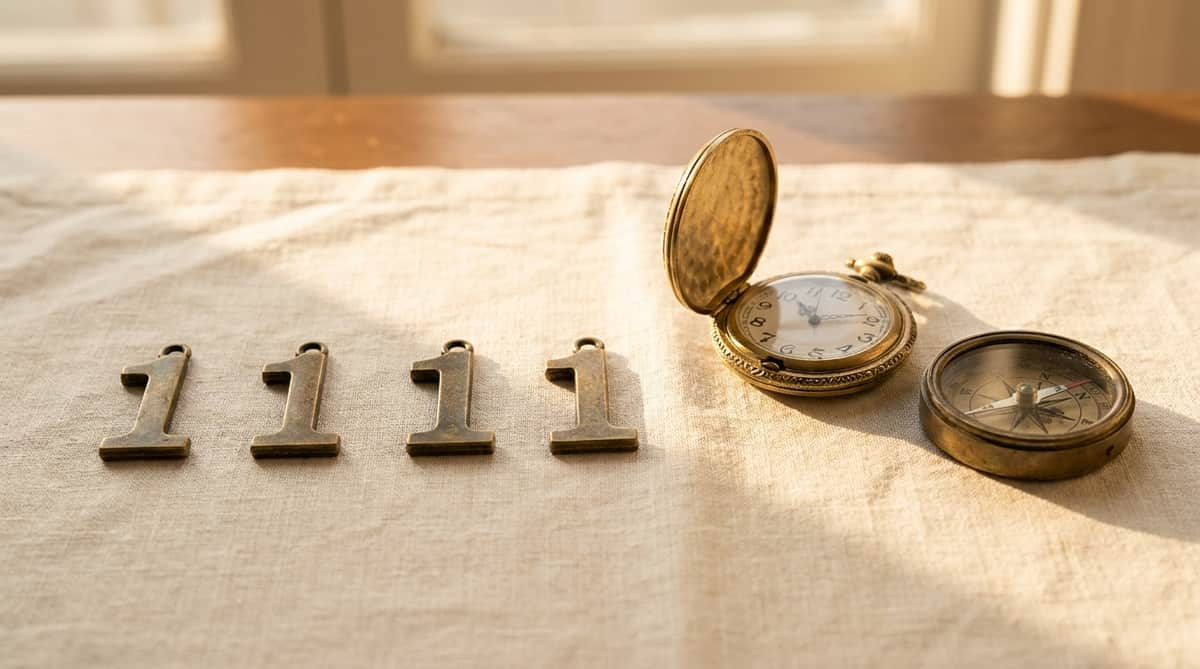
No repeating sequence gets reported as often as 1111. It's the one that shows up on a clock twice a day at the same literal minute, the one with its own wish-making folklore attached, and the one numerologists treat differently from every other number in the series for a specific structural reason: it's built on 11, the digit numerology refuses to collapse into something smaller. Here's where that distinction comes from, what the number is said to mean across love, career, and money, and how it's actually different from 111 rather than just a longer version of it.
Why 1111 Isn't Just "111 With an Extra Digit"
Most repeating numbers in this series get their meaning by reducing to a single digit — 555 reduces to 6, 999 to 9, and so on. 1111 breaks that pattern. Add its digits (1+1+1+1=4) and you get 4, the stability-and-hard-work number also tied to 444. But numerologists generally don't read 1111 through that reduction at all, because splitting it in half gives 11 and 11 — and 11 is one of three "master numbers" in numerology (alongside 22 and 33) that practitioners deliberately leave unreduced, treating it as carrying its own charge rather than folding it down to 2. That's the real reason 1111 gets written up as a bigger deal than its neighbors: it's read as two master numbers side by side, not a quadrupled 1.
The practical reading most sources converge on: where 111 is framed as the first, quieter nudge toward a new beginning, 1111 is framed as the loud version — a moment numerology writers describe as a "portal" or an "alignment point," language that doesn't get applied to 222 or 333. Whether or not that framing holds up, it's the consistent distinction between the two numbers across numerology sources, not just a difference in how many 1s are in front of you.
1111 in Love, Career, and Money
Love: 1111 is commonly read as a signal tied to timing rather than a verdict on a specific relationship — a new connection crossing paths at a meaningful moment, or two people already circling each other being nudged to stop hesitating. It's frequently paired with "twin flame" framing in online numerology writing, a concept distinct from soulmate language that treats the meeting as mirrored rather than simply compatible.
Career: in career contexts, 1111 is usually read as a prompt to act on an idea rather than keep refining it — numerology writers tie it to the same "new beginnings" theme as 111, but with more urgency: less "a door is opening" and more "the door is open now."
Money: financially, the number is tied to manifestation language more than any other in the series — the idea that attention and intention shape outcome, which is also why 1111 shows up constantly in manifestation and "law of attraction" content well outside strict numerology circles.
1111 vs. 111 vs. the Rest of the Series
The four numbers people most often confuse or lump together, and what actually separates them:
- 111 — single master structure (three 1s, no master-number pairing); read as the first, quieter signal of a new beginning. Full guide.
- 1111 — built from two master numbers (11 and 11); read as the same new-beginnings theme, amplified to "portal" or "alignment" language not used for the others.
- 444 — reduces to 4, same digit root as 1111; read as confirmation that an existing foundation is solid, the steadier counterpart to 1111's more urgent framing. Full guide.
- 222 — reduces to 6; read as balance and partnership rather than a starting point. Full guide.
The 11:11 Wish Tradition, and Why You Keep Seeing It
Separate from angel-number numerology, 11:11 carries its own older folk tradition of making a wish the moment a digital clock hits it — a habit widely reported as a shared cultural ritual well before "angel numbers" became a popularized framework in the 2000s. That earlier tradition is one reason 1111 gets noticed and reported more than any other repeating number: it has two independent cultural reasons to catch attention (the wish ritual and the angel-number reading) stacked on top of the same non-mystical mechanism behind all of them — frequency illusion, where noticing a pattern once makes the brain quicker to spot it again. A digital clock offers two chances a day to catch 11:11 specifically, same as any other four-digit match, but the wish tradition gives people an extra reason to glance at the clock at exactly that minute in the first place, which only reinforces how often it gets caught.
What People Do When They Keep Seeing 1111
There's no fixed ritual tied specifically to 1111 beyond the 11:11 wish habit, but common suggestions across numerology and wellness writers include: treating the sighting as a prompt to name the idea or decision it's nudging toward, rather than leaving it vague; using it as a checkpoint to notice what you were just thinking about right before you saw it; and, for people who track it, keeping a running note of where and when it shows up. None of this is a tested method — it's a reflection habit, not a mechanism with evidence behind it.
Wearing 1111 as a Daily Reminder
For anyone who finds a specific number personally meaningful, some people choose to keep it somewhere they'll see it daily rather than waiting for it to appear by chance. FARUZO's angel number necklace lets you set a number — 1111 or any other — as a wearable version of the same reminder, and the bar necklaces collection works the same way for a shorter, flatter engraving. If you're not sure which number actually applies to you, the angel number decoder walks through the most commonly reported sequences and what each is said to mean.
Frequently Asked Questions
Is 1111 more significant than 111?
Numerology sources generally treat it that way, specifically because 1111 splits into two master numbers (11 and 11) rather than reducing the way most repeating sequences do. 111 is read as the quieter, earlier version of the same new-beginnings theme.
Why is 11 a "master number"?
In numerology, 11, 22, and 33 are conventionally left unreduced rather than collapsed to a single digit, on the reasoning that doubling (or tripling) a foundational digit creates its own distinct meaning rather than just a bigger version of a smaller number. 11 specifically is tied to intuition and insight.
Is the 11:11 wish tradition the same thing as the angel number?
No — they're separate traditions that happen to point at the same clock time. The wish habit (making a wish the instant a clock reads 11:11) is an older, more general folk tradition; the angel-number reading of 1111 is a newer numerology framework. Many people now treat them as connected, but they didn't start as the same idea.
Why do I keep seeing 1111 specifically?
Numerology offers no mechanism for why a specific number would repeatedly catch someone's attention. A more measurable explanation is frequency illusion, where noticing a pattern once makes it easier to notice again afterward — and 1111 has the added advantage of the separate 11:11 wish tradition giving people an extra reason to check a clock at that exact minute.
Does 1111 mean something different for twin flames specifically?
"Twin flame" is a separate pop-numerology concept from standard angel-number readings, and writers who use the term often attach it to 1111 more than to other numbers, framing it as a sign two people's paths are meant to cross or re-cross. It's not part of the core numerology reading of the number — it's a popular add-on specific to online spiritual-wellness content.