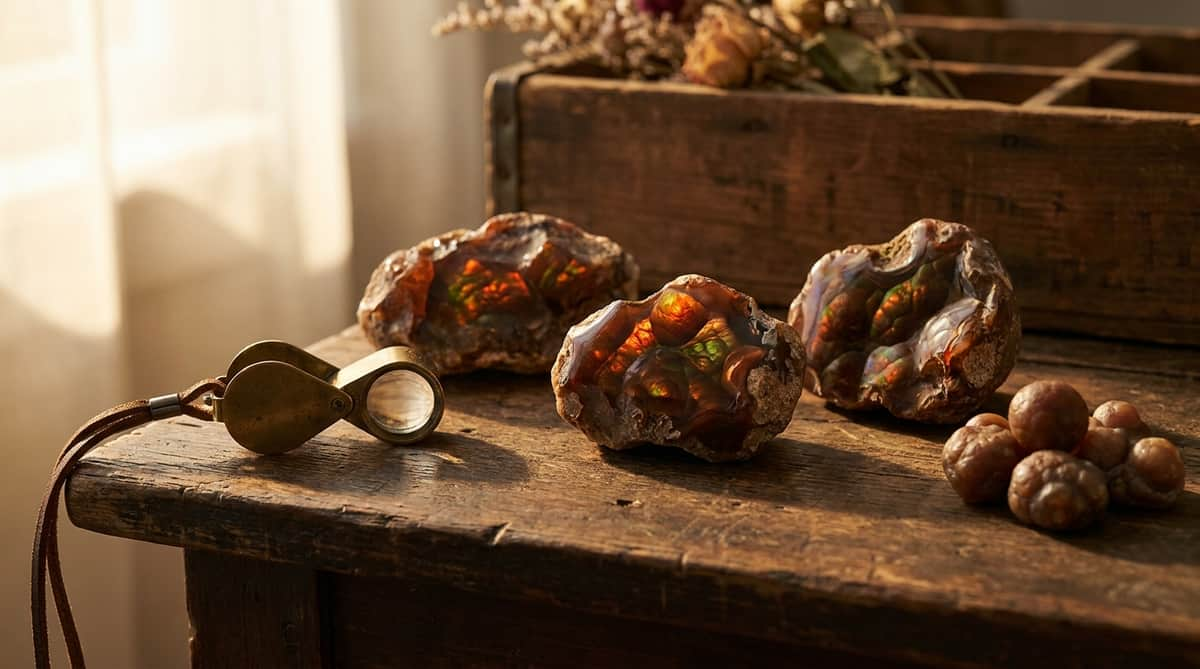
Fire agate earns its name from flashes of iridescent color that really do look like flame trapped inside brown stone — but the "fire" has nothing to do with heat, and the "agate" part is a little misleading too.
Most fire agate shows none of the banding that defines a true agate. Here's what it actually is mineralogically, where the flame-like shimmer comes from, how it compares to other stones with a similar optical trick, and how it's cut and cared for.
At a glance
- Fire agate is a variety of chalcedony (microcrystalline quartz) with a Mohs hardness of 6.5–7 — and despite the name, most specimens show none of the banding that defines true agate.
- The "fire" is the Schiller effect, the same optical trick behind mother-of-pearl's sheen — caused by thin internal layers of iron oxide, not heat.
- It's found in a narrow geographic belt: central/northern Mexico (Chihuahua, Sonora) and the U.S. Southwest (Arizona, New Mexico, California).
- Because the fire layer sits beneath the surface, fire agate is almost always cut as a cabochon, never faceted.
What Fire Agate Actually Is
Fire agate is a variety of chalcedony — a microcrystalline form of quartz, chemically silicon dioxide (SiO2) — with a Mohs hardness of about 6.5 to 7, similar to most other quartz-family gemstones.
Despite the name, fire agate usually lacks the parallel banding that technically defines agate as a chalcedony variety. It's grouped and sold under the "agate" name by trade convention and visual association, not because a typical specimen shows true agate banding.
It's found only in a geographically narrow stretch of the Americas — central and northern Mexico and the southwestern United States, specifically Arizona, New Mexico, and California — with Mexico's Chihuahua and Sonora regions and the Arizona/California border country among the most-cited production areas.
Where the "Fire" Actually Comes From
The flame-like flashes that give fire agate its name come from the Schiller effect — the same optical phenomenon responsible for the sheen on mother-of-pearl — rather than from anything resembling combustion.
As the stone formed, thin layers of the iron oxide minerals goethite or limonite were deposited in bands inside the silica. Light reflecting and interfering between those microscopically thin layers produces the shifting, iridescent flashes of red, orange, green, and gold that read as "fire" from certain angles.
It's an internal layering effect, not a surface coating — which is why the iridescence shifts and disappears as a polished stone is tilted in the light, rather than staying fixed like a dyed or painted surface would.
Fire Agate vs. Other "Shimmer" Stones
Several gemstones are known for a similar play of light, but the physical cause behind each one is different enough to be worth knowing if you're comparing stones by name alone:
- Fire agate — iridescent flashes from the Schiller effect, caused by thin layers of iron oxide (goethite or limonite) inside chalcedony; same underlying phenomenon as mother-of-pearl.
- Precious opal — the "play of color" comes from diffraction: light bending around a microscopic internal lattice of stacked silica spheres, a structurally different mechanism from fire agate's layered iron oxide.
- Labradorite — its blue-to-gold flash (labradorescence) comes from light interference between internal twinning planes in the feldspar crystal structure, a third distinct cause.
- Regular banded agate — its visual interest comes from color banding laid down in bands during formation, not from any light-interference effect at all — most agate has no iridescence.
The overlap in vocabulary — "fire," "flash," "play of color" — covers at least three unrelated physical causes, which is worth knowing before assuming any two shimmering stones are related just because they're both called iridescent.
How Fire Agate Is Cut
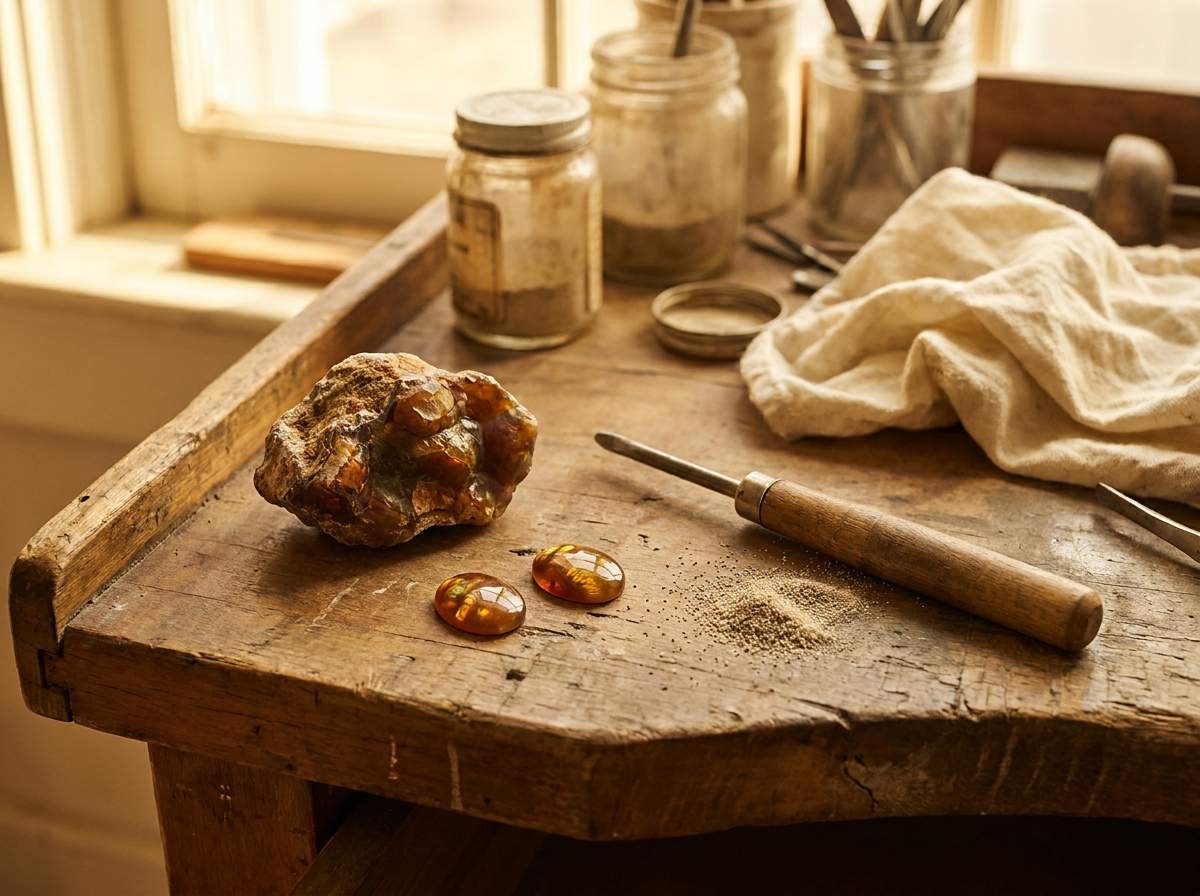
Because the fire-producing layer sits beneath the stone's outer surface, and the material is largely opaque to translucent rather than transparent, fire agate is almost always cut as a cabochon — a smooth, polished dome.
A cutter shapes and orients that dome specifically to expose the iridescent layer at the best angle — a skilled, somewhat trial-and-error process, since the fire layer's exact position inside the rough isn't visible until cutting begins.
It isn't faceted the way a transparent gem would be. Its hardness (6.5–7) is high enough that a polished cabochon resists everyday scratching reasonably well once set.
A Note on Where the Name Comes From
Unlike many gemstones with names rooted in ancient mythology, fire agate's story is a relatively modern, regional one: the stone is specific to a narrow belt of the American Southwest and northern Mexico.
Its trade name is simply descriptive — "fire" for the iridescent flash, "agate" for its broader chalcedony family resemblance — rather than tied to a royal history or a founding legend the way stones like amethyst or garnet are.
Because the deposits are geographically limited and the iridescent layer isn't visible from outside a rough stone, fire agate has historically been more of a specialist collector and lapidary-hobbyist material than a mainstream commercial gem — part of why it's less widely known than chalcedony cousins like carnelian or onyx, despite its striking appearance once cut.
The Meaning People Attach to It
In crystal-healing and wellness traditions, fire agate is commonly associated with grounding, protection, courage, and confidence, with some sources linking it to the sacral chakra and to physical vitality or stamina.
None of this is scientifically established — these are folk and crystal-trade beliefs, not documented mineral properties, and fire agate carries no official birthstone status for any month. The honest throughline in serious gemological write-ups is the optical physics of the Schiller effect, not the metaphysical claims layered on top.
Caring for Fire Agate Jewelry
Fire agate's Mohs 6.5–7 hardness makes it reasonably durable for occasional wear — harder than opal or pearl, softer than sapphire or diamond.
Like most cabochon-cut stones, it should still come off before sports, heavy manual work, or an ultrasonic cleaner, since a hard knock can chip the polished dome.
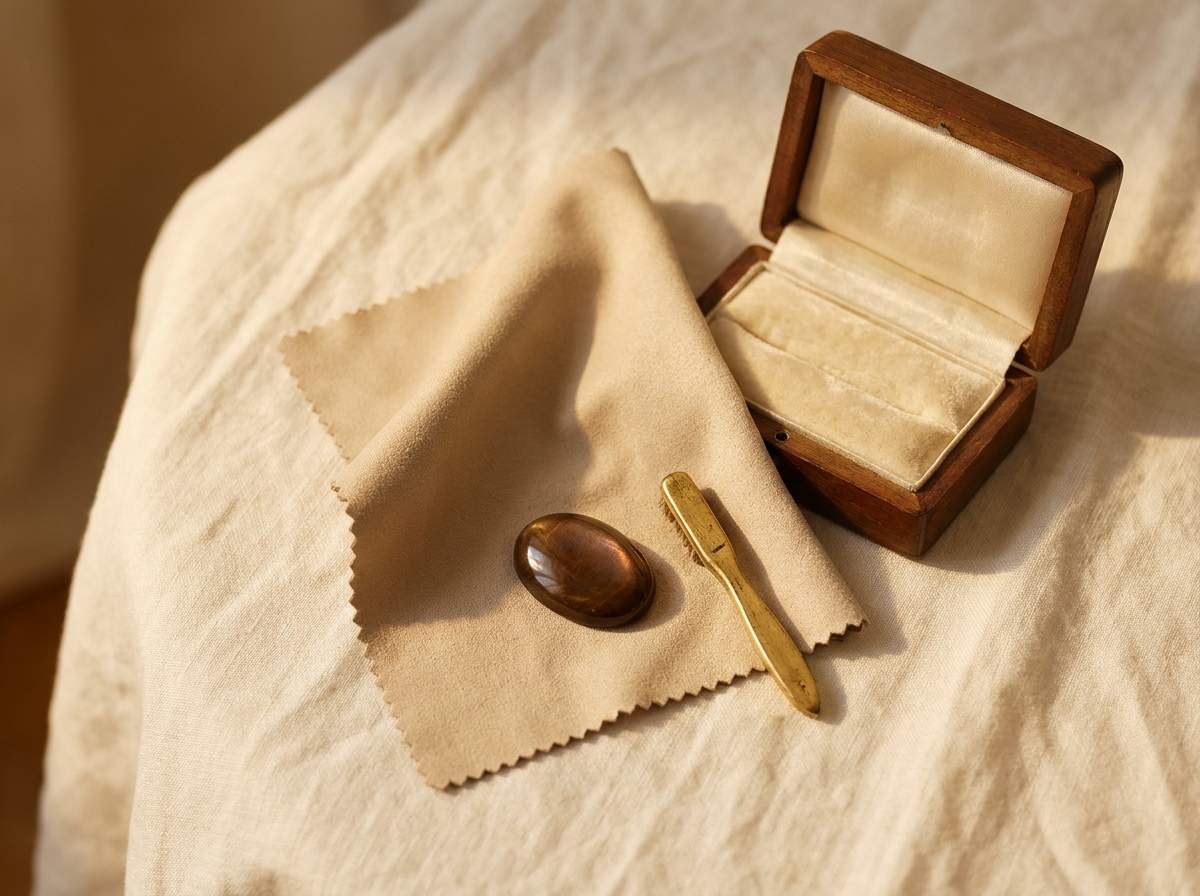
A soft damp cloth is the safest way to clean it — avoid harsh chemicals or extended soaking.
If the goal is a daily-wear piece that doesn't need that kind of care, FARUZO's engraved necklaces are plated over 316L stainless steel — nickel-safe and considerably more scratch- and chip-resistant for everyday wear than a natural cabochon.
For other stones with their own optical "fire," our agate meaning guide covers fire agate's banded relative, and our moonstone vs. opal comparison looks at two other stones known for shimmer caused by a different optical mechanism entirely.
Frequently Asked Questions
Is fire agate actually banded like a regular agate?
Usually not. Despite being classified and sold as an agate, most fire agate lacks the parallel color banding that technically defines true agate. It's grouped under the agate name by trade convention and its chalcedony composition rather than because a typical piece shows agate's defining banded structure.
What causes fire agate's iridescent "fire"?
The Schiller effect — the same optical phenomenon behind mother-of-pearl's sheen. Thin internal layers of the iron oxide minerals goethite or limonite interfere with light as it passes through and reflects off them, producing shifting flashes of red, orange, green, and gold, rather than anything related to heat or flame.
Is fire agate's "fire" the same thing as opal's play of color?
No. They look similar in effect but come from different physical causes. Opal's play of color comes from light diffracting around a microscopic lattice of stacked silica spheres. Fire agate's flash comes from light interfering between thin layers of iron oxide — the same category of effect as mother-of-pearl's sheen, not opal's diffraction.
How hard is fire agate, and is it durable enough for jewelry?
Fire agate measures about Mohs 6.5 to 7, similar to most quartz-family gemstones — harder than opal or pearl, softer than sapphire or diamond. A polished cabochon holds up reasonably well to everyday wear, though it should still come off before activities that risk a hard knock, since a chip can damage the thin fire-producing layer near the surface.
Where does fire agate come from?
It's found in a narrow geographic range: central and northern Mexico (notably Chihuahua and Sonora) and the southwestern United States, specifically Arizona, New Mexico, and California. It isn't mined in the many countries that produce ordinary banded agate.