Walk into a crystal shop and "dumortierite" can mean two different things on the same shelf: a solid blue-violet stone sold under its own name, or a piece of ordinary quartz shot through with microscopic dumortierite fibers and labeled "blue quartz" or "dumortierite quartz."
They look related because one contains the other, but they're not the same mineral, and most pages covering this stone skip past that distinction entirely. Here's what dumortierite actually is, how the quartz mix-up happens, what it's believed to mean, and how it compares to the other blue "third eye" stones it usually gets shelved next to.
At a glance
- Dumortierite is an aluminum borosilicate mineral (not quartz), typically rated Mohs 7 hardness
- "Blue quartz" or "dumortierite quartz" is ordinary quartz colored by dumortierite fibers — a different material from solid dumortierite
- Believed in crystal-healing tradition to support patience, discipline, and mental organization; tied to the third eye chakra
- Harder than sodalite, lapis lazuli, and azurite — the other blue "third eye" stones it's most often compared to
What Dumortierite Actually Is
Dumortierite is an aluminum borosilicate mineral, with a formula usually written as Al₇BO₃(SiO₄)₃O₃ (some mineral databases give a slightly narrower range, Al₆.₅₋₇BO₃(SiO₄)₃(O,OH)₃ — the same boron-aluminum-silicate chemistry, just notated differently). It was named for the French paleontologist Eugène Dumortier, who is credited with the mineral's identification.
Sources differ slightly on hardness: most commonly cited at Mohs 7, though some mineral databases list a wider range up to 8.5 — worth noting if a seller quotes one figure as if it were the only one.
Its color runs from the deep blue and violet-blue it's best known for through greenish-blue, brown, pink, and gray, a range Wikipedia attributes to iron and other trace elements substituting into the crystal structure.
The "Blue Quartz" Mix-Up, Explained
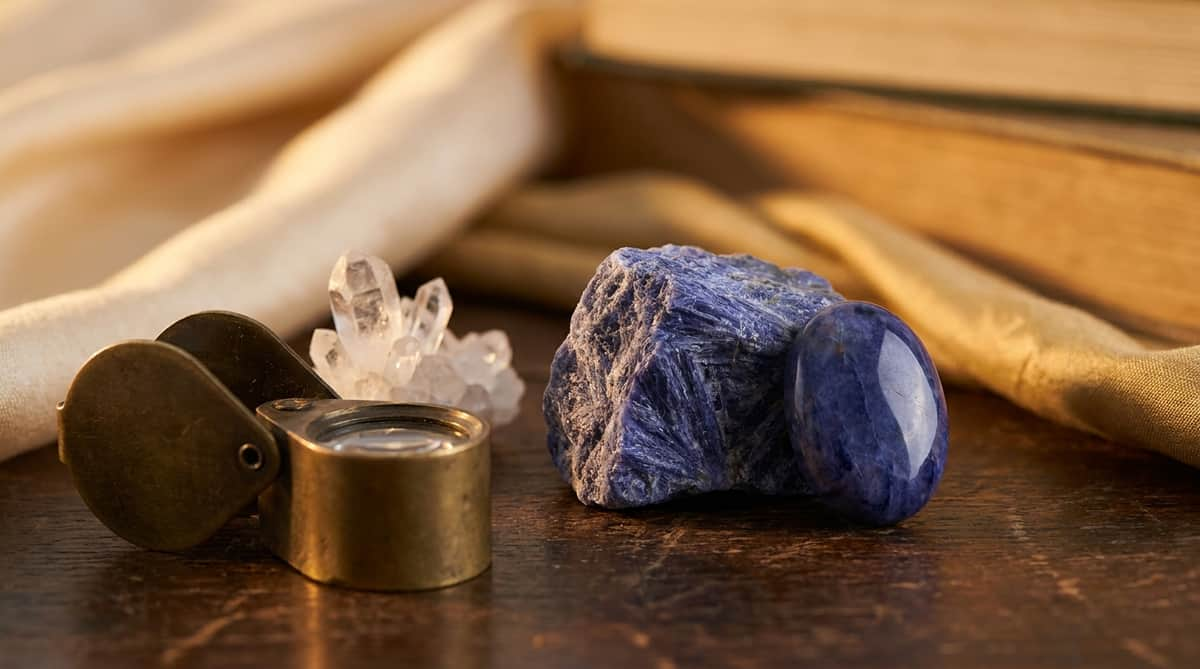
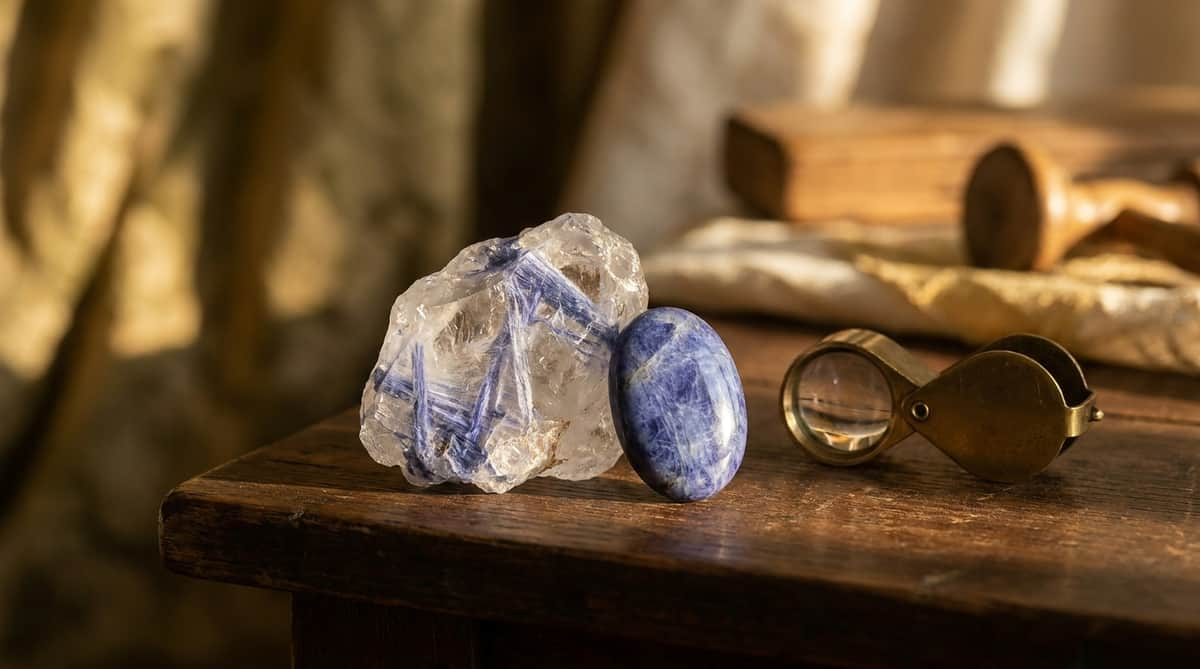
The confusion starts because dumortierite rarely forms large, clean crystals of its own — it's more commonly found as fine, fibrous inclusions packed inside a host of ordinary quartz. That combination gets sold as "blue quartz," "dumortierite quartz," or occasionally "blue aventurine" (a separate, inaccurate name borrowed from true aventurine's different inclusion mineral).
The underlying stone in that case is genuinely quartz — the same mineral as clear quartz or amethyst — colored by dumortierite fibers rather than being dumortierite itself. True, solid dumortierite without a quartz host is less common in jewelry and usually sold under its own name rather than a "quartz" label.
The practical difference matters mostly for hardness and clarity expectations: quartz-hosted material inherits quartz's Mohs 7 durability and typically looks more uniformly saturated, while pure dumortierite can show more visible fibrous structure.
Where It's Found
Brazil's Minas Gerais state is the most specifically documented source, with dumortierite turning up in pegmatite belts there and in the Serra do Espinhaço and Macaúbas districts, per a 2014 study in the Brazilian journal Revista Espinhaço.
Madagascar is widely cited as another significant source, and Sri Lanka also appears on most origin lists, though with less mine-level detail available than for the Brazilian deposits. Smaller quantities have been reported from France (where it was first identified), Namibia, and the United States.
How It's Cut and Used in Jewelry
Because the deep blue-violet color is the main draw and transparent, facetable crystals are uncommon, dumortierite — whether solid or as the quartz-hosted "dumortierite quartz" material — is almost always cut as cabochons, beads, or tumbled stones rather than faceted the way a clear gem would be.
It shows up most often in pendants, beaded bracelets, and carved shapes rather than rings, partly a style choice and partly practical: cabochon cuts hide the fibrous, sometimes slightly streaky internal structure better than a facet would.
The Meaning People Attach to It
In crystal-healing traditions, dumortierite is most often described as a stone of patience, discipline, and mental organization — sometimes called the "Stone of Patience" and associated with easing impulsive reactions in favor of a more orderly approach.
It's also commonly tied to the third eye chakra, in the same family as other blue and indigo stones used in that tradition for insight and intuition.
None of this is scientifically established; it's a belief system some people find useful, not a documented property of the mineral, and health claims occasionally attached to it (respiratory or metabolic benefits) have no medical evidence behind them.
Dumortierite vs. the Other Blue "Third Eye" Stones
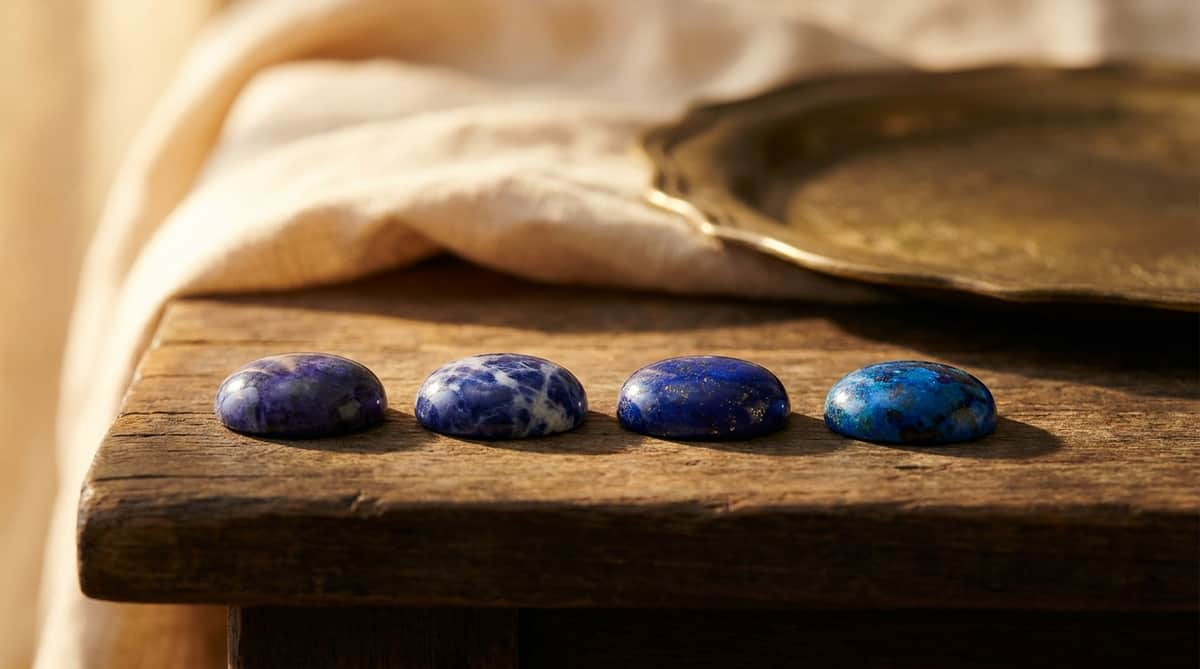
Dumortierite is usually shelved alongside a handful of other blue and indigo stones associated with intuition and insight in crystal-healing traditions. They're often confused for each other at a glance, but differ in hardness, color, and the specific meaning attached to them:
- Dumortierite — Mohs 7 (or up to 8.5 depending on the source); deep blue-violet, often as fibrous inclusions in quartz; associated with patience and mental discipline.
- Sodalite — Mohs 5.5–6, softer and more easily scratched; typically royal blue with white calcite veining; associated with logic and rational thought rather than patience specifically. Full guide.
- Lapis Lazuli — Mohs 5–5.5, the softest of the group; deep blue with gold pyrite flecks, historically the most prized of the three; associated with wisdom and truth. Full guide.
- Azurite — Mohs 3.5–4, by far the softest and most fragile, rarely worn as everyday jewelry; vivid, intense blue; associated with insight and clearing mental clutter. Full guide.
Of the four, dumortierite is the hardest and most practical for daily wear — a meaningful distinction if the appeal is less about which legend sounds right and more about which stone can actually survive being worn.
Caring for Dumortierite Jewelry
At Mohs 7 (or the quartz-hosted material, which shares quartz's own Mohs 7), dumortierite holds up to ordinary daily wear better than most of the blue stones it gets compared to.
It can handle light knocks that would chip lapis lazuli or azurite, though it should still come off before swimming, cleaning, or workouts, and is best cleaned with a soft damp cloth rather than ultrasonic or steam cleaning if any fractures are visible.
For a version that skips stone-care questions entirely, FARUZO's engraved necklaces are plated over 316L stainless steel — nickel-safe and far more scratch-resistant for everyday wear than any natural stone on this list.
If the blue-violet color is the draw more than a specific stone's lore, our lapis lazuli meaning guide and sodalite meaning guide cover the two most commonly compared alternatives in more depth.
Frequently Asked Questions
Is dumortierite the same as blue quartz?
Not quite. "Blue quartz" or "dumortierite quartz" is ordinary quartz colored by fine dumortierite inclusions — the host stone is genuinely quartz, not dumortierite. Solid dumortierite without a quartz host exists too, but it's less common in jewelry and usually sold under its own name.
What does dumortierite mean?
In crystal-healing tradition, dumortierite is read as a stone of patience, discipline, and mental organization, sometimes called the "Stone of Patience," and is associated with the third eye chakra alongside other blue and indigo stones. These are traditional beliefs rather than documented properties.
How hard is dumortierite, and is it durable enough for daily wear?
Most sources put it at Mohs 7, though some mineral databases list a range up to 8.5. Either figure makes it harder and more wear-resistant than sodalite, lapis lazuli, or azurite, the other blue stones it's most often compared to.
Is dumortierite a birthstone?
No. It has no official birthstone status for any month and no widely recognized zodiac pairing, unlike some of the other stones in this series.
What's the difference between dumortierite and sodalite?
Dumortierite is harder (Mohs 7 versus sodalite's 5.5–6) and tends toward a more violet-leaning blue, often with a fibrous rather than solid appearance when quartz-hosted. Sodalite is typically a more uniform royal blue, frequently veined with white calcite, and is associated with logic and rational thought rather than dumortierite's patience-and-discipline reading.