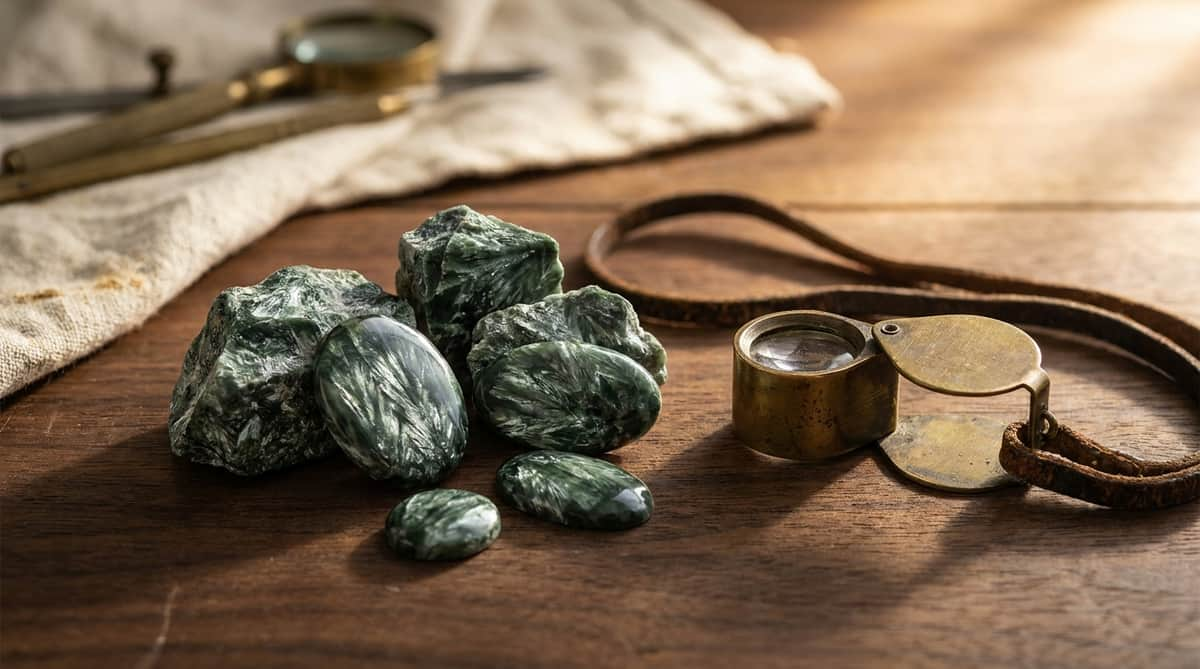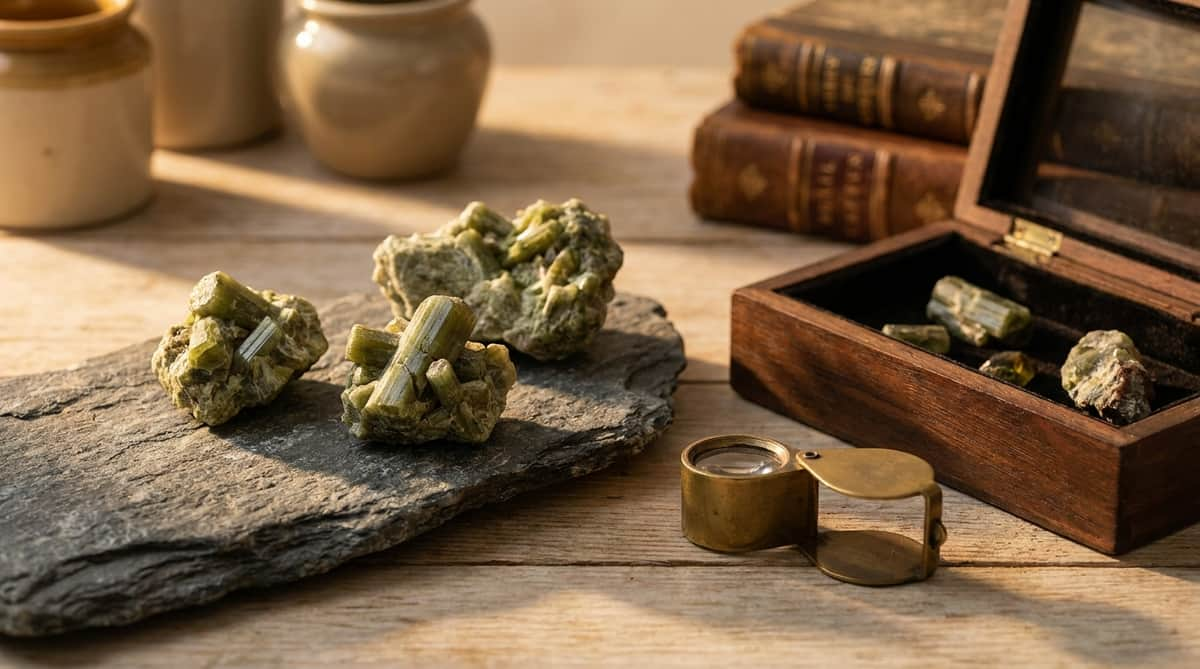
Epidote isn't rare, and it isn't usually sold as a polished gem the way amethyst or citrine are — but it's common enough, and distinctive enough, that an entire family of related minerals is named after it: the epidote group.
That makes it one of the more geologically important stones in this series even though most people have never heard of it. Here's what epidote actually is, what it's believed to mean, and how it compares to the mineral relatives it gets confused with.
At a glance
- Epidote is a calcium-aluminum-iron silicate common enough to give its name to an entire mineral group.
- It rates Mohs 6–7 for hardness, with a specific gravity around 3.38–3.49.
- Facet-grade crystal is rare — most epidote in jewelry is sold as a cabochon or specimen piece, not faceted.
- Tanzanite, a zoisite variety long grouped with epidote, was formally removed from the epidote group in 2006.
What Epidote Actually Is
Epidote is a calcium-aluminum-iron sorosilicate, with a formula usually written as Ca₂Al₂(Fe³⁺,Al)(SiO₄)(Si₂O₇)O(OH). The name comes from the Greek epidosis, meaning "increase" — a reference not to any claimed metaphysical property, but to its crystal shape.
French mineralogist René Just Haüy, who coined the name, was describing how one side of the crystal's base runs longer than the other.
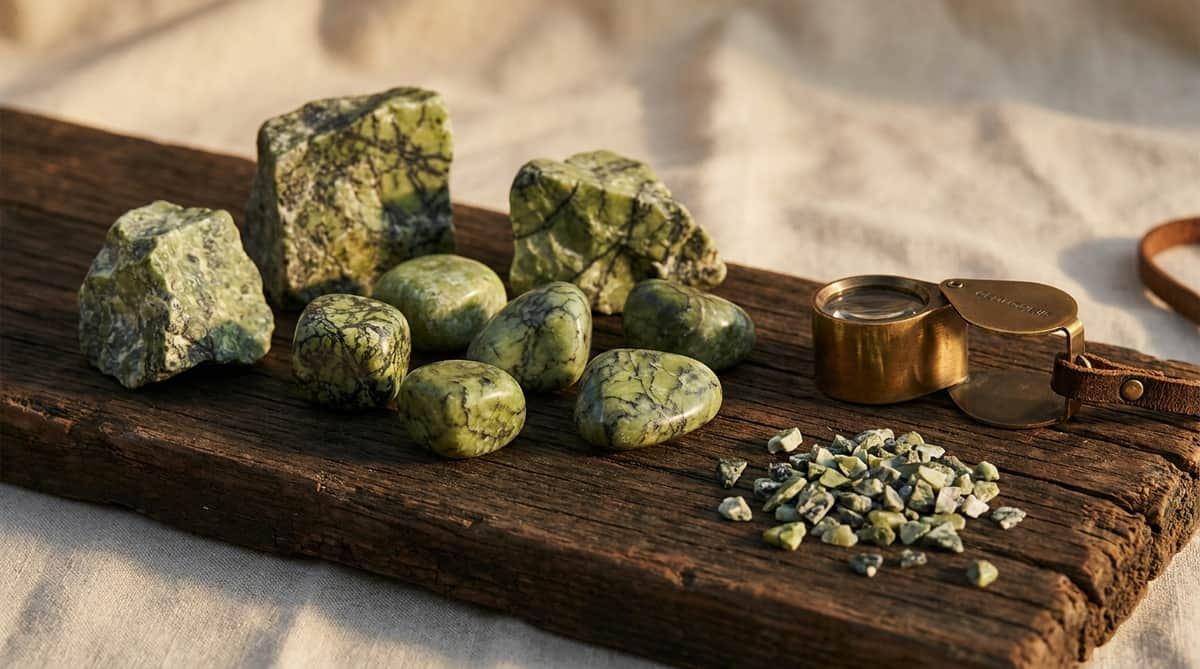
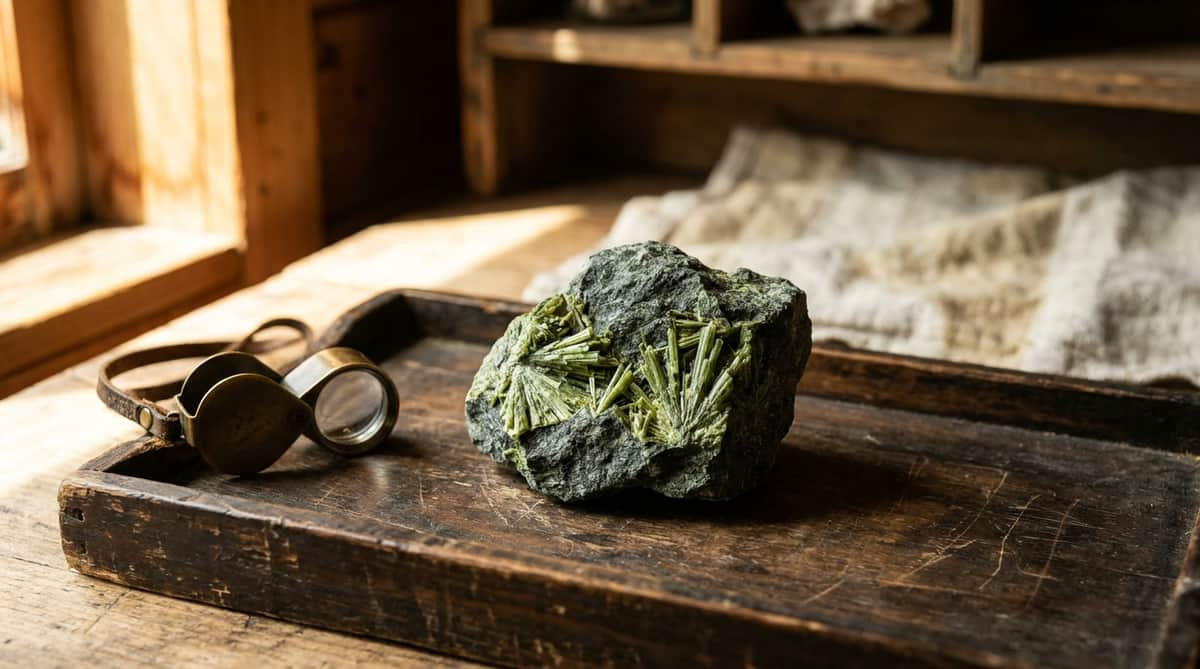
It sits at Mohs 6–7 on the hardness scale, with a specific gravity of roughly 3.38–3.49. It's most often yellowish-green to pistachio-green, though it can also turn up brown, grey, or nearly black depending on its exact iron content.
Where It's Found
Epidote is described by mineralogists as a rock-forming mineral of "secondary origin" — meaning it typically forms from the alteration of other minerals rather than crystallizing directly from magma.
It shows up most often in marble and schistose metamorphic rocks, forming through the hydrothermal alteration of feldspars and micas in igneous rock. A quartz-epidote rock even has its own name: epidosite.
Well-documented localities include Knappenwand in Austria's Salzburg region (famous for exceptionally large, well-formed crystals), the Ala Valley and Traversella in Piedmont, Italy, Arendal in Norway, and Le Bourg-d'Oisans in France's Dauphiné region.
Haddam, Connecticut and Prince of Wales Island, Alaska round out the list in the US. Brazil is the source most associated with facet-grade material — transparent, dark green crystals clean enough to occasionally cut as gemstones rather than just collected as mineral specimens.
How It's Cut and Used in Jewelry
Because gem-quality, transparent epidote crystal is uncommon — most epidote is opaque or included — it's rarely faceted the way a clean sapphire or tourmaline would be.
When it does appear in jewelry, it's more often a cabochon, a tumbled stone, or a mineral specimen piece than a faceted centerpiece. Collectors value facet-grade Brazilian material specifically because it's the exception rather than the rule.
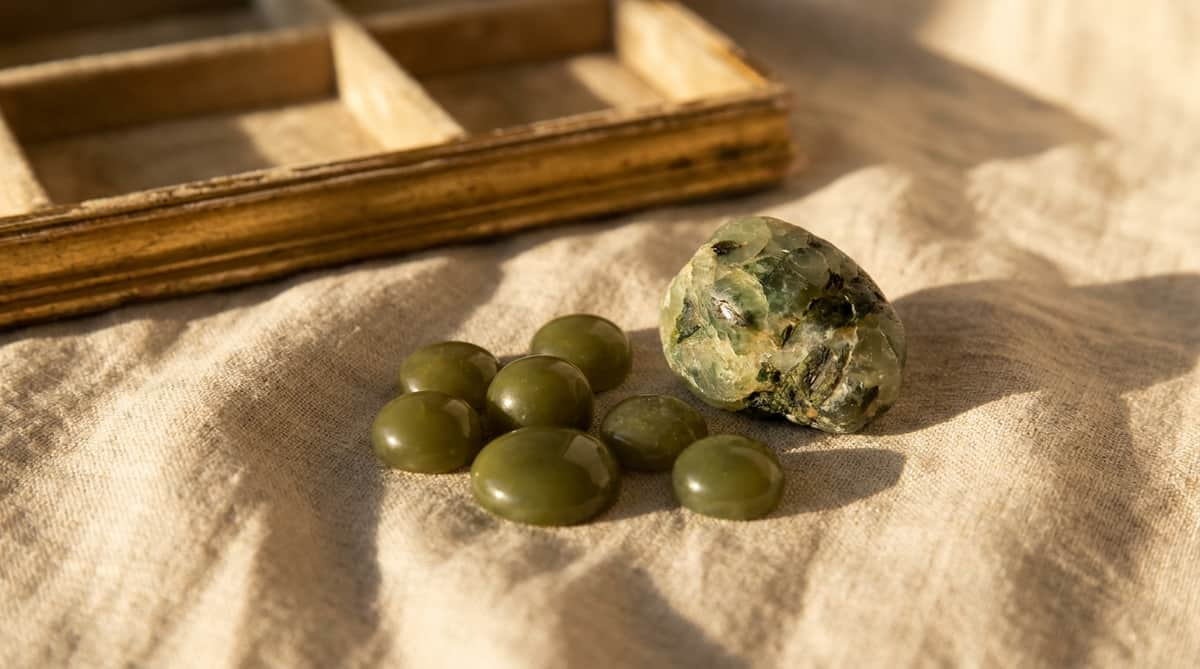
It's also sometimes found intergrown with prehnite, where green prehnite studded with dark epidote crystals — "epidote in prehnite" — is sold as a combination stone in its own right.
Collectors prize it because the two minerals' contrasting textures — prehnite's smooth, almost waxy translucence against epidote's sharp, dark inclusions — don't occur together in any other common mineral pairing.
Because facet-grade epidote is genuinely scarce, most of what gets sold under the name in jewelry is specimen-grade material set as-is — polished but not faceted, with its natural crystal faces or cabochon dome left visible rather than cut into symmetrical angles.
That's part of why it tends to show up in pendants and statement pieces aimed at mineral collectors, rather than in mainstream ring or earring settings the way a calibrated, faceted stone would.
The Meaning People Attach to It
In crystal-healing traditions, epidote is most commonly described as a stone of growth, abundance, and amplification — a reading that leans directly on its Greek "increase" etymology, even though that name originally described crystal geometry, not an energetic property.
Sellers commonly describe it as useful for self-confidence, motivation, and manifesting change, with some sources framing it as a stone that amplifies whatever energy or intention a person already brings to it, for better or worse.
None of this is scientifically established — it's a belief system some people find meaningful, not a documented property of the mineral. The "amplification" framing in particular is worth treating as a later, retail-era add-on to a name that's really about crystal shape.
Epidote vs. Its Mineral Relatives
Epidote lends its name to an entire mineral group, and several better-known stones are, or were, grouped with it — including one surprising exception:
- Epidote — Mohs 6–7; yellowish-green to pistachio-green, sometimes brown or black; the group's namesake, forms in metamorphic and hydrothermally altered rock.
- Clinozoisite — the aluminum-rich end of the same mineral series as epidote (the two form a solid-solution series, differing mainly in iron content); typically paler, greyish-green to colorless, and less commonly seen as a named gem than epidote itself.
- Piemontite — the manganese-rich variety in the same family, prized for its distinctive reddish-violet to brownish-red color — a striking contrast to epidote's green, caused entirely by manganese replacing some of the iron and aluminum in the structure.
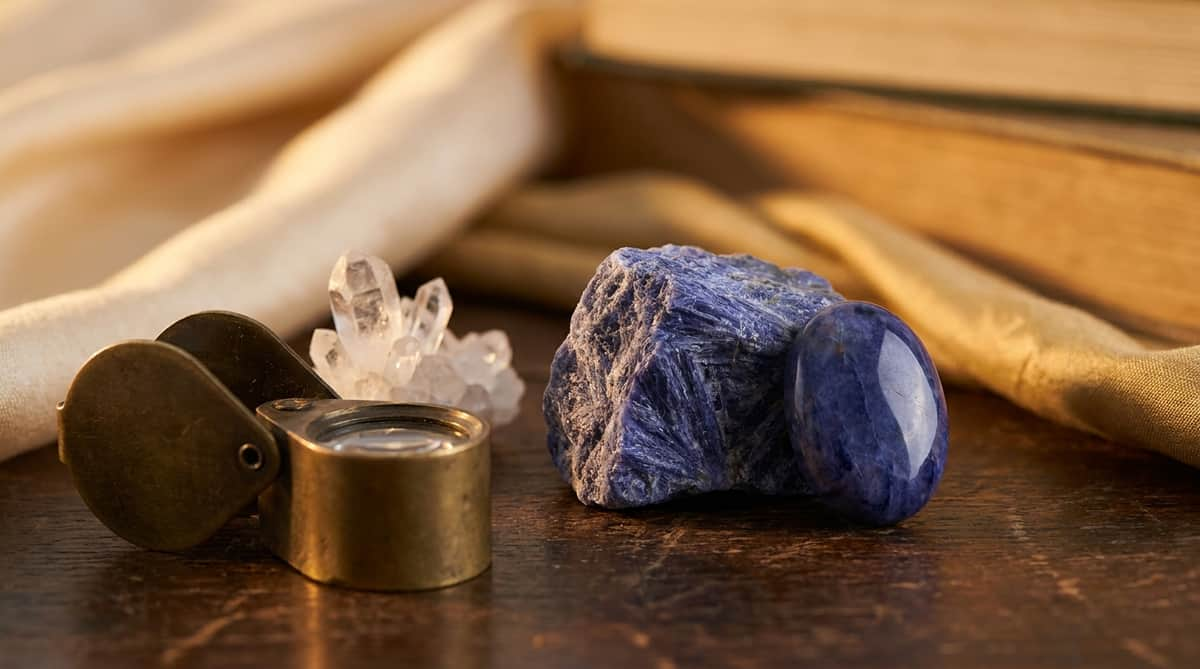
- Zoisite (including tanzanite) — closely related and long grouped with epidote by many mineralogists, but formally reclassified out of the epidote group in 2006, when a nomenclature revision determined zoisite is structurally a distinct, orthorhombic polymorph rather than a true epidote-group member. Tanzanite, zoisite's famous blue gem variety, is the best-known casualty of that reclassification — it's still described as "epidote-related" informally, but it isn't one anymore by current mineralogical rules.
That last entry is the one worth remembering if a seller's description calls tanzanite "a member of the epidote group" — it's an understandable holdover from the older classification, but not technically accurate since 2006. For a direct look at tanzanite specifically, including how it compares to its other deep-blue rival, see our sapphire vs. tanzanite guide.
Caring for Epidote Jewelry
At Mohs 6–7, epidote is durable enough for occasional wear, but it sits below quartz-family stones and well below sapphire. It's worth treating more like a semi-precious stone than an everyday-proof one.
Avoid ultrasonic or steam cleaning, keep it away from harsh chemicals, and store it separately from harder stones that could scratch it in a jewelry box. A soft cloth with mild soap and water is the safest routine.
For daily-wear pieces where stone durability isn't a factor at all, FARUZO's engraved necklaces and personalized rings plate over 316L stainless steel rather than a natural stone — nickel-safe, and immune to the scratching and chipping concerns that come with a Mohs 6–7 mineral.
Frequently Asked Questions
What does epidote mean?
In crystal-healing tradition, epidote is read as a stone of growth, abundance, and amplification — a reading tied to its Greek name, epidosis ("increase"), though that name originally described the crystal's shape, not a claimed energetic property. These are traditional beliefs rather than documented properties.
Is epidote the same as tanzanite?
No, and they're less related than many sellers imply. Tanzanite is a variety of zoisite, which was formally removed from the epidote group in a 2006 mineralogical reclassification. The two were historically grouped together for decades, which is why the association still shows up in older or informal descriptions.
What color is epidote?
Most commonly a yellowish-green to pistachio-green, though specimens can also appear brown, grey, or nearly black depending on their exact iron content. Color intensity and clarity vary a lot between localities.
Is epidote durable enough for everyday jewelry?
It sits at Mohs 6–7, which is wearable but less durable than quartz-family stones or sapphire. It can handle occasional wear with care but isn't the best choice for a ring worn daily without breaks, and should be kept away from ultrasonic cleaners and harsh chemicals.
Is epidote a birthstone?
No. It has no official birthstone status for any month and no widely recognized zodiac pairing, unlike some of the other stones in this series.