Emerald is one of the most recognized gemstones in the world, but its reputation for fragility and its long history of enhancement treatments are often misunderstood. This guide covers what emerald actually is, how it forms, where it comes from, how to tell a real one from a look-alike, and how to wear and care for it. If you're not sure which stone matches a different month, our birthstone finder can help you check.
What Emerald Actually Is
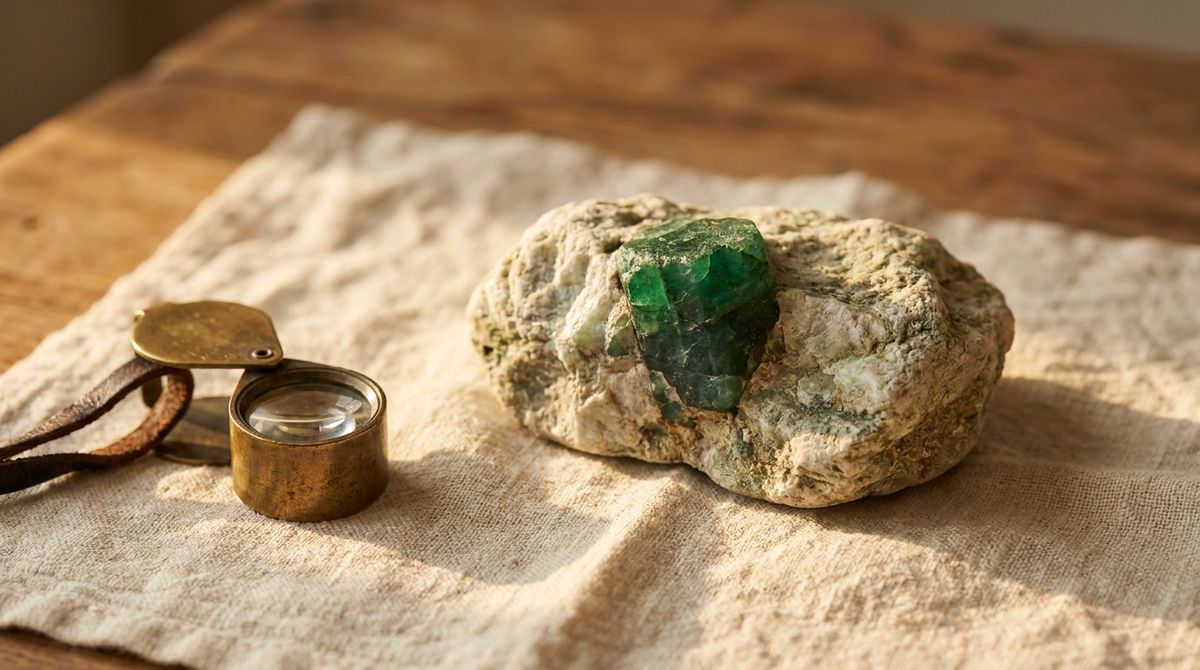
Emerald is the green variety of beryl, a mineral family that also includes aquamarine (blue), morganite (pink), and heliodor (yellow). What separates emerald from its beryl relatives is color: trace amounts of chromium and, in many stones, vanadium are what give emerald its characteristic green, replacing a small number of aluminum atoms in beryl's crystal structure. Beryl itself is a beryllium aluminum silicate, and in its pure form it's actually colorless — every colored variety, emerald included, owes its hue to trace elements that got mixed in during crystallization.
On the Mohs hardness scale, emerald ranks 7.5 to 8, which sounds durable in isolation. But hardness only measures resistance to scratching, not resistance to breaking, and emerald is notorious for forming with internal inclusions and fractures — so much so that gemologists sometimes call emerald's characteristic inclusions its "jardin," French for garden. Those inclusions and fractures make emerald genuinely more fragile in daily wear than its hardness number alone would suggest.
Properties: Physical, Mental, and Metaphysical
Physical
Emerald's hardness of 7.5 to 8 makes it reasonably scratch-resistant, but its natural tendency toward inclusions and surface-reaching fractures is what actually governs how it should be handled. Because of this, the gem trade has long treated emerald with oil, and sometimes resin, to fill surface-reaching fractures and improve apparent clarity. This is a long-standing, widely disclosed practice in the trade rather than a deceptive one, but it does mean emerald needs gentler cleaning and care than harder, less-included stones like diamond or sapphire.
Mental
In wellness and crystal circles, emerald is often described as a stone of clarity, renewal, and emotional balance — language that leans on the gem's vivid, calming green as a kind of visual shorthand. As with any stone's meaning in our different gemstones guide, that's a belief carried by tradition and marketing, not a measured effect.
Metaphysical
Emerald has carried symbolic weight across cultures for thousands of years, often associated with rebirth, fertility, and eternal spring because of its color. Ancient and medieval writers attributed protective and healing properties to the stone, and it was long believed to grant its wearer the gift of foresight or truth-telling. As with the folklore attached to most gemstones, these are traditions passed down through history and belief systems, not documented or measured effects.
Where Emerald Comes From, and Its History
Emerald has been mined and worn since antiquity. Cleopatra is historically associated with emerald mines in Egypt's Wadi Sikait region, worked since at least the Ptolemaic era and among the oldest known emerald sources in the world, even though the stones they produced were generally lower in quality than what the trade prizes today.
The modern emerald trade is centered on a handful of major sources. Colombia has historically produced the finest emeralds in the world, with the Muzo and Chivor mines standing as the most storied names in the stone's history — Colombian emeralds are prized for a rich, slightly bluish-green color. Zambia and Brazil are also major producers, each known for their own characteristic tones. More recently, Ethiopia's Shakiso deposit, discovered in 2016, has become a significant new source, and Ethiopian emeralds have moved quickly into the mainstream market since then.
Emerald also gave its name to a cut: the emerald cut, a rectangular step-cut with trimmed corners, is named after this specific stone. That's not a coincidence of naming — the emerald cut's broad, flat step facets distribute stress more evenly across the stone than a brilliant cut's many small facets would. Given how fracture-prone emerald tends to be, cutting it into a brilliant style risks shattering it during the cutting process itself, which is part of why the step-cut approach became so strongly associated with this particular gem.
How to Tell Real Emerald From Look-Alikes
Emerald's rich green has been imitated for centuries, and a few materials are common enough substitutes to be worth knowing about. Green glass and synthetic spinel have both been used to mimic emerald's color at a much lower cost, and lab-grown (synthetic) emerald — chemically identical to natural emerald but grown under controlled conditions — has become increasingly common in the market. Green varieties of other minerals, including certain tourmalines and some chrysoberyl, can also be mistaken for emerald by an untrained eye. For comparison, malachite is another well-known green stone, though its banded, opaque appearance and much softer structure make it easy to distinguish from emerald once you know what to look for — our malachite meaning guide covers that stone in more depth.
The most reliable way to distinguish natural emerald from a look-alike or a synthetic is a gemological examination: refractive index, specific gravity, and — critically for emerald specifically — an inclusion analysis under magnification, since natural emerald's characteristic "jardin" of inclusions is difficult to replicate convincingly in synthetic material. Given how routinely emerald is treated with oil or resin, a full disclosure of any treatment is also something a reputable jeweler or lab should be able to confirm.
How to Wear and Care for Emerald Jewelry
Emerald's susceptibility to internal fractures means it needs more careful handling than harder, less-included gems. Avoid ultrasonic and steam cleaners entirely, since the heat and vibration can worsen existing fractures or drive out the oil used to fill them. Warm water, a mild soap, and a soft cloth are the safer way to clean emerald jewelry at home, and it's worth removing emerald pieces before activities with a real risk of impact or harsh chemical exposure, including swimming pools and household cleaning products.
Because emerald is genuinely more fragile than its hardness suggests, it tends to suit settings and pieces that see occasional wear more comfortably than something subjected to daily friction, like an everyday-stacked ring. If you're building a personalized piece around May's birthstone, our birthstone rings and birthstone necklaces both offer emerald as the May option — FARUZO's personalized pieces are crafted in 316L stainless steel with a gold-plated, rose-gold-plated, or silver-tone finish, so you can pair the birthstone detail with the metal tone you prefer.
Frequently Asked Questions
Is emerald a durable stone for everyday jewelry?
It's harder than many gemstones at 7.5 to 8 on the Mohs scale, but its natural inclusions and fractures make it more prone to chipping or cracking than its hardness alone would suggest. Emerald is generally better suited to occasional wear or protective settings than to jewelry that takes daily knocks.
What birthstone month is emerald?
Emerald is the modern and traditional birthstone for May. If you're not sure which stone matches a different month, our birthstone finder is a quick way to check.
Why is emerald almost always treated with oil?
Because natural emerald forms with surface-reaching fractures far more often than most gemstones, the trade has long used oil, and sometimes resin, to fill those fractures and improve the stone's apparent clarity. It's a long-standing, widely disclosed practice, not a hidden defect, but it does mean treated emeralds need gentler care than untreated stones.
Why is the emerald cut named after this specific gem?
The emerald cut is a rectangular step-cut with trimmed corners, and it was developed specifically for stones like emerald that are prone to internal fractures. Its broad, flat step facets spread stress more evenly through the stone than a brilliant cut's many small facets, reducing the risk of the gem cracking during cutting or wear.
Where do most emeralds come from today?
Colombia has historically produced the finest emeralds, particularly from the Muzo and Chivor mines, while Zambia and Brazil are also major sources. Ethiopia's Shakiso deposit, discovered in 2016, has become a significant newer source in recent years.