Malachite is the stone that turns up twice in most people's lives without them clocking it as the same mineral both times: the vivid, swirl-banded green of an Egyptian eyeshadow pot in a museum case, and the same swirl-banded green on a ring or pendant sold as a healing crystal today. Both uses are real, and both come from the same soft copper mineral — which is also exactly why it needs different care than most stones in a jewelry box.
What malachite actually is
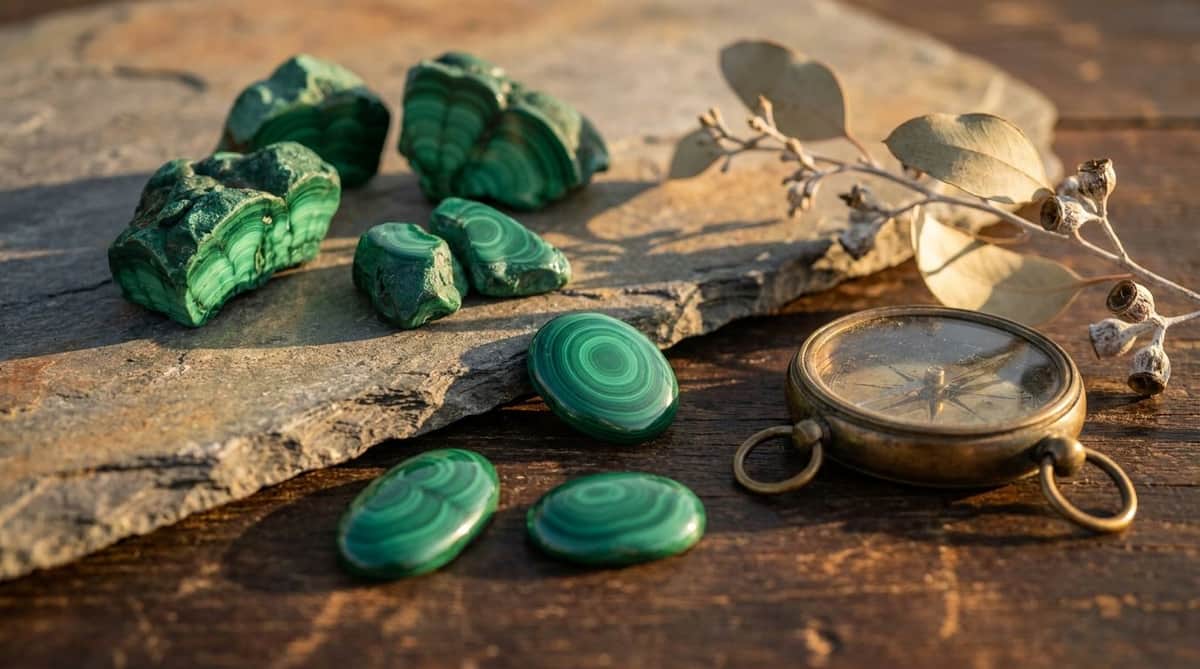
Malachite is a copper carbonate hydroxide, Cu₂CO₃(OH)₂ — its green color comes directly from the copper in that formula, the same element that turns a weathered penny or an oxidized copper roof green. It forms in the oxidized upper zone above copper ore deposits, where copper-bearing water reacts with carbonate rock and precipitates out as malachite over time. That slow, layered growth is why cut and polished malachite shows concentric banding — light and dark green rings, sometimes called "eyes" — that looks similar to agate's banding but forms through an entirely different process.
It's a soft stone by gem standards: 3.5 to 4 on the Mohs hardness scale, well below quartz (7) or even a fingernail's rough equivalent of 2.5 on the low end. It's also sensitive to heat and reacts with weak acids, which rules out ultrasonic cleaners, steam cleaners, and anything acidic — including some jewelry-cleaning solutions and even prolonged contact with sweat or lotion, which can dull the polish over time.
Where it comes from
Egypt and Israel were mining malachite more than 4,000 years ago, making it one of the oldest continuously worked ornamental minerals. The Ural Mountains in Russia became the source most associated with malachite's luxury era — 19th-century Russian malachite, quarried in enormous blocks, was cut into vases, tabletops and wall panels for imperial palaces, including entire malachite-clad rooms that still exist today. Those Ural deposits are now largely exhausted. Most malachite in the lapidary market today comes from the Democratic Republic of the Congo, with smaller amounts from Australia, France, and Arizona in the United States.
Malachite in ancient Egypt
Egyptian use of malachite predates its use as jewelry by a wide margin. Ground into powder and mixed with animal fat or oil, it made udju — a green eye cosmetic worn by both men and women, applied with the same ritual attention as the black kohl line that usually followed it. The goddess Hathor, associated with beauty, love and joy, carried the epithet "Lady of Malachite," and the green pigment mined from the Sinai region fell under her domain; wearing it was thought to invoke her protection as much as it served as makeup. Malachite jewelry, amulets, and inlay work existed alongside the cosmetic use, but the eyeshadow is the use case that shows up most consistently across Egyptological sources.
Physical, mental, and metaphysical: what people say about it
Physical: as a soft, banded copper mineral, malachite is chosen more for how it looks — bold, marbled green, no two pieces alike — than for durability, which is why it turns up more often in pendants and earrings than everyday rings.
Mental: in crystal-healing traditions, malachite is described as a "stone of transformation," associated with clearing stagnant thinking and pushing through change that's been avoided. That's a belief-system framing, not a documented effect.
Metaphysical: the same traditions pair malachite with the heart chakra and describe it as protective — a stone people historically carried or wore as a guard against negative energy, an association that likely traces back to the same protective role it held for Hathor in ancient Egypt, carried forward into modern crystal lore.
In zodiac pairings — again a matter of tradition rather than fact — malachite is most often linked to Capricorn and Scorpio, with Taurus and Libra sometimes included via its ruling planet Venus in some systems. Different sources disagree on the exact sign, which is normal for stones whose zodiac associations were assigned well after their historical use began.
How to tell real malachite from fake or reconstituted malachite
Genuine malachite shows banding that varies unpredictably — no two rings of green are identical, and the pattern doesn't repeat in a regular grid. Reconstituted malachite (real malachite powder mixed with resin and re-pressed) and painted plastic or resin imitations tend to show flatter, more uniform color and mechanically regular banding instead. Because natural malachite contains a meaningful amount of copper, a genuine piece feels heavier for its size than a resin or plastic imitation of the same dimensions. A cotton swab dabbed with a small amount of acetone, tested on a hidden edge, will pick up green dye if the piece is a dyed substitute rather than true malachite — real malachite won't transfer color this way.
One thing worth knowing before buying: because natural malachite is often botryoidal and riddled with small voids, it's common lapidary practice to fill gaps with a malachite-and-resin mix before cutting and polishing — a form of stabilization rather than an attempt to fake the stone, but worth asking about if you're buying a larger or more intricately shaped piece.
Caring for malachite jewelry
Skip ultrasonic and steam cleaners entirely — the heat and vibration both risk damaging a stone this soft. Clean it with a soft, dry cloth, or a barely damp one if needed, and avoid soaking it. Keep it away from perfume, lotion, and acidic cleaning products, which can react with the surface over time, and store it separately from harder stones that could scratch it in a jewelry box. If malachite is going into a personalized birthstone or gemstone piece, it's better suited to a pendant or earrings worn occasionally than a ring worn through daily tasks, given how easily it can chip or scratch at 3.5–4 on the Mohs scale.
For the broader logic behind why different stones get different symbolic meanings — and how much of that is documented tradition versus modern crystal-shop marketing — different gemstones and what they really mean covers the pattern across dozens of stones, and gemstone color meanings breaks down why green stones in particular cluster around growth and renewal themes across cultures. If malachite ends up in a ring despite its softness, how to clean a gemstone ring safely is worth reading first, since several of the shortcuts it warns against — ultrasonic cleaners, harsh chemicals — are the exact things malachite can't tolerate.
Frequently Asked Questions
Is malachite a durable stone for everyday jewelry?
Not especially. At 3.5–4 on the Mohs hardness scale, it's soft compared to quartz-family stones (7) or sapphire (9), so it scratches and chips more easily — better suited to pendants or occasional-wear pieces than a ring worn daily.
Is malachite toxic?
As a copper carbonate mineral, malachite dust can be irritating if inhaled in quantity, which matters mainly during cutting and polishing rather than wearing a finished, sealed piece of jewelry. Finished malachite jewelry is not considered a hazard to wear.
Why does malachite have rings and bands in it?
The banding forms as the mineral grows in layers within the oxidized zone above copper deposits — each ring reflects a stage of that slow growth, similar in appearance to (but not the same process as) the banding seen in agate.
What is malachite's connection to ancient Egypt?
Egyptians mined it as early as 4,000 BCE and ground it into udju, a green eye cosmetic associated with the goddess Hathor, who carried the epithet "Lady of Malachite." Jewelry and amulet use existed too, but the cosmetic use is its best-documented ancient role.
How can I tell if malachite jewelry is real?
Check that the banding looks irregular rather than uniform or grid-like, that the piece feels heavier than a similarly sized piece of plastic or resin would, and — if you're able to test discreetly — that a cotton swab with acetone doesn't pick up green dye from the surface.
Malachite's appeal hasn't really changed in four thousand years — it's still chosen for the same bold, unrepeatable green banding that made it worth grinding into eyeshadow for a goddess. What's changed is how it's worn: less often on the eyes now, more often as a pendant that asks for a little more care than most stones in a jewelry box, and gives back a pattern no other piece quite matches.