
Crystal guide
Zircon Meaning, Properties and Care
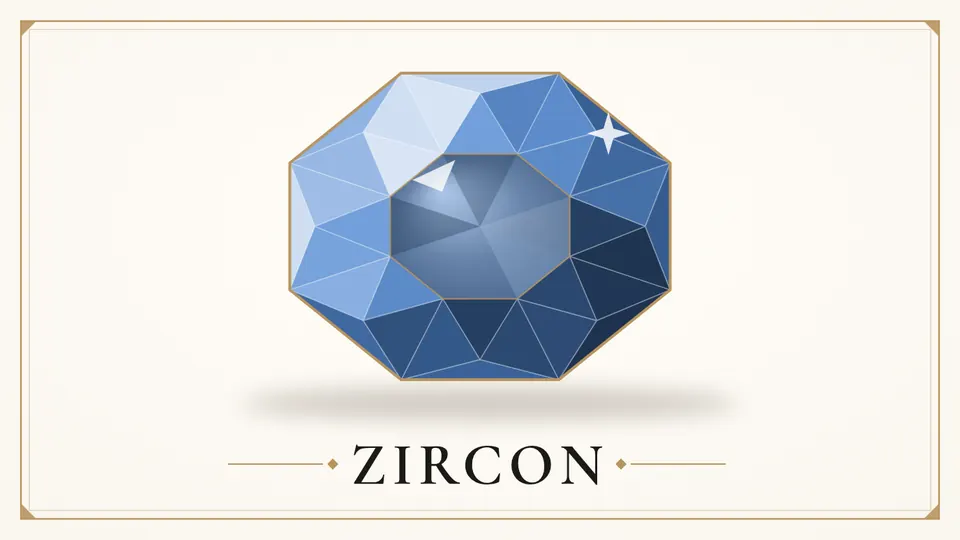
Zircon is a natural gem mineral, a zirconium silicate (ZrSiO4). It is not cubic zirconia, the lab-made diamond simulant whose name sounds almost the same. Zircon sits at 6 to 7.5 on the Mohs scale and is brittle, so the edges of its facets can chip and wear. Most blue zircon is heat-treated. In tradition it is a stone of protection and peaceful nights.
At a glance
- Zircon is a natural mineral, zirconium silicate (ZrSiO4). Cubic zirconia is a different, lab-made material (ZrO2).
- Mohs 6 to 7.5 and brittle: facet edges can chip and wear, so give it a protective setting.
- Blue zircon is typically heat-treated, and the colour of some treated stones can revert in strong light. Ask the seller.
- A December birthstone on modern US lists. Care: soft brush, mild soap, no ultrasonic or steam cleaners.
Quick facts
| Family | Zirconium silicate (a nesosilicate mineral), the natural gem that is also the main source of the metal zirconium |
|---|---|
| Chemical formula | ZrSiO4 |
| Crystal system | Tetragonal |
| Mohs hardness | 6–7.5 |
| Luster | Vitreous to adamantine, with a very high refractive index, strong fire and strong double refraction; notably brittle, so the girdle and facet edges can show wear |
| Transparency | Transparent when cut as a gem |
| Natural colors | blue (most often heat-treated), colourless (often heat-treated), red, orange, yellow, brown, green |
| Main localities | Sri Lanka, Australia, Cambodia, Myanmar, Vietnam |
| Common treatments | heat treatment is common and is used to make blue and colourless stones, and some orange, yellow and red ones; some heat-treated stones can revert to their original colour, usually light brown, after long exposure to bright light; heat-treated blue zircon can fade under ultraviolet light and may be more brittle; ask the seller in writing whether the colour is natural or heat-treated |
| Birth month | December (on modern US lists, with turquoise and tanzanite) |
Zircon at a glance, in pictures
Hardness range
Natural colors
- blue (most often heat-treated)
- colourless (often heat-treated)
- red
- orange
- yellow
- brown
- green
Common forms of Zircon
- Rough raw chunk
- Faceted cut gem
How hard is Zircon?
- Talc 1
- Gypsum 2
- Copper coin ~ 3
- Calcite 3
- Fluorite 4
- Apatite 5
- Glass ~ 5.5
- Steel knife ~ 5.5
- Orthoclase 6
- Zircon 6–7.5
- Quartz 7
- Topaz 8
- Corundum 9
- Diamond 10
What it is and where it comes from
The name zircon is thought to come from the Persian zargun, meaning gold-coloured, or from the Arabic zarkun, meaning cinnabar or vermilion. Yellow, orange and red zircon has traditionally been called hyacinth.
Zircon occurs in a wide range of colours, from colourless, red, orange, yellow, brown and green to blue. Blue is the colour most people picture today, and it is typically produced by heating.
More on its history
Heating brown zircon to roughly 800 to 1,000 degrees Celsius can turn it blue or colourless. Heat-treated blue zircon from Cambodia is sometimes sold under the trade name cambolite.
Colourless zircon has been confused with diamond for centuries because of its brilliance and flashes of coloured light, and colourless stones from Sri Lanka were once called Matara diamonds. Unlike diamond, zircon is strongly doubly refractive and noticeably more brittle.
Zircon and cubic zirconia share the element zirconium, which is why their names look alike. Zircon is a natural zirconium silicate. Cubic zirconia is cubic zirconium dioxide (ZrO2), a lab-made diamond simulant, and it is sometimes wrongly called cubic zirconium.
Gem zircon is often found near sapphire sources, including Sri Lanka, Australia, Myanmar, Vietnam and Cambodia. Elahera in central Sri Lanka and Harts Range in Australia are named sources.
Zircon through time
-
About 4.4 billion years ago
Zircon grains from the Jack Hills in Western Australia date from this time, the oldest dated minerals found on Earth.
-
1880s
Victorian jewellers favour blue zircon, and fine examples survive in English estate jewellery from this decade.
-
1952
An update to the US birthstone list replaces lapis lazuli with zircon for December.
-
1976
Cubic zirconia, a lab-made diamond simulant, enters commercial production, with mass production for jewellery from 1977.
In crystal tradition
What follows is belief and folklore, passed down in crystal tradition. It is not measured fact.
Traditionally associated with: protection, restful sleep.
In the Middle Ages zircon was believed to bring peaceful nights and to ward off evil spirits. These are old beliefs, not measured effects of the stone.
In Hindu tradition zircon is one of the nine navaratna gems, where it alternates with hessonite garnet.
Chakra, zodiac and planet links for zircon vary from one tradition to another. Treat them as folklore.
How to care for Zircon
- Water Safe
- Sunlight Caution
- Salt Unknown
- Heat Caution
- Ultrasonic Avoid
- Chemicals Safe
Safe = fine as a rule · Caution = only briefly or gently · Avoid = can damage the stone · Unknown = no reliable guidance.
Clean zircon with a soft brush, mild soap and warm water, then dry it. Skip ultrasonic and steam cleaners. Strong light can pale some heat-treated stones and heat can change the colour of some zircon, so keep it away from long bright light and hot places. Take it off for gardening, sport and washing up, because rough conditions can wear the facet edges. Store it in a soft pouch.
Real or fake? Look-alikes and treatments
Often confused with
- Cubic zirconia
- Moissanite
- White sapphire
- Blue topaz
- Synthetic spinel
- Glass
Common look-alikes
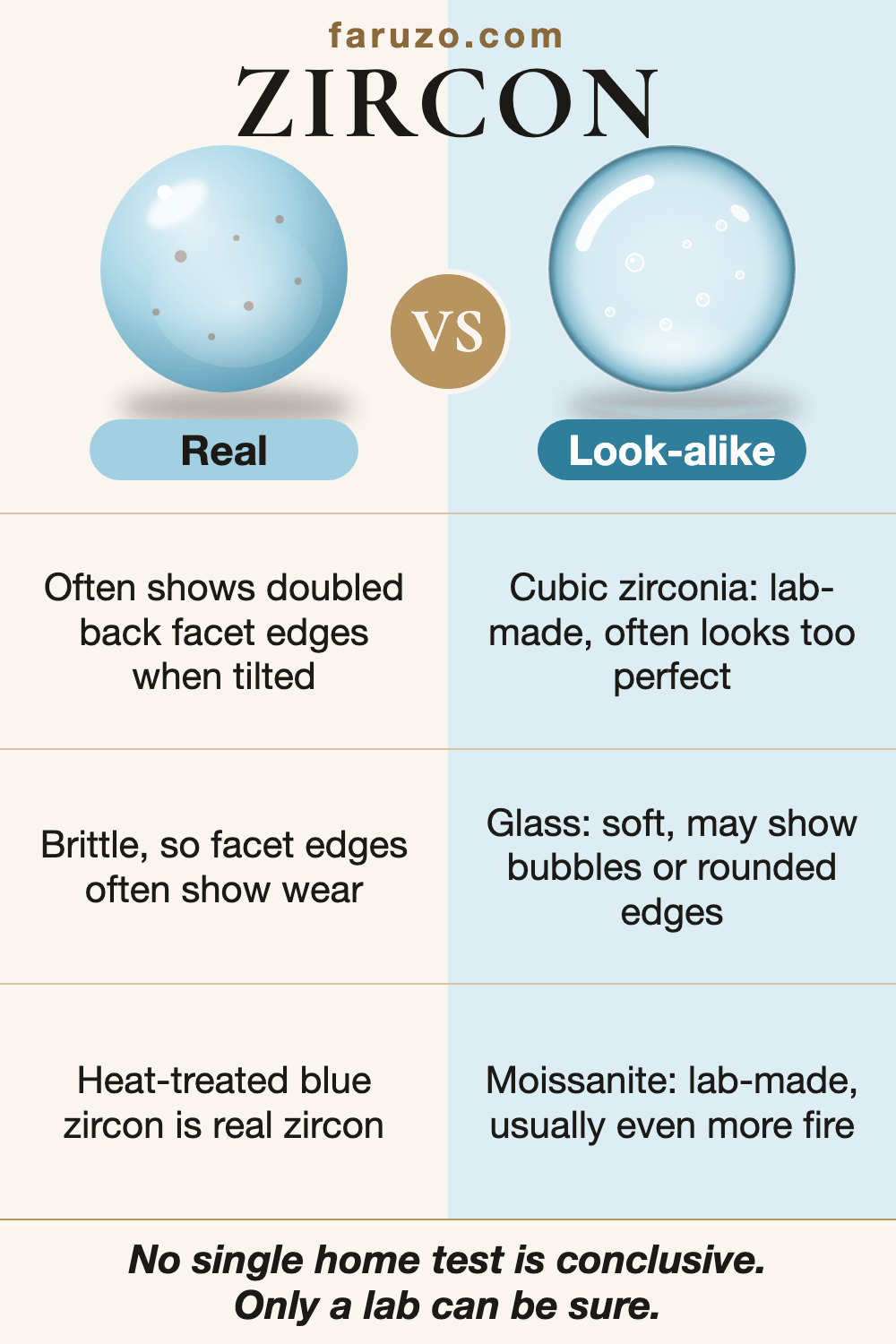
- Cubic zirconia. A different material, not a cheaper form of zircon. Cubic zirconia is lab-made cubic zirconium dioxide (ZrO2), sold as a diamond simulant. It is harder (Mohs 8 to 8.5) and denser, is single-refracting and usually looks flawless, while zircon can show doubled back facet edges at a tilt and often wear at the edges.
- Moissanite. Moissanite is a lab-made diamond simulant with even more fire than zircon, harder at Mohs 8.5 to 9.25 and much less dense. Both are doubly refractive, so a doubled-facet look does not separate them. A lab can.
- White sapphire. White sapphire is much harder (Mohs 9) and has far less fire, so it can look lifeless when cut next to colourless zircon.
- Blue topaz. Blue topaz is often colourless topaz treated to turn blue. It is harder (Mohs 8), lighter for its size and shows fewer flashes of coloured light than zircon. Colour alone is not a safe guide, so a lab can confirm.
- Synthetic spinel. Lab-made spinel is a common simulant that can mimic zircon in several colours. It is single-refracting and tends to look lifeless, without zircon's fire.
- Glass. Glass is an old and common imitation. It is soft, so facet edges round and scratch quickly, and it can show gas bubbles, flow lines or mould seams.
Safe checks you can do
- Ask the seller in writing whether the stone is natural zircon, cubic zirconia, moissanite, glass or another gem, and whether its colour is natural or heat-treated.
- Tilt the stone under a 10x loupe. Zircon's strong double refraction can make the back facet edges look doubled, while cubic zirconia, which is single-refracting, does not. Moissanite doubles too, so this is a hint, not proof.
- Look at the facet edges and girdle. Zircon is brittle and often shows wear there, while cubic zirconia is usually flawless.
- Do not rely on colour. Blue zircon, blue topaz and lab-made spinel can look alike, so for a stone that matters ask for an identification report from an independent gem lab.
- Do not scratch-test a zircon you plan to keep, because a brittle stone can chip at the edges.
Wearing Zircon
Ring
Careful
Fine with care, but knocks can mark it.
Bracelet
Safe
Fairly hard, so fine for normal bracelet wear.
Pendant
Safe
Fairly hard, and a pendant sits clear of knocks.
Earrings
Safe
Fairly hard, and earrings rarely take knocks.
Guide for everyday wear, based on hardness and care notes. Safe, Careful or Avoid.
Zircon is Mohs 6 to 7.5 but brittle, so the edges of its facets can chip and wear. A ring is fine with care in a setting that shields the edges, and it should come off for gardening, sport and washing up. A pendant, earrings and a bracelet are fine for normal wear, as long as the stone comes off for rough work. Keep it out of long bright light between wearings.
Related stones
Questions about Zircon
What does zircon mean?
In tradition zircon is linked with protection and peaceful nights, and in the Middle Ages it was believed to ward off evil spirits. Those are old beliefs, not measured effects of the stone. Its practical claim to fame is brilliant fire and a long history of being mistaken for diamond.
What is zircon?
Zircon is a natural mineral, a zirconium silicate with the formula ZrSiO4 and a tetragonal crystal structure. It occurs in blue, colourless, red, orange, yellow, brown and green, and it has been cut as a gem for centuries.
Is zircon the same as cubic zirconia?
No. Zircon is a natural zirconium silicate (ZrSiO4) that forms in rock. Cubic zirconia is cubic zirconium dioxide (ZrO2), a lab-made material sold as a diamond simulant, and it entered commercial production in 1976. They share the element zirconium, which is why the names sound alike, but they are different materials with different hardness, density and optics.
A listing says zircon or zirconia: which one is it?
They are not interchangeable, so ask the seller to name the material in writing: natural zircon, cubic zirconia, moissanite or something else. Zircon is the natural gem; cubic zirconia is a lab-made simulant that is usually colourless and flawless. If the wording is vague, a gem lab can identify the stone.
Is zircon a real gemstone or a fake diamond?
Zircon is a real, natural gemstone. Colourless zircon was used as a diamond substitute for centuries because it is brilliant and shows fire, but it is a different mineral that is strongly doubly refractive and more brittle than diamond. Today it is valued as a gem in its own right, most often in blue.
Is zircon a December birthstone?
Yes. Zircon is a December birthstone on modern US lists, alongside turquoise and tanzanite. Some lists also name blue topaz, so check which list you are following.
How hard is zircon?
6 to 7.5 on the Mohs scale, depending on the stone. Hardness only measures scratching, though. Zircon is brittle, so a knock can chip a facet edge, and edges tend to wear with daily contact.
Can you wear a zircon ring every day?
It is possible but not ideal. A ring takes the most knocks, and zircon's facet edges can chip and wear, so a protective setting and removing it for gardening, sport and washing up help. Pendants and earrings are gentler on the stone.
Is blue zircon natural or treated?
Blue zircon is a natural mineral, but its blue is typically produced by heat treatment, often starting from brown rough. It is a standard trade practice, and a treatment should be disclosed when a stone is sold. Ask the seller to say in writing whether the colour is natural or treated.
Is heat-treated zircon still real zircon?
Yes. Heating changes the colour, not what the stone is, so a treated blue zircon is still real zircon. The treatment matters for care: some treated stones can revert to a light brown in long bright light, and heat-treated blue zircon may be more brittle.
Does zircon fade in sunlight?
Some can. Colours of certain zircon, especially heat-treated stones, may pale or revert after long exposure to bright light. Between wearings keep it in a closed box or soft pouch instead of on a sunny windowsill.
How can you tell zircon from cubic zirconia, moissanite or blue topaz?
A home look can only hint. Zircon's strong double refraction can make back facet edges look doubled at a tilt, and its edges often show wear, while cubic zirconia is single-refracting and usually flawless. Moissanite also doubles, and blue topaz is lighter and shows fewer flashes of colour. For a stone that matters, ask for an identification report from an independent gem lab.
How do you clean zircon?
Use a soft brush, mild soap and warm water, then dry it. Ultrasonic and steam cleaners are not recommended. The stone is generally stable to chemicals, but heat and long bright light can change the colour of some zircon.
Where does zircon come from?
Gem zircon is often found near sapphire sources, including Sri Lanka, Australia, Myanmar, Vietnam and Cambodia. Elahera in central Sri Lanka and Harts Range in Australia are named sources, and heat-treated blue zircon from Cambodia is sometimes sold as cambolite.
Is zircon one of the oldest minerals on Earth?
Yes. Zircon grains from the Jack Hills in Western Australia have been dated to about 4.4 billion years, the oldest dated minerals found on Earth. Zircon resists weathering, which is why such old grains survive.