The star and crescent is a crescent moon paired with a star, most often a five-pointed one. It is much older than any one nation or faith: moon-and-star imagery appears in ancient art, a version of it was used by the city of Byzantium, and it later became an Ottoman state emblem, then part of many national flags. Today it is widely recognised as a sign of Muslim identity, though historians point out that this link is a fairly modern development.
Below: where the pairing comes from, what happened in Byzantium and under the Ottomans, how the Islamic association grew, a timeline of dated facts, and how it differs from other moon and star symbols.
At a glance
- The star and crescent is a celestial pairing that long predates any single state or religion.
- It is linked in tradition with the city of Byzantium, later Constantinople, and was adopted as an Ottoman state emblem in the 18th century, in the usual account.
- It appears on the flags of several countries, including Turkey and Pakistan, in more than one design.
- Its link to Islam is widely felt today, but it is often noted that it is not found in scripture and grew largely through Ottoman and later state use.
What does the star and crescent mean?
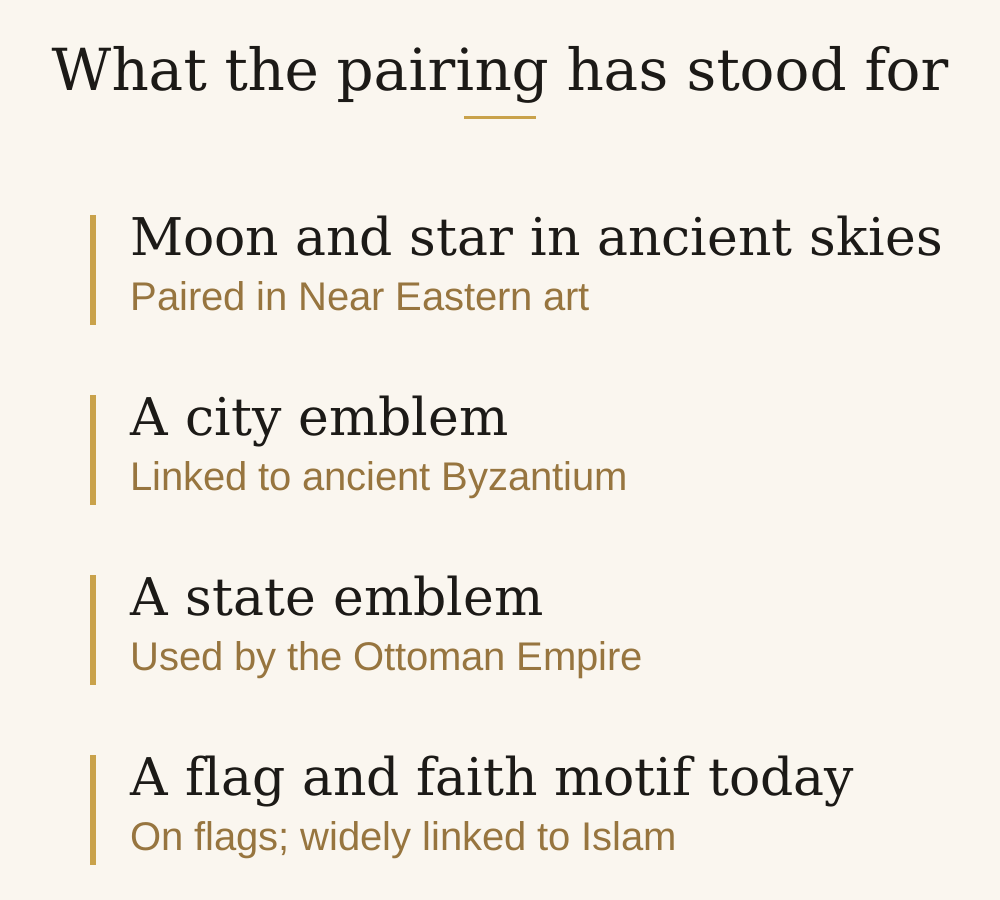
There is no single original meaning, because the pairing has been read differently in different periods. In ancient skies, a crescent moon beside a bright star is simply a striking sight, and several early cultures read it as a sign of the heavens. Later, it became a city emblem, then a state emblem, then a flag motif. In modern times, many people see it as a sign of Muslim identity, and others see it as a national or celestial design.
For that reason, it is worth asking which of these a particular piece of art means. A crescent and star on a flag, on a coin, on a mosque finial or on a necklace can each carry a slightly different meaning. We describe the history here and leave personal meaning to the wearer.
Ancient origins: the moon and the morning star
Crescent moons and stars are among the oldest sky symbols humans drew. In the art of ancient Mesopotamia, a crescent is commonly read as a sign of the moon god, often called Sin or Nanna, and a star or rosette as a sign of the goddess Ishtar, linked with the planet Venus. The two are often shown near each other. Specialists describe these as common readings rather than a fixed rule, and a crescent with a star in these images is not yet the later flag emblem.
Similar sky imagery turns up elsewhere in the ancient Mediterranean and Near East. The point to keep in mind is that the pairing is old and widely shared, so no one culture or religion can claim to have invented it.
Byzantium and the crescent
The Greek city of Byzantium, on the site that later became Constantinople and then Istanbul, is the place most often linked with the symbol before the Ottomans. Coins from the city are described as showing a crescent and a star, and some date them to around the 1st century BCE, while other accounts place the symbol's use there earlier. Accounts differ, so treat any single date as approximate.
A popular story ties the emblem to the city's defence, with the moon said to have revealed a night attack. This kind of tale is generally treated as tradition rather than documented fact, and some retellings link the crescent to a moon goddess protecting the city. What can be said more safely is that the crescent was an established city emblem and stayed in use for a long time.
There is no single original meaning, because the pairing has been read differently in different periods.
The symbol also appears on some Sasanian Persian coins from around the 5th century CE, a reminder that it travelled widely.
The Ottomans and the state emblem
How the Ottomans came to use the crescent is a place where accounts differ. An older and widely repeated account says they took over the city's emblem after capturing Constantinople in 1453. One view is instead that the crescent was already in Turkic and Ottoman use for a century or more before that date. Both accounts agree on the later outcome.
Several references say the star and crescent became an official Ottoman state symbol during the reign of Sultan Mustafa III (1757–1774), and was firmly established under Selim III (1789–1807). The flag of 1844, a white crescent and star on a red field, is generally treated as the direct ancestor of the modern Turkish flag. The Turkish Flag Law of 29 May 1936 then fixed its exact proportions.
National flags
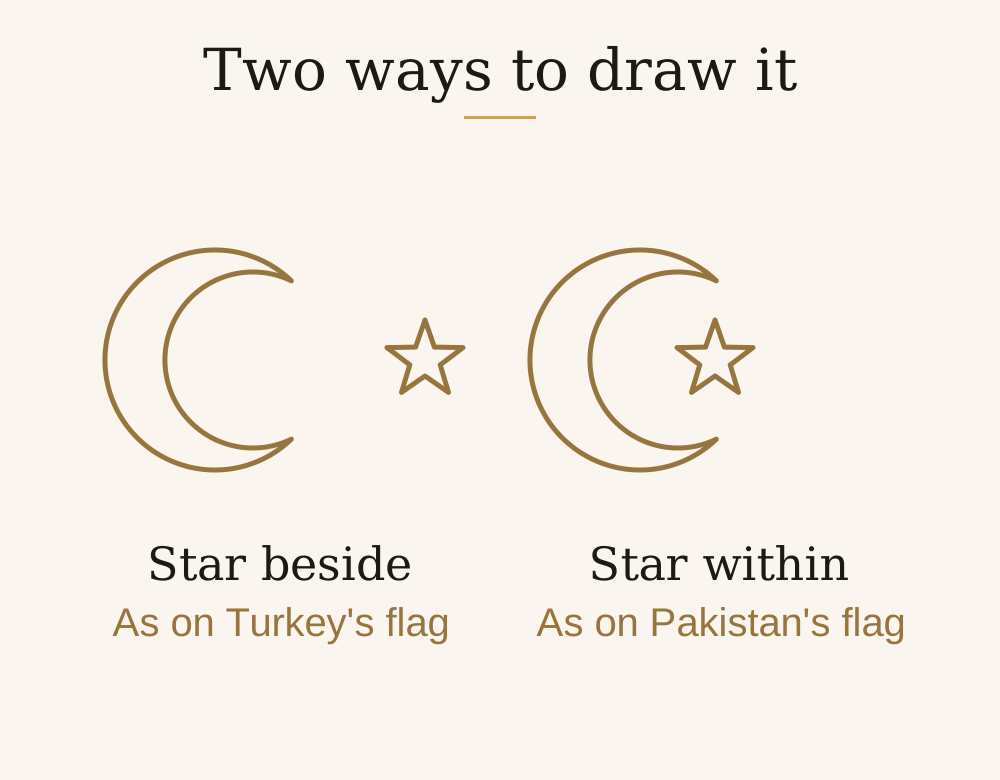
When Ottoman-ruled lands became separate states, several kept or adapted the emblem. Turkey's flag uses a white crescent and star on red. Pakistan's flag, adopted in 1947, places a white star within a white crescent on a dark green field. Algeria, Tunisia, Azerbaijan and Malaysia also use a crescent with a star in their own designs, and the Maldives uses a crescent alone. Singapore's flag carries a crescent with five stars.
These are different flags with different histories, and each country explains its own design. Reading all of them as "the same symbol" would flatten that history. The crescent shapes, star points and colours vary from one flag to the next.
How it came to be linked with Islam
The Islamic calendar is based on the lunar month, and the sighting of the new crescent traditionally marks the start of a month, including Ramadan. That gives the crescent a natural place in Muslim life. Many mosques carry a crescent finial, and the Red Crescent movement uses a crescent on its own as its emblem.
At the same time, it is often noted that the crescent and star were not part of early Islamic practice, and some hold that the link is not rooted in scripture. Many describe the association as growing largely through the long prominence of the Ottoman state, whose flag was among the best-known in the region, and through later national flags. By the mid-20th century, the symbol was often described as one of Islam.
Both statements can be true together: the star and crescent is a historical emblem and, for many people today, also a meaningful sign of identity. What it means to a person who wears it is theirs to say.
Often confused with
Several celestial symbols look similar, but their stories are separate.
- Star: a star alone, traditionally read as guidance, hope or destiny.
- Sun and moon: a pairing of day and night, usually read as balance.
- Moon phases: the cycle of the moon, usually read as change and renewal.
- Star of David: a six-pointed star, a separate symbol with its own history.
The table sets them side by side.
| Symbol | Shape | Traditionally read as |
|---|---|---|
| Star and crescent | Crescent moon with a star | A city, state and flag emblem; widely linked to Islam today |
| Star | One star, often five-pointed | Guidance, hope and destiny |
| Sun and moon | Sun and moon together | Balance of day and night |
| Moon phases | A row of moon stages | Cycles and renewal |
How people wear it today
The star and crescent is worn as a pendant, ring or earrings. Some wearers choose it as a sign of Muslim faith or heritage, others for a connection to Turkey, Pakistan or another place, and others simply as a moon-and-star design. If you wear it as a religious or national sign, the history above explains why the symbol means so much to some and why its past is more layered than it looks. When choosing jewelry, look for a piece whose metal is described plainly, such as 316L stainless steel with a gold-plated, rose gold-plated or silver-tone plated finish, rather than vague "gold" or "silver" wording. Genuine stainless steel is nickel-safe.
Frequently Asked Questions
What does the star and crescent symbolize?
There is no single meaning. It began as a pairing of moon and star in ancient sky imagery, became an emblem of the city of Byzantium and of the Ottoman state, and now appears on many national flags. Many people today also see it as a sign of Muslim identity.
Is the star and crescent a symbol of Islam?
It is widely used and recognised that way today. It is often noted that it is not found in scripture or in early Islamic practice, and that the link grew largely through Ottoman and later state use. Both views are commonly stated.
Where did the star and crescent come from?
Moon-and-star imagery is ancient and widely shared. The city of Byzantium used a version of it, and the Ottomans later made it a state emblem. Accounts differ on exactly when and how each step happened.
Did the Ottomans take the crescent from Byzantium?
An older account says they adopted the city's emblem after capturing Constantinople in 1453. One view is that the crescent was already in Turkic and Ottoman use before that. Accounts differ, so both are given here.
Which countries have a star and crescent on their flag?
Examples include Turkey, Pakistan, Algeria, Tunisia, Azerbaijan and Malaysia, each in its own design. The Maldives uses a crescent alone, and Singapore's flag has a crescent with five stars.
Does the star point up or down, and does it matter?
Designs vary. On Turkey's flag, the star sits beside the horns of the crescent, and on Pakistan's flag it sits within them. No single arrangement is the "correct" one across all uses.