Look up on a clear, moonless night, far from any town, and you are seeing almost exactly what your ancestors saw ten thousand years ago. The constellations have barely shifted. Before there were maps, or compasses, or clocks, there were stars — fixed points of light that told sailors where they were, told farmers when to plant, and told the frightened and the grieving that some things do not go out. Of all the symbols we wear, the star may be the oldest, and the most quietly hopeful.
The Oldest Light We Know
For most of human history, the night sky was the original source of meaning. Stars were where the gods lived, where the dead went, where fate was written. The Latin word for star, stella, and its Greek cousin aster still glint through our language — in stellar, in astronomy, in the little asterisk that means 'look here.' Even our darker words carry starlight: disaster comes from the Italian disastro, an 'ill-starred' event, a moment when the heavens seemed to turn against you.
That is the heart of what a star has always meant — light in the dark. Not the blaze of the sun, which is certainty, but a smaller, braver kind of light: the kind you have to look for, the kind that holds steady when everything around it is black. To wear a star is to carry that idea against the skin — that even in the longest night, something is still shining, and it is enough to steer by.
The North Star and the Way Home
One star has meant more to travellers than all the others: Polaris, the North Star. It sits almost exactly above the Earth's northern axis, so while the whole sky wheels through the night, Polaris stays put — a single unmoving point that always shows you north. For centuries, sailors, caravans and escaping captives found their bearings by it. The old word lodestar means precisely this: a star that leads, a fixed thing you set your course by. We still use it for a person or a principle we would follow anywhere.
There is something moving in the fact that the guiding star is not the brightest one. Polaris is only modestly bright; you find it by tracing the edge of the Big Dipper. It guides not by dazzling but by staying. And because the Earth slowly wobbles over millennia, the pole star itself changes — the ancient Egyptians steered by Thuban, and thousands of years from now the honour will pass to Vega. Even the fixed point moves, in the end. But within any human life, the North Star is constancy itself: the promise that you can always find your way home.
Wishing on a Star
'Star light, star bright, the first star I see tonight' — the little rhyme most of us learned before we could tie our shoes is nineteenth-century American, but the impulse behind it is far older. To wish on the first star of the evening is to send a hope somewhere it can be heard. Fittingly, that 'first star' is often not a star at all but Venus, the evening star, the brightest thing in the dusk. The wish lands anyway.
This is the tender side of the star's meaning: desire, aspiration, the reaching for something just out of grasp. The English words consider and desire may both descend from sidus, the Latin for star — to consider, perhaps, was once to study the stars; to desire, to long for them, de sidere, 'from the stars.' The etymology is debated and can't be proven, but the intuition endures. When we want something badly, we still look up. And the Romans left us the phrase we reach for at every graduation and every hard beginning: per aspera ad astra — through hardship, to the stars.
Stars Across Cultures and Faiths
Almost every culture has read meaning into the stars, and each drew a slightly different picture. In Christianity, the Star of Bethlehem is the sign that leads the wise men to the Christ child — a star, again, as a guide toward hope. The star-and-crescent widely associated with Islam is in fact far older than the faith, an emblem of the ancient city of Byzantium adopted by the Ottomans and later spread across many national flags. Sailors across the Pacific navigated by memorised star paths long before European ships arrived, holding entire oceans in their heads as maps of light. (The six-pointed Star of David carries its own distinct history, which deserves — and has — a story of its own.)
The shape shifts with the meaning. The familiar five-pointed star, or pentagram, is genuinely ancient: the Pythagoreans treated it as a symbol of health and harmony, and it has since stood for the five elements, the five senses, and much else. Six points make a hexagram; seven can signify the classical planets or the days of creation. A star's number of points is never accidental — it is a small piece of grammar, telling you which of the star's many meanings someone meant to speak.
You're My Star
Somewhere along the way, the star came down from the sky and became a way of talking about the people we love. To call someone your star is one of the warmest things you can say: you light my way, I steer by you, I would find you in any dark. We say it to the friend who talks us off the ledge at midnight, to the mother whose voice is our true north, to the person whose steadiness has become the fixed point we plan our lives around.
The star holds our grief, too. For those who have lost someone, the idea that a loved one has 'become a star' — watching, still shining, still up there — is one of the oldest comforts we have. A star pendant worn against the heart can quietly mean I still steer by you. And between friends, a star can be a promise in both directions: not one person guiding another, but two lights agreeing to keep each other company through whatever dark comes. You are my star, and I am yours.
Wearing the Star, Giving the Star
This is why a star necklace makes such a natural gift. It says something a plainer charm cannot — not just 'I'm thinking of you,' but 'you guide me,' 'you give me hope,' 'you are the constant I find my bearings by.' Given to a graduate, it means reach; given to a child, it means you are watched over; given to a friend, it means I would find you anywhere. It is a small, wearable way of pointing at everything the sky has always meant and saying: that, but about you.
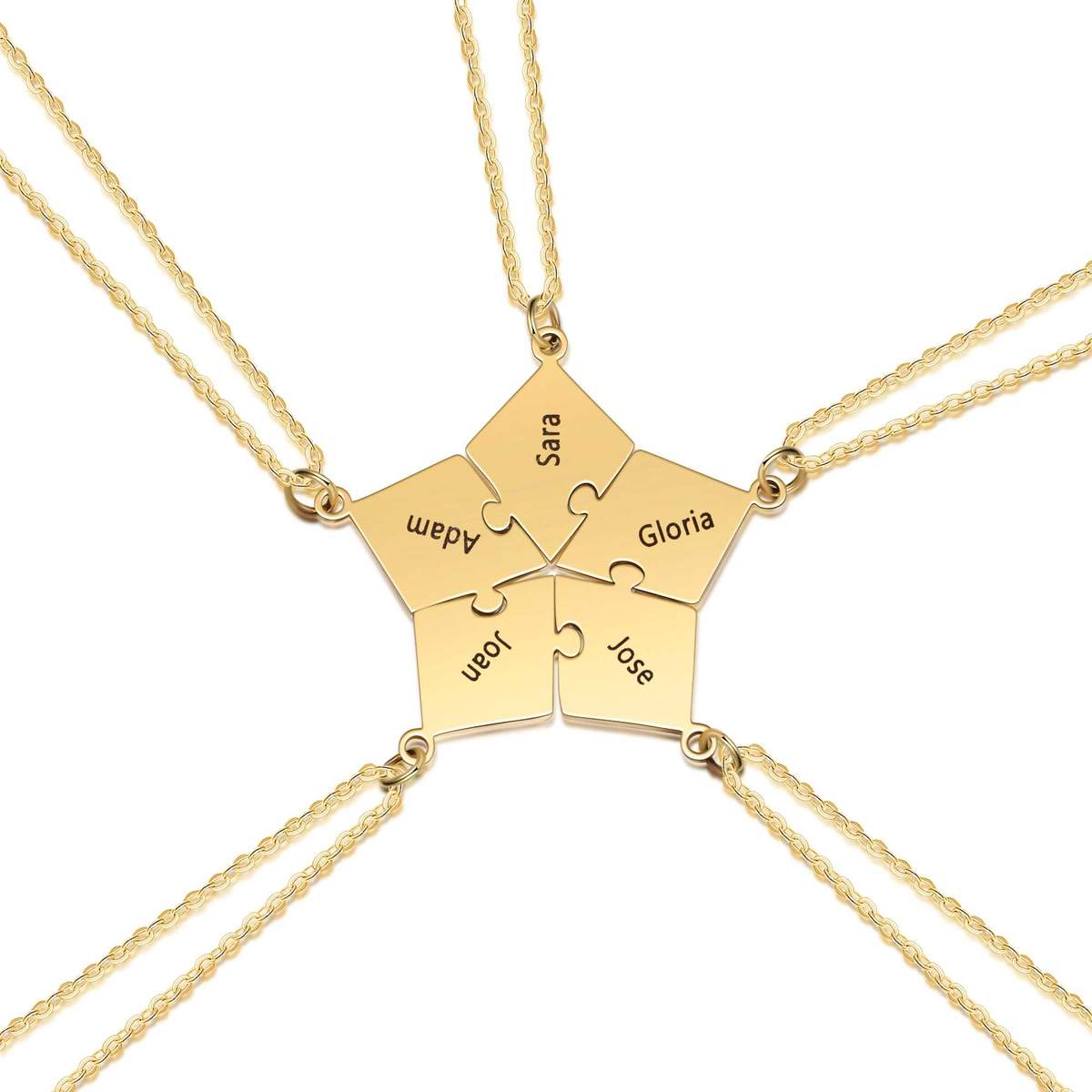
For two friends, there is something especially fitting in matching stars. Our Best Friend Star Necklace set is made exactly for this — a pair of stars, one for each of you, so that on any ordinary Tuesday or any hard night apart, you can touch the pendant and remember there is someone out there whose light you steer by, wearing yours in return. No grand gesture, no speech. Just two people quietly agreeing to be each other's north.
A Fixed Point of Your Own
In the end, the star endures as a symbol because it answers a need that never goes away: the need for something to hold steady when we cannot. We still look up for the same reasons our ancestors did — to find our direction, to make our wishes, to feel less alone under a very large sky. To wear a star is to keep a little of that within reach: a reminder that light travels a long way to find us, that hope is a discipline as much as a feeling, and that the people who guide us home are the truest stars we will ever have.
Frequently Asked Questions
What does a star necklace symbolize?
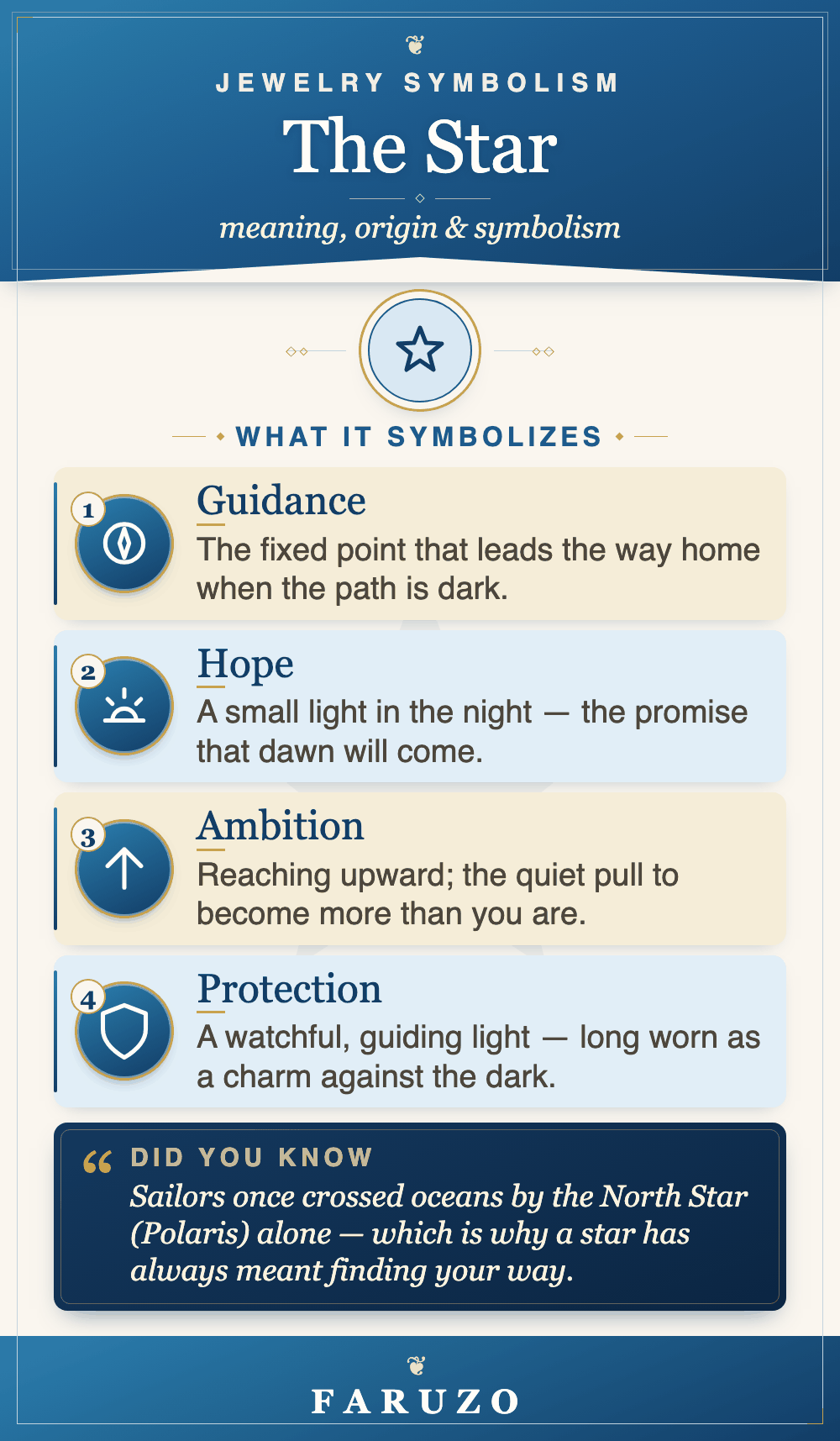
A star necklace most often symbolizes guidance, hope and light in dark times, echoing how people have steered by the stars for thousands of years. It can also represent ambition and reaching for something greater, or stand for a person you love — someone who lights your way or watches over you. Given as a gift, it's a quiet way of saying 'you guide me.'
Is a star a symbol of good luck?
Yes, stars are widely seen as symbols of hope, protection and good fortune, which is part of why we still 'wish upon a star.' Because a star signifies light in darkness and finding your way, many people wear one as a hopeful, protective talisman. It isn't tied to a single superstition — its luck comes from its long association with guidance and aspiration.
What does the North Star symbolize?
The North Star, Polaris, symbolizes direction, constancy and finding your way home, because it stays fixed in the northern sky while every other star appears to move around it. For centuries travellers and sailors navigated by it, which is why we call a trusted guiding person or principle a 'lodestar.' Wearing it can mean steadiness, or someone who is your own true north.
What does it mean to call someone your star?
Calling someone your star means they guide you, give you hope, or are a steady, shining presence in your life — the person you 'steer by.' It's a warm way to honour a best friend, a parent or a partner. For those who are grieving, saying a loved one 'is a star now' expresses the comforting belief that they're still watching over you.
What does a five-pointed star mean compared to other stars?
The five-pointed star (or pentagram) is the most common and has ancient roots, once symbolizing health and harmony for the Pythagoreans, and later the five elements or senses. Different point counts carry different meanings: six points form the hexagram, or Star of David, and seven can represent the classical planets. In jewelry, the familiar five-pointed star simply reads as a universal emblem of hope and guidance.