Most people know garnet as one thing: the deep red stone tied to January birthdays. That's a small slice of the truth. Garnet isn't a single mineral at all — it's a family of six closely related species that, together, span nearly the entire color wheel, from fiery orange and vivid green to one of the rarest color-change blues in gemology. This guide goes past the birthstone framing to cover what garnet actually is, the real geology and history behind it, how to identify a genuine stone, and how to wear and care for it. For the traditional January birthstone angle, see our january birthstone garnet guide.
What Garnet Actually Is
Garnet is the name for a group of closely related silicate minerals rather than a single species — gemologists group them by the general formula X₃Y₂(SiO₄)₃, where the X and Y positions can be filled by different combinations of calcium, magnesium, iron, manganese, aluminum, and chromium. Six main species make up the group: pyrope, almandine, spessartine, grossular, andradite, and uvarovite — and most gem-quality garnet on the market is actually a blend across two or more of them rather than a pure single species.
On the Mohs hardness scale, garnet runs 6.5 to 7.5 depending on the species, with a specific gravity between 3.5 and 4.3. It crystallizes in the isometric (cubic) system and has no cleavage — unlike stones such as kyanite or topaz that split cleanly along a weak plane, garnet fractures unevenly instead. For a broader sense of how garnet's hardness stacks up against other gems, see our mohs hardness scale guide — that lack of a hidden weak direction is a real practical advantage for everyday jewelry.
Properties: Physical, Mental, and Metaphysical
Physical
Garnet is transparent to translucent in its gem-quality forms, so it's almost always faceted rather than cut as a cabochon — the cut lets light travel through and bounce back out, which is what gives a well-cut garnet its brightness. Its lack of cleavage and solid mid-to-upper hardness make it a genuinely durable everyday-wear stone, closer in toughness to sapphire than to softer, cleavage-prone gems.
Mental
In wellness and crystal circles, garnet is described as a stone of vitality, willpower, and grounded confidence — language that echoes its historic reputation as a “stone of life,” an association the ancient Egyptians themselves are recorded as holding (more on that below). As with any stone's meaning in our different gemstones guide, that's a belief carried by tradition and practice, not a measured effect.
Metaphysical
Garnet's protective reputation has real historical roots: Roman soldiers wore garnet intaglio rings into battle believing the stone warded off injury, and the association with protection and courage carried into medieval Europe. Contemporary claims tying specific garnet species to particular chakras are a modern layer added by 20th-century crystal-healing writers, not an ancient one — worth reading as belief, not documented history.
Six Species, Nearly Every Color
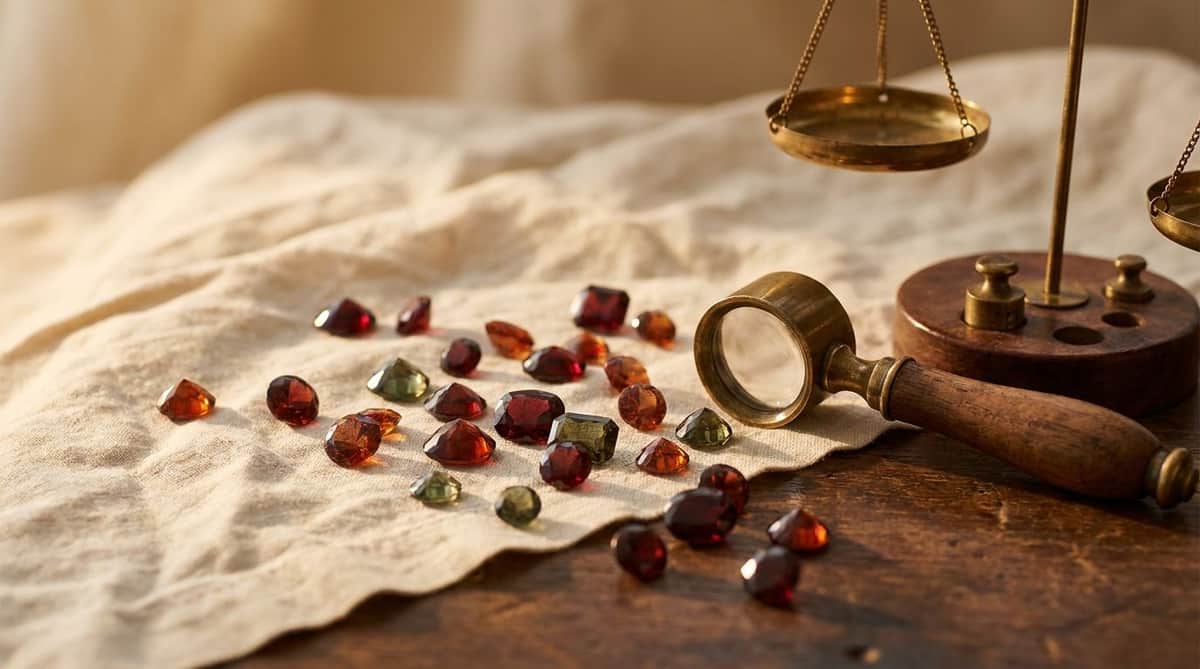
Garnet's biggest myth is that it only comes in red. In reality, each of the six species tends toward its own color, and together they cover most of the visible spectrum — see our gemstone color meanings guide for how color generally ties into a stone's symbolism.
Pyrope is a deep, pure red — the name comes from the Greek purōpós, “fire-eyed,” since it's the one garnet species that's reliably red in its natural state. Almandine is the most common gem garnet, reddish-brown to purplish-red, named for Alabanda, an ancient gem-cutting center in what's now Turkey. Spessartine runs vivid orange to reddish-orange, named for the Spessart mountains in Bavaria, Germany, where it was first described.
Grossular ranges from colorless to a vivid green; its name comes from the Latin for gooseberry, after the pale green color of the first specimens found. Its finest green variety, tsavorite, wasn't identified until 1967, when geologist Campbell R. Bridges found it in Tanzania (and in neighboring Kenya in 1971); Tiffany & Co. brought it to market in 1974, naming it after Kenya's Tsavo National Park. Andradite includes demantoid, garnet's most prized green variety, discovered around 1853 along Russia's Bobrovka River in the Urals, where it was first mistaken for peridot — demantoid's horsetail-shaped mineral inclusions and unusually high sparkle actually raise a stone's value instead of lowering it. Uvarovite is a rare, vivid green almost always found only as tiny crystals, named after Count Sergei Uvarov, a 19th-century Russian statesman and mineral collector.
And in 1998, garnet broke its last rule: miners near Bekily, Madagascar found garnets that shift from blue-green in daylight to purple under incandescent light — the first commercially available blue garnets, colored by unusually high levels of vanadium. Genuinely blue garnet remains one of gemology's rarest finds.
A History Far Older Than January
Garnet's use predates the birthstone calendar by thousands of years. Egyptians inlaid garnet into jewelry and carvings as far back as roughly 3100 BC, prizing it enough to bury pharaohs wearing it. Garnet beads moved along Bronze Age trade routes across the ancient world. By the 3rd and 4th centuries AD, garnet had become a favorite of Roman jewelers, who carved it into intaglios — engraved gems pressed into wax to seal documents — and set them into signet rings worn as both identification and protective talisman.
How to Tell Real Garnet From Look-Alikes
Because garnet spans so many colors, it gets confused with different stones depending on which species you're looking at. Deep red pyrope and almandine are the classic budget substitute for ruby — a jeweler can usually tell them apart instantly with a refractometer, since garnet and ruby (corundum) have different refractive indices, and ruby fluoresces under UV light in a way most garnet doesn't. Green tsavorite and demantoid get compared to emerald, but they're notably more brilliant face-up thanks to garnet's higher dispersion — emerald's fire is much more muted. Orange spessartine is sometimes sold as citrine or fire opal; garnet's hardness (6.5–7.5, versus opal's much softer 5.5–6.5) and the lack of the play-of-color that defines genuine opal are the tells. If in doubt, any reputable jeweler can confirm species and treatment status with standard gemological testing — refractive index, specific gravity, and inclusion pattern together are decisive.
How to Wear and Care for Garnet Jewelry
Garnet's combination of solid hardness and no cleavage planes makes it one of the more forgiving colored gemstones for daily wear, rings included — not something we'd say about lapis lazuli or kyanite. That said, its lack of cleavage doesn't mean it's indestructible: a hard enough direct blow can still chip a facet edge, so it's still worth avoiding activities where a ring takes repeated knocks. For the general cleaning routine, see our gemstone ring cleaning guide — warm, soapy water and a soft brush are safe for garnet, and ultrasonic or steam cleaners are usually fine for eye-clean pyrope and almandine but best avoided for demantoid and any heavily included stone, since internal fractures can spread under vibration or heat. Store garnet pieces separately from harder stones like sapphire or diamond to avoid surface scratches in storage. Garnet's own birthstone month makes it a natural pick for a personalized piece — browse our birthstone rings collection for ready settings.
Frequently Asked Questions
Is garnet only red?
No — that's the most common misconception about the stone. Garnet is a family of six mineral species that together occur in nearly every color: red, orange, green, and even a genuinely rare blue, discovered as recently as 1998.
Is garnet a real birthstone?
Yes — garnet is the modern and traditional birthstone for January. Our january birthstone garnet guide covers that history and symbolism in more depth; this guide focuses on the mineralogy, identification, and care side instead.
What's the most valuable type of garnet?
Demantoid (green andradite) and tsavorite (green grossular) are generally the most valuable garnet varieties, prized for their brilliance and rarity — fine demantoid with visible horsetail inclusions can rival the price of mid-tier emerald.
Can garnet get wet or go in the shower?
A brief rinse is fine for most garnet jewelry, since it has no cleavage plane to worry about, but it's still good practice to remove any ring before swimming in chlorinated water or using harsh household cleaners, which can dull the polish over time.
Is garnet more durable than emerald?
Generally yes. Garnet's Mohs hardness (6.5–7.5) is comparable to emerald's (7.5–8), but emerald is famously included and brittle with weak spots that make it prone to chipping, while garnet's cleaner fracture pattern and typically higher clarity make it the sturdier everyday-wear choice.
Does garnet have cleavage?
No — garnet has no cleavage plane at all, which is why it fractures unevenly instead of splitting cleanly like kyanite or topaz. That absence of a weak plane is one of the practical reasons it holds up so well as an everyday-wear stone.
For more stone-by-stone breakdowns like this — real mineralogy over birthstone folklore — browse the rest of our Gemstones & Crystals guides.