
Crystal guide
Sunstone Meaning, Properties and Care
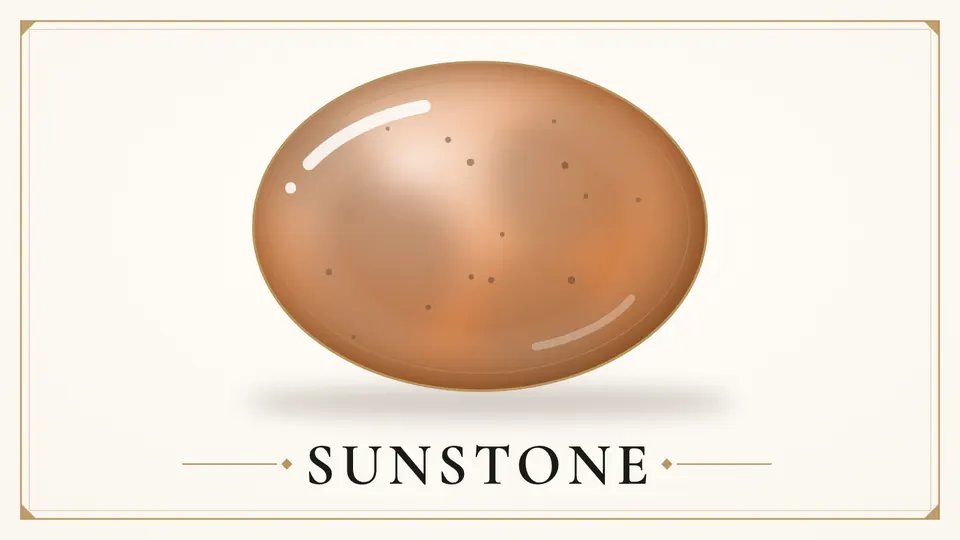
Sunstone is a feldspar with tiny reflective flakes inside that flash like sparks as the stone moves, an effect called aventurescence. It sits at about 6 to 6.5 on the Mohs scale and can split along a flat plane if knocked. In crystal tradition it is a bright, warm stone linked to sunshine, joy and confidence.
At a glance
- A feldspar whose glitter comes from tiny flakes inside, usually orange to red-brown, sometimes green.
- Mohs about 6 to 6.5, with cleavage, so a hard knock can split it.
- Oregon made sunstone its state gemstone in the late 1980s. Not on the standard birthstone lists.
- Goldstone is glass, often sold as sunstone, and copper-diffused feldspar also exists. Ask what you are buying.
Quick facts
| Family | Feldspar (silicate): the glittering variety of oligoclase, labradorite or orthoclase |
|---|---|
| Chemical formula | (Na,Ca)(Al,Si)4O8 for the common plagioclase types; orthoclase sunstone is KAlSi3O8 |
| Crystal system | Triclinic for the usual oligoclase and labradorite types |
| Mohs hardness | 6–6.5 |
| Luster | Glassy, with a glittery sheen from tiny flakes inside, and cleavage along one main plane |
| Transparency | Transparent to translucent, sometimes opaque |
| Natural colors | orange to red-brown, red, green, yellow, colourless, bicolour |
| Main localities | USA (Oregon), Norway, Sweden, Russia (Siberia), Ethiopia |
| Common treatments | Oregon sunstone is marketed as natural and untreated, but copper-diffused feldspar exists and has been sold as natural, so ask what has been done to a stone; red or green stones sold as andesine deserve a question about origin and treatment |
Sunstone at a glance, in pictures
Chakras (traditional)
Hardness range
Natural colors
- orange to red-brown
- red
- green
- yellow
- colourless
- bicolour
Traditionally linked to
- Planet
- Sun
- Zodiac
- Leo
- Element
- Fire
Common forms of Sunstone
- Rough raw chunk
- Tumbled polished pebble
- Cabochon smooth dome
How hard is Sunstone?
- Talc 1
- Gypsum 2
- Copper coin ~ 3
- Calcite 3
- Fluorite 4
- Apatite 5
- Glass ~ 5.5
- Steel knife ~ 5.5
- Orthoclase 6
- Sunstone 6–6.5
- Quartz 7
- Topaz 8
- Corundum 9
- Diamond 10
What it is and where it comes from
Sunstone is a feldspar. Its glitter comes from thin, flat flakes of native copper, hematite or goethite lying parallel to a cleavage plane. They flash as the stone turns, which gives the effect called aventurescence or schiller.
The glittering feldspars include oligoclase, labradorite and orthoclase types. The same glitter can show up in each, which is why sunstone is a name for an effect rather than one single mineral.
In the early 1800s sunstone was a little-known, rare and costly gem. Finds in Norway, Siberia and elsewhere made it better known, easier to get and cheaper. The Tvedestrand area of Norway was long its best-known source.
Gem-quality Oregon sunstone comes mainly from Harney and Lake counties. Its copper flakes give both the glitter and the colour, and more copper generally means a deeper colour. Oregon named it the state gemstone in the late 1980s.
In the early 1900s sunstone finds were described from lava fields in Oregon's Warner Valley, where Native peoples may have collected it earlier.
In the early 2000s red and green feldspar sold as andesine reached the market and looked much like Oregon sunstone. Much of it was later found to have been coloured by copper diffusion. A Tibetan source of untreated red andesine was also reported, and where some of this material truly comes from is still an open question.
The name sunstone was also used in medieval Icelandic texts for a stone said to show where the sun was on a cloudy day. Which mineral that was has never been settled. Iceland spar and cordierite have been proposed, and neither is the feldspar sold as sunstone today.
In crystal tradition
What follows is belief and folklore, passed down in crystal tradition. It is not measured fact.
Traditionally associated with: joy, confidence, warmth, optimism.
Sunstone is traditionally associated with the Sun, warmth, joy and confidence, and with the Sacral and Solar Plexus chakras. This is a modern spiritual tradition, not a fact about the stone.
Leo is the zodiac sign most often linked to it, though zodiac links vary from one tradition to another. Treat them as folklore.
One legend tied to the Oregon stones says a wounded warrior's blood fell on the stone, carried his spirit into it and turned it red. It is a story, not a record of how the stone formed.
How to care for Sunstone
- Water Safe
- Sunlight Unknown
- Salt Unknown
- Heat Caution
- Ultrasonic Avoid
- Chemicals Caution
Safe = fine as a rule · Caution = only briefly or gently · Avoid = can damage the stone · Unknown = no reliable guidance.
Wipe sunstone with a soft cloth and mild soap in lukewarm water, then dry it. Skip ultrasonic and steam cleaners, because vibration and sudden heat can stress a stone that has a cleavage plane. Avoid harsh cleaners as a precaution. How it reacts to long sun or salt water is not well documented, so avoid both as a precaution. Store it apart from harder stones, which can scratch it.
Real or fake? Look-alikes and treatments
Often confused with
- Goldstone
- Aventurine
- Plain orange or red glass
Common look-alikes
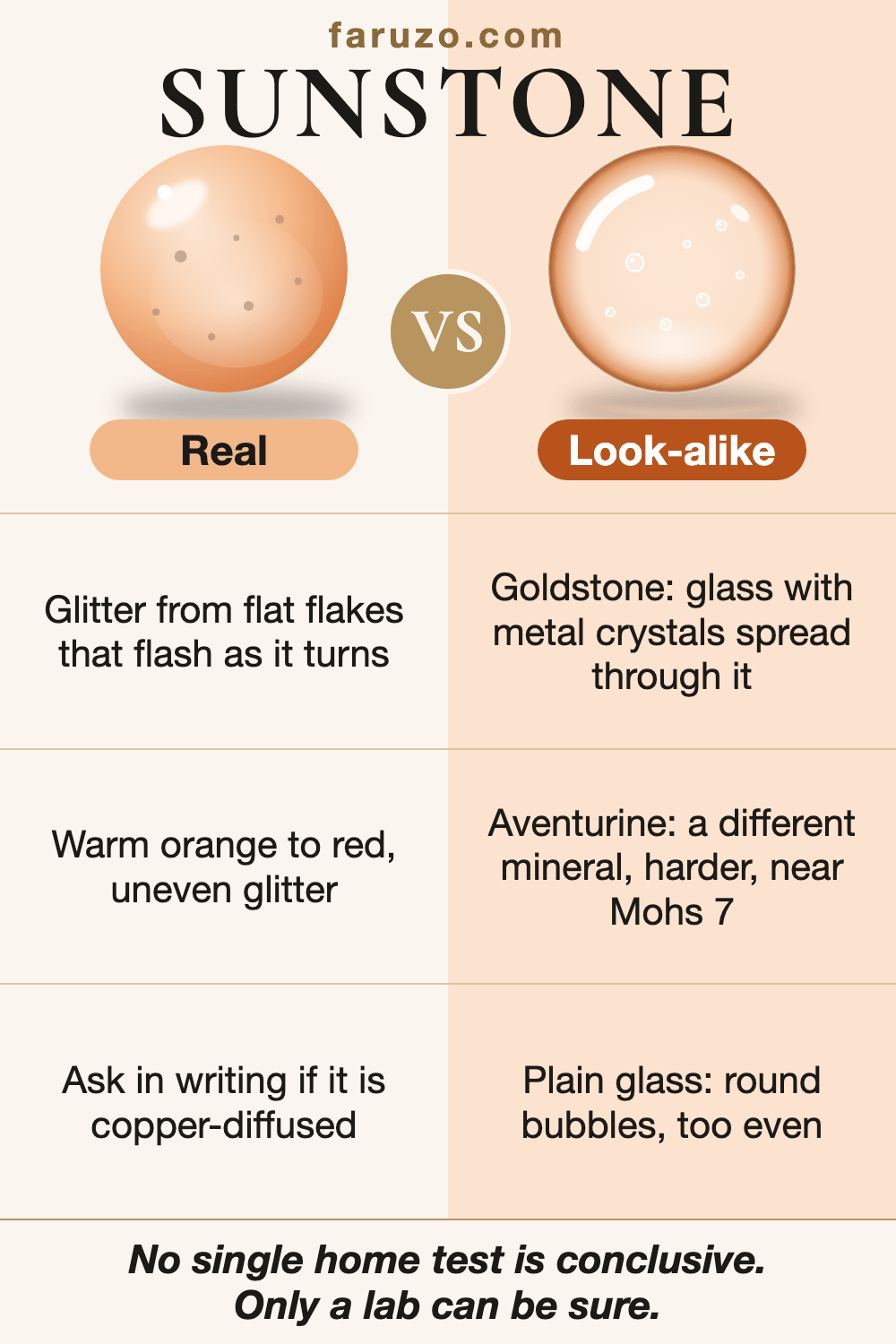
- Goldstone. Goldstone is glass with tiny metal crystals, usually copper, suspended in it, and it is often sold under the sunstone name. Its glitter sits inside a glassy body and is not tied to flat flakes in a crystal. Under magnification the difference is easier to see, and a lab can confirm.
- Aventurine. Aventurine is a different mineral, quartz with tiny mica flakes, and it comes in orange to brown shades that can resemble sunstone. It is harder, near Mohs 7. A colour match alone is not safe, so ask the seller to name the stone.
- Plain orange or red glass. Ordinary glass can copy the warm colour without the glitter. Look for round gas bubbles and for a look that is too even. Glass shows no flat flashing flakes and no cleavage.
Safe checks you can do
- Ask the seller in writing whether the stone is natural sunstone, goldstone (glass), copper-diffused feldspar or another material.
- Turn the stone under a light. Natural sunstone flashes from flat flakes as the angle changes, while goldstone's glitter is spread through a glassy body. Magnification helps, but it is not conclusive.
- Treat bright, even glitter in very cheap beads or tumbled pieces as a prompt to ask, since goldstone is glass and is sometimes sold as sunstone.
- For deep red or green stones sold as andesine, ask where they were mined and whether copper diffusion was used. A lab can screen for it.
- Do not scratch-test or heat-test a stone you plan to keep. A lab is the safer route when it matters.
Wearing Sunstone
Ring
Careful
Fine with care, but knocks can mark it.
Bracelet
Careful
A knock on a bracelet can split it along a flat plane.
Pendant
Careful
It can split along a flat plane, so keep it protected.
Earrings
Careful
A flat-plane split is possible, so keep earrings for dressy wear.
Guide for everyday wear, based on hardness and care notes. Safe, Careful or Avoid.
Sunstone sits at about 6 to 6.5 on the Mohs scale and can split along a flat plane, so every piece calls for some care. Pendants and earrings take the fewest knocks. A bracelet or ring suits careful or occasional wear, ideally in a protective setting. Take it off for the gym and rough work, and keep it apart from harder stones.
Related stones
Questions about Sunstone
What does sunstone mean?
In crystal tradition sunstone is a bright, warm stone linked to the Sun, joy and confidence, and to the Sacral and Solar Plexus chakras. That is a belief, not a fact about the stone. Its practical claim to fame is a glitter that flashes like sparks.
What is sunstone?
Sunstone is a feldspar that glitters because of tiny reflective flakes inside it. Most is oligoclase or labradorite, with some orthoclase. It is usually orange to red-brown, and sometimes green or colourless.
What makes sunstone sparkle?
Thin, flat flakes of native copper, hematite or goethite lie parallel to a cleavage plane inside the stone. They catch light and flash as it moves. The effect is called aventurescence or schiller.
How hard is sunstone?
About 6 to 6.5 on the Mohs scale, a little softer than quartz. Hardness only measures scratching, though. Cleavage means a sharp knock can split it.
Is sunstone a birthstone?
Sunstone is not on the standard modern or traditional birthstone lists, though lists vary and some alternative lists may include it. August is usually given as peridot, spinel and sardonyx. Check the list you are following.
What colours does sunstone come in?
Most is orange, red-brown or red, with some yellow, green, brown and colourless stones. Deep red, deep green and strong bicolours are among the most sought-after.
Where does sunstone come from?
Oregon is one of the best-known sources today, mainly Harney and Lake counties. Norway was the classic source for a long time, and sunstone is also found in Sweden, Siberia and Ethiopia.
Is goldstone the same as sunstone?
No. Goldstone is man-made glass with tiny metal crystals, often copper, inside it. It looks similar, is often sold as sunstone and shares nothing with it except the glitter. Natural sunstone is a feldspar.
Is the Viking sunstone the same as this stone?
Probably not. The sunstone in Icelandic texts was said to show where the sun was in cloudy weather. Which mineral it was is unproven, and Iceland spar and cordierite have been proposed. Neither is the glittering feldspar sold as sunstone.
Is sunstone treated or colour-diffused?
Oregon sunstone is marketed as natural and untreated. Copper-diffused feldspar, often red or green and sold as andesine, has also reached the market, and the origin of some of it is still debated. A treated stone is real feldspar, but it should be sold as treated, so ask the seller to say in writing what has been done.
Can you wear a sunstone ring every day?
It is not the best choice. At about 6 to 6.5 sunstone can scratch, and a knock on a ring hand can split it along a flat plane. A protective setting and occasional wear suit a ring better than daily wear.
Can sunstone get wet, and can you clean it in an ultrasonic cleaner?
A rinse in lukewarm water with mild soap is fine, then dry it. Skip ultrasonic and steam cleaners, since vibration and sudden heat can stress a stone with a cleavage plane.
Is sunstone the same as moonstone or labradorite?
They are all feldspars but different stones. Moonstone has a soft milky glow, labradorite flashes colour over a grey base, and sunstone glitters from tiny flakes. Some Oregon sunstone is a labradorite-type feldspar.
What should you ask a seller before buying sunstone?
Ask whether it is natural sunstone, goldstone or another material, where it was mined, and whether its colour is natural or from diffusion. A sunstone sold at a very low price in bright, even-glittering beads is worth an extra question.