The phoenix is a legendary bird that, in the oldest tellings, lives for centuries and is then succeeded by a new bird of its own kind. It has long stood for rebirth, renewal and starting again. The image most people know today, a bird that burns and rises from its own ashes, is a later and more dramatic version of the story.
Below: where the phoenix legend comes from, what different traditions made of it, a timeline of the writers who described it, and how it differs from similar birds.
At a glance
- The phoenix is a mythical bird of the ancient Mediterranean, a symbol of rebirth, renewal and endurance.
- The earliest Greek mention is traditionally credited to Hesiod, around the 8th century BCE, though the details are thin.
- Its fiery rebirth from ashes is not in the earliest accounts; it appears in later tellings.
- The Chinese fenghuang is often called "the Chinese phoenix," but it is a different bird with a different meaning.
What does the phoenix mean?
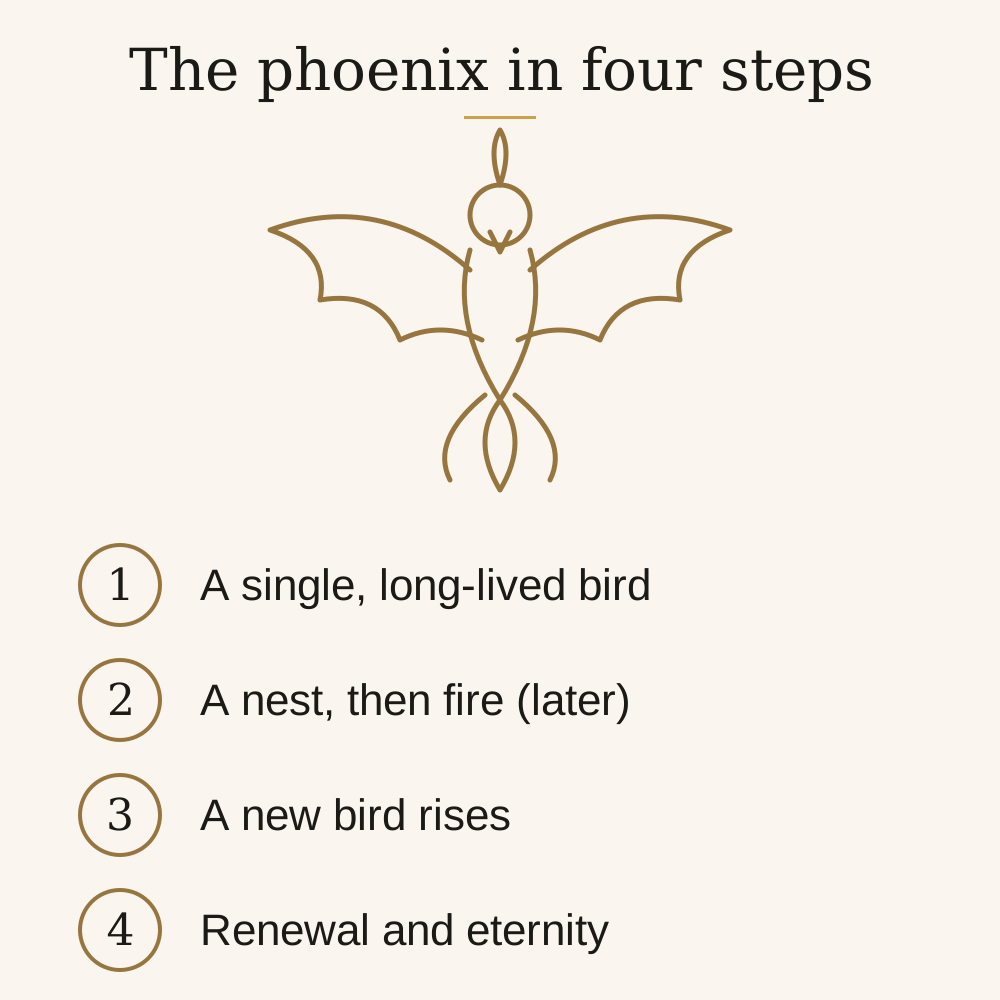
In short: a life that renews itself. The phoenix is a single, long-lived bird. When its life comes to an end, something new takes its place. People have read that as hope after loss, new beginnings, and the sense of coming back stronger.
That is a symbolic reading, not a promise of any effect. The phoenix has meant different things in different eras, and the rest of this page separates what the old texts actually say from what jewelry and popular culture later added.
Where does the phoenix legend come from?
The oldest Greek reference is usually credited to the poet Hesiod, in the 8th century BCE, and it is brief. The first fuller account is generally given to Herodotus, in the 5th century BCE. He describes a bird the Egyptians of Heliopolis spoke of, which appears rarely, and he says he had not seen it himself. Notably, his version does not mention fire or ashes.
Later Roman writers added detail. Ovid (about 8 CE) describes a single phoenix that lives for five centuries and then builds a nest, from which a young phoenix is born. Pliny the Elder calls it a famous Arabian bird, while doubting whether it is real at all. Several Roman writers describe a nest of spices. The idea of the bird burning itself belongs to this later layer of storytelling.
Even the name is unsettled. It has been explained as meaning "reddish-purple," "palm tree," or linked to Phoenicia, and it is debated which is correct.
The Egyptian bennu: a possible ancestor
Egyptians told of the bennu, a bird tied to the sun, the city of Heliopolis and creation. It is usually drawn as a heron-like bird with two long feathers on the back of its head, not as the colorful, eagle-like bird of later Greek art.
The bennu is often seen as the root of the phoenix. It is less certain that the link is direct. Some argue that parts of the Egyptian record were shaped by Greek ideas of the phoenix, rather than the other way around. If you read that the phoenix "is" the bennu, treat it as a popular simplification.
The phoenix in Rome and early Christianity
In Rome the phoenix became a sign of eternity. Phoenix imagery appears on imperial coins from around Hadrian's reign (about 118 CE), and later writers used the bird as a symbol of Rome's own lasting renewal.
Early Christian writers also took up the image. The late 1st-century letter known as 1 Clement offers the phoenix as a sign of resurrection, placing it in Arabia and saying it lives five hundred years. Later writers, including Tertullian, used the bird in a similar way, and it appears in early Christian burial art. The Bible itself does not name the phoenix, which is worth knowing if you see it described as a biblical symbol.
The phoenix is a story about renewal, retold by many cultures in different ways.
What the phoenix stands for
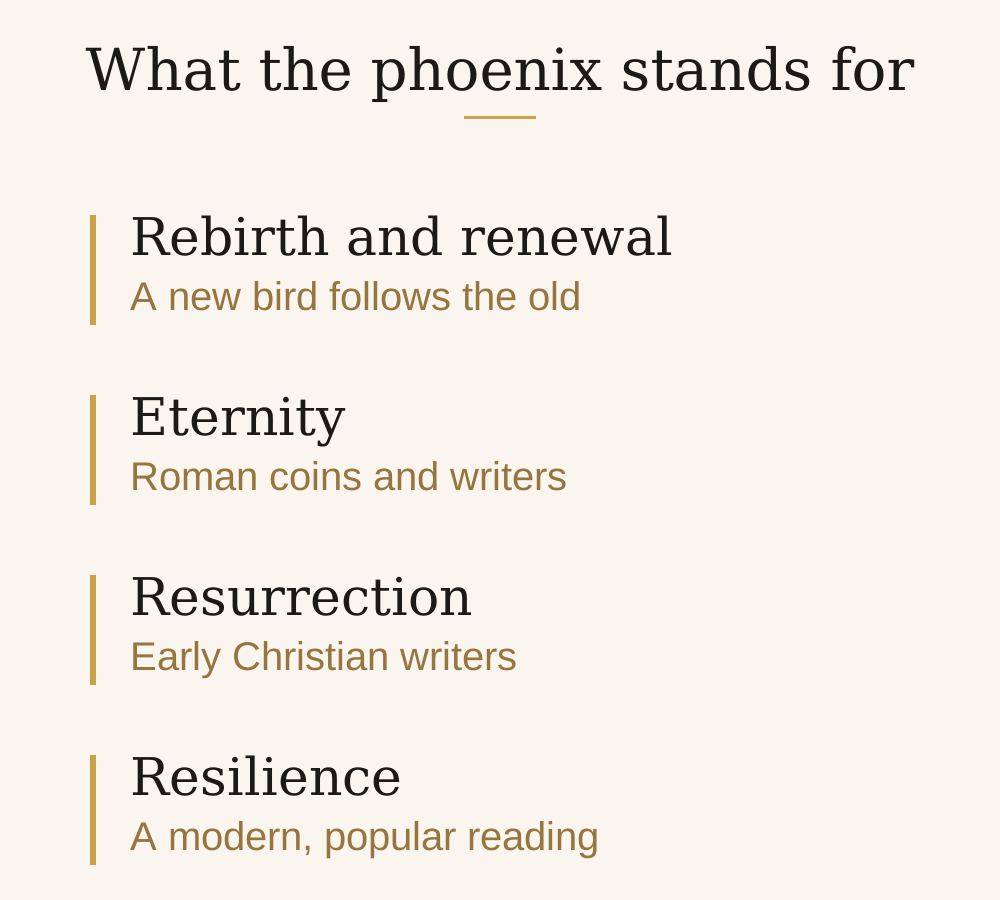
No single text lists every meaning, but across these traditions the phoenix points in similar directions:
- Rebirth and renewal, from the new bird that follows the old.
- Eternity, in Roman use.
- Resurrection, in early Christian writing.
- Resilience, a modern reading that came with the "rising from ashes" image.
The phoenix and the Chinese fenghuang
The fenghuang is often translated as "Chinese phoenix," but the two birds are not the same. The fenghuang does not burn and return from ashes. It is generally linked with harmony and good fortune, and the name was originally a pair, feng and huang, connected with yin and yang. Over time it became linked with the empress, paired with the dragon for the emperor. Accounts differ on exactly when, with some pointing to the Han dynasty for the first links and others to the Yuan dynasty for the merging of the pair into a single female bird.
Related birds exist in Japan (the hō-ō) and Korea (the bonghwang). When you see "phoenix" on a piece of East Asian jewelry, it is worth asking which bird is meant.
Often confused with
Several symbols share the idea of renewal, each from a different world.
- Scarab: an Egyptian beetle tied to the rising sun and rebirth.
- Butterfly: change and transformation in nature.
- Ouroboros: a snake eating its tail, a symbol of cycles.
- Sun and moon: daily return and renewal in the sky.
- Feather: often a quiet reminder of someone loved or of lightness.
The table sets the phoenix beside the symbols it is most often grouped with.
| Symbol | Shape | Stands for |
|---|---|---|
| Phoenix | Long-lived bird | Rebirth, renewal and eternity |
| Fenghuang | Paired or single bird | Harmony and good fortune, with no ashes |
| Scarab | Dung beetle | Rebirth and protection, from the rising sun |
| Ouroboros | Snake eating its tail | Cycles, from a separate tradition |
How people wear it today
The phoenix is worn as a pendant, ring, bracelet charm or tattoo, often for a fresh start after a hard chapter: a move, a new job, the end of a relationship, or a long season of change. Some wearers like it as a private reminder of their own resilience. Its wings and tail make it a graceful, symmetrical shape that suits jewelry. When choosing jewelry, look for a piece whose metal is described plainly, such as 316L stainless steel with a gold-plated, rose gold-plated or silver-tone plated finish, rather than vague "gold" or "silver" wording. Genuine stainless steel is nickel-safe, which is what helps with sensitive skin.
Frequently Asked Questions
What does a phoenix symbolize?
Traditionally, rebirth, renewal and the idea of beginning again. In Roman use it also stood for eternity, and early Christian writers used it as a sign of resurrection.
Does the phoenix really burst into flames?
Not in the earliest accounts. Herodotus does not mention fire or ashes. The image of the bird burning and rising from its ashes appears in later tellings, so it is better thought of as a later layer of the legend.
Is the phoenix the same as the Egyptian bennu?
They are often linked, but not identical. The bennu was a heron-like bird tied to the sun and creation. It is debated how direct the connection to the Greek phoenix is.
Is the Chinese fenghuang a phoenix?
It is usually translated that way, but it is a different bird. The fenghuang is tied to harmony and good fortune and does not rise from ashes.
Is the phoenix a Christian symbol?
Early Christian writers used it as a sign of resurrection, and it appears in some early burial art. The Bible does not name the phoenix, so it is a tradition of later writers rather than a biblical symbol.
Is the phoenix a good symbol for a new start?
Many people choose it for exactly that reason. It is a popular, modern reading rather than an ancient rule, and it is a personal choice what it means to the wearer.