
Quick answer: January has two birth flowers: the carnation and the snowdrop. The Old Farmer's Almanac lists both, and Britannica names the snowdrop as a January birth flower. By tradition, the carnation stands for love and remembrance, and the snowdrop for hope.
On this page: Carnation · Snowdrop · Which flower to give · Carnation vs snowdrop · FAQ
At a glance
- Carnation: Dianthus caryophyllus, from the Mediterranean; tradition links it to love, admiration and remembrance
- Snowdrop: genus Galanthus; tradition links it to hope and compassion
- Carnation colors: meaning shifts with color, from pink for affection to white for innocence
- Snowdrop season: often the earliest garden flower to bloom, late winter or early spring
- Source of the list: a modern convention compiled by almanacs and florists, not an official ruling (our note)
January at a glance
- Birth flowers: carnation and snowdrop
- Birthstone: garnet. Read the January birthstone guide
- Zodiac: Capricorn until about January 19, then Aquarius. See Capricorn and Aquarius
Carnation: the flower of love and remembrance
The carnation is Dianthus caryophyllus, also called clove pink. It belongs to the pink family and is native to the Mediterranean. Britannica describes fringe-petaled flowers that often have a spicy fragrance.
The Almanac calls it a staple of the flower trade, especially for Mother's Day and Valentine's Day, because of its meanings of love and remembrance. It is the state flower of Ohio.
What the carnation means, by color
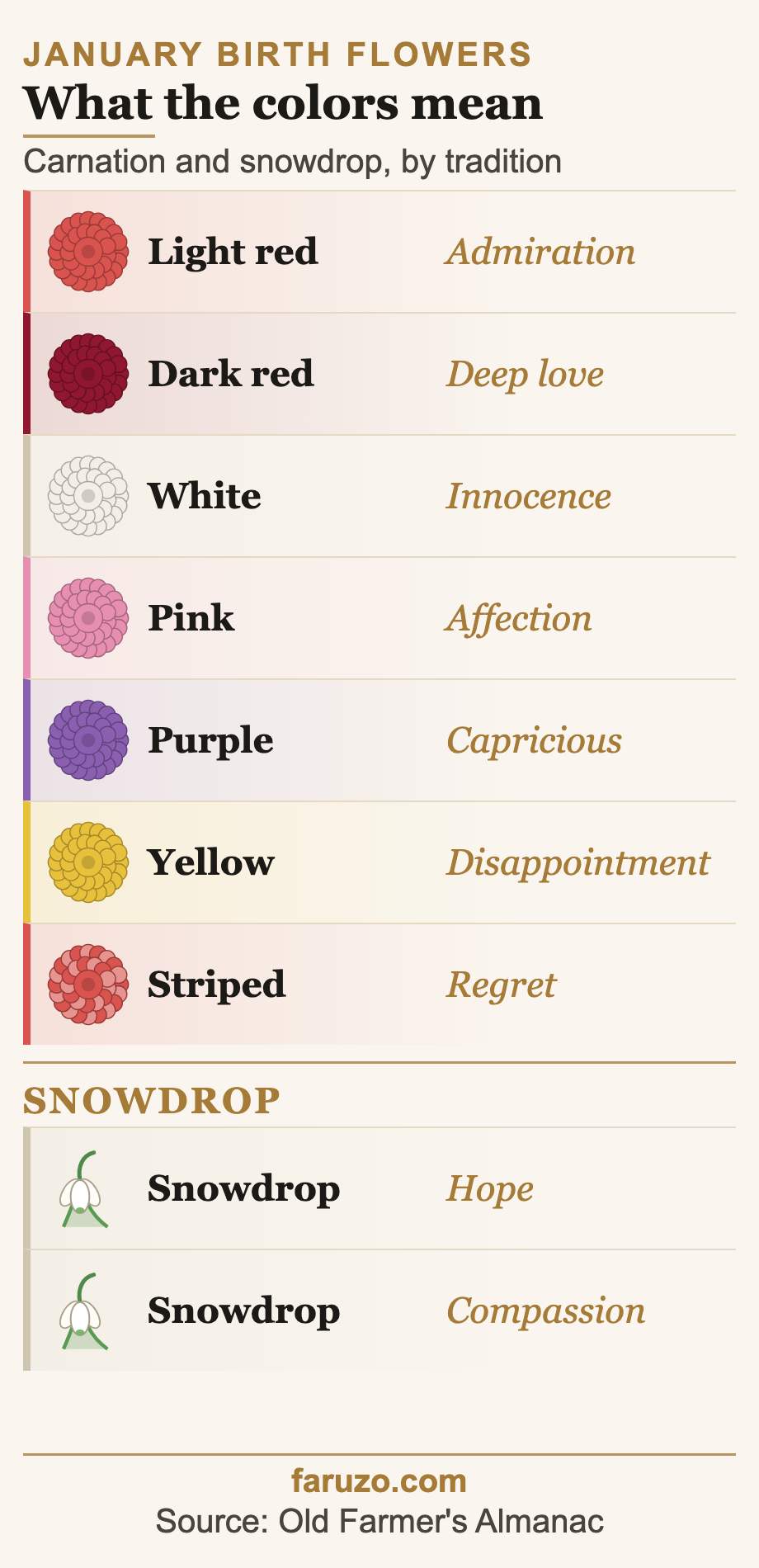
Carnation meaning depends on color. The Almanac gives this list:
- Light red: admiration
- Dark red: deep love
- White: innocence, pure love and remembrance
- Pink: affection, a mother's love
- Purple: capriciousness
- Yellow: disappointment or rejection
- Striped (any color): regret
Early carnations were mostly pale pink and peach. Today they also come in orange, green, bi-colors and frosted forms.
Carnation history and legend
The name is said to come from Theophrastus, the Greek botanist. In Greek translation it means "flower of the gods". The Almanac says carnations grew wild on Greek hillsides and appeared in garlands and art in ancient Greece and Rome.
In the Elizabethan era, carnations were used to spice wine and ale as a cheaper stand-in for clove.
Meanings that come from different places and times:
- A white carnation is worn in the Netherlands to remember veterans and the resistance in World War II.
- Bright red carnations represent Portugal's 1970s "Revolution of the Carnations".
- In 1907, Anna Jarvis of Philadelphia chose the pink carnation as the symbol of Mother's Day.
One Christian legend says the first pink carnation grew from the tears of Mary. It is a legend, not a record.
Growing carnations
Garden carnations grow about 1 to 2.5 ft tall with flowers around 2 in. Perpetual-flowering types reach up to 3 ft with larger blooms.
They are herbaceous perennials, though you can grow them as annuals. They prefer cooler summers and moist, well-draining, gritty, organic soil. They dislike high heat.
Snowdrop: the first flower of the year
Snowdrops are the genus Galanthus, about 20 species of white-flowered plants in the amaryllis family. They are often the earliest garden flowers to bloom, sometimes with snow still on the ground.
The name comes from Greek: gala (milk) and anthos (flower), for the pure white look. Each flower has six white tepals, which are petals and sepals that look alike. Three long outer ones curve outward, and three small inner ones are notched.
What the snowdrop means
The Almanac says snowdrops express both sympathy and celebration: optimism and hope in happy times, compassion after a death or misfortune. The white color links them with innocence. Its birth-month chart sums it up as hope and compassion.
Snowdrop legend and folklore
One Christian story says an angel turned snowflakes into snowdrops for Adam and Eve as a sign of hope. It is a story, not a fact. Among pagans the flower was tied to the start of spring.
An older belief held that a single snowdrop brought indoors stood for death, because the flower grew in graveyards. Today it signifies hope and beauty.
Growing snowdrops
Plant dry bulbs in early fall, once the soil has cooled. Use rich, well-drained soil, and let the foliage die back naturally. They look best in groups of three or four or more, and woodland settings suit them.
They return each year if winter lows are at least 20°F but no colder than -30°F. Seeds carry a fatty structure that attracts ants, which spread them.
Some species are at risk in the wild. Britannica lists Galanthus trojanus, found in only three places in northwest Turkey, as critically endangered. Causes include climate change, habitat loss, overgrazing and overcollection.
The snowdrop year, step by step:
- Early fall: plant dry bulbs, once the soil has cooled
- Late winter to early spring: the flowers appear, sometimes with snow still on the ground
- Early spring, when shoots show, or after flowering: feed lightly
- After flowering: let the leaves die back on their own
Why these two flowers for January?
Birth-month flower lists are modern conventions. Almanacs and florists compile them, and no single official body sets them.
For January, the Old Farmer's Almanac gives carnation and snowdrop. Britannica names the snowdrop as a January birth flower.
How meaning differs by color
The carnation changes its message with color: a pink one says affection, a white one remembrance, a striped one regret. The snowdrop is almost always white, so its meaning stays close to hope and compassion.
Which flower to give
- Carnation: pink for affection or a mother's love, white for remembrance or pure love, dark red for deep love, light red for admiration. By the same list, yellow stands for disappointment and striped for regret, so many people skip those for gifts
- Snowdrop: suits both celebration and sympathy: hope in happy times, compassion after a loss
- Card idea: keep it to one line, such as "Thinking of you" with white or "You are loved" with pink
Carnation vs snowdrop
- Meaning: love and remembrance, versus hope and compassion
- Look: fringe-petaled flowers in many colors, versus six white tepals on nodding flowers
- Plant: a herbaceous plant of the pink family, versus a bulb in the amaryllis family
- When: carnations bloom in midsummer in cool conditions, snowdrops in late winter or early spring
FAQ
Is the carnation or the snowdrop the "real" January flower?
Neither is official. No single body sets birth-month flowers. The Old Farmer's Almanac lists both, and Britannica names the snowdrop as a January birth flower.
Which carnation color suits which message?
By the Almanac's list, pink says affection and a mother's love, white says remembrance and pure love, and dark red says deep love. Yellow carries disappointment and striped carries regret.
Is the snowdrop a sad flower?
Not today. An older belief tied a single bloom indoors to death, because snowdrops grew in graveyards. Now the Almanac says the flower signifies hope and beauty.
Can snowdrops handle very cold winters?
The Almanac says they return each year if winter lows stay between 20°F and -30°F.
Do carnations like hot climates?
Not much. The Almanac says they dislike high heat and may be a poor choice for a southern garden, and that they prefer cooler summers.
What is the January birthstone?
Garnet. We cover it in the January birthstone guide.
Which zodiac signs have January birthdays?
Capricorn until about January 19, then Aquarius from about January 20.
Are carnations a good Mother's Day flower?
Pink ones are the classic choice: they stand for a mother's love, and in 1907 Anna Jarvis of Philadelphia chose the pink carnation as the symbol of Mother's Day.
Keep going
- See every month in the birth month flowers by month guide.
- Prefer a stone? Read the January birthstone guide to garnet.
- Compare flower and stone lists in birthstones by month.