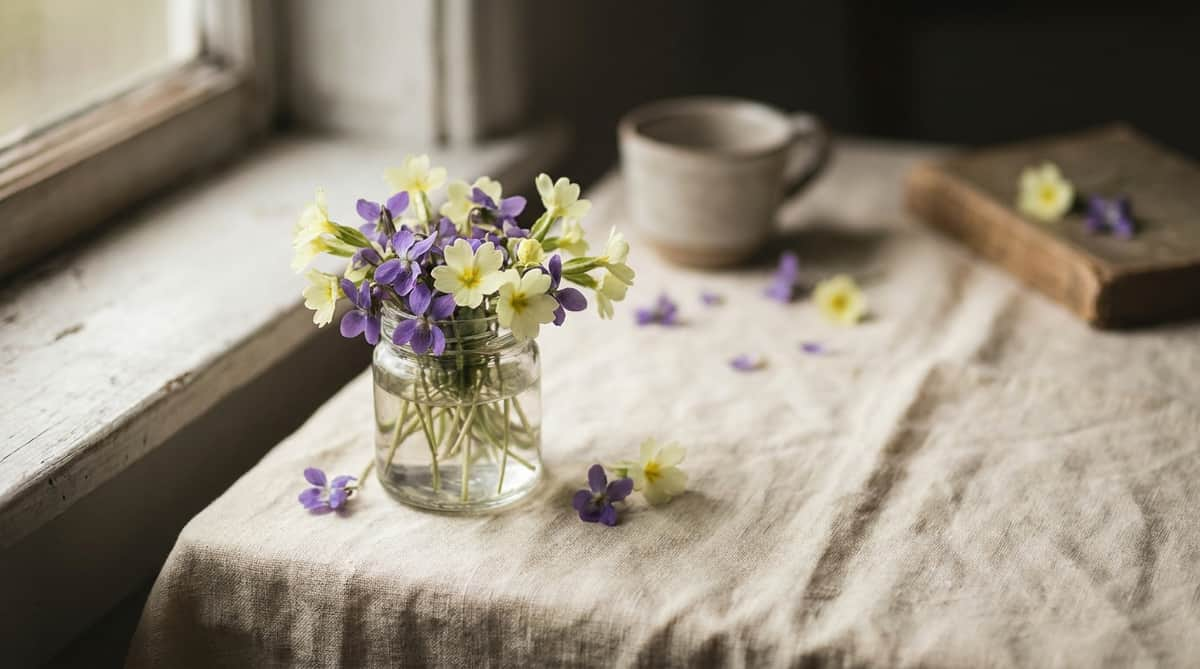
Quick answer: February has two birth flowers: the violet and the primrose. By tradition, the violet stands for quiet devotion and faithfulness, and the primrose for the innocence of new love. The red rose, despite Valentine's Day, is not February's birth flower.
On this page: Violet · Primrose · Why these two flowers for February? · Which flower to give · Violet vs primrose · FAQ
At a glance
- Violet: genus Viola, more than 400 species; tradition links it to modesty, faithfulness and remembrance
- Primrose: genus Primula, more than 500 species; tradition links it to young love
- Violet colors: meaning shifts with color, from yellow for high worth to blue for devotion
- Season: both are small woodland plants that bloom in the cold end of winter or in early spring
- The list: a modern convention compiled by almanacs and florists, not an official ruling
February at a glance
- Birth flowers: violet and primrose
- Birthstone: amethyst. Read the February birthstone guide
- Zodiac: Aquarius until about February 18, then Pisces. See Aquarius and Pisces
Violet: the flower of quiet devotion
The violet belongs to the genus Viola in the Violaceae family, with more than 400 species. It is native to the temperate regions of Europe and Asia and the wider Northern Hemisphere.
Violets are among the earliest plants to bloom in spring. They usually have heart-shaped leaves and asymmetrical flowers. Many are violet, but others are blue, yellow, white or cream, and some are two-toned, often blue and yellow.
Four US states have a violet as their state flower: Illinois, New Jersey, Rhode Island and Wisconsin.
What the violet means
By tradition, the violet stands for modesty, faithfulness, everlasting love, innocence and remembrance.
In the Victorian age, a gift of violets was a declaration to always be true. Today the flower is still a reminder of loyalty, thoughtfulness and dependability.
What the violet means, by color
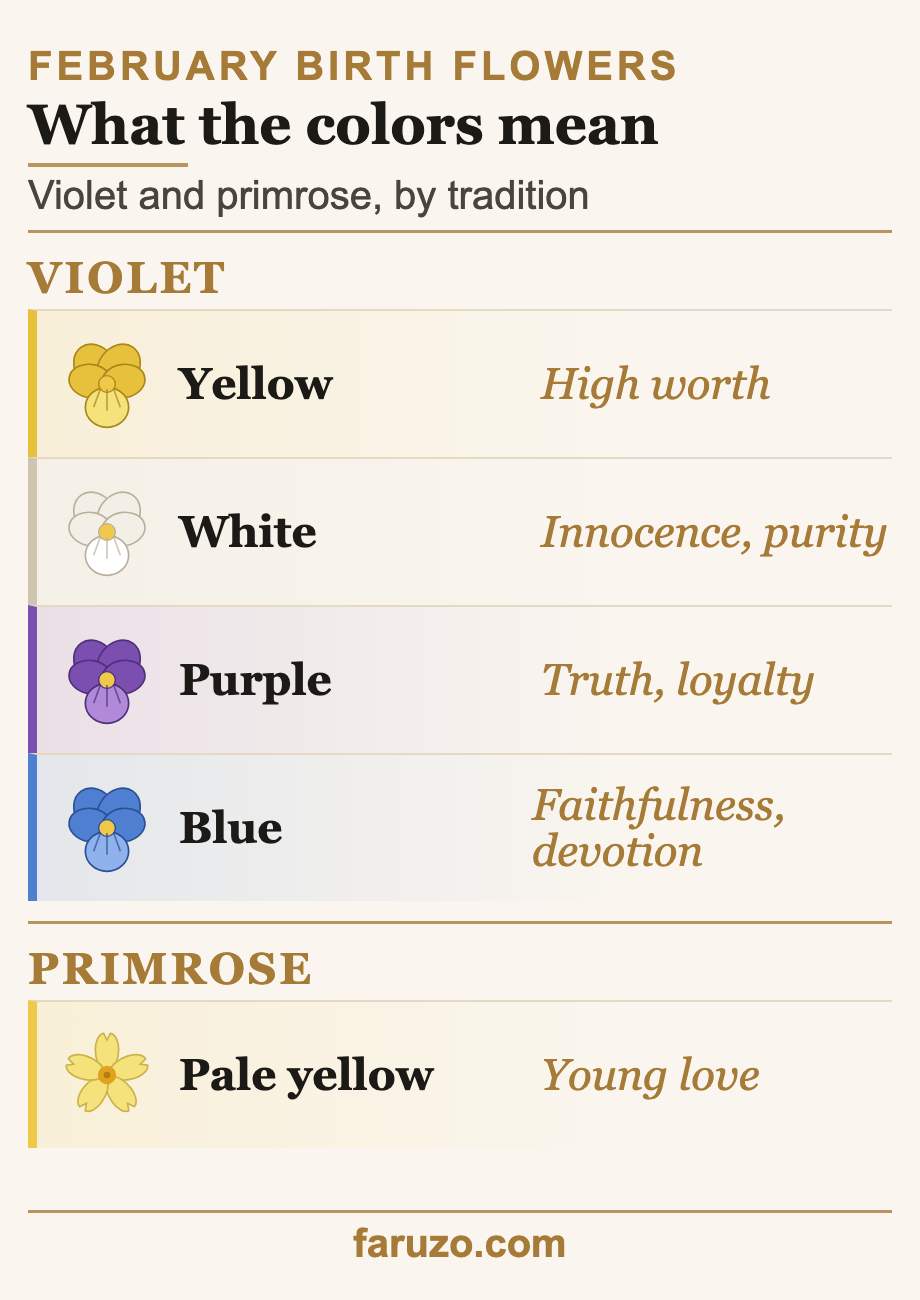
Violet meaning shifts with color. A commonly cited list reads like this:
- Yellow: high worth
- White: innocence and purity
- Purple: truth and loyalty
- Blue: faithfulness and devotion
Violet history and legend
The name comes from the Latin viola, which meant both the violet flower and the color violet. The ancient Greeks saw the violet as a symbol of fertility and love. Greeks and Romans also used it in wine and funeral decorations.
In the Middle Ages, monks were said to call violets the "Herb of the Trinity" because of their three main colors: purple, yellow and green.
A Christian tradition ties the violet to the humility of the Virgin Mary. One legend says the flowers blossomed when the angel Gabriel told Mary she would have a child. It is a legend, not a record. By the same tradition, Renaissance paintings show Mary with purple flowers, a nod to modesty.
In Victorian times some people believed that carrying violets could keep evil spirits away. That is a belief, not a fact.
Growing violets
Violets do well at the front of a border, in garden beds and in containers. Wild violets often appear on their own, and you can also plant them or start them from seed.
They like a woodland-style setting with rich, organic soil, and full sun to partial shade. Early spring is the best planting time.
Keep the soil steadily moist, especially in warm months, but avoid overwatering. Mulch generously to keep the roots cooler. In a warmer climate, give them afternoon shade.
Violets are the host plant for the mining bee, a specialist pollinator common in the eastern US that visits only violets. They also attract other pollinators, including bees and hummingbirds.
Primrose: the flower of young love
The primrose is a small perennial woodland plant of the genus Primula, with more than 500 species. It has European origins and, despite the name, is not a member of the rose family.
It is one of the first flowers of spring. The genus name comes from the Latin primus, meaning "first", for that early appearance.
What the primrose means
In the Victorian era, a gift of primroses meant young love. In the language of flowers, it says "I can't live without you." The birth-month chart in the Old Farmer's Almanac sums it up as the innocence of new love.
Some cultures saw the primrose as a symbol of a woman, with each petal a stage of her life.
Primrose history and legend
In Norse mythology, the primrose is a symbol of Freya, the goddess of love.
Old folklore also surrounds it. The ancient Celts were thought to see large patches of primroses as a gateway to the fairy realm. One belief held that eating a primrose would let you see a fairy. Another said the flower kept evil spirits away and brought protection, safety and love. These are beliefs, not facts.
In England, April 19 is Primrose Day. It honors former Prime Minister Benjamin Disraeli, and visitors lay primroses at his statue in Westminster each year.
Shakespeare mentions the primrose several times, including in A Midsummer Night's Dream.
Why these two flowers for February?
Birth-month flower lists are modern conventions. Almanacs and florists compile them, and no single official body sets them. For February, most sources agree on violet and primrose.
Valentine's Day makes many people expect a rose. But roses are at their best in June, and the red rose is not February's birth flower. Few flowers bloom in February. Violet and primrose are tiny woodland plants of winter and early spring.
Some lists also add the iris, a flower that symbolizes hope and faith. If you see the iris on another chart, that is a disagreement between lists, not a mistake. Violet and primrose are the pair most sources share.
Which flower to give
For a violet, let the color carry the message:
- Purple: truth and loyalty
- Blue: faithfulness and devotion
- White: innocence and purity
- Yellow: high worth
The primrose suits young love, a new relationship or a first Valentine's Day together.
A simple card idea: "Quiet and loyal, like the violet" for a long-time friend, or "Here's to a new beginning" with primroses.
Violet vs primrose
- Meaning: violet is quiet devotion and faithfulness; primrose is the innocence of new love
- Genus: Viola, more than 400 species, versus Primula, more than 500 species
- Colors: violets range from purple, blue, yellow and white to two-toned; the meaning changes with each
- Folklore: violet links to Greek and Roman tradition and to the humility of Mary; primrose links to Freya and to fairy lore
- Best for: violet suits loyalty and long bonds; primrose suits a fresh start
Tap a month to preview its flower, tap again to open its guide. Schematic drawings in each bloom's usual colour — real flowers vary.
FAQ
Is the rose February's birth flower because of Valentine's Day?
No. The red rose is a Valentine's Day tradition, not a birth-month flower. Roses are at their best in June, and the usual February pair is violet and primrose.
Why does the iris appear on some February lists?
Some sources add the iris, which symbolizes hope and faith. Birth-month lists are modern conventions, so they differ. Most sources agree on violet and primrose.
Which violet color should I give?
Pick by message. Purple says truth and loyalty, blue says faithfulness and devotion, white says innocence and purity, and yellow says high worth.
What zodiac signs fall in February?
Aquarius runs until about February 18, and Pisces starts around February 19. See the guides to Aquarius and Pisces.
What is the February birthstone?
Amethyst. Its purple shade echoes the violet. Read the February birthstone guide.
What is Primrose Day?
It falls on April 19 in England. It honors former Prime Minister Benjamin Disraeli, and visitors lay primroses at his statue in Westminster.
Can violets grow in shade?
They do well in full sun to partial shade. In a warmer climate, give them afternoon shade and keep the soil moist.
Do violets handle cold?
They are tough in the cold, but they are neither drought- nor heat-tolerant. Mulch to keep the roots cooler in warm months.
Keep going
- See every month in the birth month flowers by month guide.
- Read the previous month: the January birth flower guide to carnation and snowdrop.
- Prefer a stone? Read the February birthstone guide to amethyst.
- Compare flower and stone lists in birthstones by month.