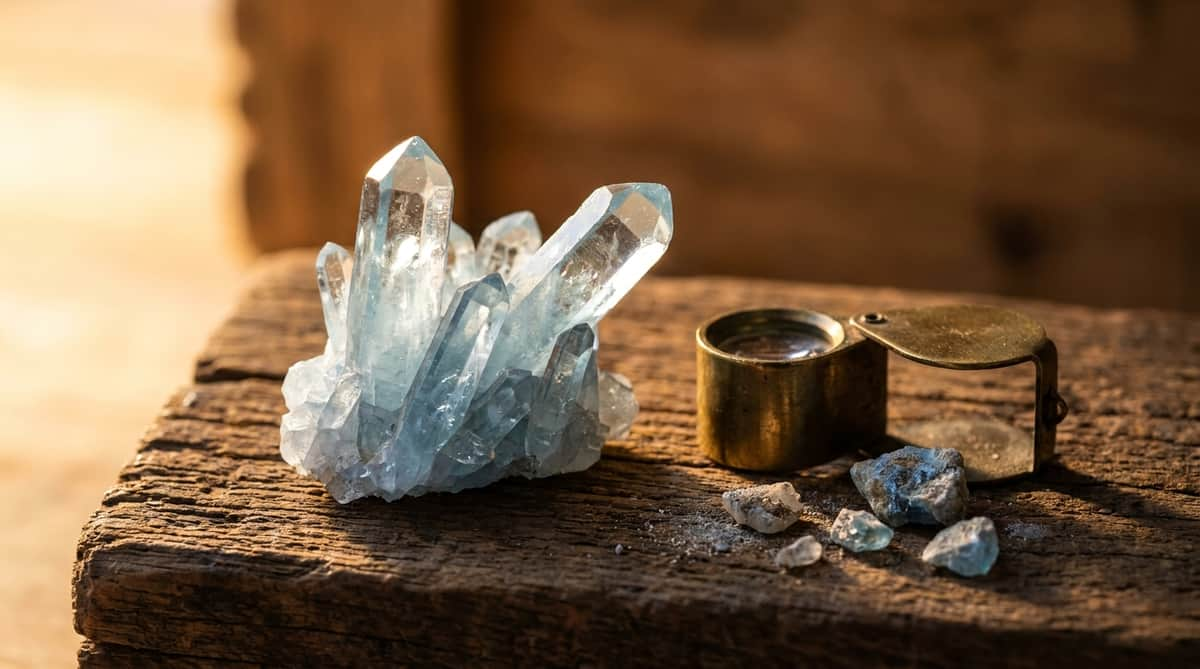
A gem rated 7.5 on the Mohs scale sounds tough — harder than steel, hard enough to resist a scratch from almost anything you'd brush against in daily life. Euclase is exactly that hard, and almost no jeweler will set one in a ring anyway.
The reason is baked into its name: Haüy, the French mineralogist who first described it, named it from Greek roots for "fracture" paired with either "well" or "easily" (sources differ on which), because the stone has one cleavage plane so perfect it splits clean in half from a single sharp knock.
Scratch-resistant and impact-fragile turn out to be two completely different kinds of durability, and euclase is one of the clearest examples of that split in the entire mineral world.
At a glance:
- Mohs 7.5 — hard enough to resist scratches, but a single perfect cleavage plane makes it split like glass from one sharp knock
- The name is Greek for "fracture" plus "well" or "easily," given by mineralogist Haüy when he first described the stone in 1792
- Mined mainly in Minas Gerais, Brazil, with further sources in Zimbabwe and Colombia's Eastern Cordillera
- Always needs a protective bezel setting — never an open claw or prong — if it's going to be worn rather than displayed loose
What Euclase Actually Is
Euclase is a beryllium aluminum silicate hydroxide, BeAlSiO₄(OH) — a nesosilicate in the same beryllium-mineral family as beryl, phenakite, and bertrandite, though structurally its own distinct species rather than a variety of any of them. Haüy first described and named it scientifically in 1792, working from early specimens that had reached European mineral collections from the Ural Mountains.
Its two defining numbers pull in opposite directions. Hardness sits at about 7.5 on the Mohs scale — comparable to beryl (the mineral family behind emerald and aquamarine) and higher than quartz.
But euclase also has perfect cleavage in one direction — technically the {010} plane — plus weaker, imperfect cleavage in two others. That combination of "genuinely hard" and "splits along a plane almost on command" is what makes it a mineralogist's and collector's stone far more than a jeweler's.
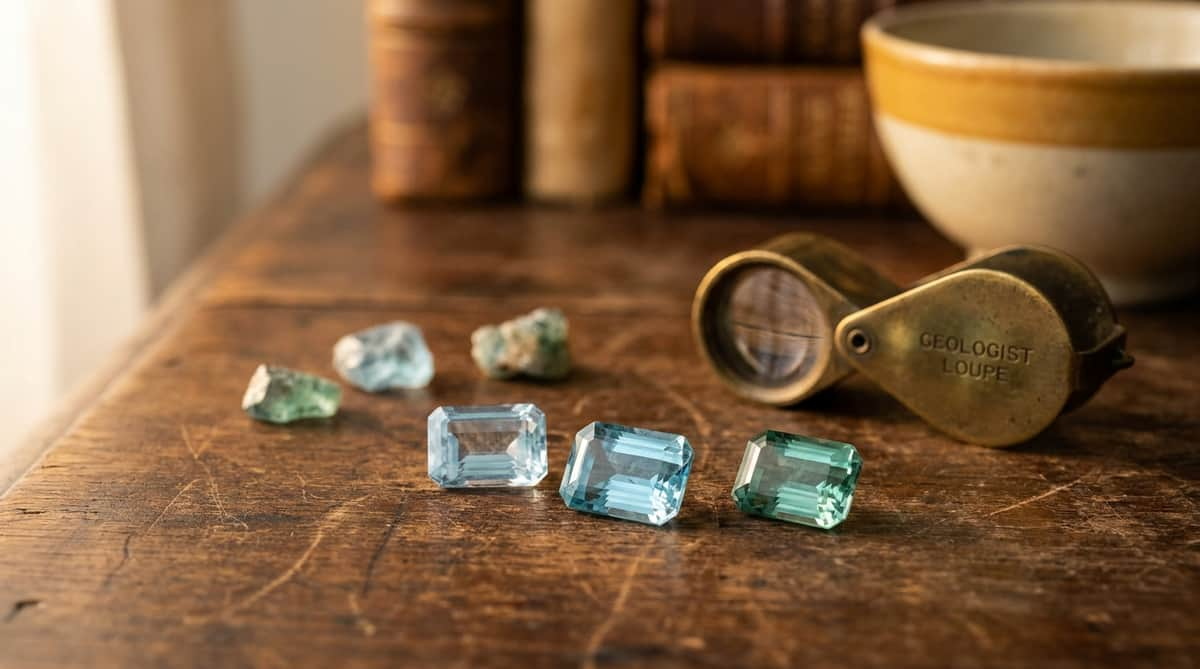
Color runs from colorless, pale green, and yellow-green through to the material collectors actually chase: pale to saturated blue and blue-green, generally attributed to trace iron.
Clarity is often described as glass-like, with a vitreous to sub-adamantine luster and distinct pleochroism in the blue stones — meaning the same crystal can show a different intensity of blue depending on the angle you view it from.
Where Euclase Comes From
Minas Gerais, Brazil — including the historic Ouro Prêto district — has been the most prolific source of gem-quality euclase. Zimbabwe's Mwami and Miami mines in Mashonaland produced intensely saturated blue-green material that renewed gemological interest in the 20th century, after the earliest Ural specimens had mostly sat in museum drawers.
Colombia's Eastern Cordillera is a third significant source — its euclase forms in medium-temperature hydrothermal veins hosted by black shale, often turning up alongside emerald in the same deposits rather than the granite pegmatites typical of Brazilian and Zimbabwean material. Smaller finds come from Austria's Tyrol region, East Africa, and parts of Peru and Bolivia.
Geologically, most euclase forms as beryl breaks down within beryllium-rich granitic pegmatites — the same slow-cooling, mineral-rich rock that also produces topaz, aquamarine, and tourmaline, which is part of why these stones keep turning up in the same mines and the same gem-show cases together.
Why Euclase Almost Never Ends Up in Everyday Jewelry
A 7.5 on the Mohs scale is, on paper, durable enough for a ring worn daily. In practice, euclase's perfect cleavage changes the calculation entirely.
A single hard knock at the right angle — against a doorframe, a car door, the edge of a sink — can split a faceted stone cleanly in two, the way a precisely struck wedge splits a log along its grain.
That risk, not the hardness number, is why euclase stays a specialist's and collector's stone rather than a mainstream one.
A few practical consequences follow directly from that fragility:
- Cutting is conservative. Lapidaries favor step cuts or modified brilliant cuts in oval or cushion outlines, shapes that avoid thin, vulnerable edges rather than chasing maximum brilliance the way a round brilliant would.
- Size is rare. Faceted stones are uncommon to begin with, and anything over five carats counts as a genuine rarity in the trade.
- Settings matter more than usual. Any euclase meant to be worn, rather than kept loose in a collection, calls for a protective bezel or rub-over setting that shields the edges — never a claw or prong setting that leaves the stone's perimeter exposed to a knock. A personalized ring built around a bezel-set accent stone is a far safer home for a piece like this than an open setting would be.
- Lab testing is worth asking for. Because genuine euclase is uncommon and often confused with other blue gems (more on that below), a seller who can produce lab verification is a stronger sign of legitimate material than color alone.
- No treatments are known. Unlike many colored gems, there's no standard heat or clarity treatment applied to euclase — what you see in a genuine stone is close to what came out of the ground.
Euclase vs. the Other Blue Pegmatite Gems It Gets Mistaken For
Blue euclase shares a color range, and often a mine district, with several better-known gems — which is exactly how misidentification happens. The real differences are all about how each one behaves under stress, not just how it looks:
- Euclase: Mohs 7.5. One perfect cleavage plane that splits the stone cleanly with a single sharp blow — high scratch resistance, low impact resistance.
- Topaz: Mohs 8, harder than euclase, but also has one direction of perfect cleavage. Jewelers already recommend protective settings for topaz for the same underlying reason as euclase — hardness and cleavage are separate properties, and topaz proves that too.
- Aquamarine (a form of beryl): Also around Mohs 7.5–8, but without a significant cleavage plane — it breaks with an irregular, conchoidal fracture instead. This is the real structural line between euclase and the beryl it so often forms alongside underground: similar hardness, very different breaking behavior.
- Kyanite: A genuinely odd comparison case. Its hardness is directional — roughly 4.5 to 5 scratch-tested along the long axis of a crystal, but 6.5 to 7 across it, per the mineralogical reference figures gemologists use for identification. It also carries two cleavage directions rather than euclase's one. Kyanite is sometimes confused with euclase purely on blue color, despite the two having almost nothing in common structurally.
Hardness alone — the number most buyers ask about first — tells you almost nothing about which of these four gems will survive a hard knock. Cleavage does.
The Meaning Crystal Sellers Attach to It
Physical. In crystal-healing retail, euclase is sometimes marketed as a stone for general vitality and stress relief, though these are retail and folklore claims rather than anything resembling medical evidence, and shouldn't be treated as health guidance.
Mental. Sellers commonly describe euclase as a "stone of happiness," associated with emotional clarity, calm, and breaking unhelpful habits or patterns — themes that show up across multiple independent crystal-shop sources, though with no single agreed origin story behind them.
Metaphysical. Chakra associations for euclase vary noticeably by source: some tie it to the throat and third-eye chakras (communication and intuition), others add the crown chakra, and some sellers split it by color — blue stones to the throat chakra, colorless ones to the third eye and crown.
That disagreement itself is a useful signal: these are retail and hobbyist traditions, not a settled or ancient system, and different shops will tell a buyer different things about the same stone.
How to Wear and Care for Euclase
If you own or are considering a euclase piece meant to be worn rather than displayed loose, treat the cleavage plane as the real constraint, not the hardness rating.
Store it separately from harder stones to prevent surface scratches. More importantly, keep it away from situations with real impact risk — it should come off before manual work, sports, or anything involving a likely knock.
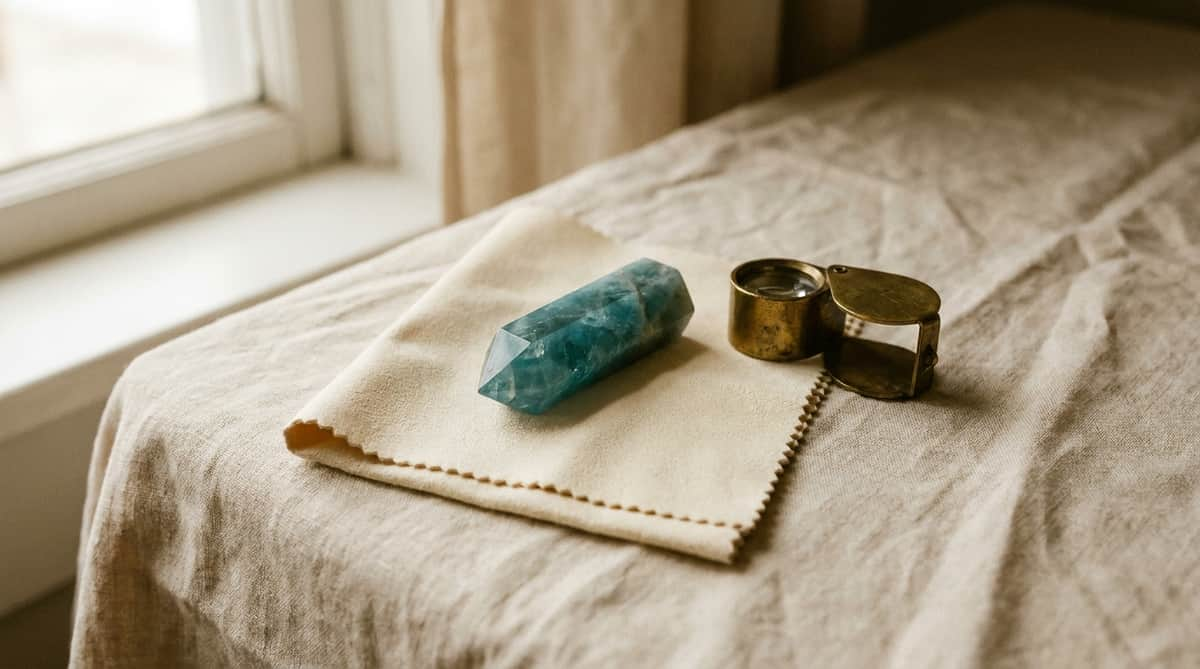
Clean it with a soft cloth and mild, lukewarm soapy water only. Skip ultrasonic and steam cleaners entirely — the vibration and heat they produce are exactly the kind of stress a perfect-cleavage stone is least equipped to handle.
For anyone shopping for one specifically to wear, confirm the setting is bezel or rub-over before anything else — the mounting matters more for euclase than it does for almost any other gem on the Mohs hardness scale. A personalized ring built around a bezel-set accent stone suits that constraint far better than an open setting would.
Frequently Asked Questions
Is euclase a durable gemstone?
It depends on what "durable" means. At Mohs 7.5, euclase resists scratches about as well as beryl does. But its perfect cleavage makes it fragile against impact — a single hard knock at the right angle can split a stone cleanly in two, which is why it's rarely set in everyday rings.
Where does euclase come from?
Minas Gerais, Brazil has historically been the most productive source. Zimbabwe's Mwami and Miami mines produced especially saturated blue-green material in the 20th century, and Colombia's Eastern Cordillera produces euclase in hydrothermal veins alongside emerald. Smaller amounts come from Austria's Tyrol region, Russia's Ural Mountains, East Africa, Peru, and Bolivia.
Why is euclase so rare in jewelry?
Its one perfect cleavage plane makes faceting and setting it risky — cutters favor conservative shapes like step cuts to avoid thin, breakable edges, and finished stones generally need a protective bezel setting rather than an exposed prong. That, plus genuine scarcity of gem-quality rough, keeps euclase mostly in mineral collections rather than on store shelves.
What does euclase's name mean?
It comes from Greek, combining a word for "fracture" with a second root that sources translate either as "well" or "easily" — both readings point to the same thing, the stone's unusually clean, perfect cleavage, which is also what Haüy was describing when he named it in 1792.
Is euclase the same as aquamarine or topaz?
No. All three appear in similar blue tones and even turn up in the same pegmatite deposits, but they're structurally distinct. Aquamarine (a beryl) lacks euclase's cleavage plane and breaks irregularly instead; topaz has its own cleavage direction but rates harder at Mohs 8. Lab testing, not color, is the reliable way to tell them apart.