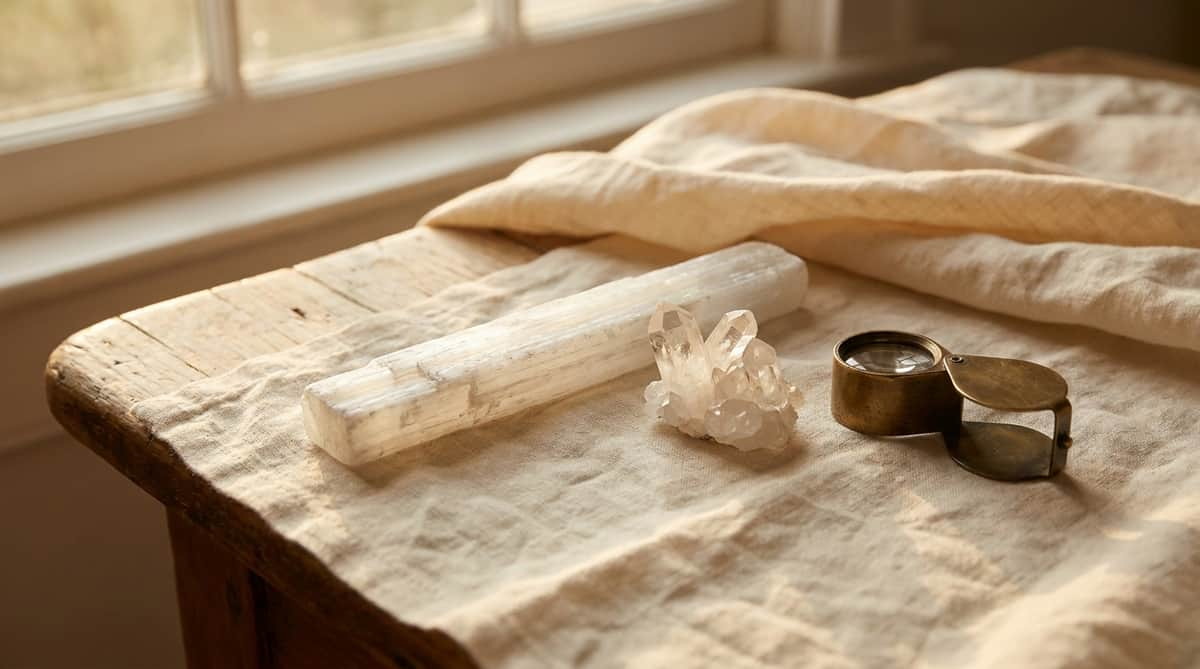
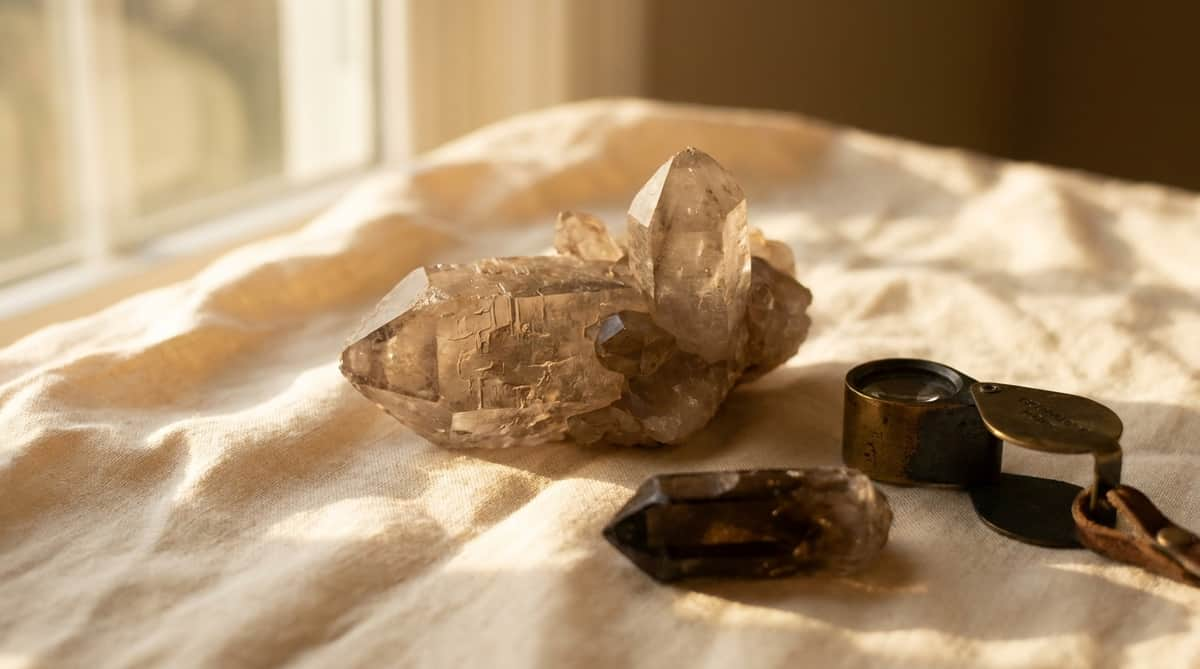
A piece of elestial quartz looks almost sculpted — terminations stacked inside terminations, faces that look etched or half-dissolved rather than smooth and prismatic. It isn't a separate mineral and it isn't carved.
"Elestial" is the crystal trade's name for a real, documented growth feature that mineralogists call skeletal quartz, and that Brazilian miners who dig most of it up call by a third name entirely.
Here's what actually causes the layered, dissolved look, which quartz varieties show it, where it's mined, and how it differs from a related feature called fenster quartz that gets confused with it.
At a glance:
- Not a separate mineral — "elestial" is the crystal trade's name for what mineralogists call skeletal quartz
- Forms by dissolution and regrowth, not steady layering — each stepped face records a reversal in the pocket's fluid chemistry
- Brazilian miners call it "Jacaré" (alligator), after its scaly, stepped surface
- Often confused with fenster quartz — a single mirror-clear "window" facet, a structurally different feature
What Elestial Quartz Actually Is
Skeletal quartz — the mineralogical term for what's sold as "elestial" — forms through a process of dissolution and regrowth rather than the slow, steady layering that produces an ordinary clear quartz point.
A quartz crystal grows normally for a while, then conditions in the hydrothermal pocket or pegmatite cavity shift. The silica-bearing fluid becomes locally undersaturated, and it partially dissolves the crystal's outer faces instead of adding to them.
When conditions swing back toward deposition, new quartz grows back over the etched surface, repeating in layers as conditions keep shifting. The result is a crystal whose faces read as re-entrant and stepped rather than flat — each layer a record of the pocket's fluid chemistry changing and reversing, not a single continuous growth event.
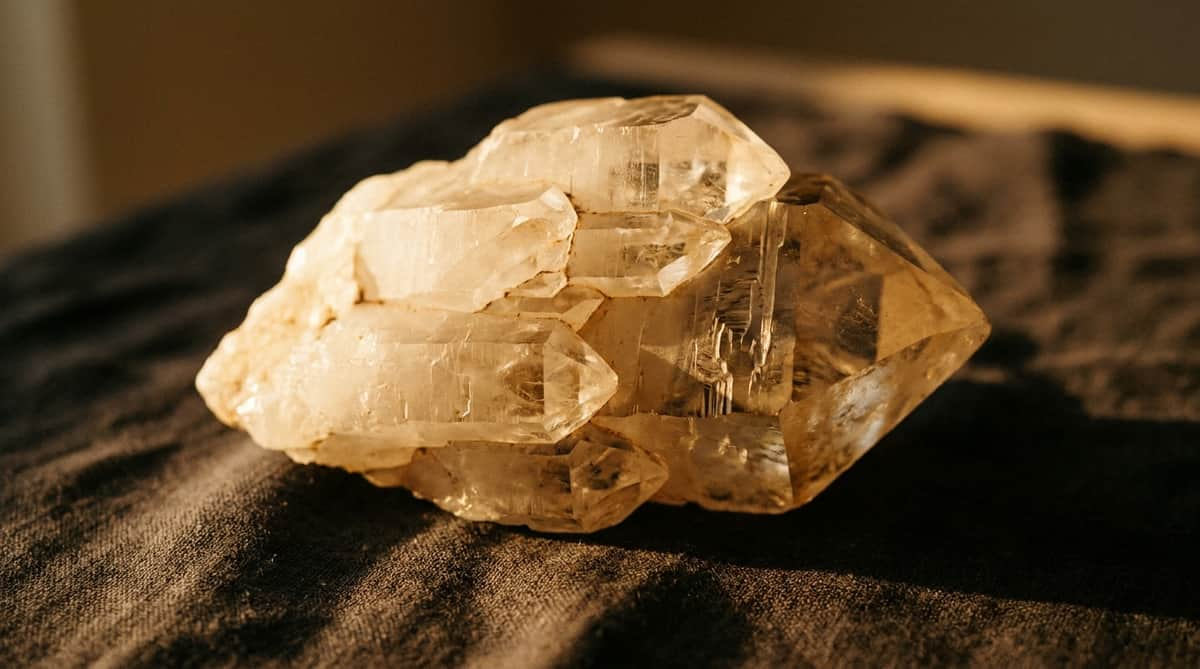
"Elestial" itself is a 20th-century crystal-trade and metaphysical term, not a geological one; mineralogists describe the same material as skeletal quartz.
One crystal-trade source credits the word to metaphysical author Katrina Raphaell in 1983, as a deliberate rebrand meant to give the stone a spiritual-sounding name its geological terminology lacked.
That specific attribution comes from a single commercial source and isn't independently confirmed, so it's worth treating as a claim rather than a settled fact — though it does match the broader, well-documented pattern of New Age crystal retail coining its own vocabulary for existing mineralogical features starting in the 1980s.
Much of the elestial quartz sold commercially comes from pegmatite pockets in Minas Gerais, Brazil, alongside minerals like microcline, albite, lepidolite, and amblygonite, and occasionally aquamarine, kunzite, or tourmaline. Brazilian miners there have their own name for it — "Jacaré" quartz, Portuguese for "alligator," after the resemblance of the stepped, scaly surface pattern to reptile skin.
Which Quartz Varieties Show the Skeletal Pattern
Skeletal growth is a structural feature, not a color, so it can turn up in several quartz varieties — though not equally often:
- Rock crystal (clear quartz) and smoky quartz — the two varieties where skeletal growth shows up most often and most dramatically.
- Citrine and amethyst — skeletal examples exist in both, but genuine skeletal citrine and amethyst are considerably rarer finds than their clear and smoky counterparts; both owe their color to trace iron held in different valence states within the same silica structure.
- Scepter quartz — a related, separately named growth oddity where a narrower crystal shaft supports a wider crystal "head"; it can occur with or without skeletal faces and is its own distinct habit, not a synonym for elestial.
Elestial vs. Fenster: Two Features People Mix Up
Both involve dissolution etching a quartz crystal's surface, and both get sold under loose, overlapping trade names — but they're structurally different:
- Elestial (skeletal) quartz — dissolution-regrowth layering spread across the whole crystal surface, producing the stepped, "stacked terminations" look.
- Fenster quartz — German for "window." A single smooth, mirror-clear facet set against an otherwise etched, frosted surface, formed where a second crystal was once in contact during growth, protecting that one spot from the later dissolution that roughened everything around it. When the neighboring crystal is eventually removed, it leaves a flat "window" preserving the exact outline of that old contact.
- The practical difference: elestial faces scatter light and look matte or frosted almost everywhere; a fenster window reflects light like a small mirror set into a rougher surface. Dealers sometimes use the two names loosely or interchangeably, but the patterns themselves are genuinely distinguishable on sight once you know what to look for.
The Meaning Crystal Sellers Attach to It
Physical. In crystal-healing retail, elestial quartz is commonly marketed as a stone of deep, layered grounding — sellers lean on the crystal's own stacked, layered structure as a visual metaphor, framing each "layer" as a stage of personal growth recorded in the stone.
Mental. It's frequently sold around themes of processing difficult emotions and integrating past experience, again drawn directly from the etched, built-up-in-stages look of the crystal itself rather than from any property that's been measured.
Metaphysical. Sellers often pair elestial quartz with smoky quartz specifically for "grounding" combinations, and some retail sources use the word "angelic" alongside it, tying the layered faces to a sense of accumulated spiritual record.
None of this is a scientifically established property of the mineral — it's retail and wellness-market language built on the stone's striking visual structure, worth knowing as context rather than treating as settled fact.
Durability and Care
Like all quartz, elestial quartz sits at Mohs 7 — hard enough for daily wear, including rings, the same durability clear quartz and smoky quartz offer.
The one practical catch is shape rather than hardness. The stepped, re-entrant faces that make elestial quartz recognizable are also thinner and more exposed at the edges than a smooth prismatic point, so a cut or polished piece set in jewelry is more prone to chipping along those layered edges under a hard knock than an equivalent plain quartz stone would be.
Clean it the same way as any quartz-family piece — warm water, mild soap, a soft cloth — and skip ultrasonic cleaners if the piece has visible internal fractures.
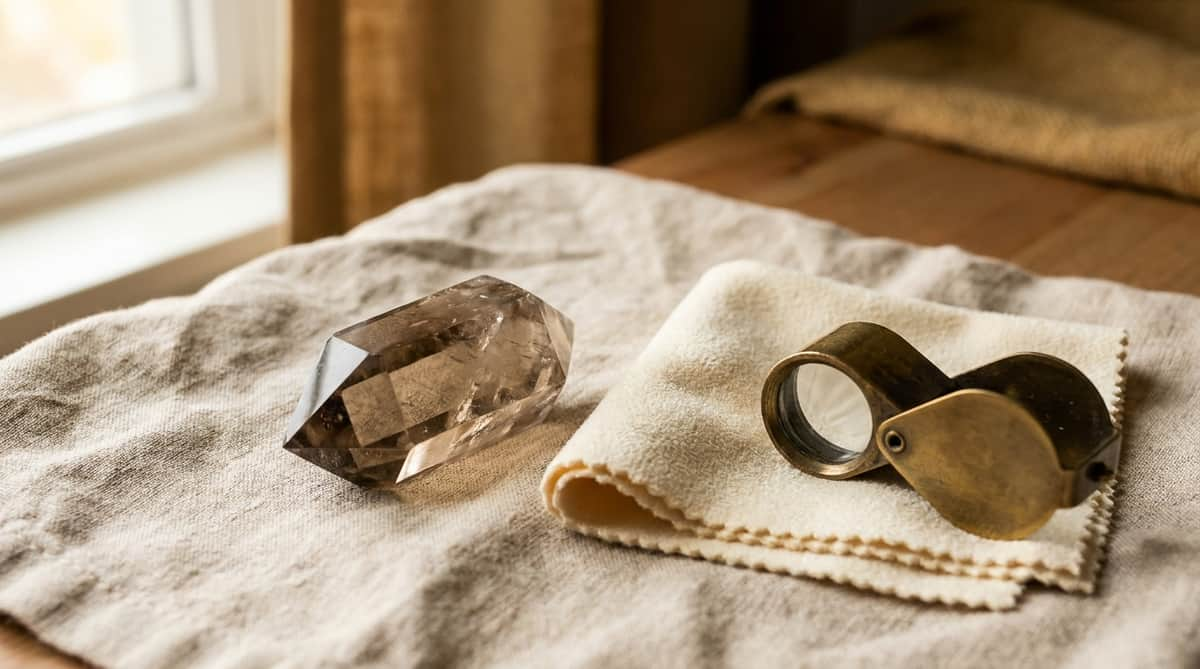
For a piece built to handle daily wear without that structural fragility, FARUZO's personalized rings are plated over 316L stainless steel — nickel-safe, and durable in a way a thin-edged natural crystal specimen was never built for.
Frequently Asked Questions
Is elestial quartz a different mineral from regular quartz?
No. It's ordinary quartz (silicon dioxide) with a specific growth history — dissolution followed by regrowth, in layers — that produces a stepped, etched surface. "Elestial" describes the growth pattern, not a different chemical composition.
What's the difference between elestial and skeletal quartz?
Nothing chemically or structurally — they're the same feature. "Skeletal" is the mineralogical term; "elestial" is the name the crystal trade and metaphysical retail market use for it.
What is Jacaré quartz?
"Jacaré" is Portuguese for alligator, the name Brazilian miners in Minas Gerais use for skeletal quartz, after the resemblance of its stepped, layered surface pattern to reptile skin. Much of the elestial quartz sold commercially is mined there.
How is elestial quartz different from fenster quartz?
Elestial (skeletal) quartz shows dissolution-etched, layered faces across the whole crystal. Fenster quartz has one smooth, mirror-like "window" facet set against an otherwise etched surface, formed where a neighboring crystal once protected that one spot from dissolution. The two features can appear on the same specimen, but they're structurally distinct.
Can elestial quartz be worn as jewelry?
Yes — at Mohs 7, it's hard enough for daily wear the same way clear or smoky quartz is. The main care consideration is its layered, re-entrant surface, which can chip more easily along thin edges than a smooth-faced quartz under a hard impact.