Most name-necklace guides are written with a women's piece in mind — thin cable chains, cursive script, a dainty pendant. That's not what most men wearing one actually want, and it's not the tradition the piece comes from either.
Men have worn their own name, rank, or identity on a chain for well over a century, long before "name necklace" existed as a marketed product category. Here's where that history actually comes from, the styles and chain weights built for a man's frame, and how to wear one without it reading as borrowed.
At a glance:
- Over a century of precedent — military dog tags became official in 1906 and mandatory in 1916, and the nameplate chain traces to 1970s–80s New York.
- Men's name-necklace chains run 3mm–6mm, versus the 1mm–1.5mm cable chains common on women's pieces.
- An 18"–20" chain sits at the collarbone; 22"–24" sits lower for layering under a shirt.
- FARUZO's pieces plate over 316L stainless steel, not sterling silver or gold-fill — nickel-safe for daily wear.
Men Already Had a Name-on-a-Chain Tradition — It Just Wasn't Called That
Military dog tags are the most direct precedent. During the Civil War, soldiers who wanted any form of identification had to buy it themselves from sutlers — camp merchants who sold stamped badges and tags, since neither the federal government nor individual states issued any.
The U.S. Army didn't make an identification tag official until December 20, 1906, and didn't make wearing one mandatory until 1916; those early tags were hand-stamped with a soldier's name, rank, serial number, unit, and religion. The Navy added its own oval tags, made of the corrosion-resistant alloy Monel, in 1917.
The exact origin of the nickname "dog tag" is disputed — the most common explanation ties it to the resemblance between a soldier's stamped tag and a dog's own license tag. By World War I, wearing your name on a chain around your neck was already standard practice for millions of men, decades before it was a jewelry trend.
The nameplate chain is the other direct ancestor, and it's a genuinely different story worth knowing on its own terms — our nameplate necklace guide covers where the flat-plate format comes from in full.
The short version: the style traces most directly to Black and Latino communities in New York City in the 1970s and '80s, and hip-hop carried it into the wider mainstream from there — early rap artists and chunky-chain style icons of that era wore large nameplate and script pieces as a visible, unmistakably personal statement, not a delicate accessory.
That's the lineage a men's name necklace is actually drawing on: identification worn out loud, scaled to be seen, not a miniaturized version of a women's pendant.
What a Men's Name Necklace Signals
Because of that history, a name necklace on a man tends to read less like sentimental jewelry and more like a worn-in identity marker — closer to a dog tag or a signet ring than to a locket.
It can carry your own name, a family name, a child's name, or a partner's, but the format itself — bold lettering, a chain substantial enough to hold weight, worn visibly rather than tucked away — is doing a lot of the signaling before anyone reads what's engraved.
That's also why a piece scaled for a women's necklace (a fine 1mm cable chain, a thin cursive script) tends to look borrowed on a man rather than intentional: it's not that men can't wear a delicate piece, it's that the tradition this style actually comes from was never delicate to begin with.
Styles That Actually Work for a Man's Build
Not every "name necklace" format scales the same way. Here's how the main options compare for a man's frame and the way most men actually wear one:
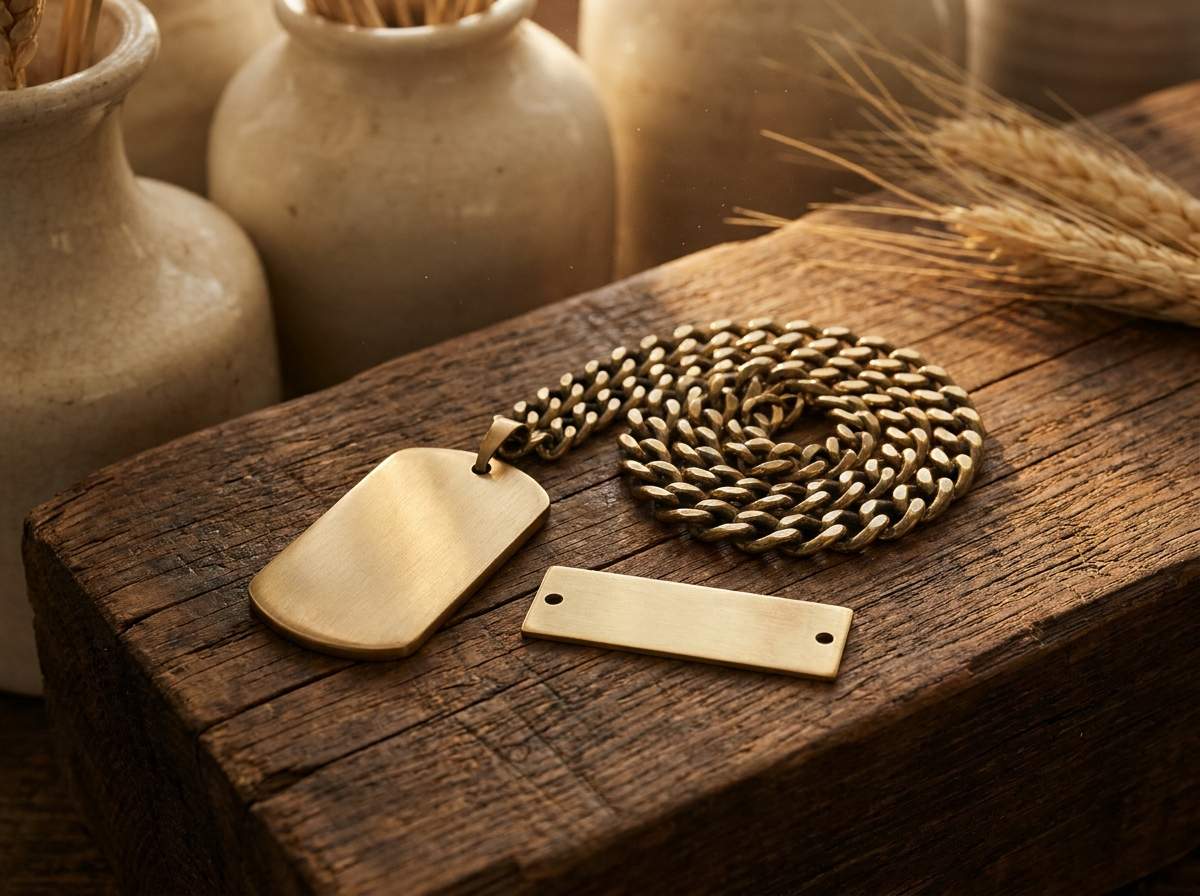
- Flat nameplate on a box or curb chain — the closest to the original 1980s format: a solid rectangular or bar-shaped plate, bold block or script lettering, worn on a chain thick enough to match the plate's visual weight. Reads the most intentionally "men's style" of any option.
- Vertical bar pendant — a narrower, often minimalist strip engraved lengthwise rather than across a plate. Sits closer to the collarbone, works well layered under a shirt, and reads more understated than a full nameplate.
- Dog-tag-style pendant — the most direct nod to the military original: a rounded-corner rectangular or oval tag, usually on a slightly heavier ball or curb chain. Reads deliberately rugged rather than decorative.
- Pendant on a figaro or Cuban-link chain — the name sits on a smaller tag or disc, but the chain itself (alternating oval-and-round figaro links, or flat interlocking Cuban links) carries most of the visual weight, so the name piece can stay smaller without looking undersized.
None of these is more "correct" than the others — a vertical bar under a collared shirt and a nameplate on a Cuban chain are both legitimate choices, they just signal differently: one discreet, one deliberately visible.
Chain Weight and Length Matter More Than for a Women's Piece
A chain that reads fine under a women's pendant often looks thin and overwhelmed under a men's name piece. As a rough guide, most men's name necklaces run on chains in the 3mm–6mm range — a thin 1mm–1.5mm cable chain, common on women's pieces, tends to disappear visually under a plate or bar sized for a man's chest.
Length matters too: an 18"–20" chain sits the pendant at or just below the collarbone and shows under an open collar; 22"–24" sits it lower, in the range most men actually prefer for layering under a t-shirt or half-open shirt rather than displaying it fully.
A heavier curb or Cuban-link chain also simply holds up better under daily wear and layering with other pieces than a fine cable chain built for a lighter pendant.
Layering With Other Men's Pieces
A name necklace rarely stands alone on a man the way it often does on a women's piece. The most common combinations: a shorter name pendant layered over (or under) a slightly longer plain chain, or a name necklace worn alongside a separate men's chain of a different link style.
A figaro with a Cuban link, for instance, lets the two pieces read as a deliberate stack rather than a single statement. Our guide to gold chain types breaks down the box, curb, figaro, rope, and Cuban-link styles in more depth if you're building out a layered stack rather than wearing the name piece on its own.
Material and Durability
FARUZO's name pieces plate over 316L stainless steel rather than sterling silver or gold-fill — it's nickel-safe and genuinely holds up to being worn daily, layered, and not babied, which matters more for a piece built to be worn constantly rather than saved for occasions.
It is plated, not solid gold or silver, so the same basic care applies regardless of gender: take it off before swimming, showering, or the gym, keep it away from perfume and lotion, and wipe it with a soft dry cloth rather than a polishing compound.
FARUZO's personalized men's jewelry collection covers nameplate, bar, and dog-tag-style pieces built with men's chain weights in mind rather than scaled down from a women's design.
Frequently Asked Questions
Is it weird for a man to wear a name necklace?
No — men have worn their own identity on a chain for over a century, starting with military dog tags and continuing through 1980s nameplate chains, well before "name necklace" was a marketed product category.
What reads as intentional rather than borrowed is mostly about scale: a chain and pendant sized for a man's frame, not a women's piece worn as-is.
What chain thickness works best for a men's name necklace?
Most men's pieces run 3mm–6mm, noticeably heavier than the 1mm–1.5mm cable chains common on women's name necklaces. A thin chain tends to look visually overwhelmed under a plate or bar pendant sized for a man's chest.
Should a man wear his own name or someone else's?
Either is common and both are traditional in their own way — a man's own name follows the dog-tag and nameplate lineage of wearing your own identity visibly, while a child's or partner's name follows the same sentimental logic as any personalized piece. Neither reading is more "correct."
What's the difference between a nameplate necklace and a dog-tag-style necklace for men?
A nameplate is a flat rectangular or bar-shaped plate with the name cut or engraved across it, usually on a box or curb chain — the format that came out of 1970s–80s New York.
A dog-tag style keeps the rounded-corner tag shape associated with military ID tags, usually on a slightly heavier ball or curb chain, and reads more deliberately rugged than decorative.
How long should the chain be for a men's name necklace?
18"–20" sits the pendant at or just below the collarbone and shows under an open collar; 22"–24" sits it lower, which most men prefer for layering under a t-shirt or half-open shirt rather than displaying the piece fully.