A pentagram is a five-pointed star drawn in a single continuous line, and a pentacle is usually the same star inside a circle. It is an old symbol with a long and varied history: in the ancient and classical world it was tied to health and recognition, in the Middle Ages to Christian ideas such as the Five Wounds, and in modern times it is best known as a sign of Wicca and other nature-based paths. The point-down version picked up different associations much more recently.
Below: the two names, the history in order, what the symbol has stood for, how the inverted form differs, a timeline of dated facts, and how it compares with other stars.
At a glance
- A pentagram is the five-pointed star; a pentacle is usually that star inside a circle, though writers do not always keep the terms apart.
- Ancient Greek tradition links it with the Pythagoreans, who are said to have used it as a sign of health and recognition.
- In the Middle Ages it was read in a Christian way, for example as the five senses or the Five Holy Wounds.
- Today the upright pentacle is a central sign in Wicca, and the inverted form carries separate, more recent associations.
What does the pentagram mean?
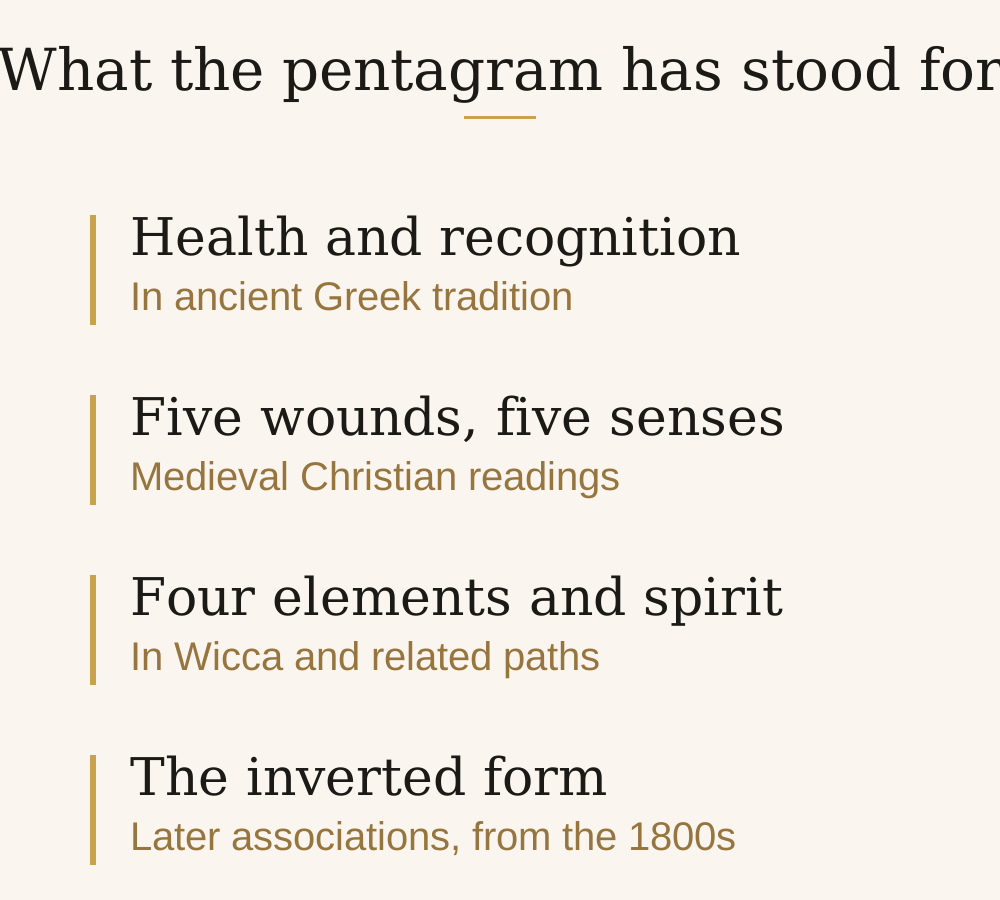
It means different things in different traditions, and no single meaning is original. Five is the key number: five points, five lines that cross each other, and an outline that can be traced without lifting the pen. That makes the star easy to read as a symbol of wholeness and connection, and traditions have attached their own five-part ideas to it, from five senses to five elements.
In short: a five-part symbol of balance, protection or the human form, depending on who is using it. The sections below take the main traditions in historical order and note where traditions differ.
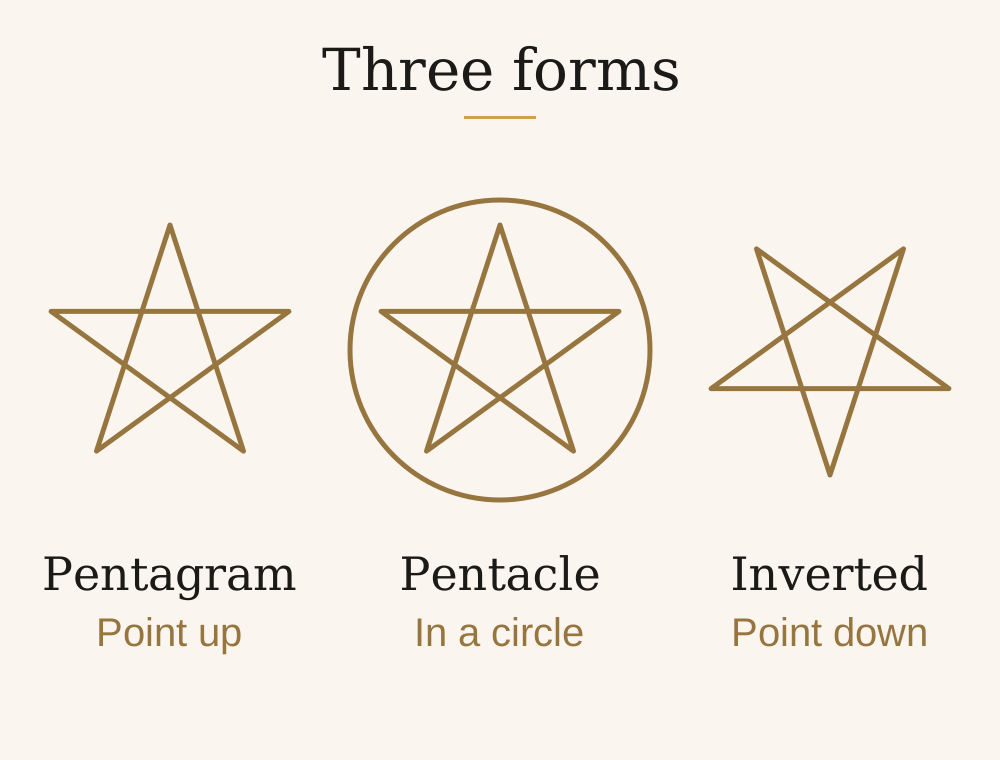
Pentagram and pentacle: the two names
Usage varies, and it is fair to say usage is not fully agreed. In many modern books, the pentagram is the star by itself, and the pentacle is the star inside a circle, which is how the symbol is usually shown in Wicca. Some older usage has "pentacle" for a charm or disc of any design, and many people use the two words interchangeably. If a piece or article is precise about the difference, it is likely using the modern convention above.
Ancient uses
Star-like marks with five points are described on very early objects from Mesopotamia, but the dating and meaning of those finds are debated. A more secure story begins in the Greek world.
Ancient Greek tradition associates the star with the Pythagoreans, the followers of the philosopher Pythagoras, whose school is dated to around the 6th century BCE. Tradition holds that they used the star as a token of recognition and linked it with hygieia, the Greek word for health. The details are uncertain, though the connection with health is widely repeated.
The five-pointed star is also known from the ancient Near East. Stamped seals from Judah, from roughly the 5th to 2nd century BCE, are mentioned as carrying the shape, and in later centuries it was sometimes called the Seal of Solomon, a name that was also used for other stars.
Medieval Christian meanings
In medieval Europe the pentagram was used in Christian art and writing. Readings such as the five senses or the Five Holy Wounds of Christ are recorded. The best-known literary example is the Middle English poem Sir Gawain and the Green Knight, from the late 14th century, in which the knight's shield bears a star the poet calls a pentangle. The poem calls it an "endless knot" and links its five points with groups of five virtues. This is read as a poet's own interpretation, not a standard church teaching.
During this period the star was also used as a protective mark in some folk practice, which is one reason it appears on old charms and doorways. As with other traditions, that is a belief of the time, and we present it only as history.
The Renaissance and the human body
In 1533, a German writer published a full edition of a book on Renaissance magic that draws a human figure with arms and legs spread to the five points of a star. This picture of the body and the star was widely copied and helped make the five-pointed star a lasting image in Western esoteric thought.
Wicca and modern paths
In the 20th century, the pentagram was taken up by Wicca, a modern nature-based religion that became public in England in the 1950s. In Wicca the upright pentacle is a central symbol. A common explanation is that the five points stand for the four classical elements, earth, air, fire and water, topped by spirit, and the circle for unity or protection. Different traditions explain it a little differently, and practitioners often say meaning is personal.
Modern pagan and Wiccan communities have also won recognition for the sign. In 2007, the US Department of Veterans Affairs added the pentacle to its list of emblems of belief that may appear on government headstones, after a legal settlement. For many wearers it is a quiet sign of faith, of belonging to a path, or of respect for nature.
The inverted pentagram
The inverted pentagram has one point down and two up. The meaning most people know today is fairly recent. In the mid-19th century a French occultist wrote that the point-down figure was a negative sign, and that idea passed into later occult writing. In the late 1960s, the Church of Satan used an inverted star inside a circle, framing a goat's head, as its emblem, which strengthened the association in the public mind.
The picture is not one-sided, though. Before and alongside this, a point-down star has been used for other reasons. Some Wiccan traditions use it to mark a particular degree of initiation, and the Order of the Eastern Star, a Masonic-affiliated body, uses a five-pointed star with a point down as its emblem. So the same shape can be read very differently depending on the setting, and context matters more than shape.
Often confused with
A star is not always a pentagram, and a few other symbols are commonly mixed up with it.
- Star: a simple star, traditionally read as guidance and hope.
- Star of David: a six-pointed star made of two triangles, a separate symbol with its own history.
- Cross: the cross, in its many forms, is a distinct symbol of Christian faith.
- Celtic knot: another continuous-line design, also called an endless knot, with its own story.
The table puts them side by side.
| Symbol | Shape | Traditionally read as |
|---|---|---|
| Pentagram / pentacle | Five-pointed star in one line, often in a circle | Health, balance, the elements; a Wiccan sign |
| Star | A single star, often solid | Guidance, hope and destiny |
| Star of David | Six-pointed star of two triangles | A sign of Jewish identity |
| Celtic knot | Interlaced continuous line | Continuity and connection |
How people wear it today
The pentacle is worn as a pendant, ring, bracelet charm or tattoo. Many wearers choose it as a sign of Wiccan or pagan faith, as a symbol of balance and protection, or for its geometry. Some people prefer the upright form because of the older meanings and the inverted form's later associations, but this is a matter of personal choice and background. When choosing jewelry, look for a piece whose metal is described plainly, such as 316L stainless steel with a gold-plated, rose gold-plated or silver-tone plated finish, rather than vague "gold" or "silver" wording. Genuine stainless steel is nickel-safe.
Frequently Asked Questions
What does a pentagram symbolize?
It depends on the tradition. Ancient Greek tradition links it with the Pythagoreans and with health. In the Middle Ages it was read in a Christian way, for example as the five senses or the Five Holy Wounds. In Wicca, it is commonly explained as the four elements plus spirit.
What is the difference between a pentagram and a pentacle?
In many modern books, a pentagram is the five-pointed star, and a pentacle is that star inside a circle. Not every writer keeps the two words apart, so the same piece may be called either.
Is the pentagram a symbol of evil?
No single reading applies. The star has older meanings tied to health, Christian ideas and modern nature-based faiths. The point-down form picked up negative associations from 19th-century occult writing and later use by the Church of Satan, but other groups use it for different reasons.
What does an inverted pentagram mean?
Today it is best known from the late 1960s emblem of the Church of Satan, and from 19th-century occult writing that called the point-down star negative. Some Wiccan traditions use it to mark a degree, and the Order of the Eastern Star uses a point-down star, so the setting matters.
Is the pentacle used in Wicca?
Yes. The upright pentacle is a central symbol in Wicca, commonly explained as the four elements topped by spirit, inside a circle. Individual traditions explain it a little differently.
Is it appropriate to wear a pentacle?
Many people wear it as a sign of faith or for its design. It helps to know that it has several histories, so some viewers may read it differently from the wearer. The choice is personal.