An initial necklace is the simplest form of personalized jewelry there is: one letter, worn on purpose. That simplicity is exactly why it's outlasted decades of jewelry trends — a single letter reads as intentional rather than loud, works with almost anything else you're wearing, and says something specific without spelling it out the way a full nameplate does. This guide covers the actual decisions that separate a piece you'll wear daily for years from one that ends up in a drawer: which letter format to pick, how to size the chain, what metal and finish hold up, and how to personalize it well.
What Counts as an Initial Necklace
An initial necklace centers on one or two letters — usually the wearer's first initial, though a partner's, child's, or family surname initial is just as common. It sits apart from a full name necklace (the whole name spelled out, usually in script) and from a monogram pendant (a decorative arrangement of two or three letters, often in a fancier interlocking style). The letter itself can hang as a small pendant on its own chain, sit centered on a bar, or appear off to one side of the chain rather than dead center — a placement detail that changes the whole read of the piece.
Single Initial vs. Double Initial vs. Full Name Necklace
These three formats get shopped against each other constantly, and the right one depends less on taste than on what you're actually trying to say with the piece:
- Single initial. The most understated option and the easiest to layer with other necklaces. Best for everyday wear, a first piece of personalized jewelry, or a subtle gift where you don't want the recipient's name announced to everyone who sees it. Typically the lowest price point in personalized jewelry — browse the full initial necklace collection to see the current letter, metal, and placement options side by side.
- Double initial (couple's or family). Two letters, often connected by a small charm, ampersand, or simply set side by side — commonly a couple's initials or a parent-and-child pairing. Reads as a relationship piece rather than a pure identity piece, and sits at a slightly higher price point than a single letter given the extra metal and setup work.
- Full name necklace. The whole name in script or block lettering, the most visually prominent of the three and the hardest to mistake for anything but personalized. Best when the point is legibility and presence rather than subtlety — it's a different piece for a different goal, not simply a "bigger" initial necklace. If a full name is what you're actually after, our name necklace collection is the better starting point than this one.
Choosing the Letter Style
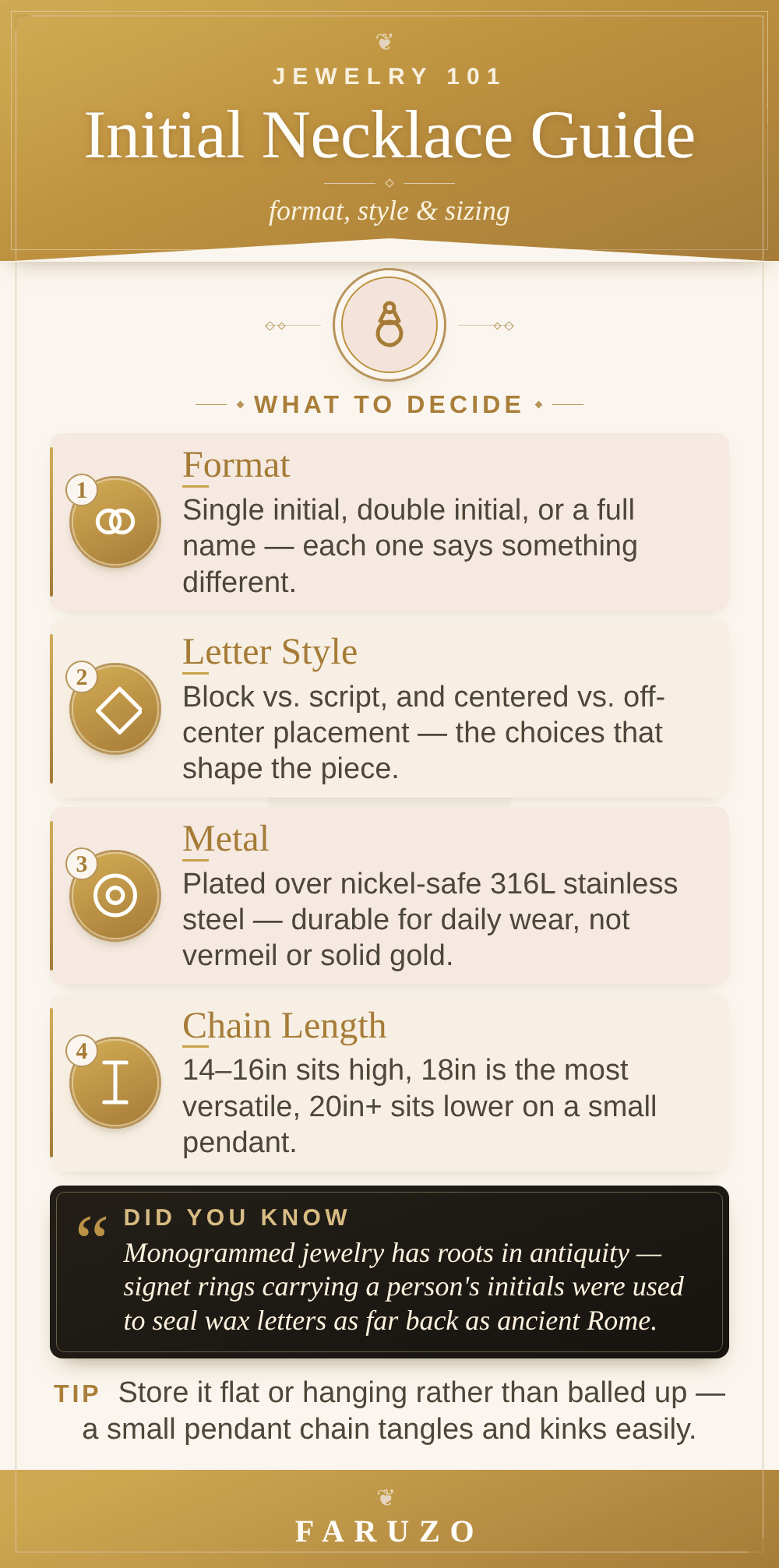
Two decisions matter more than any others here. First, block versus script: a block letter (think a clean sans-serif capital) reads modern and stays legible at a small size, while a script letter (a flowing, cursive-style capital) reads more traditional and can lose crispness if scaled down too far — if you're set on script, don't go smaller than you'd want a signature to be. Second, placement: a centered letter reads classic and symmetrical, while an off-center letter — sitting slightly to one side of the chain rather than dead-center — has been the more requested styling choice in the last few years, largely because it layers more naturally against a second necklace without the two pendants competing for the same spot.
Case matters too, even though it's easy to overlook: an uppercase letter reads bolder and more graphic, a lowercase letter reads softer and more casual. Neither is more "correct" — it's a genuine style choice, not a rule.
Metal and Finish
FARUZO pieces are plated over 316L stainless steel, which is nickel-safe and holds up to daily wear far better than the thin costume-jewelry plating that gave nameplates their "tacky in six months" reputation. It's worth being precise about the terminology here, because the jewelry industry is genuinely loose with it: plated steel is not the same thing as vermeil (which specifically means a gold layer over solid sterling silver), and neither is the same as solid gold. None of that makes plated steel a lesser choice — it's a different, more durable one for daily wear — but knowing which you're buying keeps you from expecting solid-metal pricing or solid-metal weight from a plated piece. For a full breakdown of how the metal options actually compare, see what metal is best for a name necklace.
Chain Length and Sizing
An initial pendant is small, which means chain length does most of the work in how the piece actually sits and reads. A shorter chain — in the 14–16 inch range — sits at or just above the collarbone and puts the letter front and center, which suits a single pendant worn alone. An 18-inch chain, the most commonly chosen length for a pendant necklace, sits a few inches lower and works well whether you're wearing the initial solo or as the shortest piece in a layered stack. Going longer than 20 inches starts to work against a small pendant like an initial — the letter can end up sitting lower than it reads well, especially over higher necklines. If you're not sure which length suits you, our full necklace length guide walks through how to measure against your own neckline rather than guessing from a size chart alone.
Layering an Initial Necklace
Because it's small and flat, an initial pendant is one of the easiest pieces to layer — pair it with a slightly longer plain chain, or with a second pendant on a different length, and the letter stays legible instead of getting lost. The one layering mistake worth avoiding: two pendants of similar size on similar chain lengths tend to overlap and fight for the same visual space, which is part of why the off-center placement mentioned above has become popular — it leaves room for a second piece to sit centered without a collision.
Gifting an Initial Necklace
An initial necklace is a low-risk personalized gift in a way a full name necklace isn't, since it doesn't require you to be completely certain how someone wants their name spelled or displayed — a single letter is harder to get wrong. It suits a first anniversary, a new relationship, a friend's birthday, or a "just because" gift where a full name would feel like too much commitment for the occasion. For a partner's or family initial specifically, the double-initial format above tends to land better than two matching single-initial pieces, since it reads as one connected gift rather than two separate ones.
Caring for an Initial Necklace
- Remove it before swimming, showering, or applying lotion and perfume — moisture and chemicals are what wear down plating fastest, not everyday air exposure.
- Store it flat or hanging rather than balled up in a drawer, since a small pendant chain tangles and kinks easily.
- Wipe it with a soft, dry cloth after wear rather than a jewelry cleaning solution, which can be harsher than a plated piece needs.
- If the letter is engraved rather than stamped, avoid abrasive cloths on the engraved face specifically, since heavy buffing can dull fine detail over time.
Frequently Asked Questions
What's the difference between an initial necklace and a name necklace?
An initial necklace carries one or two letters; a name necklace spells out the full name, typically in script. They're different pieces for different goals — subtlety versus presence — not different sizes of the same idea.
Which initial should I get — mine or someone else's?
Either is common. Your own initial reads as a personal, self-contained piece; a partner's, child's, or family initial reads as a relationship or connection piece — many people choose a last-name (surname) initial specifically for that shared, family read, while a first-name initial stays more personal. Neither is more "correct" — it depends on what you want the necklace to say.
What chain length works best for an initial necklace?
18 inches is the most versatile length for a single small pendant — it works alone or as the base layer if you add a second necklace later. Shorter chains (14–16 inches) put the letter higher and more front-and-center.
Is plated stainless steel a lower-quality option than gold vermeil?
It's a different option, not a lesser one. Plated 316L stainless steel is nickel-safe and more durable for daily wear than thin vermeil plating, though it isn't the same material as solid or vermeil silver — worth knowing which you're buying, not a quality judgment either way.
What if the sizing isn't right after I order?
Check the sizing details on the specific product listing before ordering, since pendant scale and chain length are listed per style. If it doesn't work out, returns are accepted within 90 days.
What's the difference between an initial pendant and a monogram necklace?
An initial pendant carries a single letter on its own; a monogram groups two or three letters — often in a decorative, interlocking style — into one design. Want one clean letter you can wear daily? An initial pendant is the simpler piece. Want multiple letters treated as a single motif? A monogram is the better fit.
What should I check before buying an initial necklace online?
Confirm the chain length and pendant size on the specific product listing, since scale varies by style; check the material — FARUZO pieces are plated over nickel-safe 316L stainless steel, not vermeil or solid gold; and know the return window (90 days) before you order, so getting the length or letter style wrong isn't a risk.