Chrysocolla's name literally means “gold glue” in ancient Greek — but the mineral has nothing to do with gold, and for most of its named history, the word “chrysocolla” didn't reliably mean this exact stone either. It's a blue-green copper mineral that ranges from soft enough to scratch with a fingernail to hard enough for daily wear, depending on how much quartz got mixed in while it was forming — which is also why two stones sold under the same name can behave completely differently once they're set in a ring.
What chrysocolla actually is
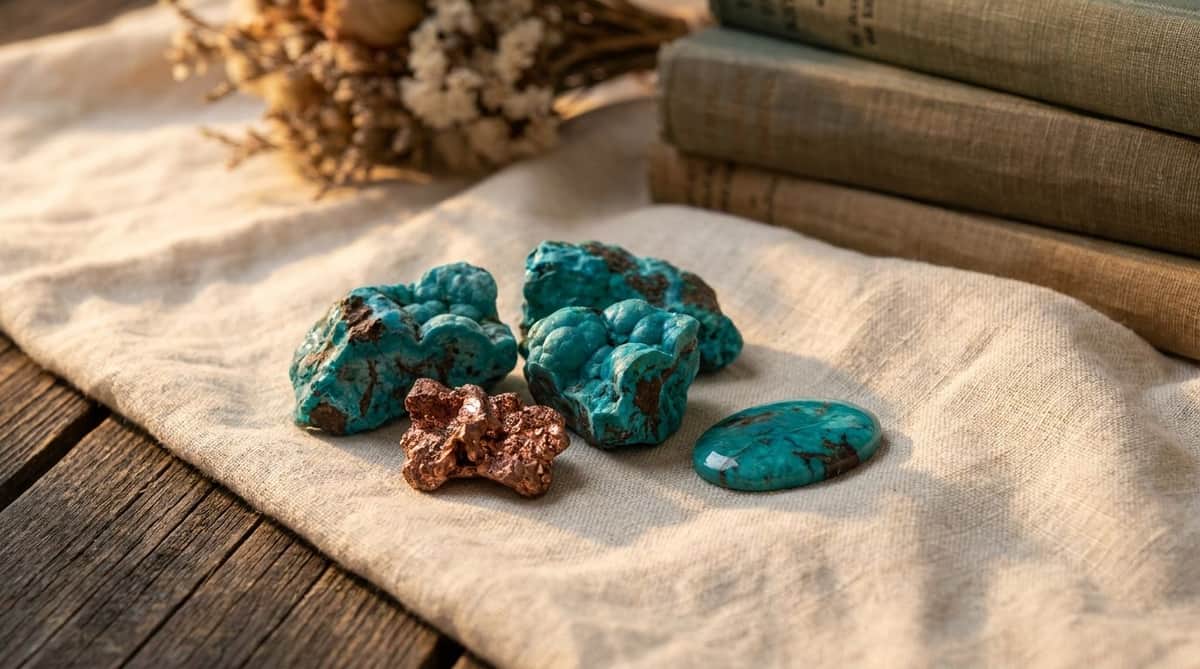
Chrysocolla is a hydrous copper silicate, roughly (Cu,Al)₂H₂Si₂O₅(OH)₄·nH₂O — the aluminum content varies from sample to sample, which is part of why the mineral's composition is described as inconsistent even within a single piece. Copper is what gives it that turquoise-to-teal color range, the same element responsible for malachite's green and azurite's blue. It forms in the oxidized upper zone of copper ore deposits, as a secondary mineral that shows up as botryoidal (grape-like) crusts, vein fillings, or rounded masses rather than visible crystals — chrysocolla essentially never forms crystals large enough to see, which is why it's always cut as a cabochon or slab rather than faceted like a diamond or sapphire.
Where it comes from
Chrysocolla forms wherever copper ore weathers near the surface, so it turns up on every copper-mining continent. Documented producing localities include the Ray mine and Bisbee in Arizona, the Kennecott mine in Utah, the San Simon mine in Chile, and the Rokana mine in Zambia's Copperbelt — not coincidentally, some of the same districts known for turquoise and malachite, since all three minerals form under similar oxidizing conditions above copper deposits. That geological overlap is a big part of why the three stones keep getting confused for each other, both historically and at the jewelry counter today.
A name with an identity problem
The name comes from the Greek khrusos (“gold”) and kolla (“glue”), first used by the Greek naturalist Theophrastus around 315 BC — not as a description of the stone's color, but as a reference to its ancient use as a flux that helped goldsmiths solder gold. Ancient authors weren't consistent about what “chrysocolla” actually meant: some classical references to the name describe what mineralogists today would classify as malachite instead, since ancient naming grouped green and blue-green copper minerals together by color rather than by composition. The name eventually settled on today's distinct mineral species, but the mix-up never fully went away — chrysocolla is still routinely confused with turquoise, since both range through similar blue-green hues and both form in the same kind of copper-rich terrain.
Gem silica: when chrysocolla is hard enough for a ring
Pure chrysocolla sits at 2.5–3.5 on the Mohs hardness scale — soft enough that dark navy-blue material is generally considered too fragile for jewelry at all. But chrysocolla frequently intergrows with chalcedony, a microcrystalline form of quartz, and when the silica content is high enough the resulting stone climbs to around 7 on the Mohs scale — about the same hardness band as garnet — hard enough for daily wear. The trade name for this variety is “gem silica” (also called chrysocolla chalcedony), and it's considered the most valuable variety of chalcedony on the market, with fine cut stones selling for well over $100 a carat. Worth knowing before buying: gem silica isn't technically “chrysocolla” by strict mineralogy at all — it's chalcedony colored blue-green by chrysocolla inclusions — which is exactly why it behaves so differently, in both hardness and price, from the soft, crumbly chrysocolla sold as tumbled stones and cabochons.
Physical, mental, and metaphysical: what people say about it
Physical: because hardness varies so much by variety, chrysocolla jewelry needs to be judged piece by piece — soft, opaque blue-green material is better suited to pendants and earrings worn occasionally, while translucent gem silica, at roughly the same hardness as quartz, can reasonably go into a ring worn daily.
Mental: in crystal-healing traditions, chrysocolla is described as a stone of calm and clear communication — something practitioners reach for to steady an anxious mind or ease into a difficult conversation. That's a belief-system framing, not a documented effect.
Metaphysical: the same traditions pair chrysocolla with the throat and heart chakras, reading its blue-green gradient as a bridge between the two, and some sources describe it as a “goddess stone” tied to divine-feminine and ancestral-wisdom themes. Zodiac associations vary by source — Gemini, Virgo, and Taurus all show up in different crystal-tradition lists — which is typical for stones whose zodiac pairings were assigned long after their historical use began, and it carries no official birthstone status in the modern birthstone list.
How to tell real chrysocolla from turquoise or a dyed imitation
Genuine chrysocolla tends to show mottled, uneven blue-green coloring with brown or black matrix veining running through it, where turquoise more often shows a flatter, more uniform robin's-egg blue against its matrix. Dyed howlite or magnesite — the same materials commonly passed off as fake turquoise — also get sold as chrysocolla; a cotton swab dabbed with a small amount of acetone, tested discreetly on a hidden edge, will pick up color from a dyed substitute, while genuine chrysocolla won't transfer any. If a piece is marketed as chrysocolla but feels unusually light and glassy and shows a very uniform color, ask specifically whether it's pure chrysocolla or gem silica — the price and durability difference between the two is large enough that the distinction should be on the listing, not something you have to guess at.
Caring for chrysocolla jewelry
Treat any piece as if it's the soft variety unless you know otherwise. Skip ultrasonic and steam cleaners, which risk fracturing material already prone to micro-fractures from its botryoidal growth structure. Clean with a soft, dry cloth or a barely damp one, avoid soaking, and keep it away from perfume, lotion, and acidic cleaning products. If chrysocolla is going into a personalized piece, a birthstone or gemstone necklace is worth a look before a ring — occasional-wear settings like pendants and earrings are the safer bet unless you've confirmed the stone is gem silica.
For the broader logic behind why different stones carry different symbolic meanings — and how much of that is documented tradition versus modern crystal-shop marketing — different gemstones and what they really mean covers the pattern across dozens of stones, and gemstone color meanings breaks down why blue and green stones in particular cluster around calm and renewal themes across cultures. And since chrysocolla's hardness is such a moving target, how to clean a gemstone ring safely is worth reading before you reach for anything beyond a soft cloth.
Frequently Asked Questions
Is chrysocolla the same as turquoise?
No. They're different minerals — chrysocolla is a copper silicate, turquoise a copper-aluminum phosphate — but they form in similar copper-rich environments and share a similar blue-green color range, which is why they get confused constantly, both historically and at the jewelry counter.
Is chrysocolla safe to wear every day?
It depends which variety you have. Pure chrysocolla is a 2.5–3.5 on the Mohs scale — soft, best kept to occasional-wear pieces. Gem silica (chrysocolla chalcedony) is closer to 7, roughly on par with quartz, and holds up fine in a ring worn daily.
What does “gem silica” mean?
It's the trade name for chalcedony (a form of quartz) colored blue-green by chrysocolla inclusions. It's not pure chrysocolla by strict mineralogy, but it's considered the most valuable variety of chalcedony, with fine cut stones selling for well over $100 a carat.
Where does the name chrysocolla come from?
From the Greek for “gold glue,” first used by Theophrastus around 315 BC to describe the mineral's ancient role as a soldering flux for gold — not its color. Ancient writers didn't apply the name consistently, and some classical references to “chrysocolla” actually describe what we'd now call malachite.
Is chrysocolla a birthstone?
No, it doesn't appear on the modern official birthstone list. Some crystal-healing traditions tie it to Gemini, Virgo, or Taurus, but sources disagree on the exact sign, which is typical for stones whose zodiac pairings were assigned long after their historical use began.
Chrysocolla is one of the few stones whose own name has been arguing with itself for over two thousand years — first mistaken for malachite, still mistaken for turquoise, and sold under one label that covers everything from a fingernail-soft cabochon to a $100-a-carat quartz variety hard enough for daily wear. Knowing which one is in front of you is most of the battle.