
Crystal guide
Moldavite Meaning, Properties and Care
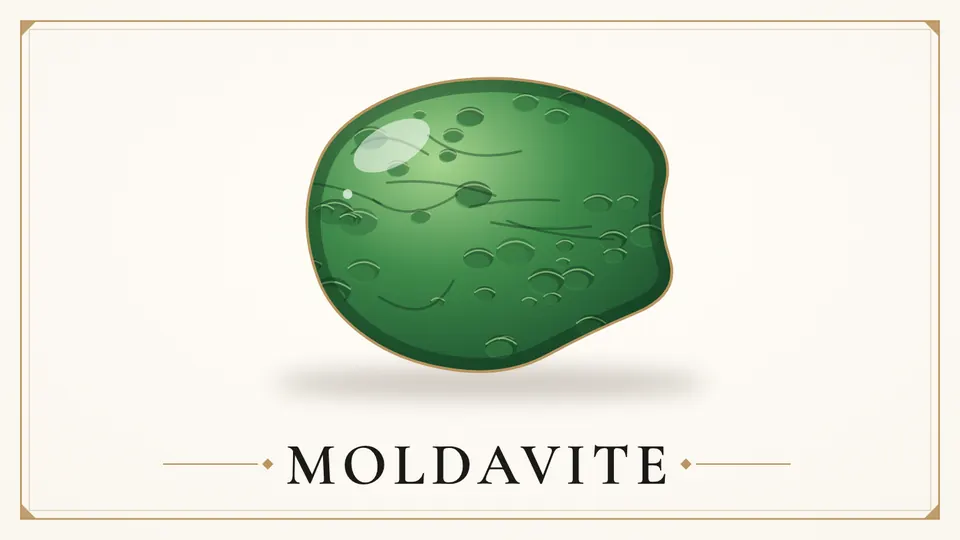
Moldavite is a green natural glass, not a crystal. It is widely thought to have formed about 15 million years ago, when a meteorite struck what is now southern Germany and flung melted rock across the region. It is found almost only in Czechia, so genuine pieces are scarce and heavily faked with cast green glass. It is also brittle, at about 5.5 to 6 on the Mohs scale.
At a glance
- A natural green glass (a type of tektite), widely thought to be made by a meteorite impact about 15 million years ago.
- Found almost only in Czechia (Bohemia and Moravia) and nearby, so real pieces are scarce.
- Mohs about 5.5 to 6 (some lists say up to 7) and brittle: it can chip or crack, so a ring is best avoided.
- Heavily faked with cast green glass. Not on standard birthstone lists.
Quick facts
| Family | Tektite: a natural silica glass, widely thought to form when a meteorite impact melts and throws out rock and soil |
|---|---|
| Chemical formula | Mostly SiO2 (silica), with some Al2O3 |
| Crystal system | None: amorphous natural glass, not a crystal |
| Mohs hardness | 5.5–6 |
| Luster | Vitreous (glassy), with a curved break and no cleavage |
| Transparency | Transparent to translucent, sometimes nearly opaque in thick pieces |
| Natural colors | bottle to forest green, olive green, brownish green (more common in Moravia) |
| Main localities | Czechia (mainly southern Bohemia and western Moravia), small amounts in nearby parts of Germany and Austria |
| Common treatments | usually sold untreated, rough or cut; often imitated with cast glass, so natural origin is worth confirming |
Moldavite at a glance, in pictures
Chakras (traditional)
Hardness range
Natural colors
- bottle to forest green
- olive green
- brownish green (more common in Moravia)
Common forms of Moldavite
- Rough raw chunk
- Faceted cut gem
- Tumbled polished pebble
How hard is Moldavite?
- Talc 1
- Gypsum 2
- Copper coin ~ 3
- Calcite 3
- Fluorite 4
- Apatite 5
- Glass ~ 5.5
- Steel knife ~ 5.5
- Moldavite 5.5–6
- Orthoclase 6
- Quartz 7
- Topaz 8
- Corundum 9
- Diamond 10
What it is and where it comes from
Moldavite is a natural glass, not a crystal and not man-made. It belongs to the tektites, glassy pieces that are widely thought to form when a large meteorite impact melts rock and soil and throws it far from the crater.
Moldavite is widely thought to come from the impact that made the Ries crater in southern Germany, about 15 million years ago. The melted drops cooled into glass as they flew, then fell across what is now Czechia.
It is the green tektite of the Central European group. Other tektites, from Australasia, the Ivory Coast and North America, are usually black or brown and are different stones.
Most moldavite comes from southern Bohemia and western Moravia in Czechia, with small amounts found nearby in Germany and Austria. The name comes from the Vltava (Moldau) river.
Moldavite was used long before jewellery. Pieces have been found worked into tools at Stone Age sites in Europe, some roughly 26,000 to 43,000 years old.
Rough moldavite often has a wrinkled, pitted surface. This is widely thought to come from natural acids in groundwater etching the glass after it landed.
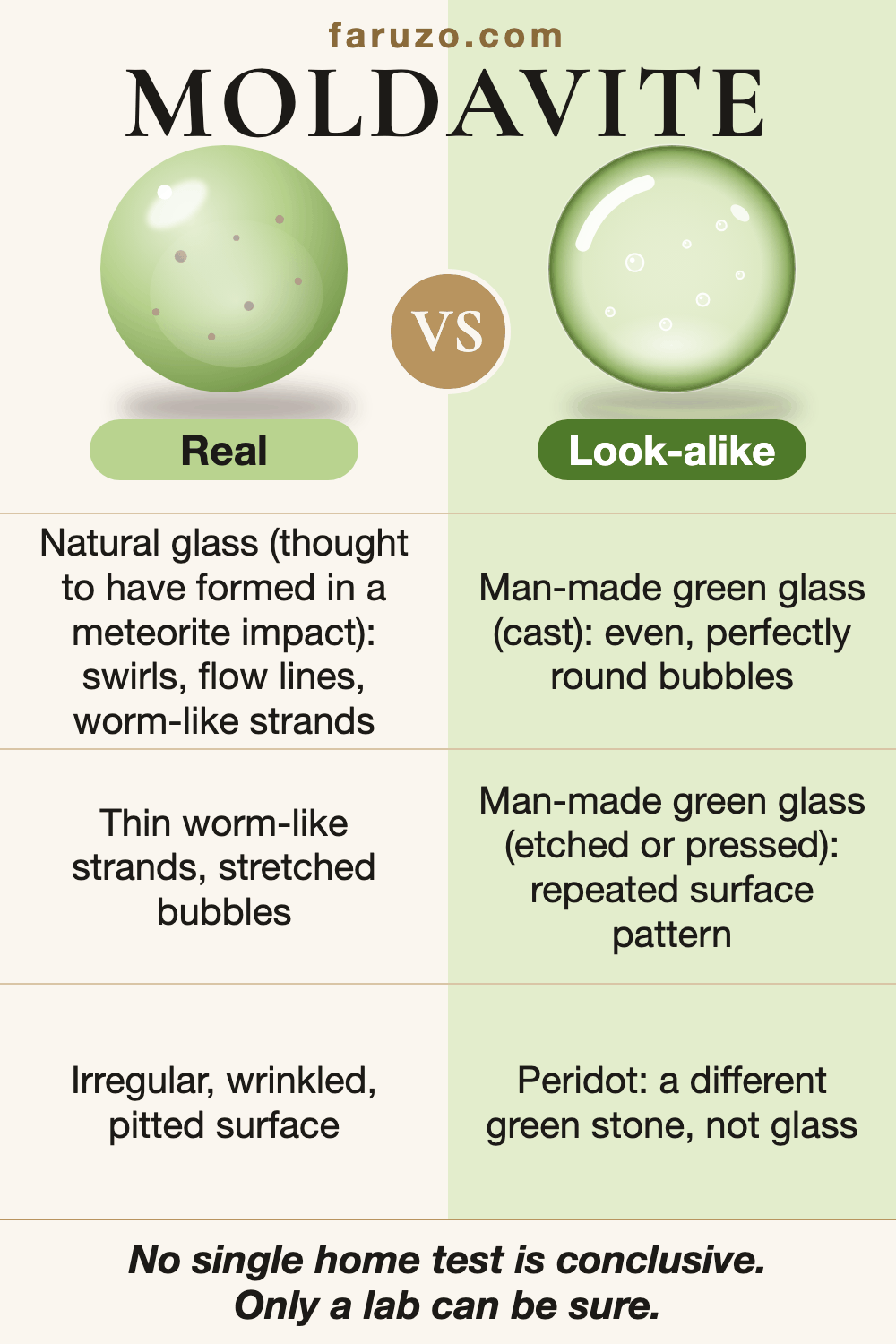
Inside, natural pieces often show swirls, flow lines, thin worm-like strands and stretched bubbles. These are among the features that help set moldavite apart from most green glass copies.
In crystal tradition
What follows is belief and folklore, passed down in crystal tradition. It is not measured fact.
Traditionally associated with: transformation, change, new beginnings.
In crystal tradition, moldavite is linked to change and personal transformation, and often to the Heart chakra. This is a modern spiritual belief, not a fact about the stone.
In crystal circles it is often called a high-vibration stone. That is a tradition, and it cannot be measured or shown to be true of the stone.
Some folklore links moldavite to the Holy Grail, with a story that the cup was made from a green stone that fell from the sky. It is a legend, not history.
In tradition, moldavite is treated as a stone with a strong reputation, and some collectors choose to wear it only occasionally. That is a custom, not a fact about the stone.
How to care for Moldavite
- Water Caution
- Sunlight Unknown
- Salt Unknown
- Heat Caution
- Ultrasonic Avoid
- Chemicals Caution
Safe = fine as a rule · Caution = only briefly or gently · Avoid = can damage the stone · Unknown = no reliable guidance.
Wipe moldavite with a soft cloth, mild soap and lukewarm water, then dry it. A short rinse is fine; do not soak it. Rough pieces with a pitted surface can be cleaned with a soft brush. Skip ultrasonic and steam cleaners, because vibration and sudden temperature swings can crack brittle glass or flake a thin surface ridge. Keep it away from strong cleaners and acids, which can mark the surface. Store it in a soft pouch apart from harder stones that could scratch it.
Real or fake? Look-alikes and treatments
Often confused with
- Cast green glass
- Textured or etched green glass
- Peridot
Common look-alikes
- Cast green glass. This is the most common fake. Moldavite is itself natural glass, so asking whether it is glass does not settle it. The difference is inside: cast glass tends to look even, often with perfectly round bubbles, while natural pieces show swirls, flow lines, thin worm-like strands and stretched bubbles.
- Textured or etched green glass. Some copies are made with a pitted, wrinkled surface to look rough. A pressed or repeated pattern is a warning sign, since a natural surface is irregular. The inside should match, with the same uneven swirls and stretched bubbles.
- Peridot. Peridot is a different green stone, not natural glass. Moldavite is a natural glass rather than a crystal and is found almost only in Czechia, so ask the seller where a piece was found.
Safe checks you can do
- Ask the seller in writing where the piece was found and whether it is natural moldavite or man-made glass. A natural find area is Czechia, mainly southern Bohemia or Moravia.
- Look inside with a bright light and a magnifier. Natural pieces often show swirls, flow lines, thin worm-like strands and stretched bubbles. Perfectly round bubbles and very even colour point to cast glass.
- On rough pieces, the natural surface is irregular, wrinkled and pitted. Compare several pieces from the same seller: copies often repeat the same texture.
- Be wary of very low prices, large clean pieces for little money, and a card or label as the only proof.
- Do not scratch-test or heat-test a piece you plan to keep. A lab is the safer route when it matters.
Wearing Moldavite
Ring
Avoid
Moderate hardness, so rings can scratch or chip.
Bracelet
Careful
Bracelets take more knocks, so wear it with care.
Pendant
Careful
Keep a pendant away from hard knocks.
Earrings
Careful
Take earrings off for sport and sleep.
Guide for everyday wear, based on hardness and care notes. Safe, Careful or Avoid.
Moldavite is brittle natural glass at about 5.5 to 6 on the Mohs scale (some lists say up to 7), so it chips and cracks more easily than most gemstones. A ring is best avoided because it takes the most knocks. A pendant or earrings take fewer knocks and suit careful wear, and a bracelet needs care too. Take it off for the gym and washing up, and keep it in a soft pouch.
Related stones
Questions about Moldavite
What does moldavite mean?
In crystal tradition moldavite is linked to change, transformation and the Heart chakra. That is a belief, not a fact about the stone. Its practical claim to fame is being a rare green glass, widely thought to come from a meteorite impact.
What is moldavite?
Moldavite is a green natural glass found almost only in Czechia. It is a type of tektite and is widely thought to have formed about 15 million years ago, when a meteorite impact in southern Germany melted rock and threw it across the region.
Is moldavite a meteorite?
No. It is widely thought to be made from Earth rock and soil that the impact melted, not from the meteorite itself. The meteorite is the cause, and the glass is local material.
Is moldavite man-made glass?
Real moldavite is natural glass that formed without people. Man-made green glass is a common look-alike, so being glass is not the test. What counts is the swirls, flow lines and stretched bubbles inside, and a believable find area.
What is a tektite?
A tektite is a piece of natural glass widely thought to form when a large meteorite impact melts rock and soil and throws it far away. Moldavite is the green tektite of central Europe. Tektites from Australasia, the Ivory Coast and North America are usually black or brown, and obsidian is a different glass made by volcanoes.
How hard is moldavite?
About 5.5 to 6 on the Mohs scale (some lists say up to 7), softer than quartz. It has no cleavage planes, but it is glass, so it is brittle and can chip or crack if knocked.
Is moldavite a birthstone?
Moldavite is not on the standard modern or traditional birthstone lists, and it has no widely agreed birth month. Some modern or alternative lists may include it, so check the list you are following.
Why is moldavite so expensive?
It is found almost only in a small region of Czechia, and demand is high, so genuine pieces cost more than most green stones. Price rises with clean, well-textured or larger pieces. A very low price should raise doubt, because cast glass is common.
How can you tell real moldavite from fake?
A home look can only hint. Natural pieces often show swirls, flow lines, thin worm-like strands and stretched bubbles, while cast glass tends to look even with round bubbles. Ask where the piece was found, and use a lab for a stone that matters.
Can you wear a moldavite ring every day?
It is best avoided. Moldavite is brittle glass, so a knock on a ring hand can chip or crack it. A pendant or earrings take fewer knocks and suit careful wear.
Can moldavite get wet, and can you clean it in an ultrasonic cleaner?
A short rinse in lukewarm water is fine, but do not soak it. Skip ultrasonic and steam cleaners, since vibration and sudden temperature changes can crack brittle glass or flake a thin surface ridge.
Where does moldavite come from?
Almost all of it comes from Czechia, mainly southern Bohemia and western Moravia, with small amounts in nearby parts of Germany and Austria. The name comes from the Vltava (Moldau) river.