
Crystal guide
Dolomite Meaning, Properties and Care
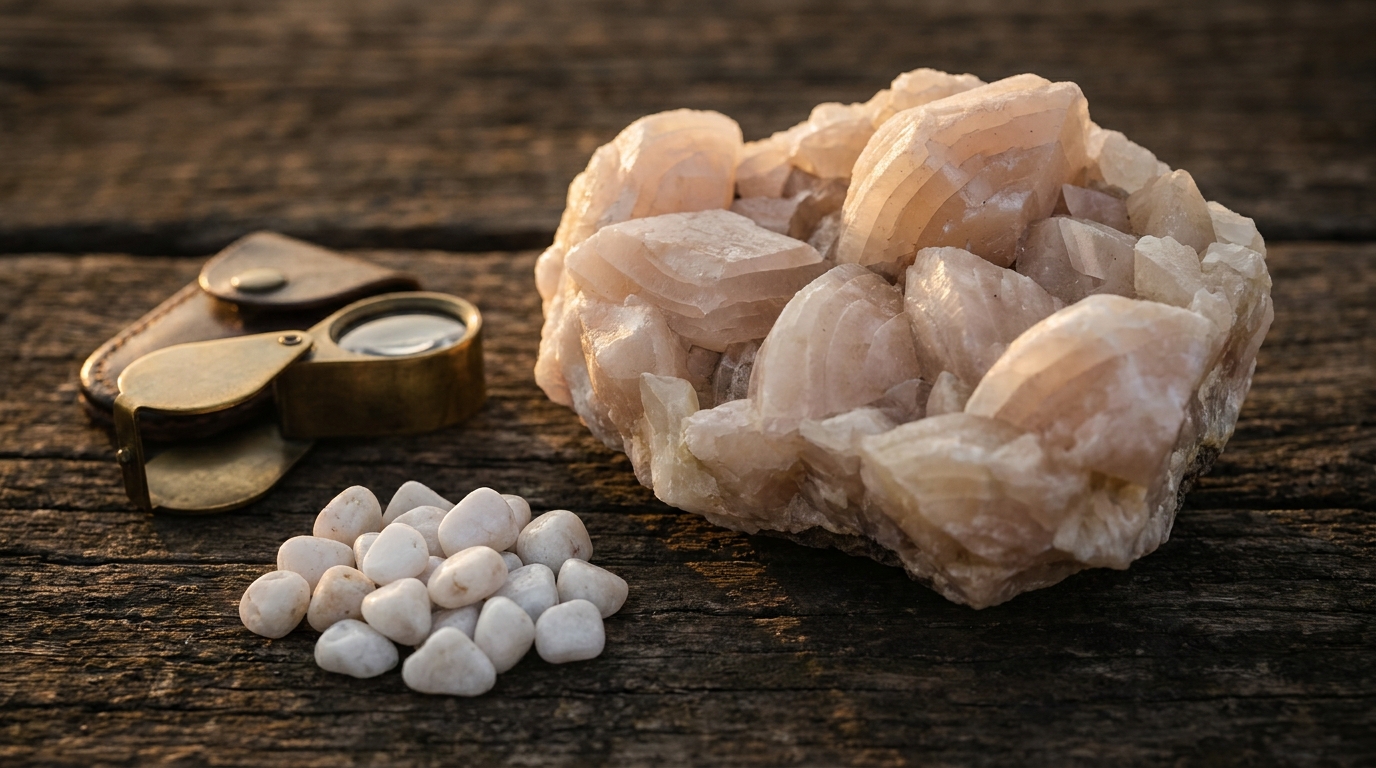
Dolomite is a calcium magnesium carbonate, CaMg(CO3)2, and it gave its name to the Dolomites, the mountain range in northern Italy. It is soft and splits along flat planes, so it suits display pieces and tumbled stones better than daily jewelry. In crystal tradition it is a stone of patience and steadiness.
At a glance
- Formula CaMg(CO3)2, trigonal crystals, hardness Mohs 3.5 to 4.
- Perfect cleavage in three directions; crystals often have gently curved, saddle-shaped faces.
- Colours run white, grey and pink, with iron adding yellow to brown tints.
- Care: soft cloth, no acids, no machine cleaners. Bright blue or hot pink pieces are often dyed.
Quick facts
| Family | Carbonate mineral (calcium magnesium carbonate), the main part of dolostone rock |
|---|---|
| Chemical formula | CaMg(CO3)2 |
| Crystal system | Trigonal (rhombohedral), often with curved crystal faces |
| Mohs hardness | 3.5–4 |
| Luster | Vitreous to pearly; perfect cleavage in three directions that do not meet at right angles |
| Transparency | Transparent to translucent, often opaque in massive pieces |
| Natural colors | white, grey, pink (rosy tints are linked to manganese), yellow to brown (tinted by iron), reddish-white or brownish-white |
| Main localities | Italy (the Dolomites and Tyrolean Alps); Spain (Eugui, Navarra), known for fine specimens; Brazil (coastal lagoons); Persian Gulf (salt flats); Australia (saline lakes) |
| Common treatments | usually sold untreated, though dyed pieces in blue, pink and other bright shades exist; because it is soft and reacts to acid, rough handling and harsh cleaners are the bigger concern |
Dolomite at a glance, in pictures
Chakras (traditional)
Hardness range
Natural colors
- white
- grey
- pink (rosy tints are linked to manganese)
- yellow to brown (tinted by iron)
- reddish-white or brownish-white
Traditionally linked to
- Element
- Earth
Common forms of Dolomite
- Rough raw chunk
- Tumbled polished pebble
- Bead drilled bead
How hard is Dolomite?
- Talc 1
- Gypsum 2
- Copper coin ~ 3
- Calcite 3
- Dolomite 3.5–4
- Fluorite 4
- Apatite 5
- Glass ~ 5.5
- Steel knife ~ 5.5
- Orthoclase 6
- Quartz 7
- Topaz 8
- Corundum 9
- Diamond 10
What it is and where it comes from
The mineral is named after the French geologist Déodat Gratet de Dolomieu, and the Dolomite Mountains in Italy were in turn named after the mineral.
Dolomite is the main part of dolostone, a rock common in mountain ranges. It also forms today in places such as coastal lagoons and salt flats.
Most dolomite goes to industry rather than jewelry: as building stone and concrete aggregate, as a source of magnesium, and as a flux in steelmaking.
Well-formed display crystals are less common. The quarry at Eugui in Spain is known for some of the finest specimens.
As a decorative stone it is limited by softness, so it is mostly seen as raw clusters, tumbled stones and beads.
In crystal tradition
What follows is belief and folklore, passed down in crystal tradition. It is not measured fact.
Traditionally associated with: patience, perseverance, grounding, emotional balance.
Dolomite is traditionally called a stone of patience and perseverance, linked to the Earth element and the Root chakra. This is a modern spiritual belief, not a fact about the stone.
Its grounding reputation is generally tied to its earthy, rock-forming nature. That is a symbolic idea within crystal practice, not a scientific claim.
How to care for Dolomite
- Water Caution
- Sunlight Unknown
- Salt Caution
- Heat Caution
- Ultrasonic Avoid
- Chemicals Avoid
Safe = fine as a rule · Caution = only briefly or gently · Avoid = can damage the stone · Unknown = no reliable guidance.
Wipe dolomite with a soft, barely damp cloth and dry it straight away. Keep it away from vinegar, lemon and other acids, which can etch it. Do not soak it, and skip ultrasonic and steam cleaners, since vibration and sudden heat can crack a cleaved stone. Store it apart from harder stones that could scratch it. Nothing firm is known about long sun, and salt water is best avoided as a precaution. Dyed pieces can lose colour in water, so keep them dry.
Real or fake? Look-alikes and treatments
Often confused with
- Calcite
- Selenite (gypsum)
- Marble and limestone
- Glass beads
Common look-alikes
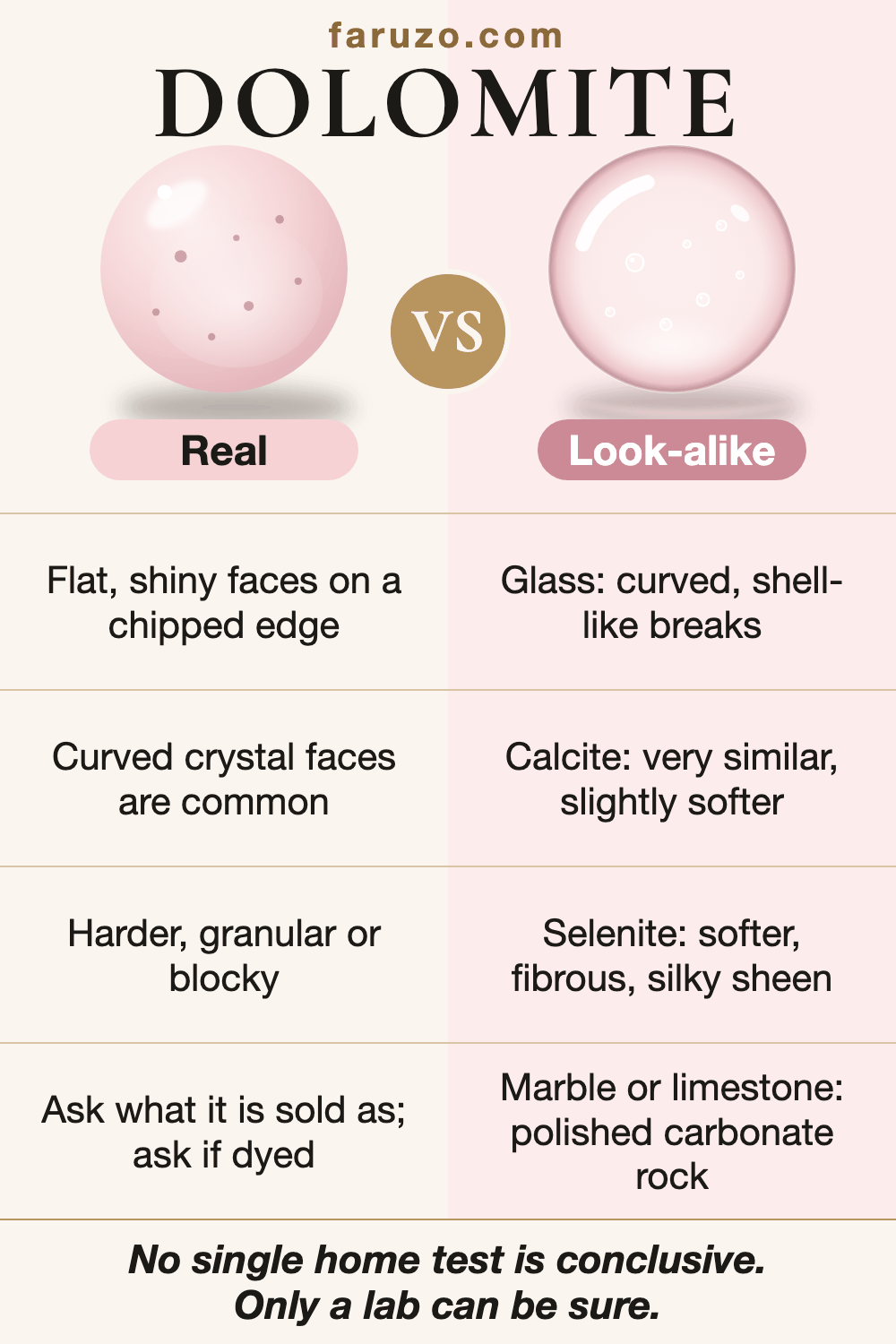
- Calcite. Calcite looks very similar but is slightly softer (Mohs 3) and fizzes readily in cold dilute acid, while dolomite reacts only weakly unless powdered. Dolomite more often shows curved crystal faces. A lab can confirm.
- Selenite (gypsum). Selenite is a different mineral, softer at Mohs 2 and often long and fibrous or in flat plates, with a silky sheen. Dolomite is harder and more granular or blocky.
- Marble and limestone. Polished white or grey carbonate rock can pass for dolomite, and dolostone is itself built from it. Look at the crystal faces and ask what the piece is sold as; a lab can separate them.
- Glass beads. Glass is often too even and may show round bubbles, while dolomite shows flat or slightly curved cleavage faces on broken edges.
Safe checks you can do
- Ask the seller in writing whether the stone is natural dolomite, calcite, dyed, glass or something else.
- Look closely at the colour. Natural pink is soft and uneven, while hot pink or vivid blue is a sign of dye, which often pools in cracks and drill holes.
- Check any chipped edge for flat, shiny cleavage faces. Glass breaks with curved, shell-like surfaces.
- Do not try acid or a scratch test on a stone you plan to keep. Both can mark something this soft, and a lab can test it more safely.
- Be wary of a very cheap, perfectly even, vivid stone sold as rare dolomite. Natural material is rarely perfectly even, so ask questions.
Wearing Dolomite
Ring
Avoid
Splits easily along a flat plane, so a ring is best avoided.
Bracelet
Avoid
One knock on the wrist can split it along a flat plane.
Pendant
Careful
It can split along a flat plane, so keep it protected.
Earrings
Careful
A flat-plane split is possible, so keep earrings for dressy wear.
Guide for everyday wear, based on hardness and care notes. Safe, Careful or Avoid.
Dolomite is soft (Mohs 3.5 to 4) and splits along perfect cleavage planes, so a ring is best avoided and a bracelet is best avoided too, since both take knocks. A pendant or earrings are kinder but still scratch and chip, so keep them for short, dressy wear in a closed setting. Do not soak dolomite, and keep it clear of acids.
Related stones
Questions about Dolomite
What does dolomite mean?
In crystal tradition dolomite is a stone of patience and perseverance, linked to grounding, the Earth element and the Root chakra. That is a belief, not a fact about the stone.
What is dolomite?
Dolomite is a calcium magnesium carbonate, CaMg(CO3)2. It forms the rock dolostone and also grows as white, grey or pink crystals, often with curved faces.
How hard is dolomite?
About 3.5 to 4 on the Mohs scale, so a knife blade scratches it easily. Perfect cleavage in three directions adds to the fragility.
What is the difference between dolomite and calcite?
Dolomite contains magnesium as well as calcium, and is a little harder, at 3.5 to 4 against 3. Calcite fizzes readily in cold dilute acid, while dolomite reacts only weakly. Dolomite crystals more often have curved faces.
Is dolomite a birthstone?
No. Dolomite does not appear on the usual modern or traditional birthstone lists.
Did the mineral or the mountains come first?
The mineral was named after the geologist Déodat Gratet de Dolomieu, and the Dolomite Mountains in Italy were then named after the mineral.
Can dolomite get wet?
A quick wipe with a damp cloth is fine, but do not soak it, and dry it straight away. Keep it away from vinegar and other acids.
Can you wear a dolomite ring?
A ring is best avoided. At Mohs 3.5 to 4 with perfect cleavage it scratches and chips easily, so pendants, earrings and display pieces suit it better.
Why is some dolomite bright blue or hot pink, and will it fade?
Natural dolomite is white, grey or soft pink. Vivid blue or hot pink pieces are usually dyed, and dye can rub off, fade in sun or run in water, so keep them dry and ask the seller what treatment a stone has had.
How do you clean and care for dolomite?
Wipe it with a soft cloth and keep it away from acids, ultrasonic cleaners and steam. Wrap it separately from harder stones and keys so nothing scratches the surface.
What is pink dolomite?
It is dolomite with a rosy tint, which is linked to traces of manganese. The shade is usually soft and pale, so a very strong pink deserves a question about dye.
What is dolomite used for besides jewelry?
Mostly industry: building stone, concrete aggregate, a source of magnesium and a flux in steelmaking. Some pieces are also kept as display specimens.