“Engagement ring vs. wedding ring” sounds like it should have a simple answer, but the two get mixed up constantly — partly because they end up on the same finger, and partly because “wedding ring” and “wedding band” already mean the same thing before you even bring the engagement ring into it. The short version: an engagement ring is given at a proposal, before the wedding. A wedding ring — or wedding band, the terms are interchangeable — is exchanged during the ceremony itself, the moment the marriage becomes official.
This guide breaks down the real difference between an engagement ring and a wedding band: what each one means, when it's given, who traditionally wears it, and how to wear both together once you have them. Whether you're drawn to a traditional diamond solitaire or a one-of-a-kind personalized ring engraved with a name or date, knowing the tradition first makes the choice easier.
Engagement Ring versus Wedding Ring: An Overview Comparison
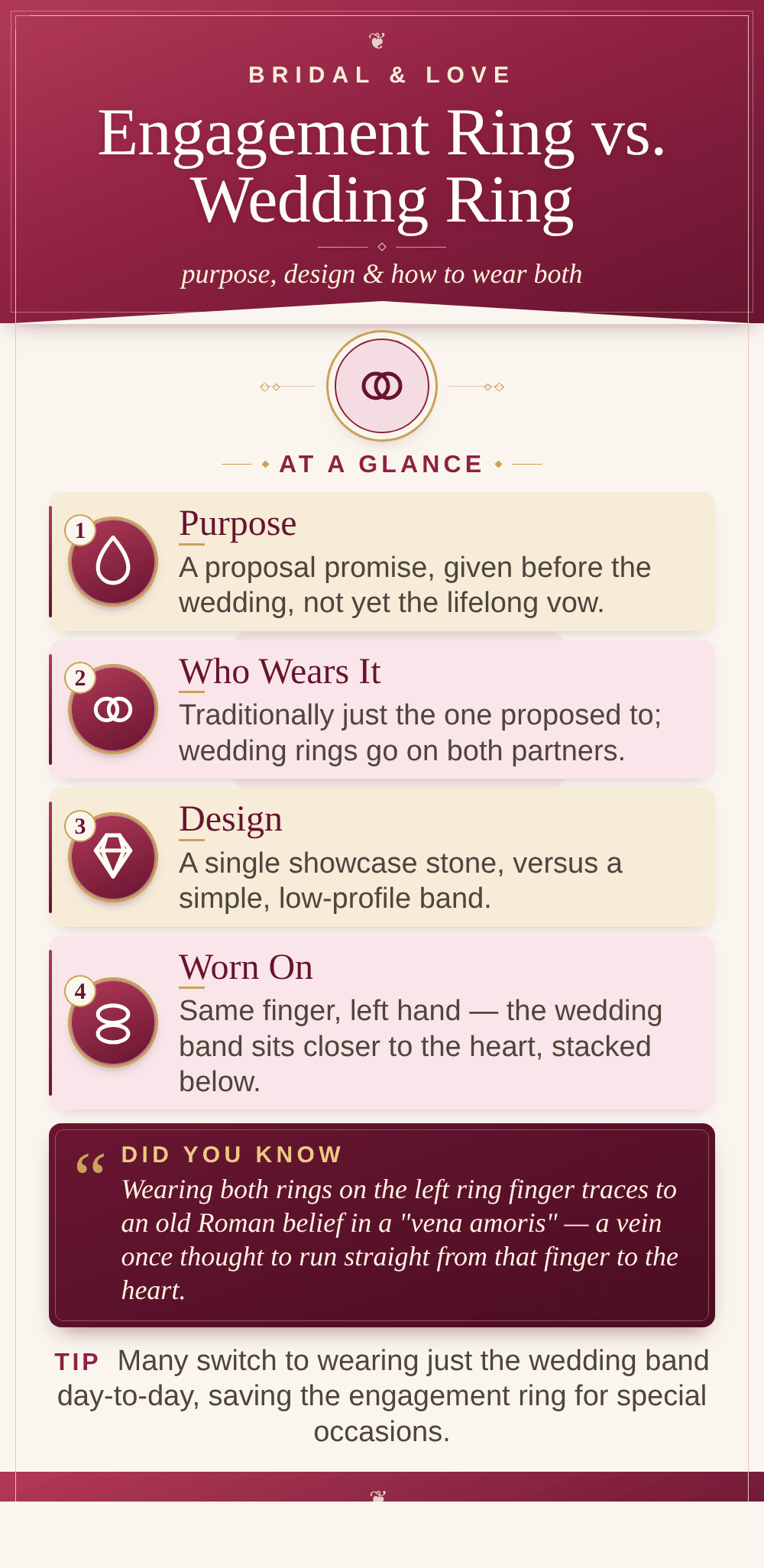
Before the details, here's the side-by-side breakdown. The chart below covers the essentials — purpose, who traditionally wears each ring, typical design, and how the two are worn together. Cost, and whether you actually need both, are covered further down.
What is an Engagement Ring?
An engagement ring — sometimes called a proposal ring — is given at the moment of proposal, symbolizing one partner's commitment to marry the other. It's worn from the day of the proposal through the wedding, and for most couples every day after that. Historically the ring centers on a gemstone — a diamond being the most traditional choice — set on a band of gold, platinum, or silver; today sapphires, moissanite, and other stones are just as common for couples who want color, or a different budget.
History of the Engagement Ring
Rings as symbols of commitment go back thousands of years, but the engagement ring as we know it has a specific, well-documented start. In 1477, Archduke Maximilian of Austria commissioned a diamond ring for his betrothal to Mary of Burgundy — the earliest ring gift on record that matches the modern engagement ring: a diamond, given specifically to mark an engagement rather than a wedding. Diamonds stayed a wealthy-only luxury for centuries after that; it wasn't until 1947, when De Beers launched its “A Diamond Is Forever” ad campaign, that a diamond engagement ring became the expected default. The timeline below traces that whole arc — engagement ring and wedding ring together — from the earliest ring exchanges to today's wider mix of metals and stones.
Design and Engagement Ring Styles
Engagement rings come in a few well-established styles:
- Solitaire – A single stone set alone on a plain band; the most traditional, timeless silhouette, and the easiest to pair with any wedding band later.
- Halo – A ring of smaller accent stones circling the center stone, making it look larger and catching more light.
- Three-Stone – Three gems set side by side, usually read as past, present, and future.
- Vintage – Milgrain edges, filigree, and other antique-inspired detailing borrowed from Art Deco and Victorian design.
- Alternative Stones – Sapphires, rubies, emeralds, and lab-grown or natural colored stones in place of a diamond, for a different color or a lower cost per carat.
Do Men Wear Engagement Rings?
Traditionally, only the partner being proposed to wore an engagement ring. That's changing: some couples now exchange engagement rings for both partners, a practice more common in same-sex marriages and in cultures where both partners have always exchanged a ring at the proposal, not just the wedding.
What is a Wedding Ring?
A wedding ring — also called a wedding band — is exchanged between spouses during the ceremony itself, the moment the marriage becomes official. It symbolizes the commitment being made right then, not a promise to make it later. Wedding rings are usually simpler than engagement rings: a plain or lightly detailed metal band, worn by both partners, meant to be worn every day for the rest of the marriage.
History of Wedding Rings
The custom is far older than the engagement ring. Ancient Egyptians exchanged rings made of braided reeds and hemp, choosing the ring's unbroken circle to represent eternity; the custom was later carried on by the Romans and Greeks. The Romans are credited with the belief behind why the ring sits on the fourth finger of the left hand — they believed a vein there, the vena amoris, ran directly to the heart. Ring exchange became a formal part of the wedding ceremony itself during the Middle Ages, when the church folded it into Christian marriage rites, and by the Renaissance it was standard practice across Western Europe — centuries before the engagement ring existed as a separate tradition.
Design and Wedding Ring Styles
Unlike engagement rings, wedding rings are often simpler in design. Popular styles include:
- Plain Band – An unadorned ring in gold, platinum, or steel; the most traditional choice, and the one least likely to catch on things during daily wear.
- Diamond Eternity Band – Small diamonds or gems set continuously around the ring, sometimes worn alone and sometimes stacked with an engagement ring.
- Curved Wedding Band – Shaped with a notch or curve so it sits flush against an engagement ring instead of leaving a gap.
- Engraved Band – Carved on the inside or outside with a date, initials, or a short phrase; black wedding bands and other dark-metal finishes are a newer take on the same idea.
Does the Groom Wear a Wedding Ring, Too?
Traditionally, yes — both spouses exchange and wear a wedding ring. Some couples skip it, usually because of a job that makes wearing a ring impractical (manual labor, some medical and food-service roles), or because they've chosen a different symbol, like a matching tattoo or bracelet, instead.
Do You Need Both Engagement and Wedding Ring?
No. Both rings are a tradition, not a requirement, and plenty of couples wear one, or neither.
Why Others Do Not Wear Engagement Rings:
- Cost – A diamond engagement ring is often the single most expensive piece of jewelry a couple buys; some would rather put that money elsewhere.
- Minimalist preference – A single simple band, worn after the wedding, is enough for some couples.
- Cultural or religious practice – Some traditions recognize only the wedding ring, or use a different symbol for the engagement itself.
Why Some People Skip Wedding Rings:
- Work or safety – Manual trades, some medical and food-service jobs, and certain sports discourage rings that can catch on things or need to come off constantly.
- Personal preference – A tattoo, a bracelet, or no visible symbol at all, by choice.
Ultimately, it's a personal decision, not an etiquette rule — there's no wrong answer.
How To Wear Engagement And Wedding Rings
If you have both rings, the traditional order is:
- Wedding ring first – worn closest to your heart, at the base of the finger.
- Engagement ring on top – stacked above the wedding band.
Some people wear the rings on the right hand instead of the left, or on separate fingers entirely — both are common variations, not mistakes. During the wedding ceremony itself, most brides move the engagement ring to their right hand temporarily, freeing the left ring finger for the wedding ring, then move it back afterward.
Who Buys the Wedding Rings?
Ring-buying responsibility is traditionally split by whose ring it is, not who's paying for the wedding:
- The bride, or her family, traditionally buys the groom's wedding ring.
- The groom, or his family, traditionally buys the bride's wedding ring.
Many modern couples skip the split entirely and buy both rings together from the same budget.
Wedding Ring Sets: Buying Engagement and Wedding Rings Together
A wedding ring set bundles:
- An engagement ring
- A wedding band for the bride
- A wedding ring for the groom
Buying a set means the metals, finishes, and styles are designed to match without any guesswork — it also makes the curved-band pairing easier, since the bride's wedding band can be cut to fit the engagement ring's exact shape instead of leaving a gap. Some jewelers offer fully custom sets; buying matching pieces separately, on your own timeline, works just as well if you'd rather choose each ring individually.
Common Engagement and Wedding Ring Queries
1. Is Proposing Without An Engagement Ring Even Possible?
Yes. The ring is a tradition, not a requirement — some proposals use a family heirloom, a different piece of jewelry, or no physical object at all, just the words.
2. How much should you pay for a ring?
The “three-month rule” — spending three months' salary — traces back to a 20th-century diamond-industry ad campaign, not a rule anyone has to follow. Spend the amount that fits your own budget: our engagement ring cost statistics guide breaks down what couples actually spent in 2026, from budget-conscious bands to five-figure pieces, so you can weigh any number against real data instead of a slogan.
3. How Do White Gold, Yellow Gold, and Platinum Differ?
- Yellow Gold – The traditional, warm-toned option; needs occasional re-polishing to keep its shine.
- White Gold – A cooler, modern-looking gold alloy plated in rhodium; that plating wears over time and needs reapplying every year or two.
- Platinum – The most durable of the three and naturally hypoallergenic, but also the heaviest and most expensive.
4. Is It Okay To Wear Engagement Ring After Marriage?
Yes. Most people wear their engagement ring stacked with their wedding band for the rest of the marriage. Some switch to wearing only the wedding band day-to-day — for comfort, safety at work, or simplicity — and save the engagement ring for special occasions.
5. If My Ring is Lost?
Ring insurance covers loss, theft, and accidental damage. It's typically sold either as a standalone policy or as a rider added to a homeowners' or renters' policy, and most insurers ask for a recent appraisal or receipt before they'll cover it. It's worth getting even for a modest ring — without it, a lost ring is simply gone, with nothing to fall back on.
Whether you choose the engagement ring, the wedding ring, or both, what matters is the meaning the ring has for you, not the price tag or the tradition behind it. Every relationship is different — choose the rings that tell your own story.
Frequently Asked Questions
Which finger do the engagement ring and wedding ring go on?
Traditionally both are worn on the ring finger of the left hand. When worn together, the wedding ring sits closer to the heart (at the base of the finger) and the engagement ring stacks above it. That said, some people wear their rings on the right hand or on different fingers, so there's no single correct way.
Is a wedding ring the same thing as a wedding band?
Yes, the terms are used interchangeably. A wedding ring, or wedding band, is the ring exchanged between spouses during the ceremony to symbolize the formal commitment of marriage. It's usually a simpler metal band, though it can be customized with engravings or set with small gems.
Do your engagement ring and wedding band need to match?
They don't have to, but many couples choose a curved wedding band designed to fit snugly around the engagement ring for a seamless look. Buying a wedding ring set is one easy way to guarantee the two pieces work together in style and metal. Whether you coordinate them or mix designs is entirely a matter of personal taste.
Can you wear a wedding band without an engagement ring?
Absolutely. An engagement ring is optional, and some people skip it altogether for financial reasons, a preference for minimalism, or cultural traditions that center on the wedding band alone. Wearing only a wedding ring is a completely valid and increasingly common choice.
Should the engagement ring and wedding band be the same metal?
Matching metals like yellow gold, white gold, or platinum gives a cohesive look and helps the rings wear evenly over time, since different metals can have different hardness. Keep in mind that white gold needs occasional rhodium plating and platinum is the most durable but pricier. If you love a mixed-metal look, though, there's no rule against pairing different tones.