A Promise Forged in Metal and Stone
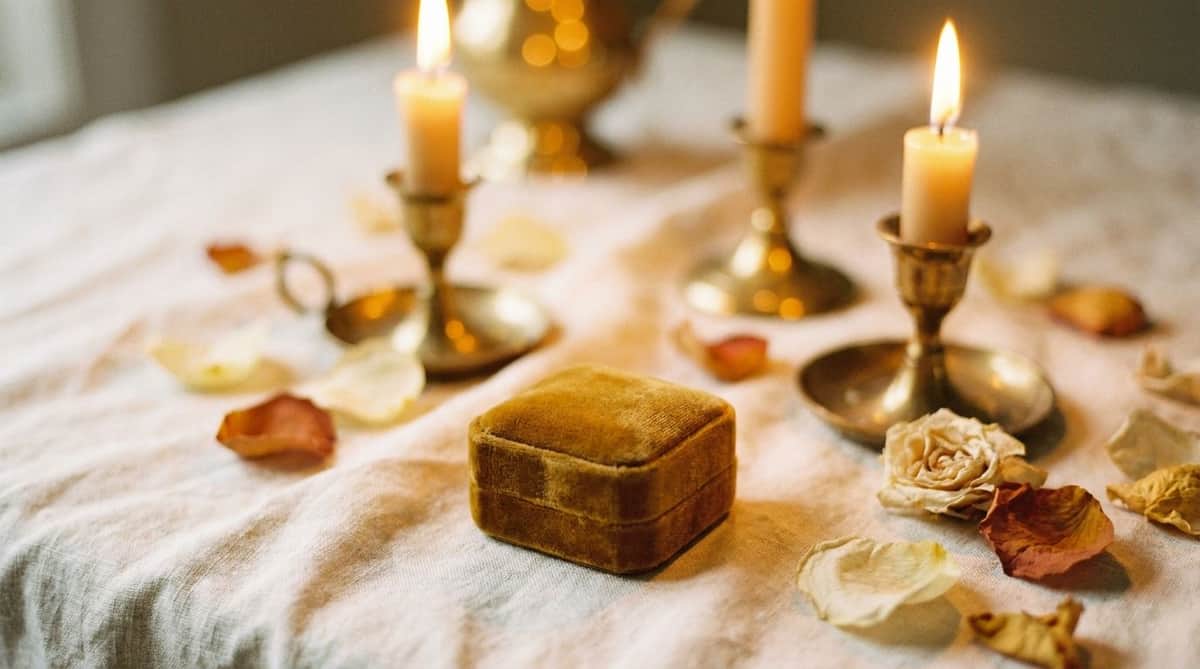
In a quiet corner of a candlelit restaurant, one person drops to one knee, the other gasps. Between them: a small box. Inside it—an engagement ring. It's a moment millions have lived, yet few stop to ask: what is an engagement ring, really?
Beyond the sparkle and the Instagram announcement, an engagement ring is a symbol of love, intent, and timeless commitment. It carries tradition, history, and deeply personal meaning. And today, more than ever, it’s also becoming a canvas for self-expression—with custom engagement rings rising in popularity.
This sits inside our broader engagement, wedding and anniversary coverage — the pieces, the etiquette, and what each one is actually for.
Table of Contents
- What Is an Engagement Ring?
- The Symbolism Behind the Ring
- A Brief History of Engagement Rings
- Modern Trends: The Rise of Custom Engagement Rings
- Types of Engagement Rings
- What to Look for in an Engagement Ring
- FAQs About Engagement Rings
What Is an Engagement Ring?
An engagement ring is a ring — usually set with one or more gemstones, though a plain band works too — that one partner gives the other at a marriage proposal, then wears afterward as public proof the couple plans to marry. There's no rule about the stone, the metal or the price; the ring itself is the agreed-upon gesture, not a required purchase.
The short description: it's a ring given at a proposal and worn continuously afterward as visible proof of an engagement — that's the whole definition. Its significance doesn't come from the stone, the metal or what it cost; it comes from being worn every day until the wedding, which is why a plain band works exactly as well as a diamond for signaling the same thing.
Why a ring at all? Because it's a public symbol of commitment worn continuously, not just spoken once — it signals intent to marry and stays visible through the engagement. It’s traditionally worn on the ring finger of the left hand, a placement ancient cultures traced to a vein they believed ran straight to the heart, the "vena amoris."
How it works, in practice: the ring is given at the proposal and worn from that moment until the wedding, when many couples add a separate wedding band next to it. That’s the whole mechanism — there’s no rule it has to be a diamond, no required metal, and no “correct” price, despite decades of advertising that made it feel that way.
“An engagement ring isn’t just a piece of jewelry—it’s the beginning of a legacy.”
The Symbolism Behind the Ring
Why a ring? Why a circle? From a symbolic standpoint, a ring is perfect:
- No beginning, no end – it symbolizes eternity.
- Worn on the hand – visible proof of commitment to others.
- Placed on the heart-hand – connecting love to life’s work and action.
While modern culture often associates engagement rings with diamonds and luxury, their real symbolism lies in the intention behind them. Whether it’s a solitaire diamond or a braided band of recycled gold, the message is the same: I choose you, now and forever.
So why does any of this matter? Because the significance of an engagement ring was never really about the object — it's about what wearing it continuously, in public, does: it turns a private decision into a visible one, every day, without either partner having to re-announce it.
A Brief History of Engagement Rings
📜 From Roman Roots to Victorian Romance
The concept of the engagement ring traces back over 2,000 years to ancient Rome, where women were given rings made of ivory, flint, or iron to signify a binding agreement. These weren’t always romantic—they often marked contracts or dowries.
💎 The Diamond Age Begins
In 1477, Archduke Maximilian of Austria commissioned a diamond ring for his bride-to-be, Mary of Burgundy. This marked the first known use of a diamond in an engagement ring—starting a trend among European aristocracy.
🛍️ The De Beers Effect
Fast forward to the 20th century, when diamond supplier De Beers launched the slogan “A Diamond Is Forever.” Their campaign revolutionized how engagement rings were marketed—and created the tradition we know today.
Modern Trends: The Rise of Custom Engagement Rings
As couples seek ways to make their proposals more personal, custom engagement rings have surged in popularity. These rings are tailored to reflect the unique relationship, story, and style of the wearer.
🔍 Why Go Custom?
- Symbolic design elements – such as engraved coordinates, family stones, or initials
- Non-traditional gemstones – sapphires, emeralds, or birthstones
- Unique band styles – twisted metals, mixed materials, or vintage designs
Many jewelers now specialize in custom creations, guiding couples through the design process from sketch to stone selection. The result? A one-of-a-kind heirloom, imbued with intention and artistry.
Tip: If you're shopping for a custom ring, ask the jeweler for a CAD rendering and wax mold before final production.
Types of Engagement Rings
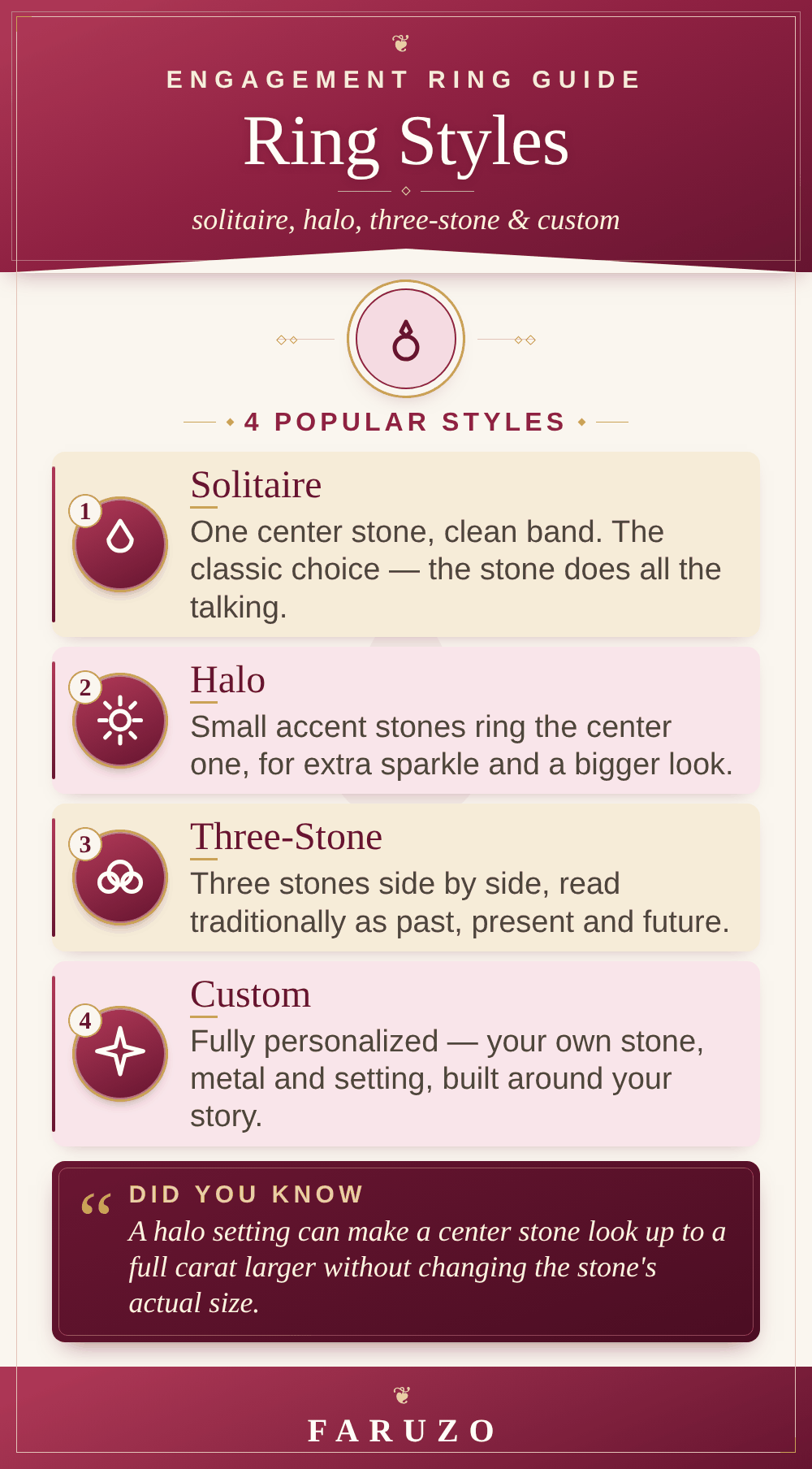
Solitaire — a single center stone on a clean band, usually white gold or platinum. The classic choice, because the stone does all the talking.
Halo — a center stone ringed by smaller accent stones, typically set in yellow or rose gold, for extra sparkle and a bigger look.
Three-stone — three stones side by side, usually platinum or mixed metals, read traditionally as past, present and future.
Custom — any metal, any stone, built entirely around the couple’s own story.
Choosing the right ring depends on personality, lifestyle and values — not just trends. And once you’ve got one, plenty of people stack it with wedding and eternity bands rather than swap it out.
What to Look for in an Engagement Ring
Once the history and the types are out of the way, the practical question is what actually matters when picking one. A few things affect how a ring wears day to day more than the marketing usually lets on.
Metal is a trade-off between durability and upkeep. Platinum is the densest and most scratch-resistant of the traditional choices, which is why it holds a prong securely for decades — but it's heavier and pricier than the alternatives. White gold looks similar for less, at the cost of an occasional rhodium replating once the plating wears thin. Yellow and rose gold skip the replating and simply develop a patina with age.
Setting matters as much as the stone itself. A low-profile setting with sturdy prongs catches less on gloves, hair and fabric than a tall, delicate one — worth asking about if the ring will be worn every day rather than saved for occasions.
Ring size is the detail a surprise proposal most often gets wrong, since there's no chance to measure beforehand. Most jewelers can resize a ring afterward, but it isn't instant or free, so borrowing a ring the person already wears — just to measure the inside diameter — beats guessing.
On budget: the idea that a ring should cost some fixed multiple of a month's salary isn't etiquette — it traces back to the same mid-century diamond marketing covered above, not any actual rule. What a couple can afford is the only real limit, and plenty now put that budget toward a personalized ring instead of a preset stone, or save the bigger piece for later.
Frequently Asked Questions About Engagement Rings
What is the purpose of an engagement ring?
An engagement ring symbolizes a couple’s commitment to marry. It’s a public declaration of love and intention, typically given during a proposal and worn until the wedding day (and often beyond).
How do you describe an engagement ring?
The standard vocabulary covers four things: the metal (platinum, white, yellow or rose gold), the setting (solitaire, halo, three-stone or custom), the center stone's shape and cut (round, oval, cushion, emerald and so on), and the band style (plain, pavé or twisted). Jewelers and insurers use that same breakdown on an appraisal, so it's worth knowing before you shop or file a policy.
What is the difference between an engagement ring and a wedding ring?
An engagement ring is given at the time of the proposal, often featuring a gemstone like a diamond. A wedding ring is exchanged during the marriage ceremony and is usually simpler, such as a band worn alongside the engagement ring.
Do both partners wear engagement rings?
Traditionally, only one partner wears an engagement ring—usually the one being proposed to. However, modern couples are redefining norms, and it's becoming common for both partners to wear engagement rings.
Why are diamonds the traditional choice for engagement rings?
Diamonds became the traditional choice after De Beers’ marketing campaign in the 1940s. They were promoted as the hardest, most enduring stone—representing lasting love and commitment.
Are engagement rings necessary?
No, they’re not required. Many couples choose engagement rings as a meaningful tradition, but others opt for different ways to symbolize their commitment—such as tattoos, heirlooms, or even skipping rings altogether.
How do engagement rings work?
The ring is given at a proposal and worn from that point on, typically on the left hand’s fourth finger. At the wedding, it’s usually joined by a separate wedding band — worn together, or less often combined into one piece. Beyond that there’s no fixed process: who buys it, how much is spent, and whether the recipient helps choose it are customs, not rules.
Who keeps the engagement ring if the engagement ends?
There’s no single answer — etiquette and local law don’t always agree, and rules vary by place. The most common convention treats the ring as a gift tied to the marriage that didn’t happen, so it’s often returned to the giver, but plenty of couples just work it out between themselves instead.
Does the shape of an engagement ring's stone mean anything?
Not really — shape is a style choice, not a coded message. Round brilliants are popular for their classic sparkle and durability, while oval, cushion, or emerald cuts tend to be chosen for a more elongated or vintage look.
💬 More FAQs: People Also Ask
What does an engagement ring symbolize?
An engagement ring symbolizes love, commitment, and the promise of marriage. It traditionally marks the intention to wed and is often seen as a physical representation of a couple’s bond.
When did engagement rings become a tradition?
Engagement rings became a cultural tradition in the 15th century, popularized by Archduke Maximilian of Austria’s diamond ring proposal. Their widespread use exploded in the 20th century thanks to advertising.
What makes a good engagement ring?
A good engagement ring suits the wearer’s style, fits their lifestyle, and carries personal meaning. It doesn’t need to be expensive—custom design and thoughtful symbolism matter more than carats.
Can you design your own engagement ring?
Yes! Custom engagement rings are increasingly popular, allowing couples to co-create a ring that reflects their unique relationship. Jewelers can help design everything from the stone to the band to personal engravings.
A Symbol That’s Evolved With Us
From iron bands in ancient Rome to personalized heirlooms handcrafted today, the engagement ring has traveled centuries—but its core meaning hasn’t changed: love, commitment, and future promise.
It’s more than a diamond. It’s more than tradition. It’s a decision to start something together—and wear that decision proudly.
“The most beautiful ring is the one you’re proud to wear every day—because of who gave it to you, and why.”
Not every couple starts with the diamond. Plenty mark the decision first with a simpler pair — matching rings engraved with both names — and let the engagement ring arrive when it arrives.
And the traditions don’t stop at the wedding — anniversaries carry their own gemstone customs, like why the fifth anniversary is marked in sapphire.