Most milestone anniversaries settle on one name, maybe two. The 30th splits between pearl and diamond; the 40th, unusually, doesn't split at all. The 35th is the odd one out in a different way — ask three different sources what the 35th anniversary gift is and there's a real chance you'll get three different answers: coral, jade, and emerald, each correct on its own list. Here's where each name comes from, what the three materials actually have in common and where they diverge, and jewelry ideas that translate any of them honestly.
Why thirty-five years gets three different answers
Assigning a material to each wedding anniversary predates any single jeweler's marketing calendar — the custom traces back to Germanic and Central European folk traditions, formalized for American shoppers in 1937 when the American National Retail Jewelers Association (now Jewelers of America) published a year-by-year list. Coral sits on that original list at year thirty-five, chosen the way most of the earlier, "traditional" materials were: for what it is rather than how it photographs, a hard-won organic material that takes years to form.
Jade is the newer, "modern" counterpart — part of the parallel list retailer associations built out in the mid-20th century, generally swapping a sentimental, older-world material for something that reads as more universally desirable on a store shelf. And emerald shows up on a third list entirely: the gemstone list jewelers use alongside the traditional and modern ones, which assigns a stone to nearly every milestone year (sapphire at five, ruby at fifteen and forty, emerald at twenty and again, on several published versions, at thirty-five). Three separate trade traditions, built decades apart, simply never converged on this particular year — which is less a gap in the system than a chance to pick whichever of the three actually fits the couple being shopped for.
Where thirty-five sits on the milestone list
Coral, jade, and emerald aren't isolated choices — they sit together at one stop on a list that runs from paper at year one to gold at year fifty, with each material generally getting more durable and more precious as the years climb:
Coral, jade, and emerald, compared
The three materials don't just come from different lists — they behave differently as jewelry, which matters more than the trivia once you're actually choosing one:
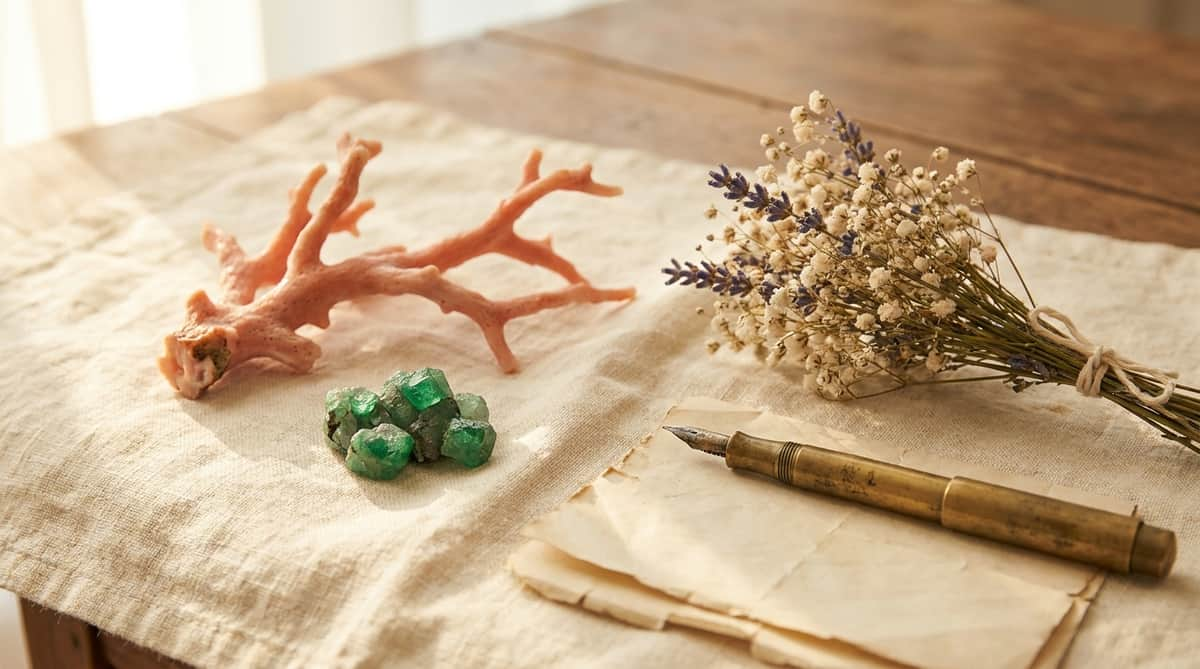
- Coral (traditional). An organic material built by marine coral polyps, not a mineral — soft as gemstones go (roughly 3–4 on the Mohs hardness scale, similar to pearl), in warm pink, orange, or red tones. Reads as the most literally "35 years in the making" of the three, since each piece took decades to form, but it scratches and fades with rough wear and needs gentler care than a mineral gem. Precious coral harvesting is also tightly regulated in several regions today, so a piece sold as "coral" in modern jewelry is as likely to be a coral-toned stone or glass as the real organic material — worth asking about directly.
- Jade (modern). A genuinely tough mineral (jadeite, the finer of the two jade types, runs around 6.5–7 on the Mohs scale) prized in East Asian jewelry traditions for far longer than it's been a Western anniversary gift, in colors running from pale celadon to a deep, saturated green. Tougher than its hardness number suggests — jade resists chipping unusually well, which is part of why it has survived as carved jewelry for millennia.
- Emerald (gemstone list). The hardest and most conventionally "gemstone" of the three at 7.5–8 on the Mohs scale, but graded down in real-world durability because natural emeralds are almost always visibly included, which makes them more prone to fracturing under a hard knock than the raw hardness number implies — see our Mohs hardness guide for how that tradeoff plays out across different stones. Deep green, widely available as a center stone or accent, and the most straightforward of the three to set into a ring or pendant the way most jewelry shoppers expect a "35th anniversary stone" to look.
None of the three is more "correct" than the others — picking between them mostly comes down to whether the couple wants the sentimental organic material, the East Asian jewelry tradition, or the conventional center-stone gem.
Ring, necklace, or bracelet — what actually fits year thirty-five
A ring works well when the 35th is being marked with something new rather than a replacement for the original wedding set — an emerald-accent band is the most literal reading of the gemstone list, worn alongside rather than instead of the wedding ring. FARUZO's personalized rings collection covers plain engraved bands as well as styles that can carry a small accent stone, for whichever direction the couple leans.
For something worn daily rather than saved for occasions, a matching pair of engraved necklaces carries the anniversary through color and an engraved date instead of a stone that needs special handling — a useful option given coral's and emerald's care requirements. FARUZO's couples necklaces category has pairs that work in warm gold tones (echoing coral) or with a small green accent (echoing jade or emerald), without requiring the actual organic or fragile material.
Budget is worth stating directly here too: a genuine, sizable emerald is priced like the precious stone it is, and ethically sourced precious coral can be harder to find and pricier than its modest reputation suggests. An engraved pendant or a slim band in a color that nods to one of the three materials covers the milestone honestly without chasing a particular carat weight or harvest certification.
Continuing the anniversary series
Thirty-five follows the same format used for the milestones around it: where each material comes from, what it's actually asking for, and jewelry ideas that translate it honestly rather than defaulting to the most expensive option. See the 30th anniversary gift guide for how pearl and diamond split at year thirty, the 40th anniversary gift guide for the one milestone where every list agrees, or the full anniversary gift guide by year for every stop on the list from paper to gold. For more on emerald specifically, see our emerald meaning guide.
Engraving ideas worth using
- The wedding date in Roman numerals — XXXV marks the exact milestone without spelling out the number.
- A short phrase naming what's lasted, kept to a handful of words so it still reads cleanly at engraving size.
- Both partners' initials set around a single date, ordered as a matching pair for pieces worn by each spouse.
- The coordinates of the wedding venue, or of wherever the marriage actually began.
Frequently Asked Questions
What is the traditional 35th wedding anniversary gift?
Coral — part of the original US gift list the American National Retail Jewelers Association standardized in 1937, now maintained by Jewelers of America.
What is the modern 35th anniversary gift?
Jade. It comes from a separate "modern" gift list that mid-20th-century retailer associations built alongside the traditional one.
What is the 35th anniversary gemstone?
Emerald. It's the stone assigned to year thirty-five on the separate gemstone list jewelers use alongside the traditional and modern lists — distinct from emerald's better-known association with the 20th anniversary and May birthstones.
Why does the 35th anniversary have three different gift materials instead of one?
Because the traditional, modern, and gemstone lists were built by different trade groups in different decades without coordinating with each other. Most years land on the same or closely related materials across lists; the 35th is one of the milestones where they simply didn't.
Is there a flower or color associated with the 35th anniversary?
Coral-toned flowers are commonly suggested for the 35th, following the traditional gift's color, though sources disagree more on a flower for this year than they do on the gift materials themselves.
What's a good jewelry gift for a 35th anniversary on a smaller budget?
An engraved pendant or slim band in a warm gold or green-accented finish covers the milestone without matching the price of a graded emerald or sourced precious coral — the engraving, not the material's rarity, is what carries the sentiment.
Does precious coral jewelry raise any sourcing concerns?
Yes — precious coral harvesting is restricted or regulated in several regions due to reef conservation concerns, so genuine coral jewelry can be harder to source and more expensive than its modest reputation suggests. Many 35th-anniversary pieces use a coral-toned stone or engraved metal instead of harvested coral for that reason.