
Crystal guide
Desert rose Meaning, Properties and Care
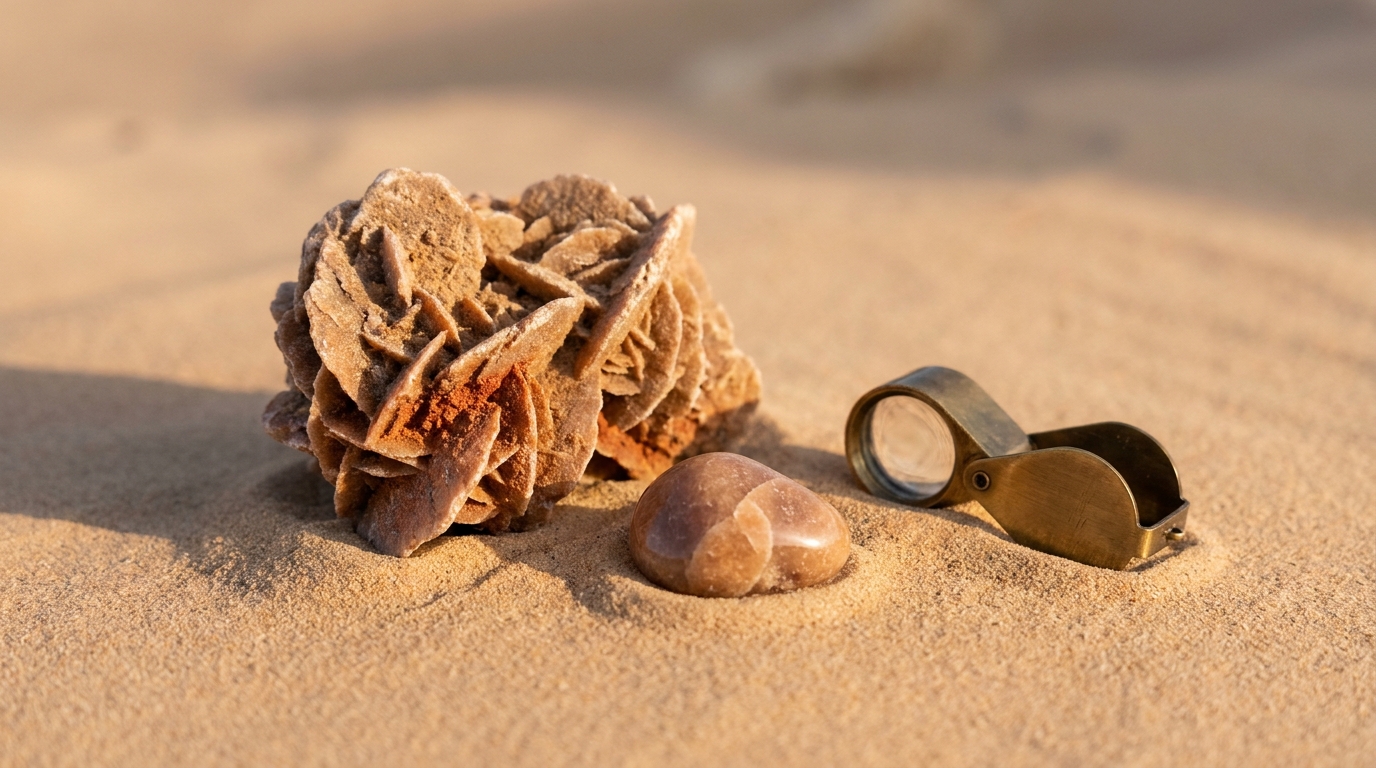
A desert rose is not a mineral of its own but a flower-like shape: flat crystal plates of gypsum or barite fanning out from a centre, with sand grains trapped inside. Gypsum roses are very soft (Mohs 2) and barite roses only a little harder (about 3 to 3.5), so this is a specimen to display rather than a stone to wear. In crystal tradition it is a stone of grounding and patience.
At a glance
- A crystal habit, not a species: usually gypsum (CaSO4·2H2O) or barite (BaSO4).
- Hardness is Mohs 2 for gypsum and about 3 to 3.5 for barite. Both split along flat planes.
- Formed in arid, sandy ground, with sand grains and iron oxide giving a gritty, rusty look.
- Care: keep it dry and dust it gently. It is a display piece, not everyday jewellery.
Quick facts
| Family | A crystal habit of sulfate minerals, most often gypsum or barite |
|---|---|
| Chemical formula | Gypsum CaSO4·2H2O or barite BaSO4, depending on the specimen |
| Crystal system | Monoclinic for gypsum, orthorhombic for barite |
| Mohs hardness | 2–3.5 |
| Luster | Dull to matte and gritty from included sand; both gypsum and barite have perfect cleavage |
| Transparency | Usually opaque, because of the sand inside |
| Natural colors | sandy tan, beige, rusty red-brown from iron oxide |
| Main localities | Tunisia (around Chott el Djerid); Algeria; Libya (Ghadames); Saudi Arabia (near Abqaiq); USA (Oklahoma, as barite rose rock) |
| Common treatments | usually sold natural, though some pieces may be dyed or sprayed to look richer; thin petals chip and snap easily, so handling is the bigger concern |
Desert rose at a glance, in pictures
Hardness range
Natural colors
- sandy tan
- beige
- rusty red-brown from iron oxide
Common forms of Desert rose
- Rough raw chunk
How hard is Desert rose?
- Talc 1
- Gypsum 2
- Desert rose 2–3.5
- Copper coin ~ 3
- Calcite 3
- Fluorite 4
- Apatite 5
- Glass ~ 5.5
- Steel knife ~ 5.5
- Orthoclase 6
- Quartz 7
- Topaz 8
- Corundum 9
- Diamond 10
What it is and where it comes from
"Desert rose" names a shape, not a mineral. The flat plates are arranged in a circle like petals, and the shape tends to form where crystals grow in arid, sandy ground.
Most desert roses form where a shallow, mineral-rich basin dries up slowly, leaving crystals to grow around the sand already there. The sand ends up trapped between the plates.
Large numbers come from the Sahara, around the salt lake Chott el Djerid in southwestern Tunisia, with related finds in Algeria and Ghadames in Libya. Barite roses are also known near Abqaiq in Saudi Arabia.
Oklahoma has its own barite version, called rose rock, found in red sandstone. It formed from a retreating Permian sea roughly 250 million years ago, when barite crystallised around grains of quartz sand. Oklahoma named it the state rock in the late 1960s.
Gypsum roses usually look sharper-edged, while barite roses tend to look softer and more rounded. Colour alone does not tell the two apart, since both range from tan to rusty brown.
Typical pieces are small, about half an inch to an inch across, but much larger rose-rock specimens exist in Oklahoma, some weighing tens of kilograms.
In crystal tradition
What follows is belief and folklore, passed down in crystal tradition. It is not measured fact.
Traditionally associated with: grounding, patience, letting go.
The desert rose is traditionally described as a stone of grounding and endurance, a reading drawn from its image of a delicate shape forming in harsh, dry ground. Some also link it with patience and with letting go of what no longer serves.
It has no single long-established chakra link, and different crystal traditions place it at the heart or crown. These are beliefs within crystal practice, not measured properties of the stone.
How to care for Desert rose
- Water Avoid
- Sunlight Unknown
- Salt Unknown
- Heat Caution
- Ultrasonic Avoid
- Chemicals Caution
Safe = fine as a rule · Caution = only briefly or gently · Avoid = can damage the stone · Unknown = no reliable guidance.
Do not soak a desert rose. Gypsum dissolves a little in water and barite roses can still crumble where sand binds the plates, so keep it dry and dust it with a soft brush. Skip ultrasonic cleaners, because vibration can snap thin petals. Gypsum loses water when heated, so keep it away from hot rooms and steam. Harsh cleaners can damage the matte surface. Store it on a shelf or in a box with padding so the petals are not knocked, away from harder stones that could scratch it. A piece that has been dyed or sprayed may behave differently, and the colour can rub off.
Real or fake? Look-alikes and treatments
Often confused with
- Celestite rosettes
- Rose-shaped carved or moulded pieces
- Gypsum versus barite roses
Common look-alikes
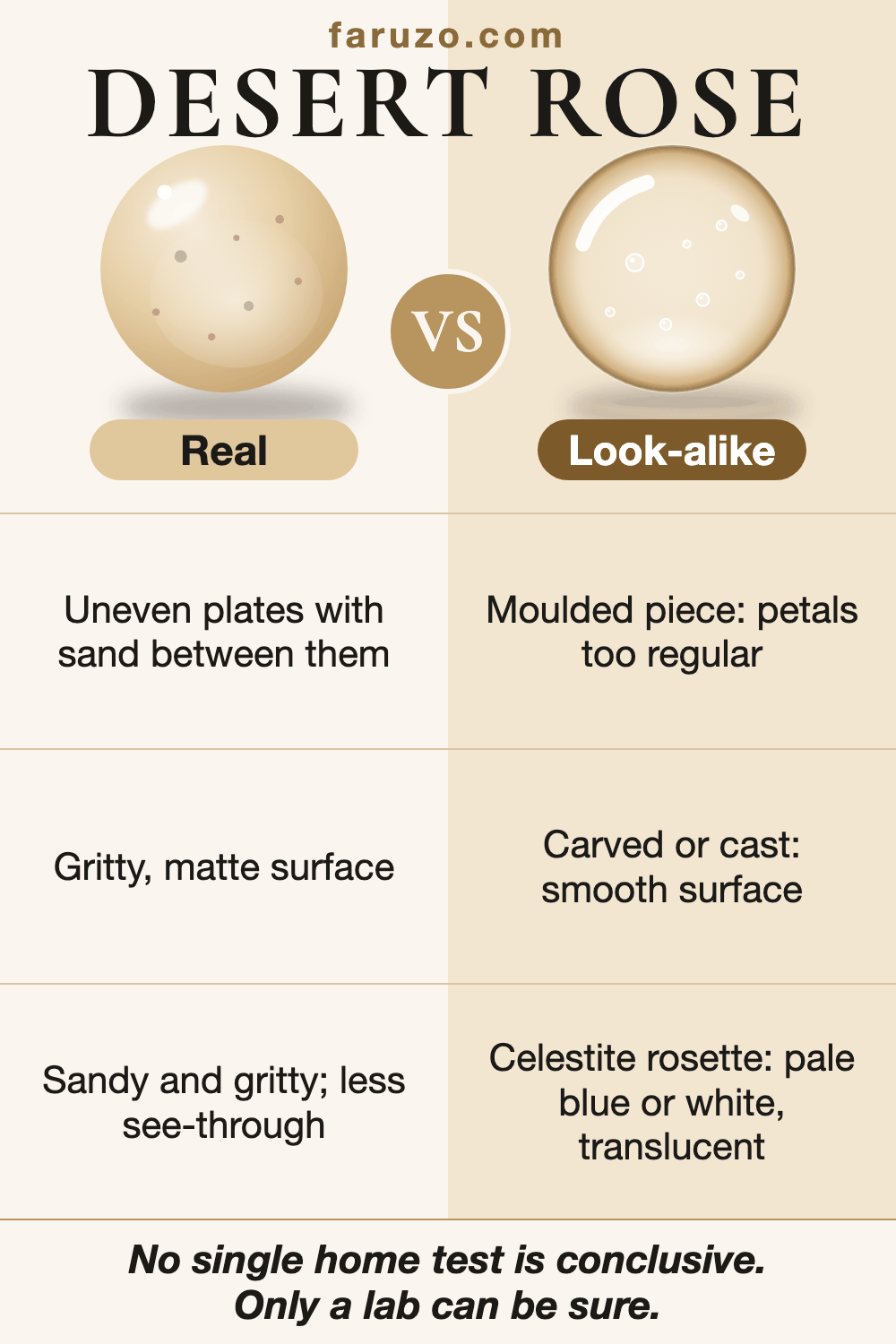
- Celestite rosettes. Celestite is another bladed sulfate that can form rosette clusters. It is often pale blue or white and more translucent, while a desert rose is typically sandy and gritty.
- Rose-shaped carved or moulded pieces. Carved or cast imitations tend to have petals that are too regular and a smooth surface. A natural rose has uneven petals and visible trapped sand.
- Gypsum versus barite roses. Both are real desert roses. Gypsum is lighter and softer with crisper edges, while barite feels noticeably heavier for its size and looks a little more rounded.
Safe checks you can do
- Look at the petals. Natural roses have uneven plates with sand grains showing between them, while moulded pieces look too regular.
- Notice the surface. A natural piece feels gritty and matte, not smooth or glossy.
- Check the weight. A barite rose feels heavy for its size, while a gypsum rose feels light.
- Be wary of very bright, even red or orange colour. It can be a sign of dye or spray, so ask the seller whether the piece is natural.
- Do not scratch-test a piece you want to keep, since it marks easily. A lab can sometimes tell gypsum from barite.
Wearing Desert rose
Ring
Avoid
Splits easily along a flat plane, so a ring is best avoided.
Bracelet
Avoid
One knock on the wrist can split it along a flat plane.
Pendant
Avoid
A pendant has to stay dry, so it is best avoided.
Earrings
Avoid
Rain and showers can ruin it, so earrings are best avoided.
Guide for everyday wear, based on hardness and care notes. Safe, Careful or Avoid.
A desert rose is soft, splits along flat planes and has thin petals that snap, and it should stay dry, so a ring is best avoided, and a bracelet, pendant and earrings are best avoided too. It suits a shelf, a dish or a display box. A small piece set in a closed setting would still be a risk, so keep it for display rather than wear.
Related stones
Questions about Desert rose
What does a desert rose mean?
In crystal tradition the desert rose is a stone of grounding, patience and endurance, drawing on the image of a delicate shape forming in dry ground. That is a belief, not a fact about the stone.
What is a desert rose?
It is a rosette of flat crystal plates, usually gypsum or barite, that grew in arid sandy ground and trapped sand between the plates. The name describes the shape, not a single mineral.
Is a desert rose a real crystal or a rock?
It is a cluster of crystals, not a single crystal and not a rock in the strict sense. The plates grew together around sand grains.
What is the difference between gypsum and barite desert roses?
They are chemically unrelated minerals with the same rose shape. Gypsum is softer (Mohs 2), lighter and usually sharper-edged, while barite is a little harder (about 3 to 3.5), heavier and more rounded. Saharan roses are usually gypsum, and Oklahoma rose rock is barite.
How hard is a desert rose?
Gypsum roses are Mohs 2, soft enough for a fingernail to mark, and barite roses are about 3 to 3.5. Both split along flat planes, and the thin petals chip and snap easily.
Is desert rose a birthstone?
No. Desert rose is not on the standard modern or traditional birthstone lists.
Can a desert rose get wet?
No. Do not soak it, and keep it dry. Gypsum dissolves a little in water and the sand-bound plates can crumble, so dust it with a soft brush instead.
Can you wear a desert rose as jewelry or in a ring?
It is a poor fit for any jewellery. A ring is best avoided because it is soft and the petals snap, and the same goes for bracelets, pendants and earrings. It is meant to be displayed.
Do desert roses fade, and are some dyed?
Natural colour comes from sand and iron oxide and is usually stable on a shelf. Some pieces may be dyed or sprayed to look redder, and that colour can rub off or look unnaturally bright.
Where do desert roses come from?
The best known source is the area around Chott el Djerid in southwestern Tunisia, with finds in Algeria, Libya and near Abqaiq in Saudi Arabia. Oklahoma has barite rose rock, formed about 250 million years ago and named the state rock in the late 1960s.
Is a desert rose related to selenite?
Both can be gypsum. Selenite is the clear, glassy form, while a desert rose is the sandy rosette form.