
Crystal guide
Bronzite Meaning, Properties and Care
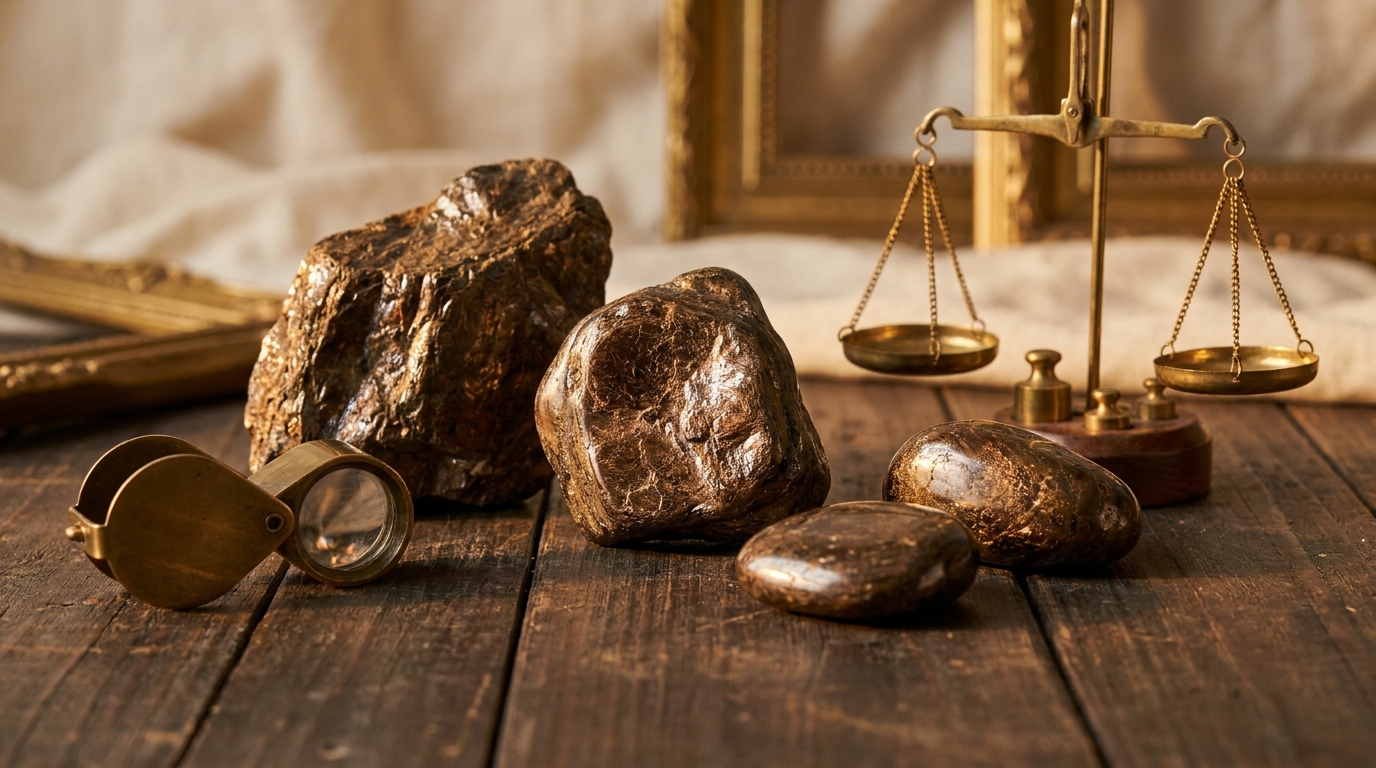
Bronzite is a brown to greenish-brown pyroxene mineral, an iron-bearing form of enstatite, best known for the bronze-coloured, metallic-looking sheen that gives it its name. The sheen is a natural feature of the stone, not a coating. It is only moderately hard and splits along flat planes, so it suits gentle wear better than daily knocks. In crystal tradition it is a grounding, steady stone.
At a glance
- Formula (Mg,Fe)2Si2O6, orthorhombic, an iron-bearing form of enstatite.
- Hardness about 5 to 6 on the Mohs scale, with perfect cleavage in two directions.
- The bronze metallic sheen is natural and shows best on polished cabochons and beads.
- Colour runs brown to greenish-brown. Best worn as a pendant or earrings, not a ring.
Quick facts
| Family | Pyroxene group, an iron-bearing form of enstatite in the enstatite and ferrosilite series |
|---|---|
| Chemical formula | (Mg,Fe)2Si2O6 |
| Crystal system | Orthorhombic |
| Mohs hardness | 5–6 |
| Luster | Sub-metallic, with a bronze-like sheen on cleavage surfaces; perfect cleavage in two directions |
| Natural colors | bronze-brown (the classic look), greenish-brown, dark brown |
| Main localities | USA (Maryland, Montana); Germany (Fichtel Mountains); Austria (Styria); Myanmar |
| Common treatments | usually sold as natural polished stone; cheap bronze-toned beads can be glass or coated stone, so ask what the material is |
Bronzite at a glance, in pictures
Chakras (traditional)
Hardness range
Natural colors
- bronze-brown (the classic look)
- greenish-brown
- dark brown
Traditionally linked to
- Element
- Earth
Common forms of Bronzite
- Rough raw chunk
- Tumbled polished pebble
- Cabochon smooth dome
- Bead drilled bead
How hard is Bronzite?
- Talc 1
- Gypsum 2
- Copper coin ~ 3
- Calcite 3
- Fluorite 4
- Apatite 5
- Glass ~ 5.5
- Steel knife ~ 5.5
- Bronzite 5–6
- Orthoclase 6
- Quartz 7
- Topaz 8
- Corundum 9
- Diamond 10
What it is and where it comes from
The name refers to the bronze-like sheen on its cleavage surfaces. It has nothing to do with the metal bronze.
Bronzite belongs to the enstatite series of pyroxenes, a family of magnesium and iron silicates. It is the iron-bearing, bronze-sheened form of enstatite, and it is sometimes described as altered enstatite rather than a separate species.
Enstatite-family minerals are common in igneous rock and are also found in many meteorites, which is an unusual background for a jewelry stone.
Notable occurrences include Maryland and Montana in the USA, the Fichtel Mountains in Germany and Styria in Austria.
Polished pieces are usually cut as cabochons or beads. A fibrous structure in some material can give a cat's-eye-like glow, which is one reason it gets compared with tiger's eye.
Hypersthene is a closely related iron-richer pyroxene, and the two names are sometimes used for similar-looking material.
In crystal tradition
What follows is belief and folklore, passed down in crystal tradition. It is not measured fact.
Traditionally associated with: grounding, steadiness, courtesy.
Bronzite is traditionally called a stone of courtesy and is associated with grounding, calm confidence and the Root chakra. This is a modern spiritual tradition, not a fact about the stone.
A frequently repeated story says Romans carried powdered bronzite as a protective talisman. It is best treated as folklore rather than established history.
How to care for Bronzite
- Water Caution
- Sunlight Unknown
- Salt Unknown
- Heat Caution
- Ultrasonic Avoid
- Chemicals Caution
Safe = fine as a rule · Caution = only briefly or gently · Avoid = can damage the stone · Unknown = no reliable guidance.
Wipe bronzite with a soft cloth, or use a damp cloth with a little mild soap, then dry it straight away. Do not soak it or put it in an ultrasonic or steam cleaner, because vibration and sudden heat can stress a stone that splits along flat planes. Keep it away from harsh cleaners and store it apart from harder stones so it is not scratched.
Real or fake? Look-alikes and treatments
Often confused with
- Bronze-toned glass
- Coated or metallic-finished stones
- Hematite
Common look-alikes
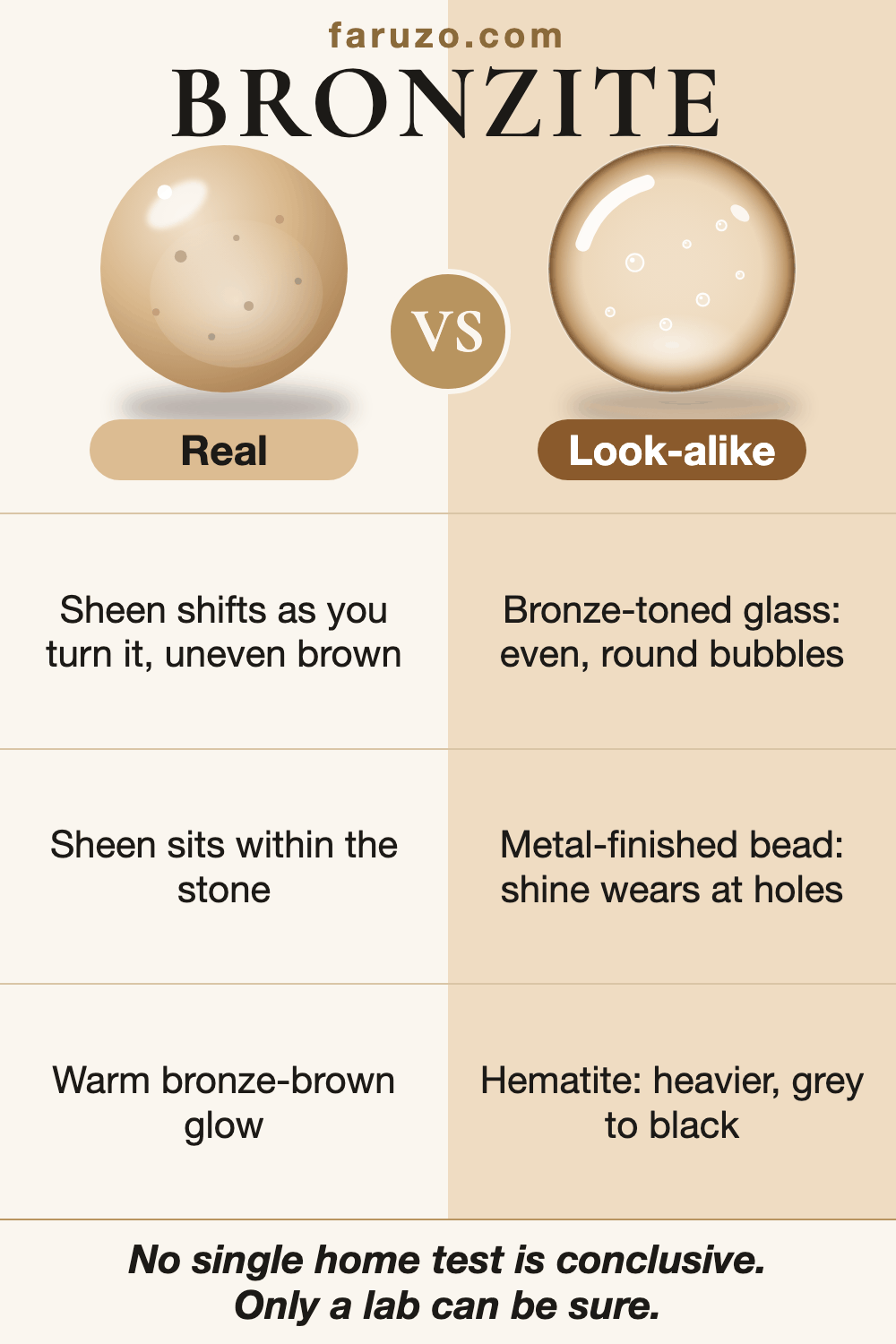
- Bronze-toned glass. Glass beads can copy the bronze colour but tend to look too even and may show tiny round bubbles. Bronzite shows a sheen that shifts as you turn it, with natural variation in colour.
- Coated or metallic-finished stones. A thin metallic coating, often on a dark bead, can give a bronze shine. Coatings may rub off at the edges and hole openings, while bronzite's sheen sits within the stone.
- Hematite. Hematite is a different mineral, heavier and metallic grey to black rather than brown, and it lacks bronzite's warm bronze-brown glow.
Safe checks you can do
- Ask the seller in writing whether the beads or cabochons are natural bronzite, glass or a coated stone.
- Turn the piece in the light. Natural bronzite shows a sheen that moves and fades with the angle, with uneven brown and bronze patches.
- Look at the edges and the holes of beads. A coating tends to wear or flake there first, and glass often shows tiny round bubbles.
- Be wary of perfectly uniform, mirror-bright beads sold at a very low price as bronzite.
- A lab can sometimes tell natural bronzite from glass or coated material, so have a piece that matters checked rather than scratch-testing it.
Wearing Bronzite
Ring
Avoid
Splits easily along a flat plane, so a ring is best avoided.
Bracelet
Avoid
One knock on the wrist can split it along a flat plane.
Pendant
Careful
It can split along a flat plane, so keep it protected.
Earrings
Careful
A flat-plane split is possible, so keep earrings for dressy wear.
Guide for everyday wear, based on hardness and care notes. Safe, Careful or Avoid.
Bronzite is only moderately hard and splits easily along flat planes, so a sharp knock can chip or crack it. That makes a ring or a bracelet best avoided, while a pendant or earrings take fewer knocks and suit it better, ideally in a setting that protects the stone. Remove it for the gym, washing up and anything rough.
Related stones
Questions about Bronzite
What does bronzite mean?
In crystal tradition bronzite is a grounding stone linked to calm confidence, courtesy and the Root chakra. That is a belief, not a fact about the stone. Its real talking point is the natural bronze sheen.
What is bronzite?
Bronzite is an iron-bearing form of enstatite, a pyroxene mineral with the formula (Mg,Fe)2Si2O6. It is brown to greenish-brown and known for a bronze-like metallic sheen.
Why does bronzite have a metallic sheen?
The sheen is natural. It is usually explained by thin, aligned plates inside the crystal that reflect light back, an effect called schiller. It looks strongest on well-polished pieces and weaker on rough or poorly cut ones.
How hard is bronzite?
About 5 to 6 on the Mohs scale, softer than quartz. It also has perfect cleavage in two directions, which makes it easier to chip.
Is bronzite a birthstone?
No. Bronzite is not on the standard modern or traditional birthstone lists.
Can bronzite get wet?
A quick wipe is fine, but do not soak it and dry it straight away. Take bronzite jewelry off for showers, swimming and washing up.
Is bronzite the same as tiger's eye?
No. Bronzite is a pyroxene, while tiger's eye is a quartz variety and noticeably harder. Both are brown with a moving shine, which is why they are sometimes mixed up.
Can a bronzite ring be worn every day?
A ring is best avoided. Rings take the most knocks, and bronzite scratches and can split along flat planes. A pendant or earrings are a safer way to wear it.
Will bronzite fade, and is the colour dyed?
The bronze sheen is natural and does not normally fade. Some cheap bronze-toned beads are glass or coated stone, though, and a coating can wear off. Ask what a piece is made of before buying.
Is bronzite the same as enstatite or hypersthene?
It is closely related. Bronzite is an iron-bearing form of enstatite, and hypersthene is a similar, iron-richer pyroxene. The names are sometimes used for similar-looking material.
Where does bronzite come from?
It forms in igneous rock, and similar minerals also occur in meteorites. Notable occurrences include Maryland and Montana in the USA, Germany and Austria.
Is bronzite rare or expensive?
The mineral is not rare, and polished beads and cabochons are widely available. Quality varies with how strong and even the sheen is.