Turquoise is one of the oldest gemstones in continuous human use, worn from ancient Egypt to the modern Southwestern United States, and it's also one of the modern birthstones for December, alongside blue topaz and blue zircon. Unlike most stones in a typical birthstone lineup, turquoise isn't a transparent, faceted gem — it's an opaque mineral prized for color alone, and that difference shapes everything from how it forms to how it needs to be worn and cared for. If you're not sure which of December's three stones fits a piece you're shopping for, our birthstone finder walks through the full modern and traditional lists month by month. This guide covers what turquoise actually is, the real geology and history behind it, how to identify genuine stone, and how to wear and care for it.
What Turquoise Actually Is
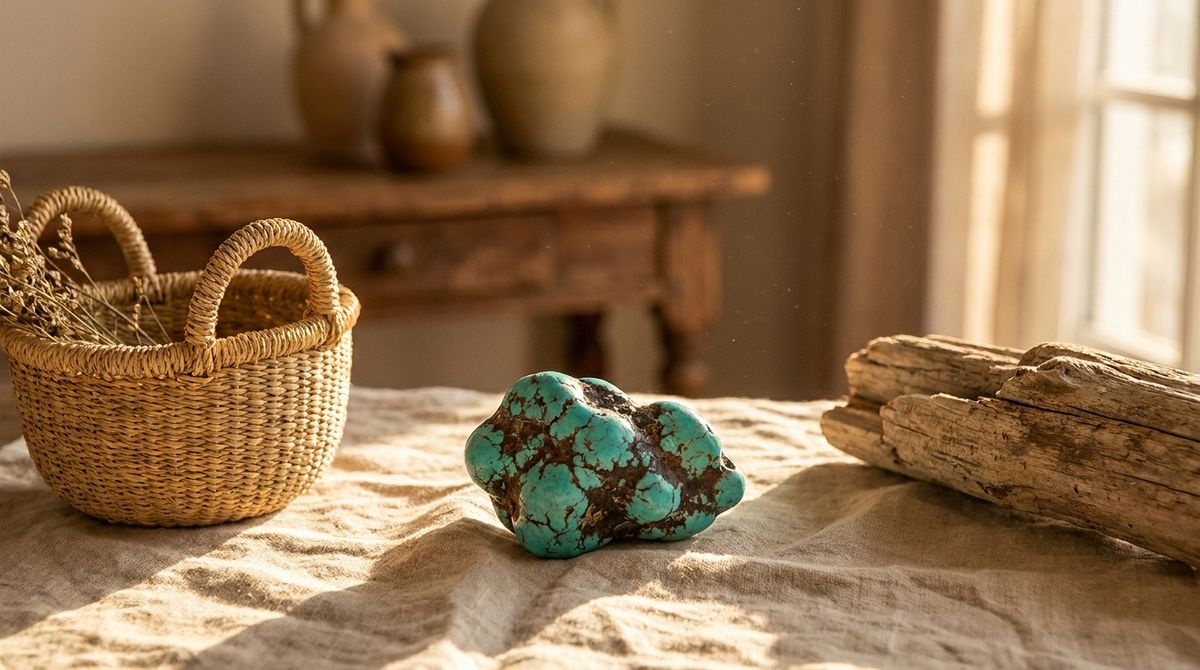
Turquoise is a hydrated phosphate mineral of copper and aluminum, and it's opaque rather than transparent — light doesn't pass through it the way it does through a stone like sapphire or garnet, which is why turquoise is almost always cut as a smooth cabochon or bead instead of faceted. Its signature blue comes from copper in the mineral's structure; where iron impurities are also present, the color shifts toward green, which is why "turquoise" covers a range from sky blue through blue-green to a more olive-toned green rather than a single fixed shade.
On the Mohs hardness scale, turquoise runs just 5 to 6 — notably softer than most other gemstones commonly set in jewelry, and it's also porous, with a structure full of microscopic pores rather than a dense, sealed crystal lattice. That combination of softness and porosity is the single most important thing to understand about the stone, because it drives both how turquoise is treated before sale and how it needs to be handled afterward.
Properties: Physical, Mental, and Metaphysical
Physical
Turquoise's opacity and relatively low hardness set it apart from most gem-quality minerals, which tend toward harder, denser, transparent-to-translucent material. It's typically found as nodules or vein-fillings in the seams and cavities of other rock, which is where its most distinctive physical feature comes from: matrix, the thin webbing or patches of host rock — often brown, black, or golden-toned limonite or sandstone — left running through the stone. Far from a flaw, matrix is a normal and often deliberately prized characteristic of natural turquoise, and spiderweb-patterned matrix in particular is considered a mark of fine, natural material by many Southwestern jewelers and collectors.
Mental
In wellness and crystal circles, turquoise is described as a stone of calm, clear communication, and protection — one of the oldest such associations attached to any gemstone, echoing thousands of years of use as an amulet across multiple, unrelated cultures. As with any stone's meaning covered in our gemstone meanings guide, that's a belief carried by tradition and practice, not a measured or scientifically established effect.
Metaphysical
Turquoise's reputation as a protective stone runs through several independent traditions rather than a single source: ancient Egyptians buried it with the dead and set it into royal jewelry, Persian rulers and soldiers wore it believing it warded off harm, and across the Southwestern United States it became central to protective and ceremonial use long before it was set into the silver jewelry most people picture today. That breadth of independent belief across unconnected cultures is part of what makes turquoise's folklore distinctive — but it remains folklore and cultural tradition, not documented physical effect.
Varieties and History
Turquoise has been mined and worn for roughly five thousand years, and three regions dominate its history. In the Sinai Peninsula in Egypt, turquoise has been mined since around 3000 BC, and turquoise jewelry was among the objects found in Tutankhamun's tomb — one of the clearest archaeological links between the stone and ancient royal adornment. In Iran, the Nishapur mines have produced turquoise for centuries and gave rise to the term "Persian turquoise," historically used as shorthand for the finest, most evenly colored blue material, prized well beyond Iran's own borders and traded along regional and international routes for generations.
In the Southwestern United States, turquoise from deposits in Arizona and Nevada — including the Sleeping Beauty and Kingman mines, two of the most significant historic American sources — became inseparable from the region's jewelry traditions. Turquoise is central to Native American Southwestern silverwork, particularly Navajo and Zuni jewelry, where it's set into silver in styles ranging from large single cabochons to intricate inlay and cluster work refined over generations.
Turquoise also sits inside a broader family of historically significant blue and blue-green stones. It shares its copper-based origin and part of its color range with malachite, and the two are frequently paired in jewelry for that shared mineral chemistry. It's also long been grouped alongside lapis lazuli — a different mineral entirely, but one that shows up in the same ancient Egyptian and Southwestern American jewelry traditions as a companion blue stone.
How to Tell Real Turquoise From Look-Alikes
Because turquoise is soft and porous, and genuine, well-colored material is limited, it's one of the most commonly treated and imitated gemstones on the market. The single most important thing to understand is stabilization: treating natural turquoise with a clear polymer or resin that hardens and seals the stone, making it more durable and less likely to absorb oils or change color. This is a standard, widely disclosed trade practice rather than a deception — most commercial turquoise sold today is stabilized, and a reputable seller will say so. Untreated, high-grade natural turquoise exists but is comparatively rare and typically priced accordingly.
Beyond stabilized natural stone, buyers should also watch for reconstituted turquoise, made from crushed turquoise fragments and powder bonded with resin into a solid block, and for outright imitations like dyed howlite or magnesite — both naturally white, porous minerals that take blue dye convincingly but have a different feel, weight, and crystal structure than turquoise. A reputable jeweler can distinguish natural, stabilized, reconstituted, and imitation material using standard gemological testing; when buying loose stone or vintage pieces, always ask which category a "turquoise" listing actually falls into.
How to Wear and Care for Turquoise Jewelry
Turquoise's combination of low hardness and high porosity makes it one of the more delicate stones for everyday wear compared to harder gems, and it needs a different care routine than most jewelry in a collection. Because it's porous, turquoise gradually absorbs oils, lotions, perfume, and perspiration over time, and that absorption can slowly alter its color — a genuine, well-documented characteristic of the stone rather than a defect or sign of poor quality. Put turquoise jewelry on after applying lotion, perfume, or sunscreen, not before, and remove it before swimming, showering, or heavy exercise.
Clean turquoise with a soft, dry or barely damp cloth only — skip ultrasonic cleaners, steam cleaners, and harsh chemical jewelry cleaners entirely, since both heat and chemicals can damage stabilized resin or affect the stone's color and surface. Store turquoise pieces separately from harder stones like sapphire or diamond, which can scratch turquoise's comparatively soft surface in storage, and keep them out of direct, prolonged sunlight, which can also affect color over time.
Frequently Asked Questions
Is turquoise a real birthstone?
Yes — turquoise is one of three modern birthstones for December, alongside blue topaz and blue zircon. The modern birthstone list was set in 1912 by the National Association of Jewelers (the trade group later known as Jewelers of America), and turquoise has held its December spot on that list ever since.
Why does turquoise change color over time?
Turquoise is porous, so it gradually absorbs oils, lotions, and perspiration from skin contact, and that absorption can shift its color over months or years of wear. It's a well-documented characteristic of the stone rather than a flaw, and it's part of why turquoise needs a different care routine than harder, non-porous gemstones.
What is matrix in turquoise, and is it a flaw?
Matrix is the thin veining or patches of host rock — often brown, black, or golden-toned — left running through a piece of natural turquoise. It's a normal characteristic of the stone rather than a defect, and distinctive matrix patterns, like spiderwebbing, are often specifically prized by collectors and Southwestern jewelers.
What does it mean if turquoise is "stabilized"?
Stabilized turquoise has been treated with a clear polymer or resin that hardens and seals the naturally soft, porous stone, making it more durable and resistant to color change. It's a standard, widely disclosed practice in the turquoise trade rather than a deception, and most commercial turquoise sold today is stabilized natural material.
How can I tell if turquoise is real?
Genuine turquoise typically shows some natural variation and, often, visible matrix, while dyed imitations like howlite or magnesite tend to look more uniformly colored and have a different weight and surface feel. Because natural, stabilized, reconstituted, and imitation material can all be sold under the same name, the most reliable way to confirm what you're buying is standard gemological testing from a reputable jeweler.