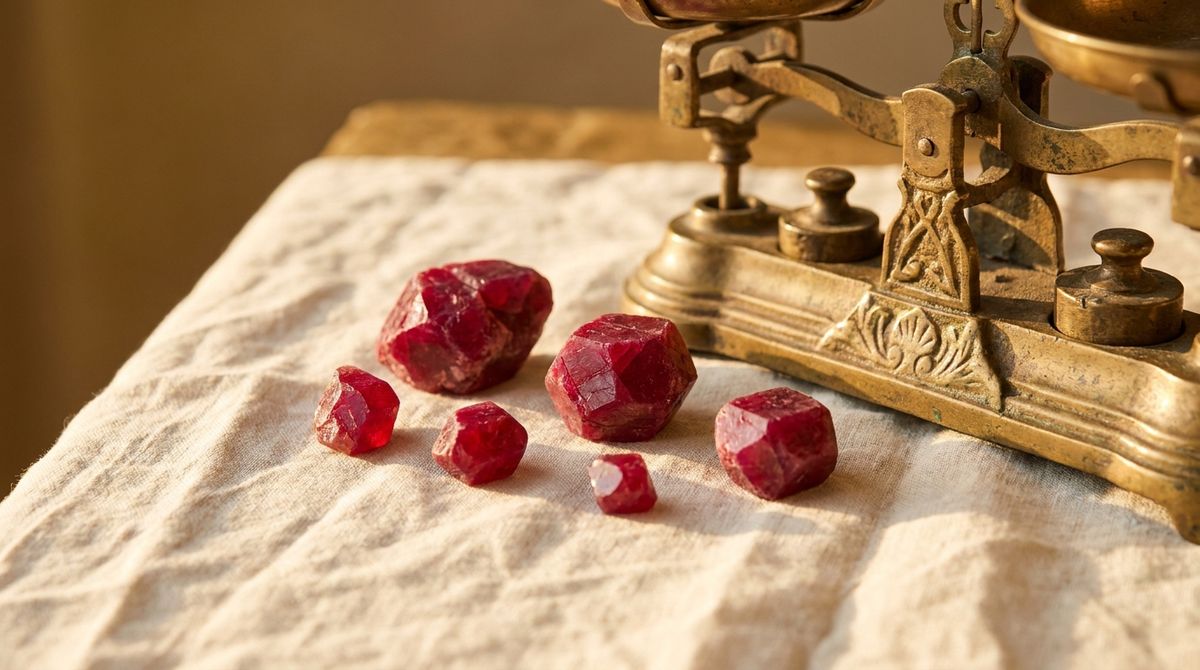
Ruby is one of the few gemstones most people can name on sight — the deep, saturated red stone tied to July birthdays and to centuries of royal jewelry. But "ruby" is really a color designation on top of a single mineral: it's the red variety of corundum, the same mineral species as sapphire, and the line between the two is drawn by nothing more than a trace element and a shade of red. This guide covers what ruby actually is, the geology and trade history behind it, how to tell a genuine stone from a look-alike, and how to wear and care for ruby jewelry. If you're comparing birthstones by month, our birthstone finder covers the full list.
What Ruby Actually Is
Ruby is the red variety of corundum, a crystalline form of aluminum oxide (Al₂O₃) that is colorless in its pure state. What turns it red is a trace amount of chromium substituting into the crystal structure — the more chromium, generally, the more intense the red. This is also what separates ruby from sapphire: they're the same mineral, corundum, and any color of gem-quality corundum other than red is classified as sapphire instead, including the pink, blue, yellow, and colorless varieties.
On the Mohs hardness scale, corundum rates a 9, second only to diamond among natural minerals. That hardness comes from the tightly packed aluminum oxide structure itself, not from any treatment, and it holds regardless of the stone's color or clarity grade — a sapphire and a ruby scratch-test identically. Combined with corundum's tendency to form in hexagonal, prism-like crystals well suited to faceting, that hardness makes ruby one of the most durable colored gemstones used in jewelry — a meaningful practical fact alongside its symbolic one, since July is also ruby's birthstone month.
Properties: Physical, Mental, and Metaphysical
Physical
Ruby is transparent to translucent and almost always faceted to maximize its color and brilliance, though heavily included stones are sometimes cut as cabochons instead — a cut that can also reveal asterism, a star-shaped light effect seen in some rubies. That effect comes from needle-like rutile inclusions aligned along the crystal's internal structure; cut as a rounded cabochon rather than faceted, the light reflects off those needles as a moving six-rayed star across the stone's surface. Star rubies are prized specifically for this optical effect, which faceting would cut away.
Mental
In wellness and crystal traditions, ruby is described as a stone of passion, vitality, and courage — a set of associations that lines up with its color and its long history as a stone carried into battle. As with any gemstone's symbolism, covered in more depth in our different gemstones meaning guide, that's a belief carried by folklore and tradition, not a measured or scientific effect.
Metaphysical
Ruby's reputation for protection has real historical roots. Burmese warriors are reported to have inserted rubies into their skin or carried them into combat, believing the stone made them invincible in battle. Medieval Europeans held a related but different belief: that ruby could cure inflammation and help heal wounds, a use recorded in period gem lore alongside its association with royalty and the blood. Neither claim has a basis in medicine, and both are worth reading as belief passed down through tradition rather than documented fact — the same caution that applies to any stone's folklore.
Pigeon's Blood, Star Rubies, and Where Ruby Comes From
The ruby trade has its own vocabulary for quality, and the term collectors reach for first is "pigeon's blood" — the trade's name for the most prized shade of ruby red, a vivid, slightly blue-undertoned red rather than a brownish or orangey one. The term is most closely associated with rubies from Myanmar's Mogok Valley, historically considered the source of the finest rubies in the world and the origin point of the pigeon's blood description itself.
Myanmar is not the only significant source, though. Thailand has long been a center for both mining and cutting, with Bangkok functioning as a major global ruby-trading hub regardless of where a given stone was actually mined. Sri Lanka has its own centuries-old ruby mining tradition, alongside the sapphires it's better known for today. And Mozambique has emerged as the most significant modern source, producing a large share of the ruby now reaching the global market since deposits there were developed in the 2000s. Star rubies, the asterism-bearing stones described above, can come from any of these sources and are valued on a separate scale from faceted stones, based on the strength and symmetry of the star rather than color alone.
How to Tell Real Ruby From Look-Alikes
Ruby's saturated red has a long history of being imitated or substituted, most often by garnet — specifically pyrope and almandine garnet, which run a similar deep red and were historically confused with, or knowingly sold in place of, ruby as a more affordable alternative. Our garnet meaning guide covers this exact comparison from garnet's side. Jewelers separate the two with standard gemological testing: ruby and garnet have different refractive indices, measurable with a refractometer, and ruby fluoresces more strongly under UV light than most garnet does — a quick, reliable tell in a lab setting. Glass and synthetic corundum are the other common substitutes; synthetic corundum shares ruby's chemistry and hardness exactly, which is precisely why it takes a trained eye and magnification, rather than a hardness test, to catch it. Natural inclusion patterns are the usual giveaway — synthetics tend to be too clean, or show curved growth lines instead of the straight, angular inclusions typical of natural corundum. If you're buying a ruby represented as natural, a gemological report from a recognized lab is the only way to confirm origin and treatment status with certainty.
How to Wear and Care for Ruby Jewelry
Corundum's 9 on the Mohs scale makes ruby one of the more forgiving gemstones for everyday wear, rings included — it resists scratching from nearly everything except diamond. That hardness doesn't make it indestructible, though: a hard enough direct impact can still chip a facet edge, so it's still worth being mindful of activities where a ring takes repeated knocks. For cleaning, warm water, mild soap, and a soft brush are safe for most ruby jewelry; ultrasonic and steam cleaners are generally fine for untreated or heat-treated stones but best avoided for rubies that have been fracture-filled or otherwise clarity-enhanced, since heat and vibration can affect the filling. If you're not certain how your stone has been treated, the gentler hand-cleaning method is the safer default.
FARUZO's personalization system offers ruby as the July birthstone option on several pieces, set in stainless steel with a gold-plated, rose gold-plated, or silver-tone-plated finish — browse the birthstone rings and birthstone necklaces collections for the current settings. Ruby's tie to a specific birth month also makes it a natural choice for family jewelry that marks more than one person's birthstone in a single piece, which is the idea behind our mom and grandma rings.
Frequently Asked Questions
Is ruby the same mineral as sapphire?
Yes. Ruby and sapphire are both corundum, an aluminum oxide mineral. Red corundum is called ruby; every other color of gem-quality corundum, including blue, pink, yellow, and colorless, is called sapphire.
What makes ruby red?
Trace amounts of chromium in the corundum crystal structure. Chromium concentration also influences the intensity of the red, which is part of why the most saturated, vivid stones command the "pigeon's blood" description.
Is ruby a real birthstone?
Yes — ruby is the modern and traditional birthstone for July. You can see how it fits alongside the other months in our birthstone finder.
What is a star ruby?
A ruby cut as a rounded cabochon that displays asterism — a star-shaped light effect caused by needle-like rutile inclusions aligned within the crystal. The effect only shows when the stone is cut to preserve it, rather than faceted.
Is ruby more durable than garnet?
Generally yes. Ruby's Mohs hardness of 9 is meaningfully higher than garnet's 6.5 to 7.5, making ruby more resistant to everyday scratching, though both are considered reasonably durable choices for jewelry worn regularly.