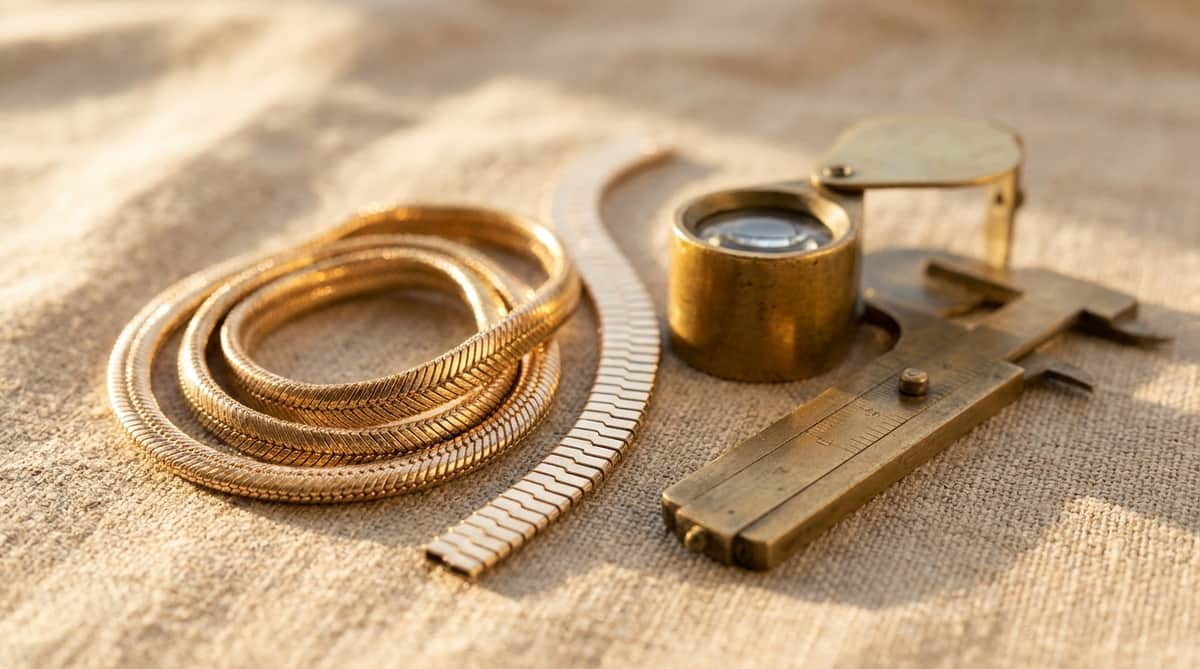
There's no visible link to point to on a snake chain, and that's exactly the point. Instead of the open or interlocking shapes you'd see on a curb, figaro, or Cuban link chain, a snake chain is built from dozens of tiny metal rings or plates fitted so tightly together that the whole thing reads as one continuous, flexible surface.
It's closer to a smooth, bendable tube than a traditional chain. That seamless look is why it's resurfacing right now as a piece worn alone, not just as an invisible pendant chain hiding under a charm the way it spent most of the last few decades.
At a glance:
- Construction, not decoration — tightly fitted metal rings or plates create one continuous surface; there's no actual snake imagery involved
- The 1850s mattered most — that's when mechanized chain-making scaled up production, roughly when snake-style chains start showing up widely in antique pieces
- Width changes how it wears — fine (1–1.5mm) layers under a pendant, classic 2mm wears alone, statement (3mm+) is driving the current no-pendant trend
- FARUZO chain pieces are plated over 316L stainless steel — nickel-safe for daily wear, not vermeil or solid gold
What Actually Makes a Chain "Snake" Style
A snake chain gets its name from how it looks, not from any serpent imagery worked into the design. According to jewelry-trade descriptions of the construction, tightly connected metal rings, bands, or plates are fitted together into a compact strand.
That tight fit creates a continuous surface that catches light the way overlapping scales do. There's no daylight between individual links the way there is on an open curb or rope chain, which is what makes it bend so fluidly against the skin and lie almost perfectly flat.
It's one of dozens of named chain constructions — our guide to types of chain necklaces breaks down where snake chain sits next to box, wheat, and rope if you're comparing builds before buying.
A Short, Slightly Murky History
Unlike some chain styles with a clean origin story, exactly where the name "snake chain" started is genuinely unclear — jewelry-history write-ups on the style describe its origins as murky rather than pinning it to one maker or decade.
What is better documented is the broader shift in how chains were made: one jewelry-history account of 1840s–1850s chains notes that the 1850s were a turning point, because that's when mechanized chain-making started scaling up production — roughly the era snake-style chains begin showing up more widely in antique pieces.
The snake motif itself in jewelry is far older, tracing back to ancient Egyptian and Roman design, but that's a different thing from the smooth-link construction being named after it.
In the 20th century the style became closely associated with Italian goldsmithing — enough that "Italian snake chain" is still common trade language today — though that's a reputation for quality chain-making generally, not proof of where the construction itself was invented.
Why It's Trending Again Right Now
For most of the 2000s and 2010s, a snake chain was mainly a backstage player — the thin, flexible chain holding up someone else's pendant, chosen because it's lightweight and doesn't twist or kink the way a cable chain can.
The current wave flips that: stylists and jewelry retailers are increasingly showing it as the main piece, not the delivery mechanism for one. Part of that is the same "wear one clean, minimal piece" mood that's pulled bar necklaces and single pendants back into rotation.
Part of it is that a slightly thicker snake chain reads as a modern, unfussy alternative to a chunkier Cuban or curb chain for anyone who wants texture without the weight — see our Cuban link chain guide if you're deciding between the two.
Worn thin, it still does its original job layered under other pieces; worn in a wider, bolder gauge, it now stands on its own.
Snake Chain vs. Other Smooth, Low-Link Chains
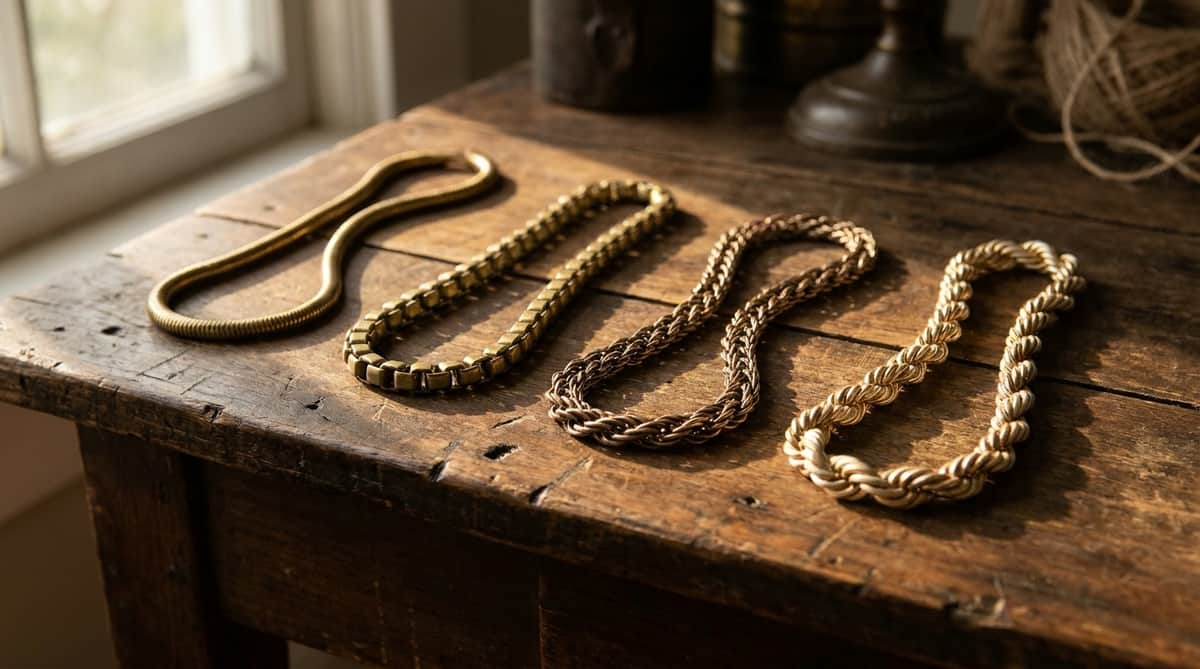
A snake chain gets compared most often to a handful of other chains that also prioritize a smooth, low-profile look over an obviously "linked" one. Side by side, here's what actually separates them:
- Snake chain — tightly fitted rings or plates with no visible individual links; the most fluid and tube-like of the group, but prone to kinking if sharply bent since there's no single link to isolate and fix.
- Box chain — square, boxy links stacked in a row; stiffer and more structured-looking than a snake chain, and easier to repair since a damaged section is one identifiable link.
- Wheat chain — multiple small links twisted and woven together; more textured and less smooth than snake, with a braided look rather than a solid surface.
- Rope chain — links twisted into a spiral that mimics actual rope; textured and sparkly rather than smooth, and the style most associated with a "statement" heavy chain look.
- Cable chain — simple, uniform oval links in a row; the most basic and most repairable construction, but visibly "chain-like" in a way snake chain isn't.
- Omega chain — similar flat, interlocking segments to a snake chain, but built to hold a more defined curve rather than snake chain's fully fluid drape.
Choosing a Width
Snake chain width does more work than on most other styles, because the construction itself changes how it behaves at different gauges — not just how heavy it looks.
A fine gauge (around 1–1.5mm) is the traditional pendant-carrier width: light, nearly invisible on its own, and the easiest to layer under a thicker piece. A classic 2mm width is sturdy enough to wear alone as a simple everyday necklace without looking delicate.
A statement width of 3mm or more is what's driving the current trend of wearing snake chain with no pendant at all — at that gauge the smooth, scale-like surface itself becomes the whole look, standing in for a chunkier chain without the added weight.
How to Wear and Style a Snake Chain
A thin snake chain still works exactly the way it always has: layered under a slightly longer pendant chain, where its smooth profile keeps it from competing visually with whatever's hanging below it.
A wider snake chain is increasingly worn as the single piece for the day — no pendant, no second chain — which is the real shift behind the current trend. Because the surface is already visually busy in its own quiet way, it tends to look best paired with simple stud earrings rather than another statement piece competing for attention.
If you want it to carry a personal detail instead of reading as purely decorative, FARUZO's name necklaces and custom necklaces & chains for men collections build that kind of engraved detail into a chain-style piece without losing the clean look.
And because mixing metal tones is now standard practice rather than a mistake, a snake chain in one tone doesn't have to match every other piece you're wearing — our guide to mixing metals covers how to pair warm and cool tones on purpose.
FARUZO's own chain pieces are plated over 316L stainless steel rather than a cheaper, allergy-prone base metal — nickel-safe for daily wear, not just inexpensive. That's a different claim from "vermeil" (a gold layer over solid sterling silver) or solid gold, and it's worth knowing which one you're actually buying before paying solid-gold prices for a plated piece.
Durability and Care
A snake chain's biggest weakness is also what gives it its look: because there's no single link to isolate, a sharp bend or kink distorts the whole continuous surface rather than one repairable section. That kind of damage is hard to fix completely.
Finer gauges are more vulnerable to bending out of shape than wider ones, and it's best paired with a light or moderate pendant rather than something heavy that puts constant strain on the structure.
Store it flat or in a loose curve rather than coiled tightly in a small pouch, and skip it before swimming, showering, or sleeping. For a plated chain specifically, avoid ultrasonic cleaners or harsh chemical dips that wear through the plating layer faster than normal wear would.
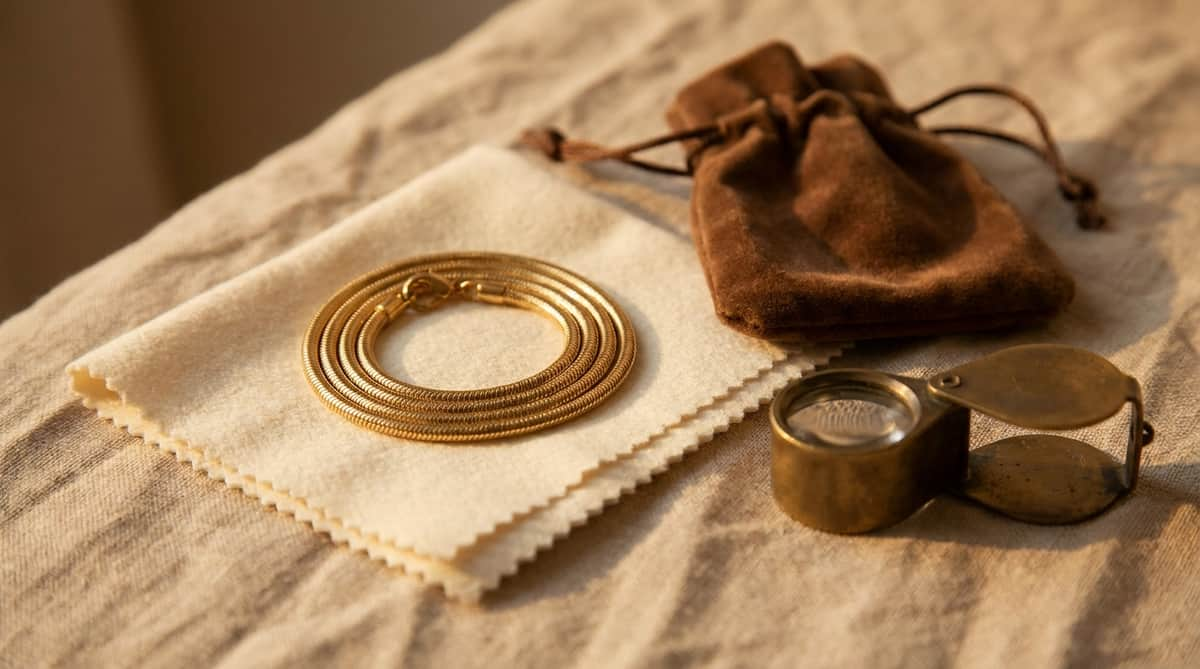
A soft cloth and lukewarm, mildly soapy water is usually enough to keep the surface clean between wears.
Frequently Asked Questions
What makes a chain a "snake chain"?
It's the construction, not a snake-themed design — tightly fitted metal rings, bands, or plates lock together into one continuous, flexible surface with no visible individual links, which is what gives it its scale-like, fluid look and bend.
Is a snake chain the same as an omega chain?
No. Both are smooth, low-link chain styles, but an omega chain is built to hold a more defined curve shape, while a snake chain is fully fluid and drapes more like a flexible tube with no set shape.
Does a snake chain kink easily?
It can. Because there's no single link to isolate a bend, a sharp fold or tight coiling can distort the chain's continuous structure in a way that's difficult to fix completely — storing it flat or in a loose curve, rather than balled up, helps prevent this.
Can you wear a snake chain alone, without a pendant?
Yes — that's actually the main shift behind its current popularity. A wider gauge (roughly 3mm or more) reads as a complete, minimal necklace on its own, while finer gauges still work best layered under a pendant chain.
Is snake chain real gold or plated?
Both exist, same as most chain styles — "snake chain" describes the link construction, not the material. It's sold in solid gold, gold-filled, and plated versions, so it's worth confirming which one you're buying rather than assuming from the look alone.