Stand in front of a foundation display and you will meet a small dictionary: porcelain, ivory, sand, honey, caramel, espresso. Jewelry counters play the same game with fewer words. Behind all the poetry sit a handful of real categories — and once you can name your own, everything gets easier to choose, from concealer to the metal of your next necklace.
The seven skin tone names, from fair to deep
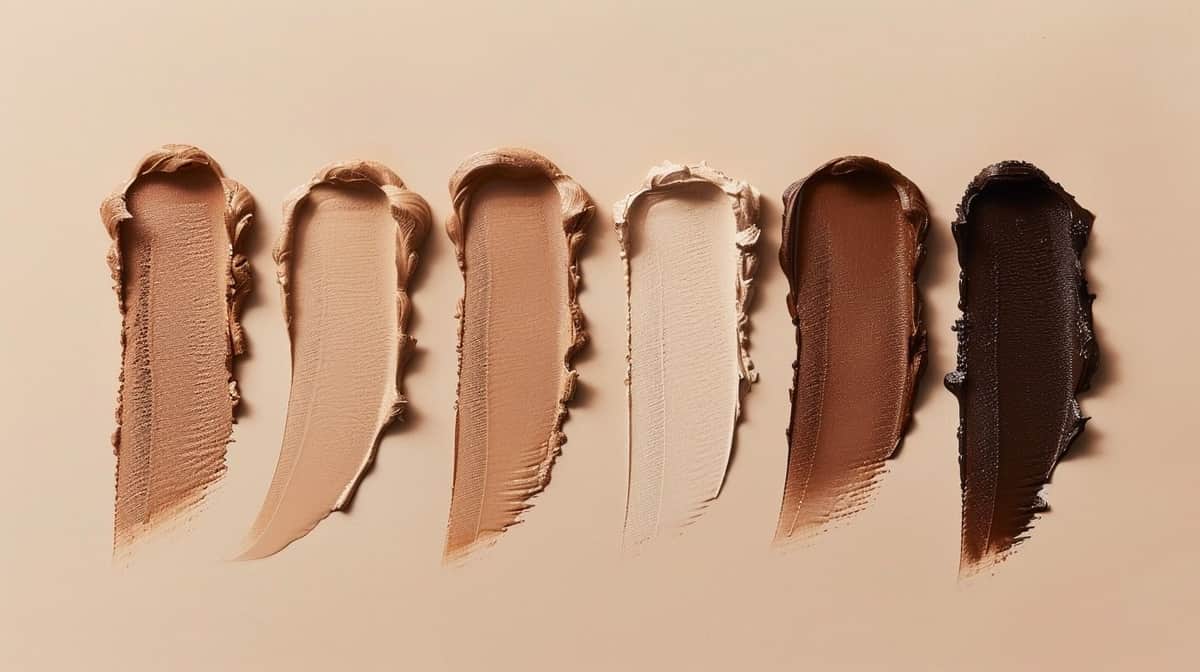
Most charts describe skin depth — how much melanin your skin carries — in seven steps. Fair is the lightest: it burns quickly, rarely tans, and often goes by 'porcelain,' 'alabaster' or 'ivory' on product shelves. Light carries slightly more melanin; it can catch a light tan but still burns with enough sun. Medium reads naturally sun-kissed and tans fairly easily. Olive sits near medium depth but is really defined by its distinctive greenish, gray-gold cast — more on that below. Tan describes warm, golden skin with moderate melanin that deepens readily in the sun. Brown skin is richer still and rarely burns, and deep — sometimes labeled 'espresso' or 'ebony' — is the deepest, most melanin-rich tone, with natural sun protection to match.
Two things worth knowing about these names. First, they are descriptions of depth only — two people who are both 'medium' can look completely different because of their undertones. Second, the beauty industry invents endless synonyms for the same seven steps, so don't be thrown when one brand's 'sand' is another brand's 'beige.' The chart is the same underneath.
Descriptive skin color names: the full vocabulary
Beyond the seven depth categories, brands and artists use a much richer set of shade names — the ones you actually see printed on foundation bottles and heard in makeup chairs. Grouped by depth, these are the common ones and what they describe:
Fair: porcelain, ivory, alabaster and snow — the palest shades, often with visible pink or bluish undertones and a tendency to burn quickly.
Light: cream, shell, sand, warm ivory and rose beige — a step deeper, ranging from pink-toned to gently golden.
Medium: beige, natural, honey, golden and buff — the broad middle where warm and neutral undertones are most common.
Tan and olive: olive, caramel, amber and bronze — sun-warmed depths, including the green-cast olive family common across Mediterranean, Latin and South Asian skin.
Brown: chestnut, cinnamon, sienna, pecan and mocha — rich mid-deep shades with undertones from red-warm to neutral.
Deep: espresso, mahogany, cocoa, umber and ebony — the deepest shades, often with cool red or blue undertones that make white metals and vivid gemstones glow.
Treat these as descriptions, not boxes: most people sit between two names, and the same person may match different ones across seasons. The category matters less than the undertone beneath it — which is what the next section is about.
Skin tone vs. undertone: the difference that actually matters
Your skin tone is the surface — how light or deep your skin is, and it shifts with the seasons. Your undertone is the hue beneath the surface, and it never changes: not with sun, not with age. This is why a foundation can match your depth perfectly and still look 'off,' and why the same gold chain glows on one friend and goes flat on another. The undertone, not the tone, is doing the deciding.
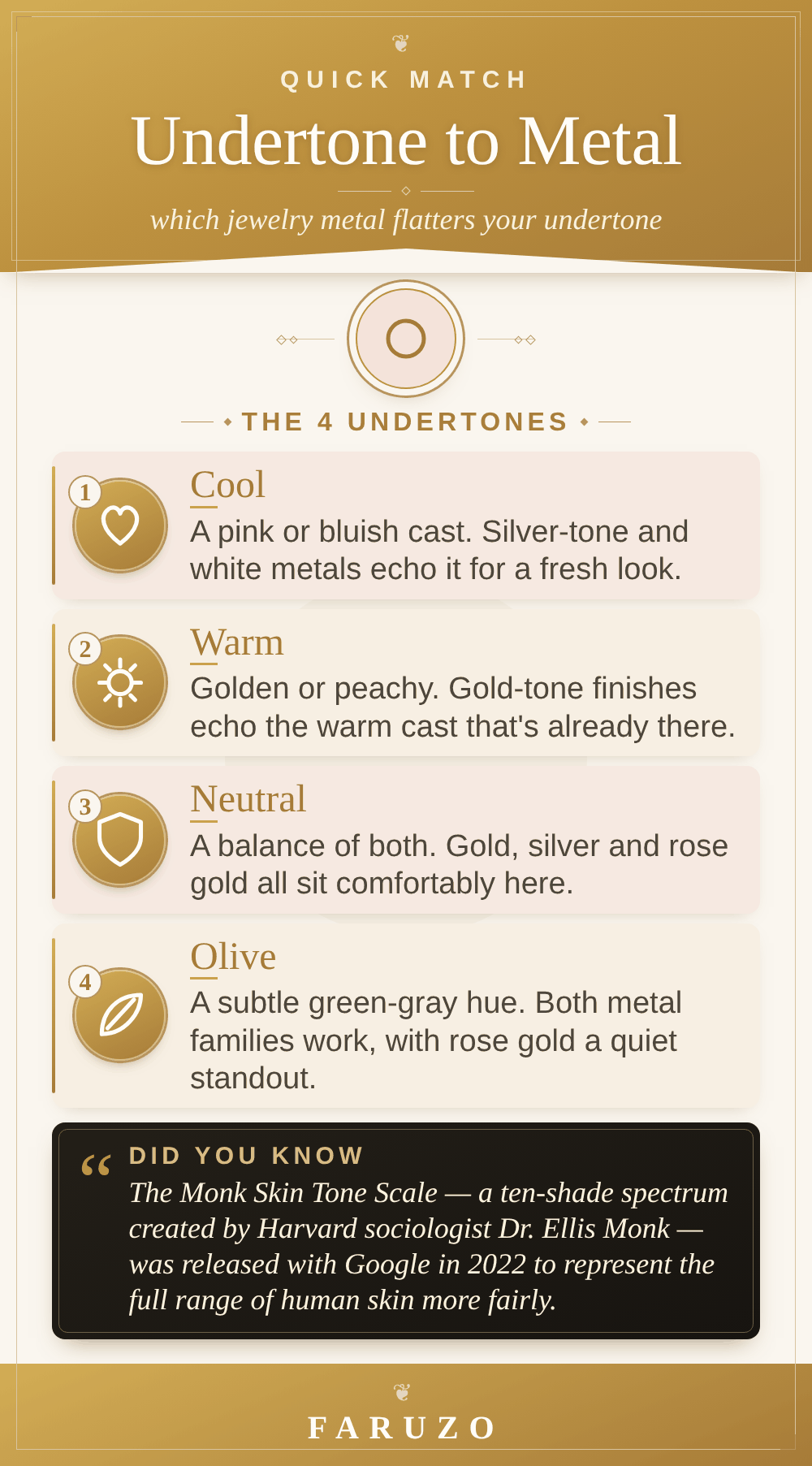
There are four: cool (a pink or bluish cast), warm (golden or peachy), neutral (a balance of both, hard to call either way), and olive — the often-forgotten fourth, a subtle green-gray hue most common in medium and tan skin. Olive is technically a kind of neutral, but it behaves differently enough with color that it deserves its own name.
How to find your undertone in two minutes
The vein test is the classic: look at the inside of your wrist in natural daylight. Blue or purple veins point to cool undertones; green points to warm; if you honestly cannot decide, you are likely neutral, and a greenish-gray blur suggests olive. The sun test adds a second opinion — skin that burns first and tans reluctantly usually runs cool, while skin that tans easily usually runs warm.
Then there is the jewelry test, which is the most fun and, for our purposes, the most useful: hold silver against your inner wrist, then gold. One of them will make your skin look brighter and more even; the other will look slightly ashy or brassy against it. Whichever flatters you is answering the undertone question directly — cool skin tends to light up next to silver, warm skin next to gold, and neutral skin genuinely wears both well.
The scales professionals use: Fitzpatrick and Monk
Dermatologists use a different map. The Fitzpatrick scale, developed by Harvard dermatologist Thomas Fitzpatrick in 1975, sorts skin into six types by how it responds to sunlight — Type I always burns and never tans, Type VI never burns — and it is still the standard for assessing sun-damage risk and laser treatments. It was never designed for cosmetics, though, which is why the tech and beauty worlds adopted a newer ruler: the Monk Skin Tone Scale, a ten-shade spectrum created by Harvard sociologist Dr. Ellis Monk and released with Google in 2022 to represent the full range of human skin more fairly. If you have ever wondered how a phone camera or a search filter decides what 'medium-deep' means, the answer is usually one of these two scales.
Matching jewelry metal to your undertone
Here is where naming your undertone pays for itself. Cool undertones are flattered by white metals — silver-tone and white-gold-tone finishes echo the pink and blue in the skin and make it look fresh (the equivalent look is sold elsewhere in the market as sterling silver or solid white gold). Warm undertones glow next to yellow metals — gold-tone finishes echo the golden cast that is already there (the equivalent look elsewhere in the market is usually called 14k gold or gold vermeil). Neutral undertones win the lottery: gold, silver and rose gold all sit comfortably. And olive skin, with its green-gray depth, wears both families well, with rose gold as a quiet standout — its coppery warmth plays beautifully against olive's coolness.
These are starting points, not rules — plenty of cool-toned women live happily in gold. If you want the full argument for each side, we've written a complete guide to choosing between gold and silver and a deeper look at which metal suits each skin tone.
And because undertones differ, every personalized piece we make comes in three plated finishes over 316L stainless steel — gold, rose gold and silver-tone — so the same engraved name can be made for the skin that will wear it. Once the metal is settled, our guide to what your name necklace says about you helps you choose the lettering.
Why skin tone names keep changing
If 'nude' once meant a single beige, you have seen the problem these names were invented to solve. As beauty brands expanded from a dozen foundation shades to forty and more, the vocabulary had to grow with them — and tools like the Monk scale exist precisely because older charts under-described deeper skin. The trend is toward more names, more precision and less assumption, which is good news for everyone: the better the language, the better the match, whether you are buying makeup, choosing a wedding palette or picking the metal of a necklace you will wear for years.
The names will keep multiplying — porcelain, honey, espresso and whatever the next campaign invents. But underneath there are just seven depths, four undertones and a two-minute test. Learn your own pair of words, and every counter, from makeup to metal, gets simpler.
Frequently Asked Questions
What are the main skin tone names?
Most charts use seven: fair, light, medium, olive, tan, brown and deep. Beauty brands layer endless synonyms on top — porcelain and ivory for fair, honey and caramel for tan, espresso for deep — but they all map back to the same seven steps of depth.
How do I know if I'm warm or cool toned?
Check your wrist veins in daylight: blue or purple suggests cool, green suggests warm, and hard-to-tell suggests neutral. Confirm with the jewelry test — silver flatters cool skin, gold flatters warm skin — and with how you tan: burning first points cool, tanning easily points warm.
What is olive skin exactly?
Olive skin has a subtle green or gray-green cast beneath the surface, most common in medium and tan depths. It is often described as a fourth undertone alongside cool, warm and neutral, and it can make typical 'warm vs cool' advice feel wrong — olive skin generally wears both metal families well.
Can my skin tone change over time?
Your surface tone can — sun deepens it in summer and it lightens in winter. Your undertone, though, is fixed for life, which is why undertone is the more reliable guide for jewelry and foundation: match the constant, not the season.
Which jewelry metal suits my skin tone best?
Match the undertone: cool skin is flattered by silver-tone and white-metal finishes, warm skin by gold-tone finishes, neutral skin wears everything, and olive skin suits both tones, with rose gold-tone a favorite. The two-minute wrist test above will tell you which group you're in.