
REAL (documented history). Stainless steel is usually dated to 1913, when Harry Brearley, a metallurgist in Sheffield, England, made a steel with so much chromium that it would not rust like ordinary steel. He was looking for a tougher metal for gun barrels, not a better knife. Others had done important groundwork before him, so the full story has more than one name in it.
At a glance
- Stainless steel is steel with at least about 10.5% chromium, which forms a thin invisible film that protects the metal from rust.
- Harry Brearley made the first practical version in Sheffield in 1913, while testing steels for gun barrels.
- French and German scientists had studied iron-chromium alloys earlier, so the credit is shared in the history books.
- Within a year or two, Sheffield cutlers were making knives from it; watch cases and jewelry came later.
What a gun barrel has to do with it
In the early 1900s, Sheffield was the center of the British steel trade. Harry Brearley ran a research laboratory there for a pair of steelmaking firms, Brown and Firth. One problem he was asked to solve was erosion: the inside of a rifle barrel wears out quickly when it is fired over and over, and there was demand for a steel that would last longer.
So Brearley tested alloys, adding chromium to see what it did. The story goes that some of the test pieces were left in a scrap pile and he noticed that the chromium ones stayed bright while the others rusted. The details of that story vary from telling to telling, and the plain version is probably closer to the truth: he was testing steels on purpose and he was good at noticing what he saw. The result, made in 1913, was a steel with a little over 12% chromium.
The steel was no better for gun barrels. But it did not rust, and he saw that this mattered for something else.
He was not the first to try chromium
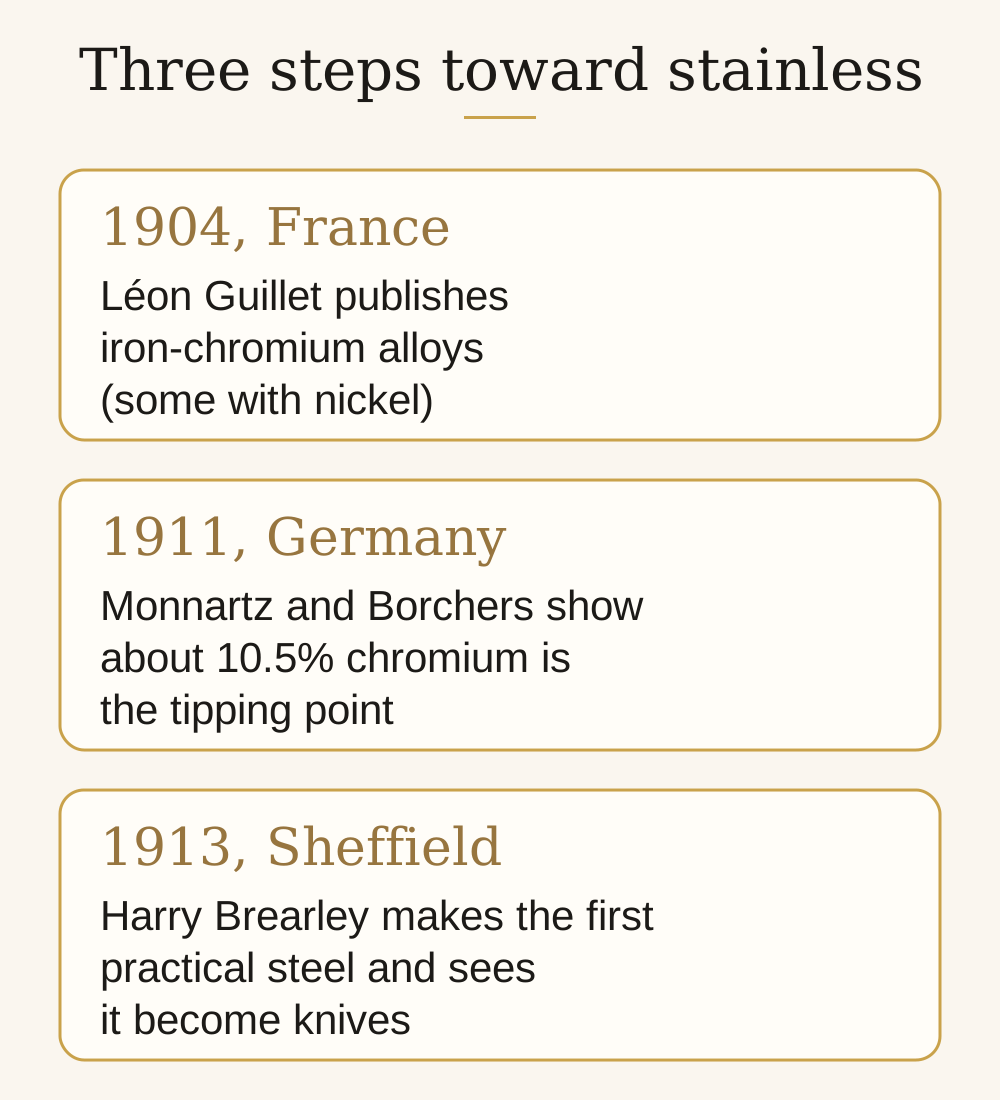
It is tempting to tell this as one man and one lucky afternoon, but the science had been moving for years. In France, Léon Guillet published iron-chromium alloys, some with nickel, from about 1904, though he did not stress their resistance to rust. In Germany, Monnartz and Borchers showed around 1911 that the protection jumps at roughly 10.5% chromium. In the United States, Elwood Haynes had filed a patent in 1912.
That is why Brearley is best described as the person who made the first practical, commercial stainless steel, not the first person to put chromium in iron. Patent overlaps followed in the years after, and the details of who owned what are still argued over. Brearley left his job at Brown-Firth in 1915 after a disagreement over the rights.
How a little chromium protects steel
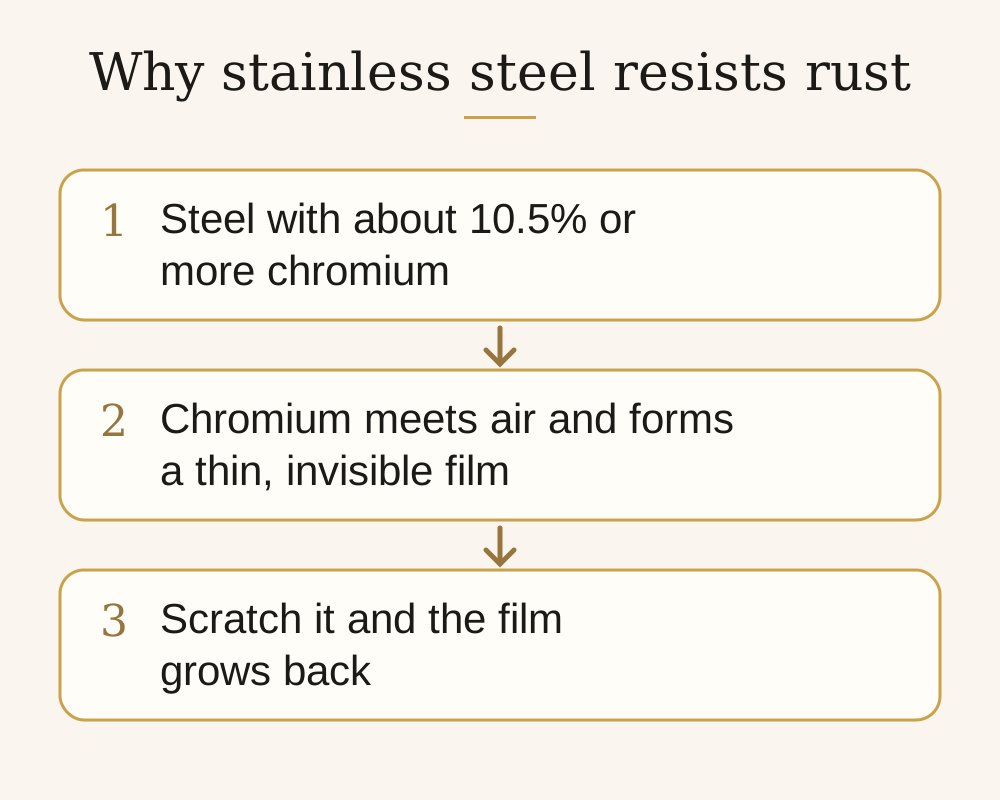
Ordinary steel rusts because iron reacts with oxygen and water, and the rust flakes away to expose fresh metal. Chromium behaves differently. When there is enough of it, it combines with oxygen in the air to form an extremely thin film, clear and tightly attached to the surface. Rust has a hard time getting through, and if the surface is scratched, the film grows back.
That is why the number matters. Below about 10.5% chromium the film does not hold, and above it the steel starts to behave like stainless steel. It is also why "stainless" does not mean "never": the film can be broken down in harsh conditions, so stainless steel resists rust and stains, but it is not immune to them.
How it got its name
Brearley first called his steel "rustless steel." The word "stainless" is said to have come from Ernest Stuart, who worked for a Sheffield cutlery firm, R. F. Mosley, one of the first makers to try it. The story goes that Brearley's steel stayed clean while ordinary table knives were marked by vinegar and that someone remarked it "stains less". That line may be a legend that grew with the retelling, but the name stuck.
Within a year or two, Sheffield cutlers were making knives from the new steel. It was a good fit for the kitchen: it did not rust in the sink and it could be cleaned easily.
Timeline of stainless steel
The dates below are given as they are most often cited. The first and last are broad, because the early research and the later spread were gradual.
From knives and watches to jewelry
Stainless steel did not move into jewelry quickly. After cutlery, it spread into chemical plants, kitchens and surgical tools, where its resistance to rust was worth the extra effort of working a hard metal. Watchmakers were slower to accept it, since gold and silver were the prestige cases. By the 1930s steel cases had become common.
When stainless steel became common in jewelry is less clear, and no single date is reliable. What is clear is why it became attractive: it is hard, it keeps its finish and it does not tarnish in the way many cheaper metals do. A necklace that is worn every day, in a shower or at the gym, has to put up with water, sweat and skin, and a metal that resists corrosion is a practical choice for that.
316L, in plain words
You will often see the code 316L on jewelry. The 316 is a grade of stainless steel that has a little molybdenum added, which helps it resist pitting in salty or wet conditions. The L stands for low carbon. It is a later member of the stainless family, not something Brearley made in 1913. The number is a description of the recipe. It is not a medical promise, and it does not mean skin will never react to any metal.
Stainless steel, steel and plated brass compared
| Metal | What it is | How it behaves |
|---|---|---|
| Ordinary steel | Iron with a little carbon | Rusts when wet |
| Stainless steel | Steel with 10.5% or more chromium | Resists rust and stains |
| Plated brass | A brass base with a thin coating | Can wear through and show the base |
A note on what FARUZO makes
FARUZO makes personalized necklaces, bracelets and rings in 316L stainless steel with a plated finish in silver, gold or rose gold tones. The plating is a finish, not solid gold. That is a practical choice for jewelry meant to be worn every day, and it is part of a long line that started in a Sheffield laboratory in 1913.
Frequently Asked Questions
Who invented stainless steel?
Harry Brearley, working in Sheffield in 1913, is usually named as the inventor of the first practical stainless steel. Scientists in France and Germany had studied iron-chromium alloys before him, and an American inventor, Elwood Haynes, filed a patent in 1912, so the credit is shared.
Was stainless steel discovered by accident?
The popular story says Brearley noticed bright test pieces in a scrap pile. The plain version is that he was testing alloys for gun barrels on purpose and noticed that the chromium ones did not rust. The scrap-pile detail varies from telling to telling.
What makes steel stainless?
Chromium. With about 10.5% or more, the steel forms a thin, invisible film on its surface that resists rust and grows back if scratched.
Can stainless steel rust?
It can, in harsh conditions. Stainless steel resists rust and stains very well, but it is not immune, which is why "stain-resistant" is a more accurate phrase than "stainless".
What does 316L mean?
316 is a grade of stainless steel with some molybdenum added for extra resistance in wet and salty conditions, and L means low carbon. It describes the recipe, not a medical guarantee.
When did stainless steel start being used in jewelry?
There is no single reliable date. It spread into cutlery first, then watches in the 1920s and 1930s, and became common in jewelry later.
More from Heirloom
Read how a TV prop made the nameplate necklace famous, browse the Heirloom hub, or see personalized necklaces made in 316L stainless steel.