
Crystal guide
Pyrite Meaning, Properties and Care
Pyrite is an iron sulfide mineral (FeS2) with a brassy-yellow metallic shine, which is why it is nicknamed fool's gold. It is Mohs 6 to 6.5, so harder than gold, but it is brittle and does not like moisture. In crystal tradition it is a stone of confidence and protection.
At a glance
- Formula FeS2 (iron sulfide), cubic crystals, often sharp cubes.
- Hardness 6 to 6.5 on the Mohs scale, but brittle, so it chips rather than bends.
- Easy to tell from gold: pyrite is much lighter and leaves a dark greenish-black streak (details below).
- Care: keep it dry; moisture and heat can dull it over time. Wipe with a soft dry cloth.
Quick facts
| Family | Iron sulfide (sulfide mineral), the most common sulfide; marcasite shares its formula |
|---|---|
| Chemical formula | FeS2 |
| Crystal system | Cubic (isometric), often as cubes, twelve-sided forms or striated faces; brittle with no good cleavage |
| Mohs hardness | 6–6.5 |
| Luster | Metallic, brassy yellow |
| Transparency | Opaque |
| Natural colors | pale brassy yellow to golden yellow; can tarnish to a darker, sometimes iridescent or brownish surface |
| Main localities | Spain (Navajun, known for very regular cubes); Peru; Italy (Elba); USA; many other countries |
| Common treatments | usually sold untreated; it is mainly cut or polished into beads, cabochons and small faceted pieces, and moisture is the bigger concern |
Pyrite at a glance, in pictures
Chakras (traditional)
Hardness range
Natural colors
- pale brassy yellow to golden yellow
- can tarnish to a darker, sometimes iridescent or brownish surface
Traditionally linked to
- Element
- Fire
Common forms of Pyrite
- Rough raw chunk
- Tumbled polished pebble
- Cabochon smooth dome
How hard is Pyrite?
- Talc 1
- Gypsum 2
- Copper coin ~ 3
- Calcite 3
- Fluorite 4
- Apatite 5
- Glass ~ 5.5
- Steel knife ~ 5.5
- Orthoclase 6
- Pyrite 6–6.5
- Quartz 7
- Topaz 8
- Corundum 9
- Diamond 10
What it is and where it comes from
The name comes from the Greek pyrites, from pyr meaning fire.
Struck against flint, pyrite makes sparks, so it has long been used to start fires. It was also used in wheellock firearms of the 16th and 17th centuries, where it was pressed against a spinning steel wheel to ignite the powder.
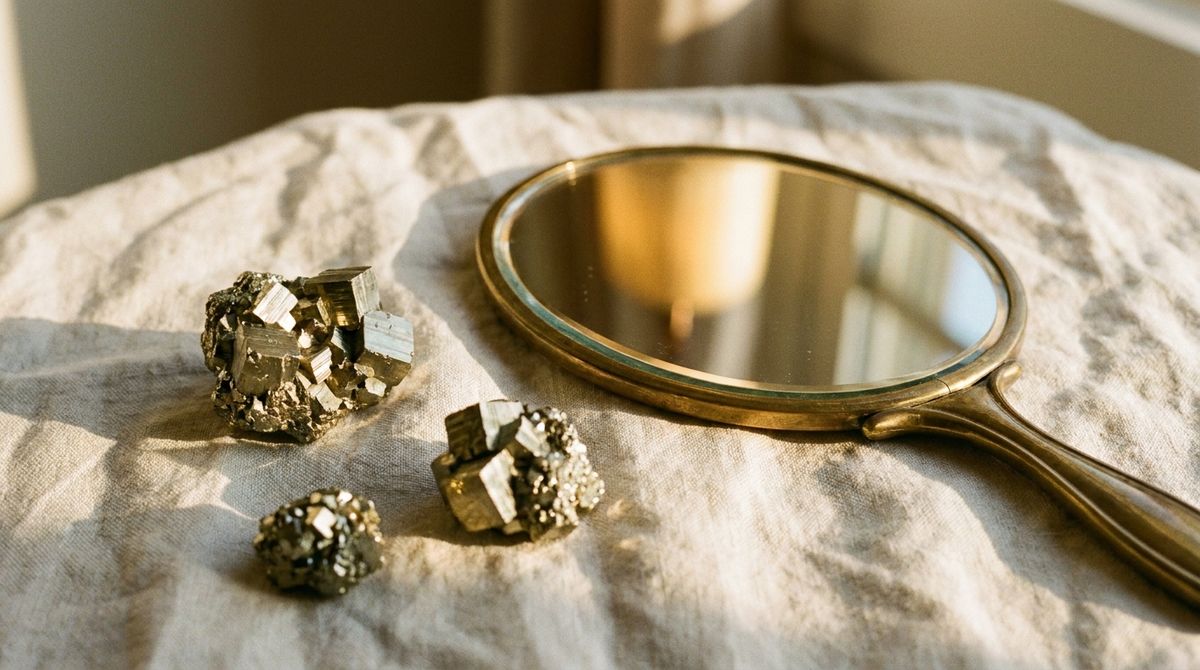
In ancient Mesoamerica, artisans assembled mirrors from many small, carefully cut pieces of pyrite. Such mosaic mirrors are among its best-known historical uses.
Pyrite was among the minerals used as crystal detectors in early radio sets in the early 20th century, before vacuum tubes took over.
Pyrite has been mined as a source of sulfur, mostly for sulfuric acid, though most sulfur now comes from oil and gas. It often occurs alongside gold deposits, which is part of why the fool's gold confusion began.
In crystal tradition
What follows is belief and folklore, passed down in crystal tradition. It is not measured fact.
Traditionally associated with: confidence, protection, abundance, willpower.
Pyrite is traditionally associated with confidence, willpower and the Solar Plexus chakra, partly because it looks like gold and has become a stand-in symbol for wealth and self-worth. This is a modern spiritual tradition, not a fact about the stone.
Traditionally pyrite is also described as a protective stone, and in modern crystal practice it is linked to abundance and manifestation. These are beliefs within crystal practice and have no physical basis.
How to care for Pyrite
- Water Avoid
- Sunlight Unknown
- Salt Unknown
- Heat Avoid
- Ultrasonic Avoid
- Chemicals Caution
Safe = fine as a rule · Caution = only briefly or gently · Avoid = can damage the stone · Unknown = no reliable guidance.
Keep pyrite dry. Moisture and humidity can dull it over time or leave a rust-coloured film, and heat may speed this up. Store it somewhere dry, not in a steamy bathroom, and clean it only with a soft dry cloth. Skip ultrasonic and steam cleaners, soaking and cleaning liquids. It is brittle, so store it apart from harder stones. Nothing firm is documented about long sun or sea salt, so keep it away from both to be safe.
Real or fake? Look-alikes and treatments
Often confused with
- Gold (fool's gold versus the real thing)
- Chalcopyrite
- Marcasite
- Mica flakes (gold-coloured glitter)
- Brass or gold-coloured plated imitations
Common look-alikes
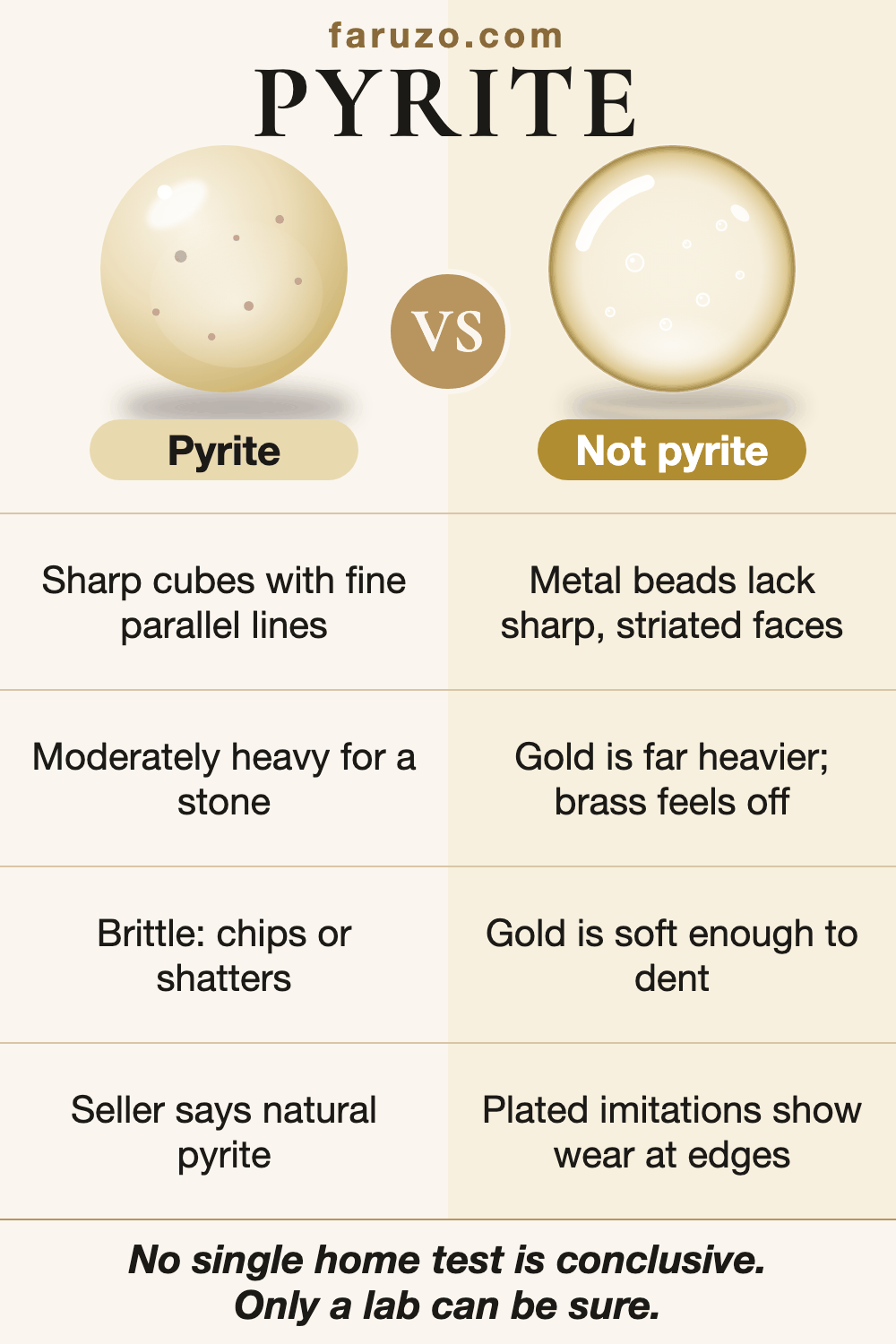
- Gold (fool's gold versus the real thing). Gold is very heavy for its size (about four times denser than pyrite), soft enough to dent and flatten, and leaves a golden streak. Pyrite feels lighter, is brittle and shatters or chips, and leaves a greenish-black to brownish-black streak. A scratch or streak test can mark a stone you want to keep, so ask a gemologist or lab if it matters.
- Chalcopyrite. Chalcopyrite is another brassy mineral. It is usually a deeper, slightly greenish gold and softer than pyrite, and it often tarnishes to rainbow colours. Crystals are rarely sharp cubes.
- Marcasite. Marcasite has the same formula but a different crystal structure and is less stable. Most pieces sold under that name are cut pyrite.
- Mica flakes (gold-coloured glitter). Thin gold-coloured flakes in rock or sand are often mica. They are very light, peel apart in thin sheets and flash and flicker as they move, whereas gold and pyrite stay solid.
- Brass or gold-coloured plated imitations. Metal beads or cubes can be made to look like pyrite. They tend to feel heavier or lighter than a stone of that size, may show plating wear at edges, and lack the sharp, striated crystal faces of natural pyrite.
Safe checks you can do
- Ask the seller in writing whether the piece is natural pyrite, and whether it could be a gold-coloured metal or a synthetic.
- Look at crystal faces. Natural pyrite cubes often show fine parallel lines (striations) on their faces and sharp, flat edges.
- Weight is a rough guide. Pyrite feels moderately heavy for a stone, but much lighter than a gold nugget of the same size.
- A streak on unglazed porcelain is a classic home check: pyrite leaves greenish-black to brownish-black, gold leaves golden yellow. It is not conclusive, and you should not do it on a polished piece you plan to keep.
- Be wary of a very cheap, perfectly uniform gold-coloured stone sold as natural pyrite, and of one that stays bright even after long contact with water. Ask questions or have a lab confirm.
Wearing Pyrite
Ring
Avoid
Brittle, and water and knocks can harm it.
Bracelet
Careful
Knocks can chip it.
Pendant
Careful
Sits clear of most knocks, but keep it dry.
Earrings
Careful
Fewer knocks than a bracelet, but keep them dry.
Guide for everyday wear, based on hardness and care notes. Safe, Careful or Avoid.
Pyrite is Mohs 6 to 6.5, harder than gold, but it is brittle and sensitive to moisture and heat. That makes a ring a poor everyday choice, since knocks can chip it and hand washing exposes it to water. Bracelets need care. Pendants and earrings take fewer knocks and spend less time near water, so they suit it best.
Questions about Pyrite
What does pyrite mean?
In crystal tradition pyrite is a stone of confidence, willpower and protection, and because it looks like gold it is also linked to abundance. These are beliefs, not facts about the stone.
What is pyrite?
Pyrite is an iron sulfide mineral, FeS2, that forms cubic crystals and has a brassy-yellow metallic shine.
Why is pyrite called fool's gold?
Its golden metallic colour has fooled prospectors for centuries, and it often occurs alongside gold deposits, which added to the confusion.
How can you tell pyrite from gold?
Gold is about four times denser, so it feels much heavier for its size, and it is soft enough to dent. Pyrite is brittle and leaves a greenish-black to brownish-black streak, while gold leaves a golden one. Home checks are not conclusive, so ask a gemologist or lab when it matters.
How hard is pyrite?
About 6 to 6.5 on the Mohs scale, harder than gold, which is about 2.5. It is brittle, though, so it can chip or shatter under a knock and is better suited to pendants and earrings than to daily rings.
Can pyrite get wet?
It is best avoided: moisture can dull it over time or leave a rust-coloured film. Take pieces off before water contact.
How do you clean pyrite?
Wipe it with a soft dry cloth only, without soaking or cleaning liquids.
Is marcasite jewelry actually pyrite?
Usually, yes. Marcasite is a separate mineral with the same formula but a less stable structure, so older pieces sold under that name are mostly cut pyrite.
Is pyrite a birthstone?
No. Pyrite is not on the standard modern or traditional birthstone lists. Any zodiac or monthly pairing you see for it is a folk association, not a widely agreed standard.
Is pyrite valuable?
Not like gold. Pyrite is common and usually inexpensive. Well-formed cubic specimens are mostly valued by collectors for their look.
What was pyrite used for historically?
Mesoamerican artisans built mirrors from many small cut pieces of it, and it was used in wheellock firearms and, among other minerals, in early radio detectors.
Will pyrite tarnish or turn skin dark?
Pyrite can dull or tarnish when it meets moisture over time. A dark mark on skin may come from a rubbed-off dull surface or from the metal around the stone, so keep it dry and wipe it after wear.
Is pyrite coated?
Natural pyrite is usually sold uncoated, but gold-coloured plated imitations exist. If the shine stays perfect through water contact, ask the seller what it is.
What is the difference between pyrite and hematite?
Hematite is an iron oxide, dark grey and metallic, with a red-brown streak, while pyrite is brassy yellow with a greenish-black streak. Both are metallic, but the colour tells them apart at a glance.