
Crystal guide
Moss Agate Meaning, Properties and Care
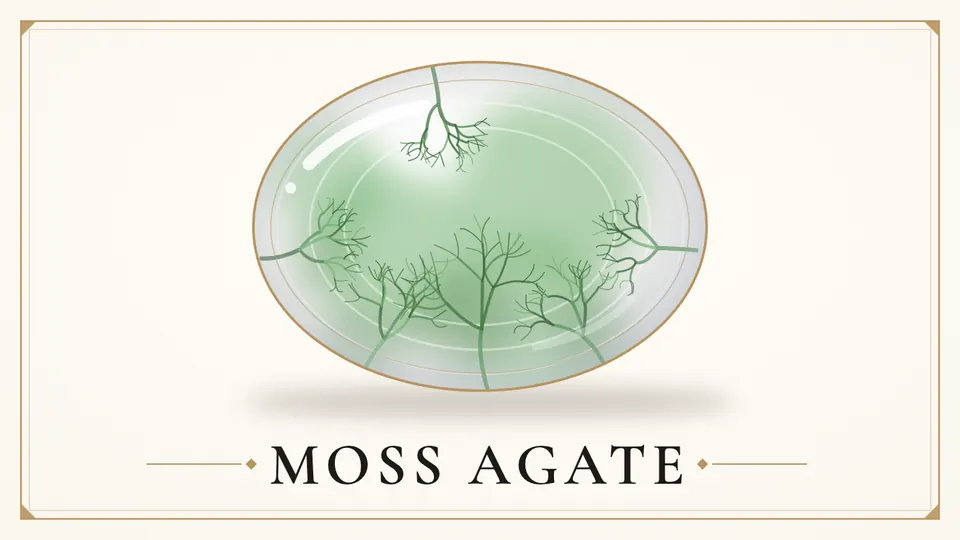
Moss agate is a milky to clear chalcedony (a fine-grained form of quartz, SiO2, around Mohs 6.5 to 7) with green, moss-like threads inside. Despite the name it is usually not a true agate, because it normally lacks the concentric banding, and the green is mineral inclusions rather than plant matter. In crystal tradition it is a stone of nature, growth and steadiness.
At a glance
- Hardness around Mohs 6.5 to 7: durable enough for most jewelry, with no cleavage.
- Chalcedony (SiO2) with green or brown inclusions of minerals such as chlorite or hornblende, not real moss.
- Usually not banded, so by the strict definition it is not a true agate.
- Care: a soft cloth and gentle hand-washing. Colour on other agates is often dyed, so ask what you are buying.
Quick facts
| Family | Chalcedony (microcrystalline quartz, silica group) |
|---|---|
| Chemical formula | SiO2 |
| Crystal system | Microcrystalline quartz (trigonal), sometimes with a little moganite (monoclinic) |
| Mohs hardness | 6.5–7 |
| Luster | Waxy to vitreous; no cleavage, uneven to conchoidal fracture |
| Transparency | Translucent to semi-translucent, with clear to milky white host material |
| Natural colors | clear to milky white base, green inclusions, brown inclusions, red and black in some stones (iron and manganese oxides) |
| Main localities | India; Brazil; Uruguay; central Europe; Montana, USA |
| Common treatments | dyeing and heating are common on chalcedony and agate in general; green moss agate is usually left natural, but check the label |
Moss Agate at a glance, in pictures
Chakras (traditional)
Hardness range
Natural colors
- clear to milky white base
- green inclusions
- brown inclusions
- red and black in some stones (iron and manganese oxides)
Traditionally linked to
- Zodiac
- VirgoGemini
- Element
- Earth
Common forms of Moss Agate
- Rough raw chunk
- Tumbled polished pebble
- Cabochon smooth dome
How hard is Moss Agate?
- Talc 1
- Gypsum 2
- Copper coin ~ 3
- Calcite 3
- Fluorite 4
- Apatite 5
- Glass ~ 5.5
- Steel knife ~ 5.5
- Orthoclase 6
- Moss Agate 6.5–7
- Quartz 7
- Topaz 8
- Corundum 9
- Diamond 10
What it is and where it comes from
Moss agate was once thought to be petrified moss. It is not: the green or brown threads are mineral inclusions, reportedly minerals such as chlorite, celadonite or hornblende, with iron and manganese oxides giving red and black in some stones.
Because it usually has no concentric banding, moss agate is not a true agate by the strict mineralogical definition. It is still sold and loved under the name, and the trade uses the word agate loosely.
Agate as a family has been worked for thousands of years, from ancient jewelry to Minoan, Greek and Roman ornaments.
Moss agate is found in several countries, including India, Brazil, Uruguay and parts of central Europe and the United States. Montana stones are known from gravels along the Yellowstone River, formed originally through volcanic activity.
In crystal tradition
What follows is belief and folklore, passed down in crystal tradition. It is not measured fact.
Traditionally associated with: nature, growth, steadiness, patience.
Moss agate is traditionally associated with the Heart chakra. This is a modern spiritual tradition, not a fact about the stone.
Moss agate is traditionally associated with the element Earth and with the zodiac signs Virgo and Gemini, though lists differ. This is a modern spiritual tradition, not a fact about the stone, and it has no scientific basis.
Because its green threads look like a small garden, moss agate is traditionally linked to nature, growth and patience. These are symbolic meanings, not effects on the body or mind.
How to care for Moss Agate
- Water Safe
- Sunlight Caution
- Salt Unknown
- Heat Caution
- Ultrasonic Avoid
- Chemicals Caution
Safe = fine as a rule · Caution = only briefly or gently · Avoid = can damage the stone · Unknown = no reliable guidance.
Moss agate is chalcedony with no cleavage and a hardness near Mohs 6.5 to 7, so warm soapy water and a soft cloth are a sensible way to clean it. Natural colour is stable, but dye on coloured agate can fade with light or heat, so keep dyed pieces out of long strong sun and away from strong chemicals. Avoid ultrasonic cleaners and salt water as a precaution.
Real or fake? Look-alikes and treatments
Often confused with
- Dendritic agate
- Dyed green agate or chalcedony
- Chrysoprase, prase and other green chalcedony
- Tree agate
Common look-alikes
- Dendritic agate. Dendritic agate has dark, fern-like or branching marks of manganese or iron oxide on the surface or between bands, often in a clear to white stone. Moss agate has green to brown, cloud-like or thread-like inclusions inside the stone. The two names are sometimes mixed up in the trade.
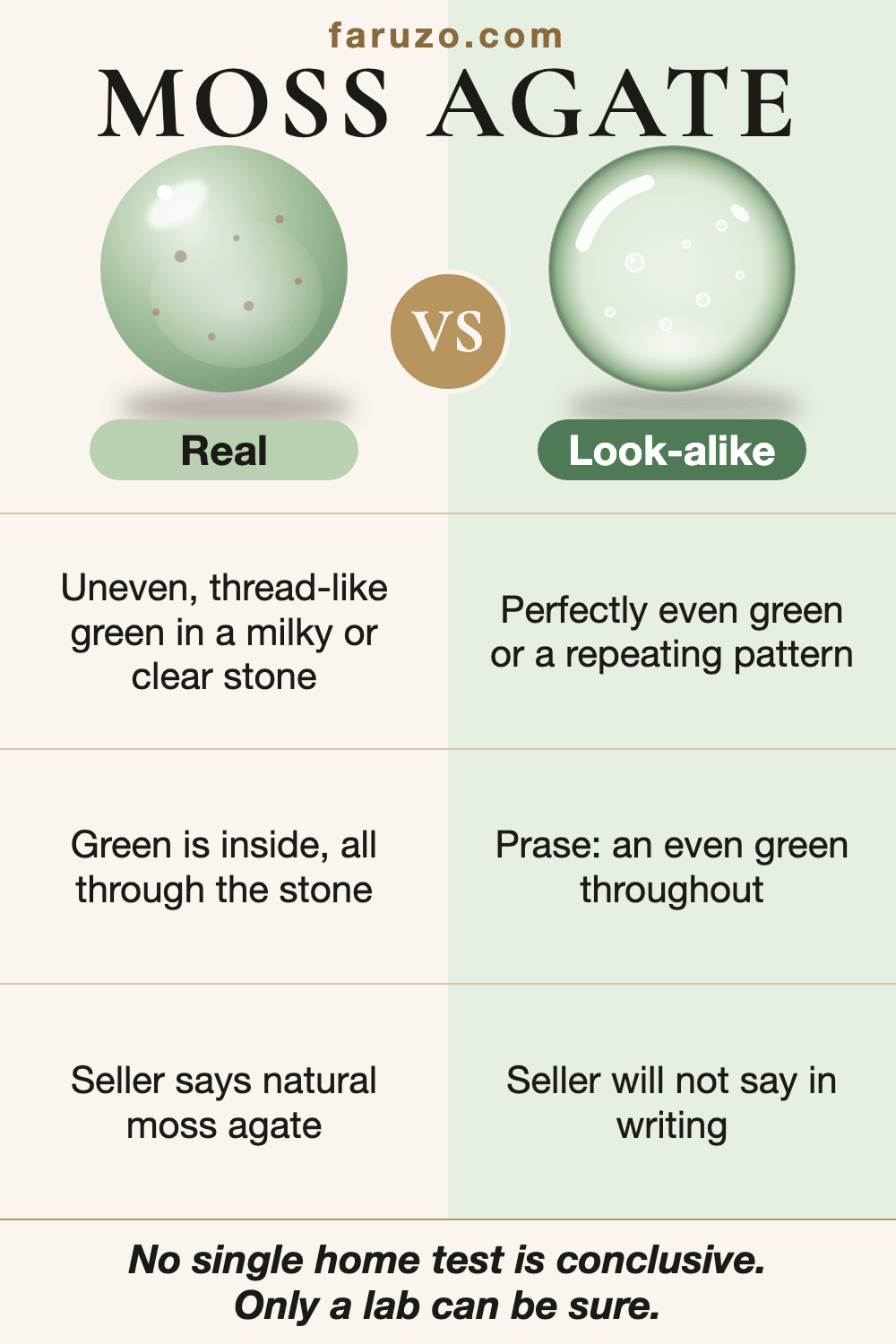
- Dyed green agate or chalcedony. Many pale agates are dyed, and green is made with salts of metals followed by heating. Dyed stone tends to look evenly and unnaturally bright, with colour that is strongest near the surface or in cracks, and may show no moss-like threads at all. Natural moss agate has a clear base with irregular green inclusions you can see into.
- Chrysoprase, prase and other green chalcedony. Chrysoprase is a fairly even apple-green chalcedony, and prase is a duller green quartz, rather than threaded. Moss agate keeps a pale, clear to milky host with distinct green inclusions.
- Tree agate. Tree agate is a milky stone with green or white branch-like patterns. It is close kin to moss agate, and the two names overlap in the trade.
Safe checks you can do
- Look for irregular, thread-like or cloud-like green inside a milky to clear base. Perfectly even green, or a repeating pattern, points to dye, glass or a moulded imitation.
- Check where the colour sits. Dyes on agate tend to be strongest near the surface and in cracks, while moss agate's green is inclusions throughout the stone. This is a hint, not proof.
- Ask the seller in writing whether the stone is natural moss agate, dyed chalcedony or something else. Dyeing is common on agate in general, so a clear answer matters.
- Bead bracelets in a very bright, even green are worth a question, since dyed beads are common. Ask whether the beads are natural or dyed.
Wearing Moss Agate
Ring
Careful
Fine with care, but knocks can mark it.
Bracelet
Safe
Fairly hard, so fine for normal bracelet wear.
Pendant
Safe
Fairly hard, and a pendant sits clear of knocks.
Earrings
Safe
Fairly hard, and earrings rarely take knocks.
Guide for everyday wear, based on hardness and care notes. Safe, Careful or Avoid.
At around Mohs 6.5 to 7 with no cleavage, moss agate is a reasonable choice for pendants, earrings, bead bracelets and rings. A ring takes the most knocks, so a protective setting helps, and storing it apart from harder stones such as sapphire or diamond avoids scratches. Take dyed or coloured agate off before heat work or long strong sun.
Questions about Moss Agate
What does moss agate mean?
In crystal tradition moss agate is a stone of nature, growth and patience, partly because its green threads look like a small garden. These are symbolic meanings from tradition, not facts about the stone or claims about your health.
Is moss agate a real gemstone?
Yes. It is a natural chalcedony, a fine-grained form of quartz (SiO2), and the moss is made of real mineral inclusions. It is a popular, affordable jewelry stone.
Is moss agate really an agate?
By the strict definition, usually not. A true agate has concentric banding, and moss agate normally lacks it. It is a chalcedony that the trade calls agate, and the name is widely used.
What is the green in moss agate?
It is mineral inclusions, reportedly minerals such as chlorite, celadonite or hornblende, in a clear to milky host. It is not moss or any plant matter, though people once thought it was petrified moss.
How hard is moss agate?
Around Mohs 6.5 to 7 as an agate-type chalcedony, with no cleavage. That is durable for most jewelry, though it can still be scratched by harder stones and chipped by a sharp knock.
How can you tell real moss agate from fake?
Look for irregular, thread-like green inside a milky to clear base. Perfectly even colour, colour concentrated near the surface or cracks, or tiny round bubbles suggest dye or glass. These are hints only, so use a lab if it matters.
How do you clean moss agate?
Wash it in lukewarm water with a drop of mild soap and a soft cloth, then rinse and dry. Skip machines, heat and long strong sun.
Is moss agate a birthstone?
Not on the standard birthstone lists. Any month attached to it is a custom or traditional choice, and lists differ.
What is the difference between moss agate and dendritic agate?
Dendritic agate shows dark, fern-like branching marks of manganese or iron oxide, while moss agate shows green to brown moss-like inclusions inside the stone. The names are sometimes used loosely in the trade, and mocha stone usually means dendritic agate.
Does moss agate fade?
The green threads in natural moss agate are mineral inclusions, not dye, so they are not expected to fade. Dyed or coloured agate can fade in long strong sun or heat.
What is the difference between moss agate and chrysoprase?
Chrysoprase is an even, apple-green chalcedony, while moss agate is a pale or clear stone with green threads. Chrysoprase is generally priced higher.
Can you wear a moss agate ring?
Yes, with care. At Mohs 6.5 to 7 it is durable, and a protective setting helps a ring take everyday knocks.