
Crystal guide
Malachite Meaning, Properties and Care
Malachite is a copper carbonate hydroxide (Cu2CO3(OH)2, Mohs 3.5 to 4) known for bold green bands and swirls. It is soft, dissolves in weak acids and darkens with heat, so it needs gentler care than most stones. In crystal tradition it is a stone of transformation and protection.
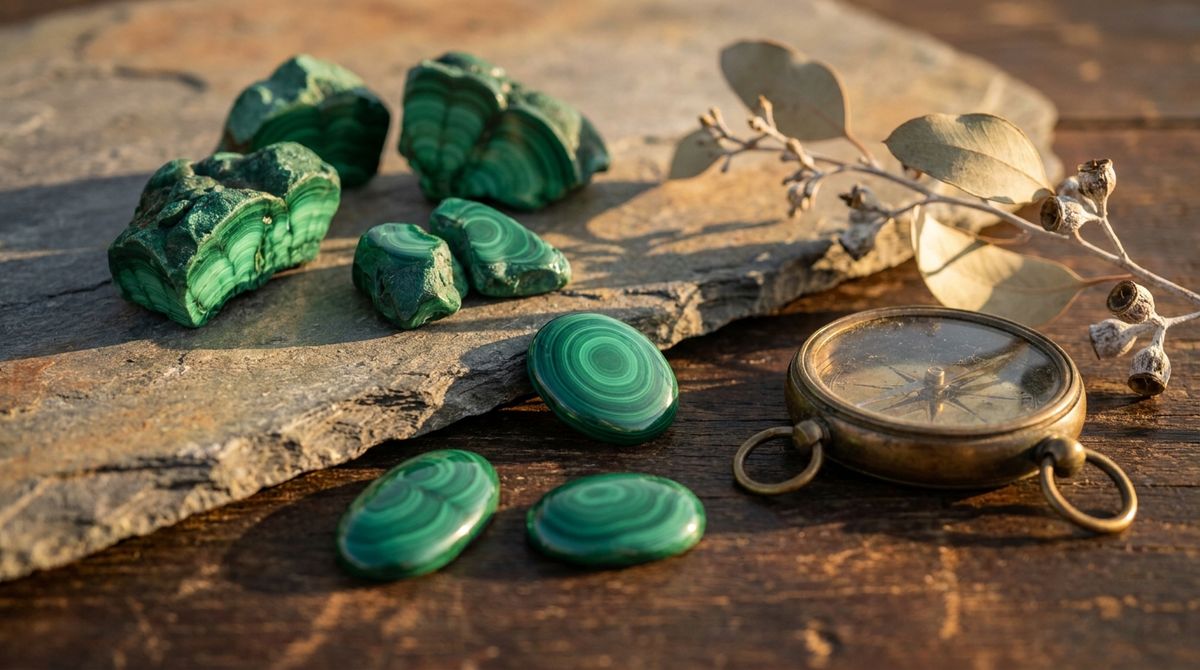
At a glance
- Hardness Mohs 3.5 to 4: soft, so it scratches and chips easily.
- Copper mineral (Cu2CO3(OH)2) in banded bright to dark green; the colour comes from copper.
- Care: no steam, no machine cleaners, no acids, no soaking.
- Best avoided as everyday jewelry; if worn at all, an occasional pendant or earrings kept dry, not a ring or bracelet.
Quick facts
| Family | Copper carbonate mineral |
|---|---|
| Chemical formula | Cu2CO3(OH)2 |
| Crystal system | Monoclinic |
| Mohs hardness | 3.5–4 |
| Luster | Adamantine to vitreous; silky if fibrous; dull to earthy if massive. Streak is light green. |
| Transparency | Opaque in jewelry. Polished pieces show concentric bands, often called eyes. |
| Natural colors | bright green, dark green, blackish green, banded light and dark green |
| Main localities | Democratic Republic of the Congo (banded material); Zambia; Namibia (Tsumeb); Australia (Broken Hill); Mexico; Arizona and other US states; Israel (Timna Valley); Russia (the Urals, historically) |
| Common treatments | rarely treated, lower quality pieces are sometimes stabilized with resin, surface is sometimes polished with wax |
Malachite at a glance, in pictures
Chakras (traditional)
Hardness range
Natural colors
- bright green
- dark green
- blackish green
- banded light and dark green
Traditionally linked to
- Planet
- Venus
- Zodiac
- CapricornScorpio
- Element
- Earth
Common forms of Malachite
- Rough raw chunk
- Tumbled polished pebble
- Cabochon smooth dome
How hard is Malachite?
- Talc 1
- Gypsum 2
- Copper coin ~ 3
- Calcite 3
- Malachite 3.5–4
- Fluorite 4
- Apatite 5
- Glass ~ 5.5
- Steel knife ~ 5.5
- Orthoclase 6
- Quartz 7
- Topaz 8
- Corundum 9
- Diamond 10
What it is and where it comes from
Malachite was reportedly mined near Sinai and the Isthmus of Suez as early as 4000 BC, which would make it one of the oldest worked ornamental minerals.
Ancient Egyptians used green malachite pigment in eye preparations, including in burials.
More on its history
The name comes from the Greek for a mallow-green stone, because the colour resembles mallow leaves.
Malachite was a green pigment in paints from ancient times until about 1800, when a synthetic copper carbonate pigment replaced it.
In the 19th century Russian royalty used large malachite pieces from the Urals for dining sets, vases, sculptures and wall panelling. The Hermitage Malachite Room is a well known example. The Urals are no longer the main source.
Victorians favoured it for carvings, beads and cabochons, and in tradition it has long been worn as a protective charm.
Malachite is also a copper ore, and it often grows together with blue azurite.
Malachite through time
-
Until about 1800
Malachite was a common green pigment in paints until a synthetic copper carbonate pigment replaced it.
-
19th century
Russian royalty had large pieces from the Urals cut into vases, dining sets, sculptures and wall panelling.
-
Victorian era
Victorians favoured it for carvings, beads and cabochons.
-
Today
Much banded material now comes from the Democratic Republic of the Congo, and the Urals are no longer the main source.
In crystal tradition
What follows is belief and folklore, passed down in crystal tradition. It is not measured fact.
Traditionally associated with: transformation, protection, change.
Malachite is traditionally called a stone of transformation, associated with pushing through change that has been put off. This is a symbolic meaning from tradition, not an effect on the body or mind.
Malachite is traditionally associated with the Heart chakra, the planet Venus and the element Earth. These mappings differ between lists and have no scientific basis.
Traditionally malachite is linked with the zodiac signs Capricorn and Scorpio, and some systems add Taurus and Libra through Venus. Lists disagree, and these pairings were assigned long after the stone was first used.
Traditionally malachite is seen as a protective stone, carried or worn as a guard against bad luck.
How to care for Malachite
- Water Caution
- Sunlight Unknown
- Salt Unknown
- Heat Avoid
- Ultrasonic Avoid
- Chemicals Avoid
Safe = fine as a rule · Caution = only briefly or gently · Avoid = can damage the stone · Unknown = no reliable guidance.
Wipe malachite with a soft, dry or barely damp cloth and dry it well; do not soak it. Skip ultrasonic and steam cleaners, and keep it away from acids, acidic cleaners, ammonia, perfume and lotion, because malachite dissolves in dilute acids. Heat breaks it down into black copper oxide, so keep it away from torches and prolonged heat; the bigger everyday risks are soaking and sweat. Effects of sunlight or salt are not well documented, so avoid them as a precaution. Store it apart from harder stones that could scratch it.
Real or fake? Look-alikes and treatments
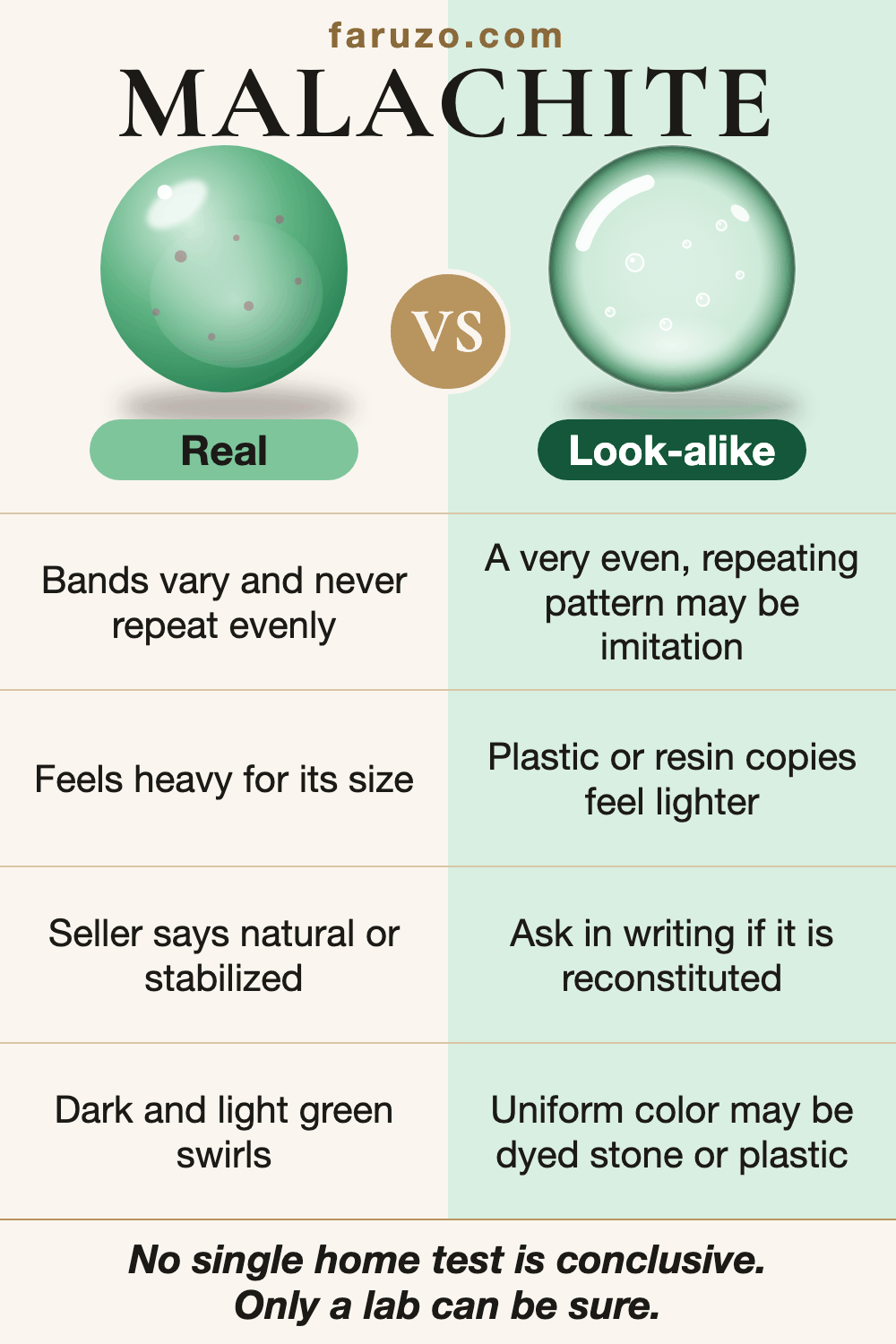
Often confused with
- Reconstituted malachite
- Dyed or painted green stone, plastic or resin
- Azurite
- Chrysocolla and other green stones
- Stabilized malachite
Common look-alikes
- Reconstituted malachite. Malachite powder or scraps pressed with resin. The banding looks flatter, more even or repeated in a regular pattern, where natural bands vary unpredictably. This is a hint, not proof, so ask for it in writing.
- Dyed or painted green stone, plastic or resin. These tend to show uniform colour and mechanically regular patterns. A real piece usually feels heavier than a plastic or resin copy of the same size, since malachite has a specific gravity of about 3.6 to 4. Weight is a hint only.
- Azurite. Azurite is the blue copper carbonate that often grows together with malachite, and mixed pieces are common. A blue and green piece can be a natural mix rather than a fake.
- Chrysocolla and other green stones. Chrysocolla, variscite and green fluorite can also look green. Malachite's concentric, sharply banded swirl in dark and light green is the usual visual clue, but a gemologist can confirm with a test.
- Stabilized malachite. Some lower quality malachite is stabilized with resin, and small voids may be filled. This is a treatment of real malachite rather than a fake, but it should be disclosed.
Safe checks you can do
- Look at the banding. Natural bands vary and do not repeat in a regular grid; a very even, repeating pattern points to reconstituted material or an imitation.
- Feel the weight. Malachite is dense, so it should feel heavier than a plastic or resin piece of the same size. Treat this as a hint, not proof.
- Ask the seller in writing whether the piece is natural, stabilized or reconstituted. Stabilizing with resin and filling small gaps is a known practice, so the real question is whether it is disclosed.
- Do not test with acid at home. Malachite fizzes in cold dilute acid, which damages the stone, and a gemologist can use safer tests. The streak is light green, but scratching a finished piece is not advised.
Wearing Malachite
Ring
Avoid
Softer than most everyday dust, so it scratches easily.
Bracelet
Avoid
Softer than most everyday dust, so a bracelet scratches easily.
Pendant
Careful
Heat can harm it, so keep it away from steam.
Earrings
Careful
Heat can harm it, so keep earrings away from steam.
Guide for everyday wear, based on hardness and care notes. Safe, Careful or Avoid.
Malachite is soft at Mohs 3.5 to 4, so it is best avoided as everyday jewelry. Rings and bracelets take the most knocks and are best avoided. A pendant or earrings can be worn occasionally, kept dry and in a protective setting. Take it off before washing up, swimming or applying perfume, and store it separately from harder stones. Dust from cutting or polishing malachite should not be breathed, so leave any cutting or polishing to workshops that use wet cutting and a mask.
Questions about Malachite
What does malachite mean?
In crystal tradition malachite is a stone of transformation and protection, traditionally linked with the Heart chakra and with pushing through change. These are symbolic meanings from tradition, not facts about the stone or claims about your health.
Is malachite a durable stone for everyday jewelry?
Not especially. At Mohs 3.5 to 4 it scratches and chips more easily than quartz (7) or sapphire (9), so rings and bracelets are best avoided. A pendant or earrings suit occasional wear better, in a protective setting.
Is malachite toxic?
The risk is in workshop dust. Dust from cutting or polishing malachite contains copper and should not be breathed, so lapidary work uses wet cutting and a mask.
Why does malachite have rings and bands?
It grows in layers in the weathered zone above copper deposits, and each band records a stage of that slow growth. The result looks a little like agate banding, but the minerals and the process are different.
What is malachite's connection to ancient Egypt?
It was reportedly mined near Sinai and Suez as early as 4000 BC, and ground green malachite was used in eye preparations, including in burials.
How can you tell real malachite from fake?
Look for irregular banding rather than an even, repeating pattern, and check that it feels heavier than plastic or resin. Reconstituted material and look-alikes such as dyed stone or plastic exist, and some real malachite is resin stabilized. A home look can only hint; a gemologist can say for sure.
How do you clean malachite?
Use a soft, barely damp cloth and dry it straight away. Machine cleaners, acids, acidic cleaners and ammonia are out, and so is soaking. Keep perfume and lotion off it.
Does heat damage malachite?
Yes. Heating breaks malachite down into black copper oxide, so keep it away from torches and long heat. This also matters when a ring is resized or repaired.
Where does malachite come from?
Much banded material now comes from the Democratic Republic of the Congo. Other sources include Zambia, Namibia, Australia, Mexico and the southwestern US. The Urals in Russia were the famous historic source.
Is malachite the same as azurite?
No. Both are copper carbonates, but azurite is blue and malachite is green. They often grow together, so blue and green mixed pieces are common.
Is malachite a birthstone?
Not on the standard birthstone lists. Crystal tradition pairs it with zodiac signs, which is a separate idea from birthstones.
Can malachite touch skin, sweat or water?
Sweat, water, perfume and acids can dull or etch a soft polished stone, so take it off for washing, swimming and workouts, and wipe it dry after wear.