
Crystal guide
Hematite Meaning, Properties and Care
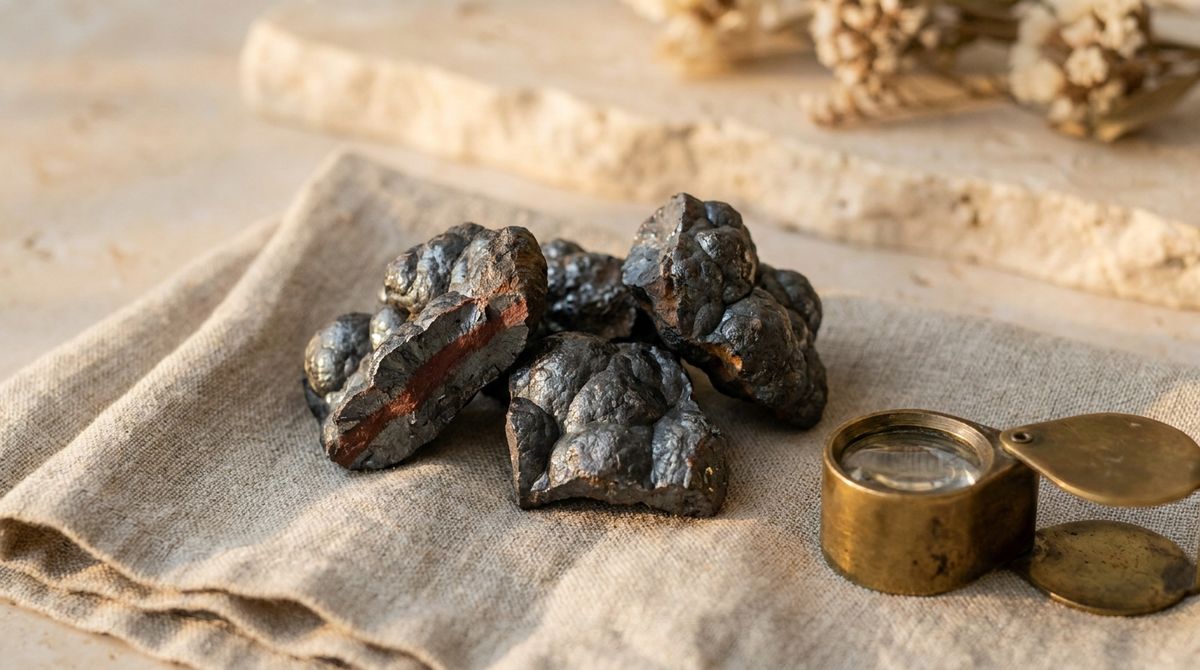
Hematite is an iron oxide mineral (Fe2O3) with a metallic grey to black shine and a red-brown streak, which is where its name, from the Greek word for blood, comes from. Natural stone is usually only weakly magnetic, so strongly magnetic hematite beads are manufactured stand-ins. In crystal tradition it is a grounding, protective stone.
At a glance
- Formula Fe2O3, trigonal; hardness about 5 to 6.5 on the Mohs scale, and it is brittle.
- Its signature is a red-brown streak, even when the stone itself looks black or silver-grey.
- Beads that snap together or cling to a magnet are usually manufactured hematine, not natural stone.
- Care: soft cloth, dry it promptly, no machine cleaners or steam. Every piece wants some care; a ring takes the most knocks.
Quick facts
| Family | Iron oxide (oxide mineral), a major ore of iron |
|---|---|
| Chemical formula | Fe2O3 |
| Crystal system | Trigonal, found as metallic plates, rounded masses and kidney-shaped lumps |
| Mohs hardness | 5–6.5 |
| Luster | Metallic to dull; uneven to conchoidal fracture, brittle |
| Transparency | Opaque in gem material |
| Natural colors | metallic silver-grey to black, reddish brown to dull red (earthy material) |
| Main localities | Australia (Pilbara and Western Australia); Brazil (Minas Gerais); USA (Lake Superior iron ranges); Elba, Italy; many other iron-ore regions |
| Common treatments | natural hematite is usually only cut and polished; many beads sold as magnetic hematite are a manufactured material instead |
Hematite at a glance, in pictures
Chakras (traditional)
Hardness range
Natural colors
- metallic silver-grey to black
- reddish brown to dull red (earthy material)
Traditionally linked to
- Planet
- SaturnMars
- Zodiac
- Aries
- Element
- Earth
Common forms of Hematite
- Rough raw chunk
- Tumbled polished pebble
- Bead drilled bead
How hard is Hematite?
- Talc 1
- Gypsum 2
- Copper coin ~ 3
- Calcite 3
- Fluorite 4
- Apatite 5
- Glass ~ 5.5
- Steel knife ~ 5.5
- Hematite 5–6.5
- Orthoclase 6
- Quartz 7
- Topaz 8
- Corundum 9
- Diamond 10
What it is and where it comes from
The name comes from the Greek haima, meaning blood, because the mineral leaves a red-brown streak when rubbed on a rough surface, even when the stone itself looks black or grey.
Hematite is one of the most abundant iron minerals and is a main ore behind much of the world's iron and steel, which is why most of it is mined for industry rather than jewelry.
Red hematite earth has been used as a pigment since prehistoric times, and polished hematite has long been carved into seals and small ornaments.
Small round hematite 'blueberries' were found on Mars by a NASA rover in the mid-2000s, and they point to water once having been present there.
Hematine is a manufactured iron-based material made to look like polished hematite and sold under names such as magnetic hematite. Beads that cling hard to a magnet are usually this material.
In crystal tradition
What follows is belief and folklore, passed down in crystal tradition. It is not measured fact.
Traditionally associated with: grounding, focus, protection.
Hematite is traditionally seen as a grounding stone, linked to the Root chakra and to focus, courage and protection. This is a spiritual tradition, not a fact about the stone.
The name means blood stone, and the stone is associated in tradition with battle and with protecting the wearer. Magnetic hematite bracelets carry the same grounding and protection meaning, although their beads are often a different material.
How to care for Hematite
- Water Caution
- Sunlight Unknown
- Salt Unknown
- Heat Caution
- Ultrasonic Avoid
- Chemicals Caution
Safe = fine as a rule · Caution = only briefly or gently · Avoid = can damage the stone · Unknown = no reliable guidance.
Clean hematite with a soft dry or slightly damp cloth and dry it straight away. A quick rinse is fine, but do not soak it or leave it damp. Real hematite is a stable iron oxide, yet a polished surface can still dull or scratch, and manufactured magnetic beads (hematine) can rust or flake. Avoid ultrasonic and steam cleaners, because vibration and sudden heat can crack or loosen a brittle stone. Keep it away from harsh cleaners as a precaution, and store it apart from harder stones that could scratch it. How it copes with long sun or sea water is not well documented, so keep it out of both.
Real or fake? Look-alikes and treatments
Often confused with
- Hematine (magnetic hematite)
- Magnetite
- Black tourmaline, black onyx and obsidian
- Glass or painted metal beads
Common look-alikes
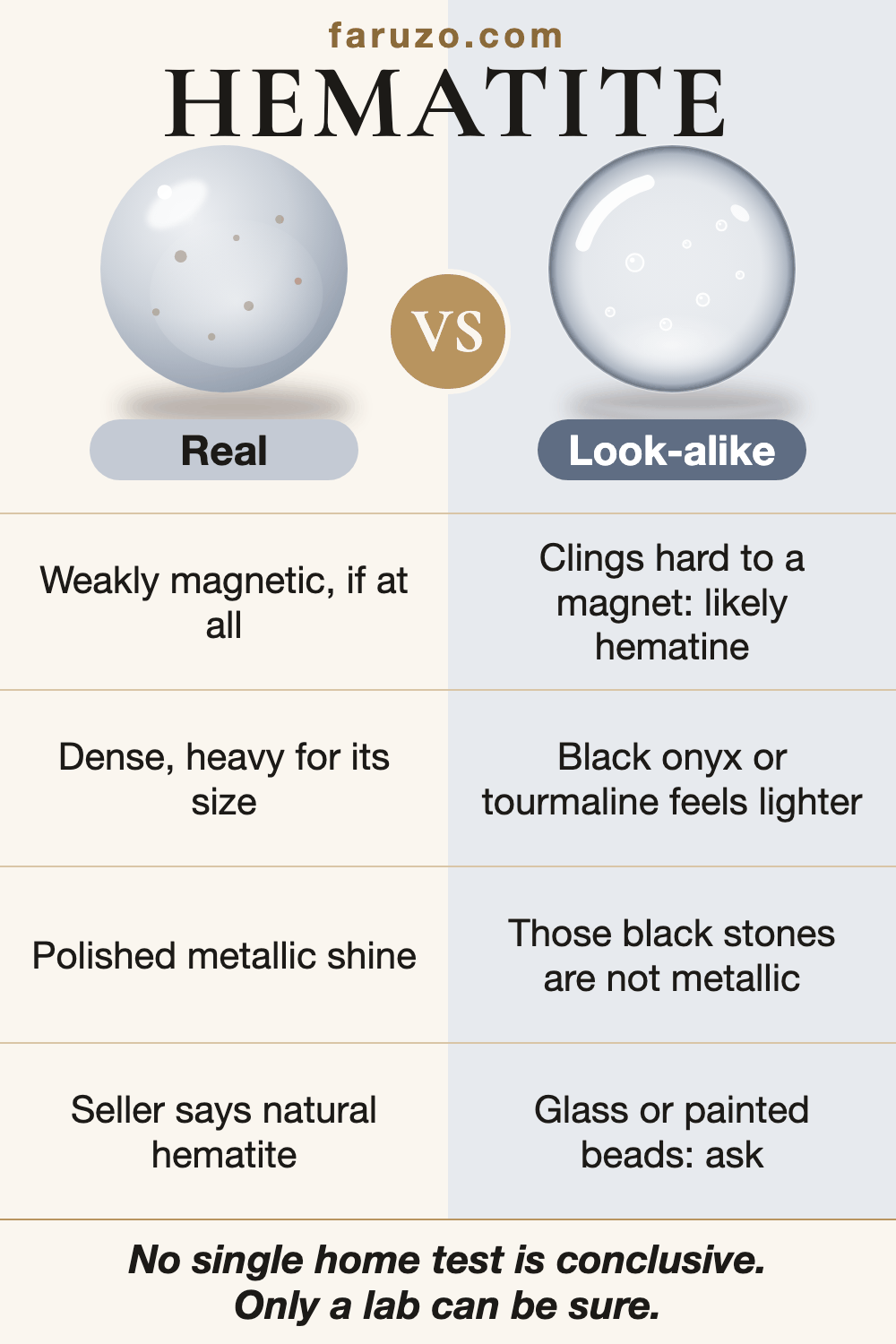
- Hematine (magnetic hematite). A manufactured, strongly magnetic material made to look like polished hematite. Natural hematite is usually only weakly magnetic, so beads that snap together or cling firmly to a magnet are very likely hematine. Ask what the beads are made of.
- Magnetite. Also grey to black and heavy, but it is strongly magnetic and leaves a black streak, while hematite leaves a red-brown streak.
- Black tourmaline, black onyx and obsidian. These black stones feel noticeably lighter in the hand than dense hematite and are not metallic in shine. Hematite looks like polished metal and feels heavy for its size.
- Glass or painted metal beads. Cheap beads can copy the dark metallic look. Chips or worn paint may show a different material underneath, and the weight often feels off. Ask whether the stone is natural.
Safe checks you can do
- Ask the seller in writing whether the beads are natural hematite or hematine (magnetic hematite).
- Try a magnet. Beads that cling hard to a magnet or snap onto each other are very likely hematine, although a piece with magnetite mixed in can also react. It is a sign, not proof.
- Feel the weight. Hematite is dense and feels heavier than a black stone such as onyx or tourmaline of the same size.
- Do not scratch-test a piece you plan to keep. A gemologist or lab can identify it more safely, including telling natural hematite from hematine.
Wearing Hematite
Ring
Careful
Fine with care, but knocks can mark it.
Bracelet
Careful
Bracelets take more knocks, so wear it with care.
Pendant
Careful
Keep a pendant away from hard knocks.
Earrings
Careful
Take earrings off for sport and sleep.
Guide for everyday wear, based on hardness and care notes. Safe, Careful or Avoid.
Hematite is only moderately hard and brittle, so a knock can chip or crack it. Every piece wants some care: a ring takes the most knocks and suits occasional wear, while bracelets, bead necklaces, pendants and earrings take fewer hard hits. Keep it away from harder stones that could scratch it, take it off for the gym, cleaning and anything rough, and dry it after contact with water.
Questions about Hematite
What does hematite mean?
In crystal tradition hematite is a grounding, protective stone linked to focus and courage and to the Root chakra. That is a belief, not a fact about the stone. Its name, from the Greek word for blood, comes from its red-brown streak.
What is hematite?
Hematite is an iron oxide mineral, Fe2O3, with a metallic grey to black shine and a red-brown streak. It is a major iron ore.
Is hematite magnetic?
Usually only weakly. A strong magnet may nudge a loose piece, but natural hematite does not normally snap beads together. Strongly magnetic jewelry is usually hematine, a manufactured material made to look like hematite.
What is hematine?
Hematine, sold as magnetic hematite or under brand names such as Hemalyke, is a manufactured, magnetised material made to look like polished hematite. It is a different material, so check what a bracelet is made of.
How hard is hematite?
About 5 to 6.5 on the Mohs scale, depending on the piece. It takes a polish but is brittle, so it can scratch against harder stones and chip or crack if knocked.
Is hematite a birthstone?
No. Hematite is not on the standard modern or traditional birthstone lists.
Can hematite get wet?
A quick rinse is fine. Dry it straight away and keep it out of damp bathroom dishes, since a soaked polished surface can dull and magnetic hematine beads can suffer more.
Why is hematite called blood stone?
The name comes from the Greek word for blood. Rubbed on a rough surface, hematite leaves a red-brown streak, even when the stone looks black. It is not the same as the green-and-red stone also called bloodstone.
How can you tell real hematite from fake?
Real hematite is heavy for its size and leaves a red-brown streak, while hematine clings strongly to magnets. No single home check is conclusive, so ask a gemologist or lab about a stone that matters.
Does hematite rust?
Real hematite is already an iron oxide, so it does not rust the way iron does. Manufactured magnetic hematite (hematine) beads can rust or flake, so keep a bracelet dry.
Does hematite need cleansing?
Crystal tradition has many cleansing rituals, but they are beliefs with no physical basis. For physical care, wipe it with a soft cloth and dry it promptly.
Is hematite rare or expensive?
Not usually. Most hematite is mined as iron ore, so jewelry-grade pieces are plentiful. Quality and finish vary, so compare weight and polish before paying more.
What is hematite used for besides jewelry?
Mostly as an iron ore for making iron and steel. Red hematite earth has also been used as a pigment since prehistoric times.
Can you wear a hematite ring?
With care, for occasional wear. Hematite is brittle at about 5 to 6.5 on the Mohs scale, so a knock can chip or crack it. Bracelets, pendants and earrings take fewer hard hits than a ring.