
Crystal guide
Fluorite Meaning, Properties and Care
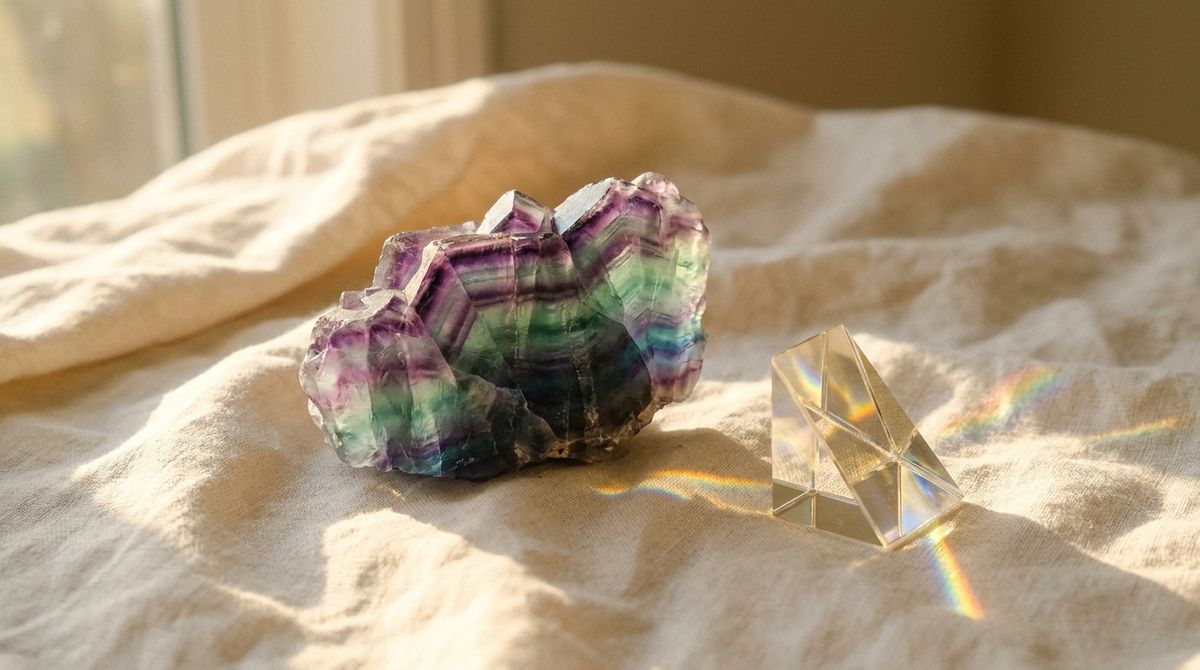
Fluorite is calcium fluoride (CaF2), a soft, colourful mineral at Mohs 4 with perfect cleavage, so it chips more easily than most stones sold as gems. It comes in more colours than almost any other mineral, often in bands or zones, and it gave science the word 'fluorescence'. In crystal tradition it is called the 'genius stone', linked to focus and clear thinking.
At a glance
- Formula CaF2, cubic crystals, hardness Mohs 4.
- Perfect cleavage in four directions: it splits along flat planes and chips easily.
- Colours include purple, blue, green and yellow, often banded or zoned, and some pieces glow under UV light.
- Care: soft cloth, lukewarm water, mild soap. No machine cleaners, and keep it out of heat and long strong light.
Quick facts
| Family | Halide mineral (calcium fluoride), also called fluorspar |
|---|---|
| Chemical formula | CaF2 |
| Crystal system | Isometric (cubic); cubes are common and octahedral forms also occur |
| Mohs hardness | 4 |
| Luster | Vitreous (glassy); perfect octahedral cleavage in four directions |
| Transparency | Transparent to translucent |
| Natural colors | purple; blue; green; yellow; colourless; pink, red, brown or black (less common); often banded or zoned in several colours |
| Main localities | China, Mexico, Mongolia, South Africa, England (Derbyshire), Spain (Asturias), Russia |
| Common treatments | usually sold untreated, though dyeing and stabilising of beads are sometimes reported; because it is soft and cleaves, rough handling in cutting and wear is the bigger concern |
Fluorite at a glance, in pictures
Chakras (traditional)
Hardness range
Natural colors
- purple
- blue
- green
- yellow
- colourless
- pink, red, brown or black (less common)
- often banded or zoned in several colours
Traditionally linked to
- Zodiac
- CapricornPisces
Common forms of Fluorite
- Rough raw chunk
- Tumbled polished pebble
- Cabochon smooth dome
How hard is Fluorite?
- Talc 1
- Gypsum 2
- Copper coin ~ 3
- Calcite 3
- Fluorite 4
- Apatite 5
- Glass ~ 5.5
- Steel knife ~ 5.5
- Orthoclase 6
- Quartz 7
- Topaz 8
- Corundum 9
- Diamond 10
What it is and where it comes from
The name comes from the Latin fluere, 'to flow', because the mineral was used as a flux that helps metal ore melt and flow. It is still used that way in steelmaking.
The word 'fluorescence' was coined in 1852 from fluorite, because many specimens glow, most often blue-violet, under ultraviolet light. Trace elements such as europium are thought to be behind the glow, and not every specimen glows.
Some fluorite also glows faintly when gently heated (thermoluminescence), and a green variety called chlorophane is known for this.
Blue John is a rare purple-and-blue banded fluorite mined in the Castleton area of Derbyshire, England, and long carved into ornamental vases and bowls.
Most fluorite is industrial. It is used as a flux in steel and aluminium making and as the raw material for hydrogen fluoride, which feeds refrigerants and fluoropolymers. Pure synthetic crystals are used in some camera, telescope and microscope lenses.
As a gem material fluorite is limited by its softness. It is mostly cut as beads, cabochons, carvings and display pieces rather than hard-wearing faceted stones.
In crystal tradition
What follows is belief and folklore, passed down in crystal tradition. It is not measured fact.
Traditionally associated with: focus, clear thinking, organisation, study.
Fluorite is nicknamed the 'genius stone' and is traditionally associated with focus, clear thinking and organising scattered thoughts. This is a modern spiritual tradition, not a fact about the stone.
By colour, purple and clear fluorite are traditionally linked to the Third Eye and Crown chakras, green to the Heart, and blue to the Throat. Zodiac links vary, with Capricorn and Pisces named most often. These are beliefs within crystal practice, not scientific claims.
How to care for Fluorite
- Water Caution
- Sunlight Caution
- Salt Unknown
- Heat Avoid
- Ultrasonic Avoid
- Chemicals Caution
Safe = fine as a rule · Caution = only briefly or gently · Avoid = can damage the stone · Unknown = no reliable guidance.
Clean fluorite with a soft cloth, lukewarm water and mild soap, then dry it. Avoid ultrasonic and steam cleaners, because vibration and sudden heat can widen cleavage cracks. Keep it out of strong heat and long direct sun, since the colour of some pieces may fade. Do not soak it. Keep it away from harsh cleaners, acids and salt, and store it apart from harder stones that could scratch it.
Real or fake? Look-alikes and treatments
Often confused with
- Glass or resin imitations
- Dyed quartz or other dyed stones
- Amethyst
- Other green or blue stones
Common look-alikes
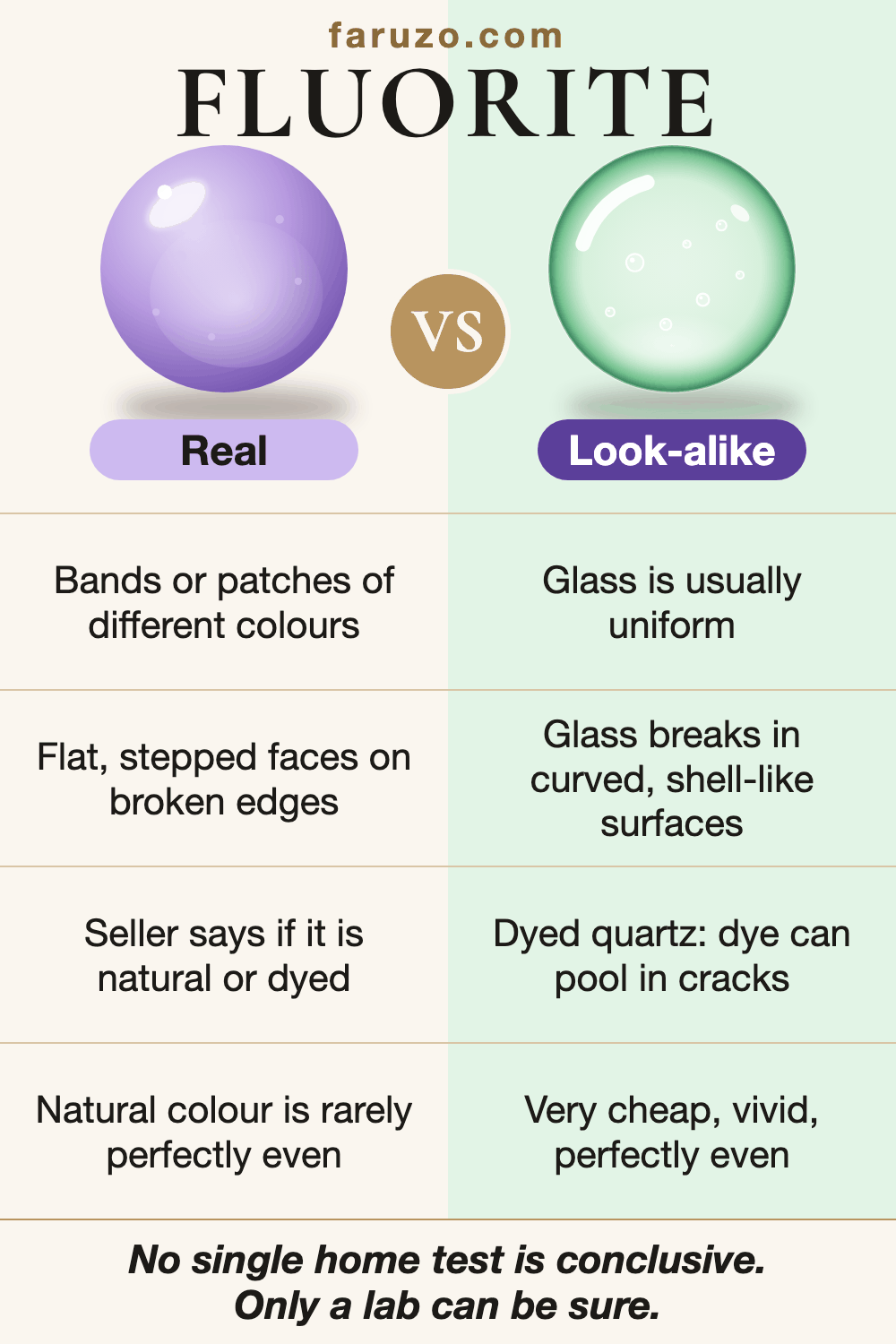
- Glass or resin imitations. Coloured glass can imitate banded fluorite. Glass is often too uniform and may show round bubbles, while real fluorite tends to have natural zoning and flat, stepped cleavage faces on broken edges. A gemologist can confirm.
- Dyed quartz or other dyed stones. Dyed stones can copy fluorite's purple and green. Dye often pools in cracks and can look unnaturally strong. Quartz is much harder (Mohs 7) and breaks with curved glassy surfaces, not flat cleavage. Ask whether the stone is natural or dyed.
- Amethyst. Amethyst is quartz, Mohs 7, with no cleavage. Fluorite is softer and shows flat cleavage faces and often multi-colour bands, while amethyst is usually a single purple with colour zoning in angular patches.
- Other green or blue stones. Some green and blue stones can look similar when polished. Fluorite's softness, flat cleavage surfaces and typical colour banding are clues, though no single sign is conclusive. A gemologist or lab can confirm.
Safe checks you can do
- Ask the seller in writing whether the stone is natural fluorite, dyed, glass or something else.
- Look for natural colour banding or zoning. Fluorite often shows layers or patches of different colours, whereas glass is usually uniform.
- Look closely at any chipped or broken edge. Real fluorite tends to show flat, stepped cleavage faces, while glass breaks with curved, shell-like surfaces.
- Be wary of a very cheap, perfectly even, vivid stone sold as rare fluorite. Natural material is rarely perfectly even, so ask questions.
- Do not scratch-test a stone you plan to keep. Fluorite is soft and splits easily, so a gemologist or lab can test it more safely.
Wearing Fluorite
Ring
Avoid
Soft and splits easily, so a ring is best avoided.
Bracelet
Avoid
Soft and splits easily: a wrist takes too many knocks.
Pendant
Careful
Splits along a flat plane, so a protective setting helps.
Earrings
Careful
Splits along a flat plane, so keep earrings for dressy wear.
Guide for everyday wear, based on hardness and care notes. Safe, Careful or Avoid.
Fluorite is soft (Mohs 4) and splits along perfect cleavage planes, so a hard knock can chip or crack it. That makes rings and bracelets best avoided. Pendants and earrings suit it better, ideally in a setting that protects the stone. Remove it for the gym, cleaning and anything rough, and keep it away from long strong light and heat.
Questions about Fluorite
What does fluorite mean?
In crystal tradition fluorite is the 'genius stone', linked to focus, clear thinking and organisation, and to the Third Eye and Crown chakras. That is a belief, not a fact about the stone. Its real claim to fame is that it gave science the word 'fluorescence'.
What is fluorite?
Fluorite is calcium fluoride, CaF2, a cubic mineral that often forms in bands of purple, blue, green and yellow. Its name comes from the Latin fluere, 'to flow', because it was used as a flux in smelting.
How hard is fluorite?
Fluorite is 4 on the Mohs scale, softer than quartz and easy to scratch with a steel knife blade (about 5.5). Perfect cleavage adds to the fragility, so it chips more easily than most stones used in jewelry.
Why does fluorite glow under UV light?
Trace elements such as europium inside the crystal absorb invisible ultraviolet light and give it off again as visible light, often blue-violet. Not every piece glows.
Is fluorite a real gemstone or just a mineral?
It is a mineral first and a gemstone by adoption. It is soft and cleaves easily, so it is mostly cut as beads, cabochons and carvings rather than hard-wearing faceted gems.
Is fluorite the same as amethyst or quartz?
No. Amethyst and quartz are silicon dioxide with Mohs hardness 7 and no cleavage. Fluorite is calcium fluoride, noticeably softer at Mohs 4, though the two share a similar purple range.
Can you wear fluorite jewelry every day?
Not really. At Mohs 4 with perfect cleavage, fluorite scratches and chips easily, so pendants and earrings hold up far better, and rings and bracelets are best avoided.
What is Blue John fluorite?
A rare banded purple-and-blue fluorite from near Castleton in Derbyshire, England. Old carved pieces are now scarce and treated as antiques.
How can you tell real fluorite from fake?
A home look can only hint. Real fluorite often shows natural colour banding and flat, stepped cleavage faces on broken edges, while glass looks more uniform and may show round bubbles. A gemologist or lab is the way to be sure for a stone that matters.
How do you clean and care for fluorite?
Wipe it with a soft cloth, lukewarm water and a little mild soap, then dry it straight away. Do not soak it; sudden heat and knocks can widen the cracks along its cleavage planes.
What is fluorite used for besides jewelry?
Mostly industry. It is used as a flux in steel and aluminium making and as a raw material for hydrogen fluoride, which feeds refrigerants and fluoropolymers. Pure synthetic crystals are used in some camera, telescope and microscope lenses.
Is fluorite a birthstone?
Not on the standard modern or traditional birthstone lists. Some alternative lists tie it to a month or a zodiac sign, but they differ, so treat any pairing as a personal custom.
Does fluorite fade in sunlight?
It can. The colour of some pieces may fade with long strong light or heat, though this varies from piece to piece. Keep fluorite off sunny windowsills and out of hot cars.
Is fluorite safe in water?
A quick wipe or rinse in lukewarm water is fine, but do not soak it or leave it in water. It is soft and cleaves easily, so long soaking and knocks can damage it.
What is rainbow fluorite?
Fluorite showing several colour bands, often purple, green, blue and yellow, in one piece. It is commonly sold as beads and tumbled stones, and the colour can fade in long strong light.