
Crystal guide
Danburite Meaning, Properties and Care
Danburite is a calcium borosilicate mineral (CaB2Si2O8), usually colourless to pale yellow, that takes its name from Danbury, Connecticut. It is fairly hard (Mohs 7 to 7.5) with only poor cleavage, and clear crystals are sometimes faceted into gems. In crystal tradition it is a gentle stone of patience and inner peace.
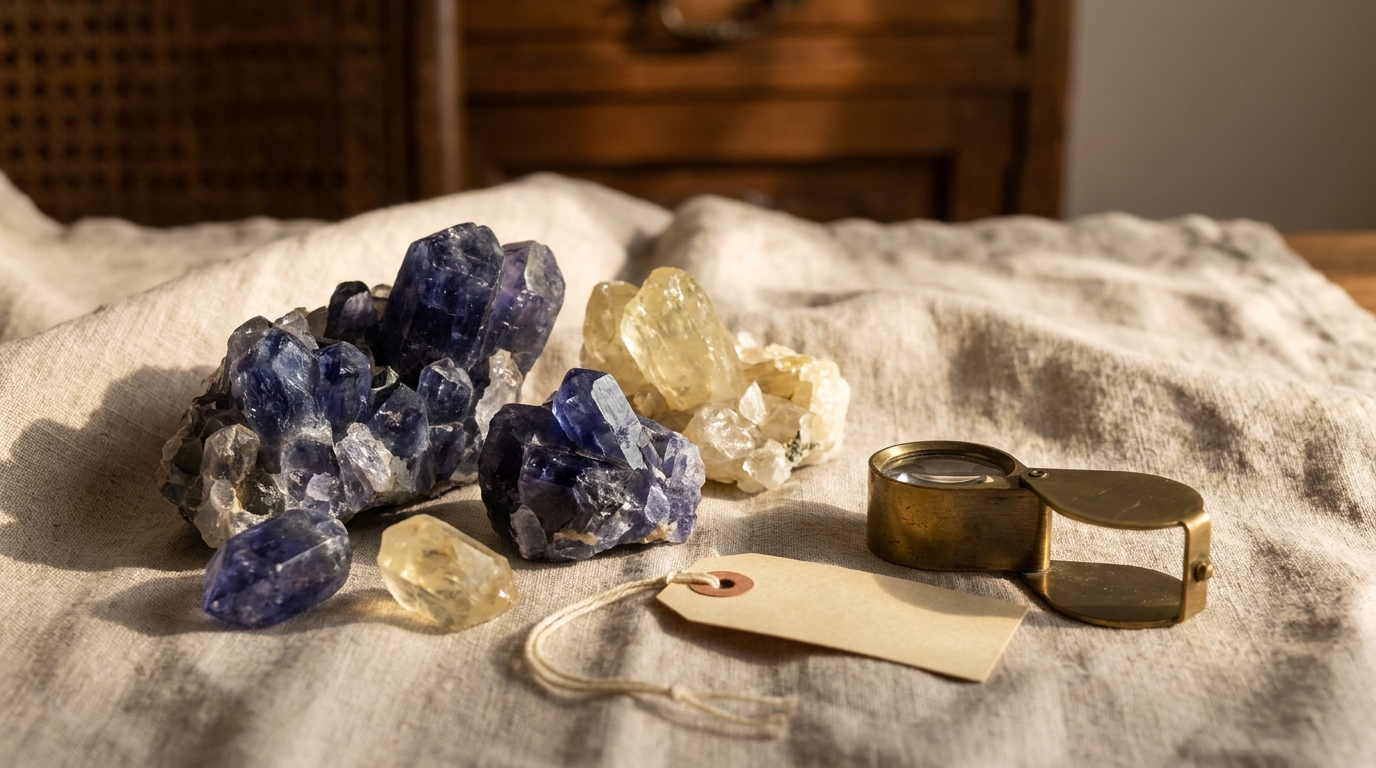
At a glance
- Formula CaB2Si2O8, orthorhombic, often in elongated prismatic crystals.
- Hardness is 7 to 7.5 on the Mohs scale, with poor cleavage, so a hard knock can still chip an edge.
- Usually colourless to pale yellow, sometimes white, pink or brownish, with a glassy shine.
- Care: soft cloth and mild soap, no ultrasonic or steam cleaners, and store it apart from harder gems.
Quick facts
| Family | Calcium borosilicate (a silicate mineral containing boron) |
|---|---|
| Chemical formula | CaB2Si2O8, also written CaB2(SiO4)2 |
| Crystal system | Orthorhombic, often as elongated, striated prismatic crystals |
| Mohs hardness | 7–7.5 |
| Luster | Vitreous to slightly greasy; poor cleavage, so it tends to fracture unevenly |
| Transparency | Transparent to translucent |
| Natural colors | colourless, white or grey, pale yellow to golden yellow, pale pink, light brown |
| Main localities | Mexico (reportedly the main source of clear crystals); Myanmar (reportedly golden-yellow crystals); Madagascar; USA (Danbury, Connecticut, where it was first found) |
| Common treatments | usually sold untreated, as clear faceted stones or crystal specimens; faceted pieces are rarely seen in everyday jewelry |
Danburite at a glance, in pictures
Chakras (traditional)
Hardness range
Natural colors
- colourless
- white or grey
- pale yellow to golden yellow
- pale pink
- light brown
Common forms of Danburite
- Faceted cut gem
- Rough raw chunk
How hard is Danburite?
- Talc 1
- Gypsum 2
- Copper coin ~ 3
- Calcite 3
- Fluorite 4
- Apatite 5
- Glass ~ 5.5
- Steel knife ~ 5.5
- Orthoclase 6
- Quartz 7
- Danburite 7–7.5
- Topaz 8
- Corundum 9
- Diamond 10
What it is and where it comes from
Danburite is named for Danbury, Connecticut, where it was first found and described in the 1830s. It is one of the few gem minerals named after a place in the United States.
The Connecticut find is not where today's stones come from. Clear crystals are reportedly mined in Mexico, golden-yellow ones in Myanmar, and some material comes from Madagascar.
It typically forms in contact metamorphic rock, where hot fluids rich in boron alter the surrounding stone.
Its clarity, hardness and strong sparkle make it worth faceting, so clear crystals are sometimes cut as gems. They are still mostly collector stones, far less common in jewelry than quartz or topaz.
In crystal tradition
What follows is belief and folklore, passed down in crystal tradition. It is not measured fact.
Traditionally associated with: patience, inner peace, emotional release.
Danburite is traditionally linked to the Heart and Crown chakras and to patience, acceptance and inner peace. Some people keep it near the bed or hold it during meditation as a comfort object.
These associations belong to modern spiritual tradition and are a matter of belief, not a measured property of the stone.
How to care for Danburite
- Water Safe
- Sunlight Unknown
- Salt Unknown
- Heat Caution
- Ultrasonic Caution
- Chemicals Unknown
Safe = fine as a rule · Caution = only briefly or gently · Avoid = can damage the stone · Unknown = no reliable guidance.
Clean it with a soft cloth, mild soap and lukewarm water, then dry it. Steam and ultrasonic cleaners are better left alone, because vibration and sudden heat can open a crack in a stone that has flaws. Store it wrapped in soft cloth, apart from harder gems such as sapphire or topaz that could scratch it.
Real or fake? Look-alikes and treatments
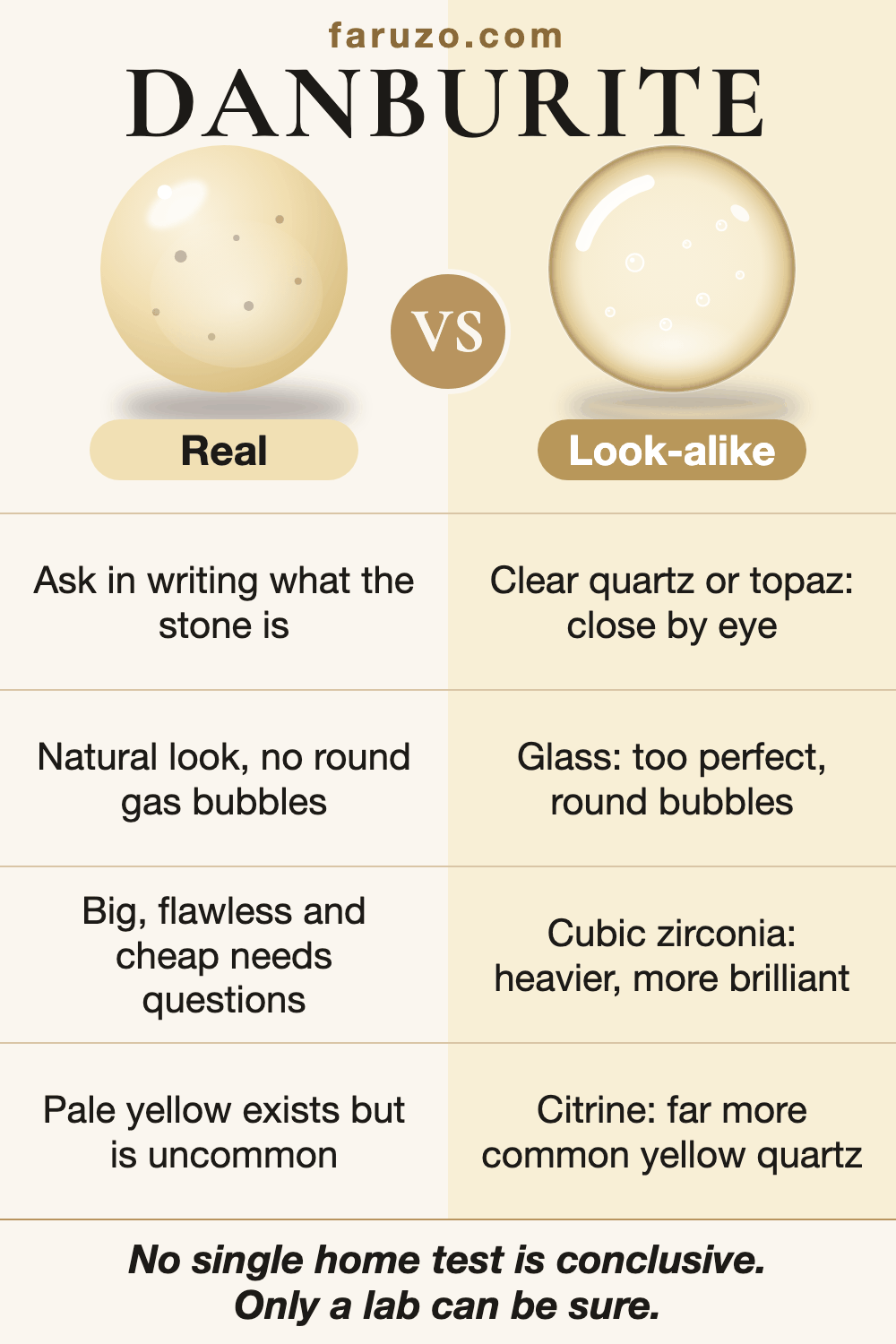
Often confused with
- Clear quartz
- White or colourless topaz
- Glass and cubic zirconia
- Citrine
Common look-alikes
- Clear quartz. Quartz is Mohs 7 and very common, so the two are close in hardness and easy to confuse by eye. Danburite tends to show a little more sparkle, and a lab can sometimes tell them apart by density.
- White or colourless topaz. Topaz is harder (Mohs 8) and is a different mineral, but clear stones can look alike. Hardness is often the clearest difference, and it is best left to a gemologist to test.
- Glass and cubic zirconia. Clear glass and cubic zirconia are common imitations of colourless gems. Glass is softer and may show round bubbles, and cubic zirconia is usually heavier and more brilliant. A lab can confirm which is which.
- Citrine. Pale yellow danburite resembles citrine, which is yellow quartz at Mohs 7 and far more common. A very large, cheap golden stone is more likely to be citrine than danburite.
Safe checks you can do
- Ask the seller in writing whether the stone is natural danburite, quartz, topaz, glass or something else.
- Be wary of a large, flawless, bargain-priced stone sold as danburite. Clear danburite is uncommon in jewelry, so a cheap listing deserves questions.
- Look for round gas bubbles or an unnaturally perfect look, which point to glass rather than a mineral.
- Do not scratch-test a stone you plan to keep. A lab can test it more safely.
Wearing Danburite
Ring
Careful
Hard, but a sharp knock can still chip it.
Bracelet
Careful
Hard, but a bracelet takes knocks that can chip it.
Pendant
Careful
Hard, and a pendant sits clear of most knocks.
Earrings
Careful
Hard, but keep earrings away from hard knocks.
Guide for everyday wear, based on hardness and care notes. Safe, Careful or Avoid.
Danburite is hard enough for regular wear, but its poor cleavage means a sharp knock can chip an edge. Rings and bracelets take the most knocks, so wear them with care and in a protective setting. Pendants and earrings take fewer, and a pendant is usually the gentlest choice. Take it off for sport and heavy work.
Questions about Danburite
What does danburite mean?
In crystal tradition danburite is a gentle stone of patience, acceptance and inner peace, linked to the Heart and Crown chakras. That is a belief, not a measured property of the stone.
What is danburite?
Danburite is a calcium borosilicate mineral (CaB2Si2O8), usually colourless to pale yellow. It is named for Danbury, Connecticut, where it was first found in the 1830s.
How hard is danburite?
Mohs 7 to 7.5, about the same as quartz and a little softer than topaz. Its poor cleavage means a hard knock can still chip it.
Is danburite a birthstone?
No. Danburite is not on the usual modern or traditional birthstone lists. Its clear and pale yellow colours are sometimes compared with April's diamond or November's topaz and citrine, but it is not an official stand-in for any month.
Is danburite rare?
Gem-quality danburite is uncommon. Clear, well-formed crystals large enough to facet come from a few places, and most of it is bought by collectors rather than jewelers.
Is danburite the same as topaz?
No. Topaz is a different mineral and is harder, at Mohs 8, while danburite is Mohs 7 to 7.5. The two can look similar when colourless or pale yellow.
Can danburite be worn every day?
It is hard enough for regular wear, but a hard knock can chip an edge. A pendant is usually the gentlest choice, and rings or bracelets are better worn in a protective setting and taken off for rough tasks.
Can danburite get wet or fade?
Water is fine for a quick rinse, and it is not known to fade in light. A clear stone can still crack from sudden heat, so keep it away from steam and hot water.
Is danburite dyed or treated?
It is usually sold natural. A stone with unusual, very vivid colour deserves a question to the seller about whether it is natural, dyed or another material.
Where does danburite come from?
It was first found in Danbury, Connecticut, but that is not a current source. Clear crystals are reportedly mined in Mexico, golden-yellow ones in Myanmar, and some comes from Madagascar.
What chakra is danburite linked to?
Crystal tradition most often links it to the Heart and Crown chakras. This is a spiritual belief and not a fact about the mineral.