
Crystal guide
Charoite Meaning, Properties and Care
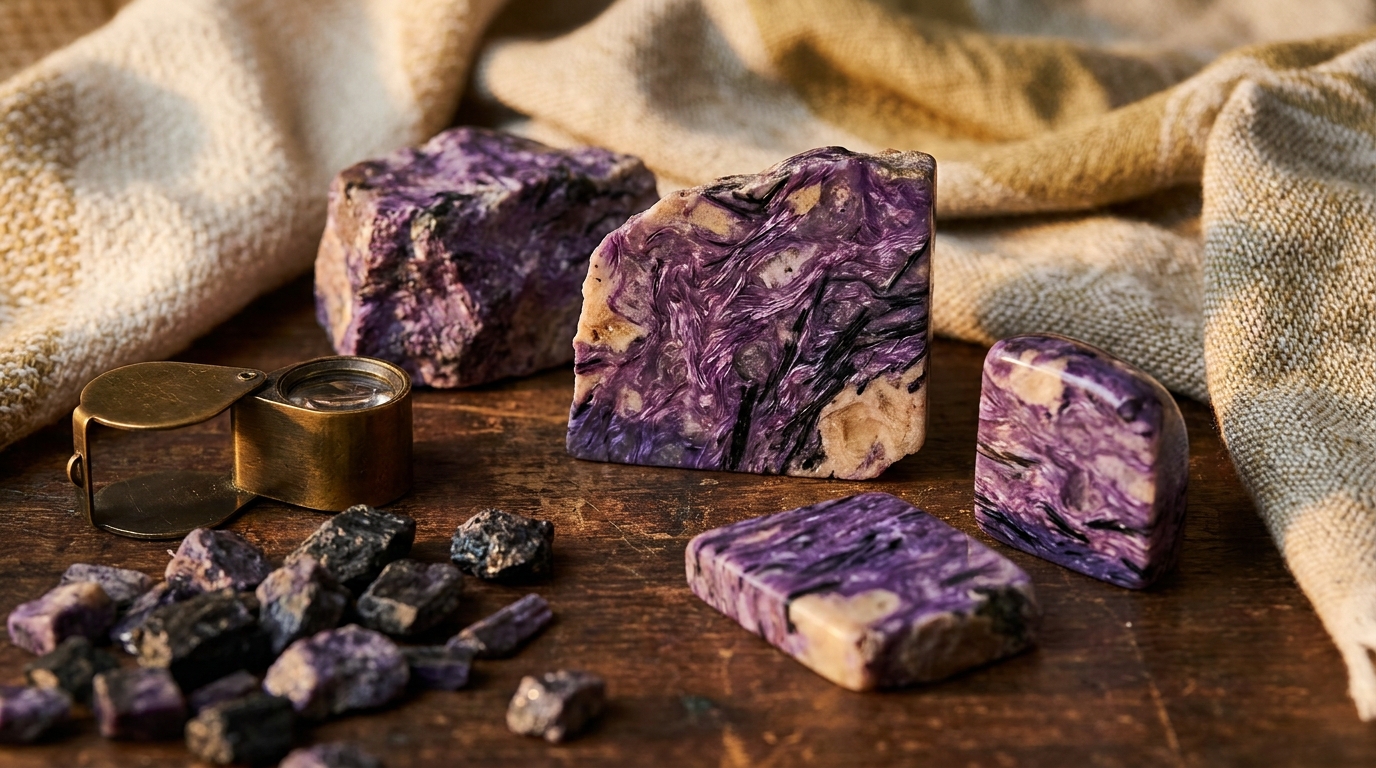
Charoite is a violet-to-lilac silicate with a swirled, almost woven look, usually sold as a rock of fibrous charoite mixed with black and pale minerals. It sits at about 5 to 6 on the Mohs scale and is reportedly found almost only in one part of Siberia. In crystal tradition it is a stone of change and letting go.
At a glance
- Formula K(Ca,Na)2Si4O10(OH,F)·H2O, monoclinic, in fibrous swirls of violet and lilac.
- Hardness 5 to 6 on the Mohs scale, with good cleavage, so knocks matter.
- Reportedly found only in the Aldan Shield of Siberia, and dyed stones are sometimes sold in its place.
- Care: soft cloth, lukewarm water, dry at once; no soaking, steam or ultrasonic cleaners.
Quick facts
| Family | Silicate mineral, usually sold as a rock mixed with other minerals |
|---|---|
| Chemical formula | K(Ca,Na)2Si4O10(OH,F)·H2O |
| Crystal system | Monoclinic, in fibrous, interlocking masses |
| Mohs hardness | 5–6 |
| Luster | Vitreous to pearly, often silky when polished; good cleavage in three directions |
| Transparency | Translucent |
| Natural colors | violet, lilac and lavender; light brown, less often; black and pale patches from the minerals mixed in |
| Main localities | Russia (Aldan Shield, Sakha Republic, Siberia), reportedly the only known source |
| Common treatments | usually polished, and often stabilised with a clear resin or similar filler; purple dye is sometimes applied to other stones to imitate it |
Charoite at a glance, in pictures
Chakras (traditional)
Hardness range
Natural colors
- violet, lilac and lavender
- light brown, less often
- black and pale patches from the minerals mixed in
Common forms of Charoite
- Rough raw chunk
- Tumbled polished pebble
- Cabochon smooth dome
How hard is Charoite?
- Talc 1
- Gypsum 2
- Copper coin ~ 3
- Calcite 3
- Fluorite 4
- Apatite 5
- Glass ~ 5.5
- Steel knife ~ 5.5
- Charoite 5–6
- Orthoclase 6
- Quartz 7
- Topaz 8
- Corundum 9
- Diamond 10
What it is and where it comes from
The name comes from the Chara River in Siberia, although the deposit is about 70 km from the river.
It was reportedly first found in the 1940s but was not formally described until 1978. Accounts of the earliest finds vary.
It forms where a syenite intruded into limestone at the Murun Massif, in the Aldan Shield of Siberia, and the deposit is reportedly the only one known.
Black aegirine needles and pale feldspar commonly sit among the violet fibres, which is why polished pieces show dark and light flecks. Each piece swirls differently.
The violet looks almost too vivid, and early pieces were reportedly taken for dyed stone.
Rough is mainly polished into cabochons, beads and tumbled pieces.
In crystal tradition
What follows is belief and folklore, passed down in crystal tradition. It is not measured fact.
Traditionally associated with: transformation, courage, letting go of old patterns, intuition.
Charoite is traditionally called a stone of transformation, linked to courage, change and letting go of old patterns. The swirled pattern makes it easy to read as turbulence settling into something beautiful.
In crystal tradition it is associated with the Third Eye and Crown chakras and with intuition. This is a modern spiritual belief, not a fact about the stone.
How to care for Charoite
- Water Caution
- Sunlight Caution
- Salt Caution
- Heat Caution
- Ultrasonic Avoid
- Chemicals Caution
Safe = fine as a rule · Caution = only briefly or gently · Avoid = can damage the stone · Unknown = no reliable guidance.
Wipe charoite with a soft cloth and lukewarm water, then dry it at once. Do not soak it, because water can get into the cleavage planes and any resin filler. Skip steam and ultrasonic cleaners, since vibration and sudden heat can open a crack. Keep strong cleaners away, store it apart from harder stones so it is not scratched, and keep it out of long direct sun as a precaution.
Real or fake? Look-alikes and treatments
Often confused with
- Sugilite
- Purple glass
- Dyed purple stones
Common look-alikes
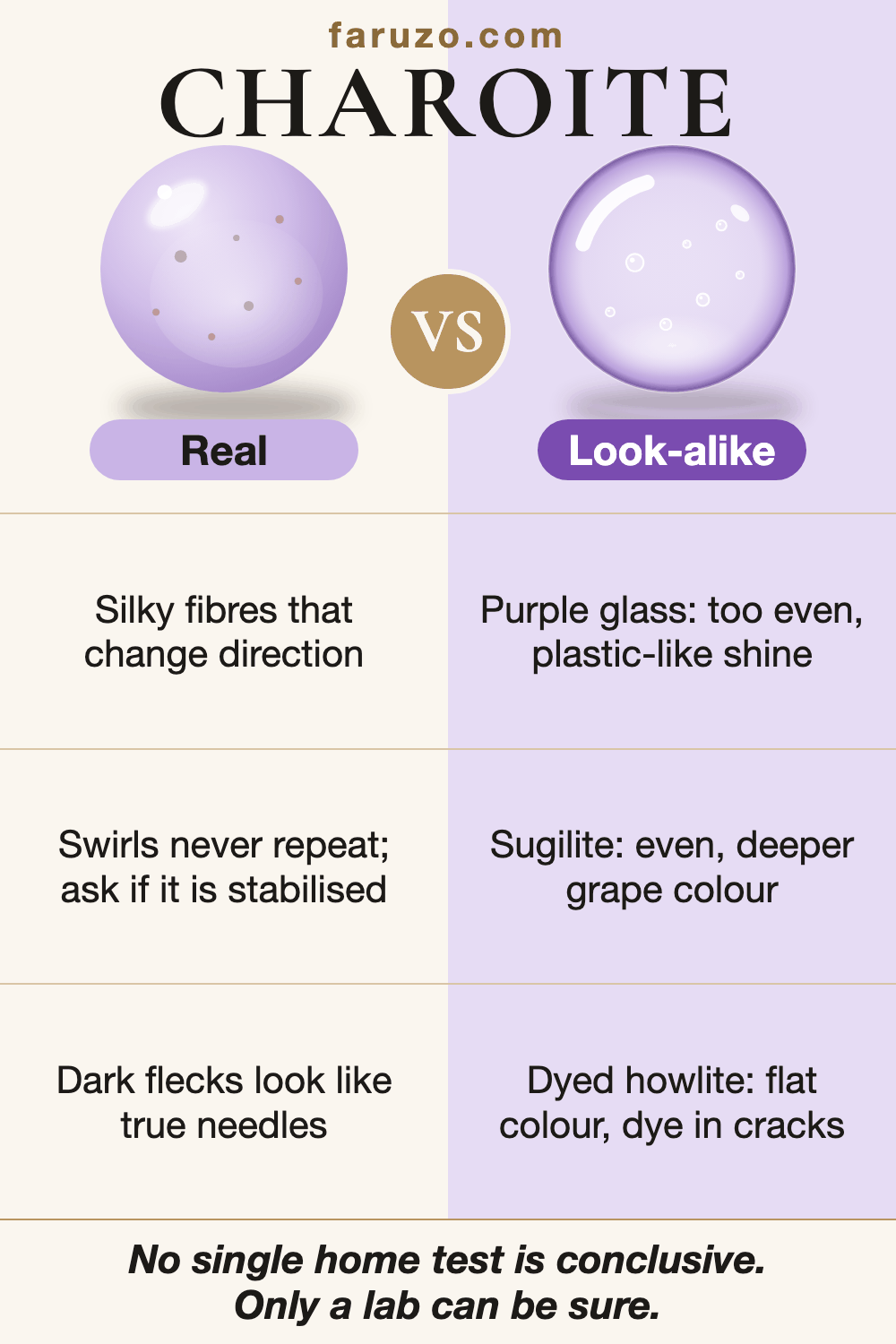
- Sugilite. Sugilite is also purple, but it is usually a more even, deeper grape colour and lacks charoite's fibrous swirls. A lab can separate them with certainty.
- Purple glass. Glass is often too even, with a plastic-like shine and sometimes round bubbles. Charoite shows silky fibres that change direction through the piece.
- Dyed purple stones. Purple dye can be applied to pale stones such as howlite or quartz. Dye tends to pool in cracks and look flat, without charoite's fibrous depth or dark needle-like flecks.
Safe checks you can do
- Ask the seller in writing whether the piece is natural charoite, stabilised, dyed or something else.
- Look for depth. Real charoite shows interlocking fibres with a silky, slightly shimmering look, and dark flecks that read as true needles rather than painted streaks.
- Be wary of a very cheap stone, or one whose swirl repeats perfectly from piece to piece. Natural patterns do not repeat.
- Do not scratch-test a piece you want to keep. A lab can test it more safely.
Wearing Charoite
Ring
Avoid
Splits easily along a flat plane, so a ring is best avoided.
Bracelet
Avoid
One knock on the wrist can split it along a flat plane.
Pendant
Careful
It can split along a flat plane, so keep it protected.
Earrings
Careful
A flat-plane split is possible, so keep earrings for dressy wear.
Guide for everyday wear, based on hardness and care notes. Safe, Careful or Avoid.
Charoite is only moderately hard and can split along flat planes, so a knock can chip or crack it. A ring or bracelet is best avoided, while a pendant or earrings take fewer knocks and suit it better, ideally in a setting that protects the stone. Remove it for the gym, cleaning and anything rough.
Questions about Charoite
What does charoite mean?
In crystal tradition charoite is a stone of transformation, tied to courage, change and letting go, and to the Third Eye and Crown chakras. That is a belief, not a fact about the stone.
What is charoite?
A violet silicate, K(Ca,Na)2Si4O10(OH,F)·H2O, whose fibres grow in interlocking swirls. It is usually sold as a rock that also holds black aegirine and pale feldspar, which gives each piece its own pattern.
Where does charoite come from?
It is reportedly found only in the Aldan Shield region of Siberia, Russia, where a syenite met limestone at the Murun Massif. It takes its name from the Chara River, about 70 km away.
How hard is charoite?
About 5 to 6 on the Mohs scale, so it is harder than calcite but softer than quartz, and it has good cleavage in three directions.
Is charoite a birthstone?
No. Charoite is not on the standard modern or traditional birthstone lists.
Is charoite a mineral or a rock?
Both, in practice. Charoite is a mineral, but what is sold as charoite is usually a rock that also holds other minerals such as aegirine and feldspar.
Is charoite dyed or stabilised?
Some pieces are stabilised with a clear filler, and purple dye is sometimes used on other stones to imitate charoite. Ask the seller what a piece is, since a filled stone needs gentler care.
How can you tell real charoite from fake?
A home look can only hint. Real charoite shows silky, interlocking fibres with depth, while glass and dyed stones look flatter and more even. A lab can confirm a stone that matters.
Can charoite get wet or fade?
Wipe it and dry it at once rather than soaking it, because water can reach the cleavage planes and any filler. Long direct sun may dull the colour of some pieces, so keep it out of bright windows.
Can you wear a charoite ring?
A ring is best avoided, because everyday knocks can chip it or split it along a flat plane. A pendant or earrings take fewer knocks.
Is charoite rare?
It is reportedly found in one area of the world, which is why genuine pieces are scarcer than the many purple imitations. Cut quality and pattern vary a lot.
What is the difference between charoite and sugilite?
Both are purple, but sugilite is usually a more even, deeper grape colour, while charoite is swirled and fibrous with dark and pale flecks.