
Crystal guide
Azurite Meaning, Properties and Care
Azurite is a deep blue copper carbonate mineral, Cu3(CO3)2(OH)2, with a soft Mohs hardness of 3.5 to 4 and perfect cleavage. It was ground into blue paint for centuries, and over long periods it can weather into green malachite. In crystal tradition it is a stone of insight and clear thinking.
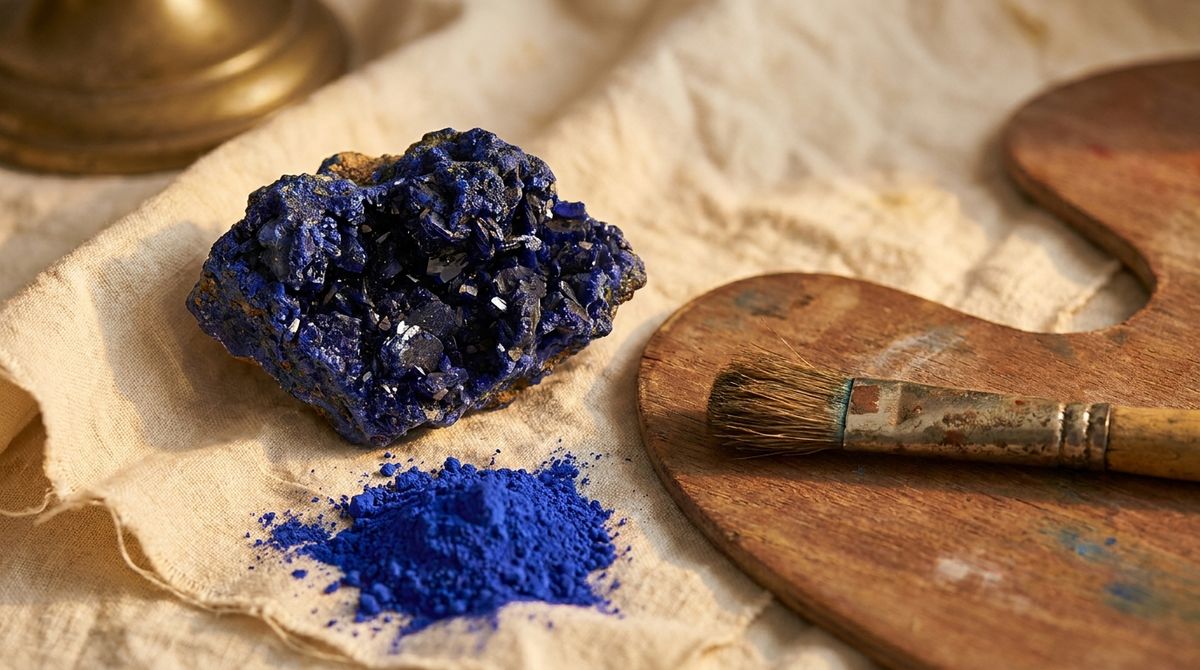
At a glance
- Formula Cu3(CO3)2(OH)2, monoclinic, with a deep blue colour that comes from copper.
- Hardness 3.5 to 4 on the Mohs scale, with perfect cleavage, so it is soft and brittle.
- Long used as a blue pigment, and often found grown together with green malachite.
- Care: keep it dry, cool and away from acids and heat; no ultrasonic or steam cleaners. Best as an occasional pendant or earrings, not a ring.
Quick facts
| Family | Copper carbonate hydroxide (carbonate mineral), a close partner of malachite |
|---|---|
| Chemical formula | Cu3(CO3)2(OH)2 |
| Crystal system | Monoclinic, as crystals, crusts or rounded masses |
| Mohs hardness | 3.5–4 |
| Luster | Vitreous, with perfect cleavage in one direction and fair cleavage in another |
| Transparency | Transparent to opaque, most often opaque in cut stones |
| Natural colors | deep azure blue, darker inky blue, blue with green banding where it grows with malachite |
| Main localities | Bisbee, Arizona (USA); Tsumeb (Namibia); Chessy, near Lyon (France); Utah (USA); Ural and Altai Mountains (Russia); Morocco |
| Common treatments | soft rough is sometimes stabilised with a clear resin to make cutting and wear easier; dyed blue stones are sometimes sold under the name, so ask what the stone is |
Azurite at a glance, in pictures
Chakras (traditional)
Hardness range
Natural colors
- deep azure blue
- darker inky blue
- blue with green banding where it grows with malachite
Traditionally linked to
- Zodiac
- SagittariusCapricorn
Common forms of Azurite
- Rough raw chunk
- Cabochon smooth dome
- Bead drilled bead
How hard is Azurite?
- Talc 1
- Gypsum 2
- Copper coin ~ 3
- Calcite 3
- Azurite 3.5–4
- Fluorite 4
- Apatite 5
- Glass ~ 5.5
- Steel knife ~ 5.5
- Orthoclase 6
- Quartz 7
- Topaz 8
- Corundum 9
- Diamond 10
What it is and where it comes from
Azurite has been ground into blue pigment for a very long time, and it was a common blue in medieval European painting. Names for the paint include mountain blue and blue bice. It may also have been used in ancient Egypt, though Egyptian blue was the main blue there.
Ground azurite paint was sometimes passed off as the costlier lapis blue.
In the early 1800s it was called chessylite, after Chessy near Lyon in France. It is also known as azure spar.
Azurite forms in the weathered upper zone of copper deposits, so it is usually found as a by-product of copper mining.
In air it is less stable than malachite, and it is often replaced by malachite while keeping its original crystal shape. That is why azurite and malachite so often appear together.
Classic specimens come from Bisbee in Arizona and Tsumeb in Namibia, and Morocco is also a source of material for cutting.
In crystal tradition
What follows is belief and folklore, passed down in crystal tradition. It is not measured fact.
Traditionally associated with: insight, clear thinking, intuition.
Azurite is traditionally linked to the Third Eye chakra and to insight, intuition and clear thinking. This is a modern spiritual tradition, not a fact about the stone.
Crystal tradition most often pairs azurite with Sagittarius and Capricorn. It is not on any standard birthstone list.
Azurite and malachite grown together are traditionally read as a balance of the reflective blue and the grounding green. That is a belief, not a property of the mineral.
How to care for Azurite
- Water Caution
- Sunlight Caution
- Salt Unknown
- Heat Avoid
- Ultrasonic Avoid
- Chemicals Avoid
Safe = fine as a rule · Caution = only briefly or gently · Avoid = can damage the stone · Unknown = no reliable guidance.
Wipe azurite gently with a dry or barely damp soft cloth. A short rinse is fine, but do not soak it. Keep it away from heat, steam, ultrasonic cleaners and acids, which can damage the surface or change the colour. Salt effects are not well documented, so keep it away from salt and sweat. Store it in its own soft pouch, away from harder stones, in a cool, dry place out of long direct sun.
Real or fake? Look-alikes and treatments
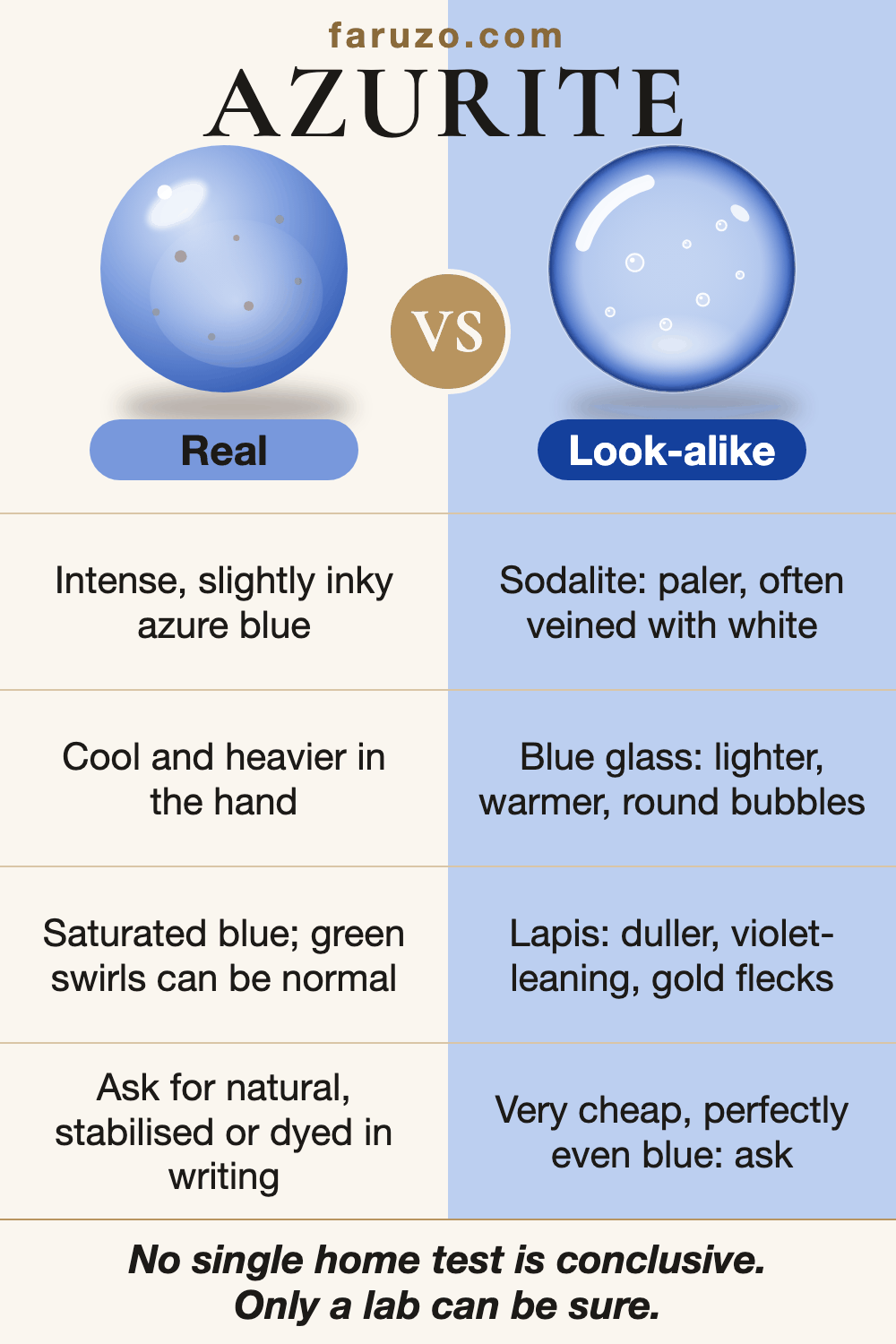
Often confused with
- Lapis lazuli
- Sodalite
- Blue glass
Common look-alikes
- Lapis lazuli. Lapis is a rock rather than a single mineral. It is usually a duller, violet-leaning blue, often with flecks of golden pyrite or white calcite, and it is harder than azurite. Azurite is a more saturated blue and fizzes in acid, so avoid testing a stone you plan to keep.
- Sodalite. Sodalite is a blue stone that is usually paler and often veined with white. It lacks azurite's intense azure colour and is harder, so it scratches less easily.
- Blue glass. Glass is a common imitation. It tends to look too even and may show round bubbles, and it feels lighter and warmer in the hand than copper-rich azurite.
Safe checks you can do
- Ask whether the stone is natural azurite, azurite-malachite, dyed or stabilised, and get the answer in writing.
- Look at the colour. Azurite is an intense, slightly inky blue, and blue-green swirls are normal in azurite-malachite.
- Check scratches and pits under a loupe. Dye tends to collect in pits and cracks, while natural colour runs through the stone.
- Be wary of a bright, perfectly even blue stone at a very low price. A lab can sometimes tell what a stone really is.
- Do not scratch or acid-test a stone you plan to keep. Azurite is soft and reacts to acid, so a lab test is safer.
Wearing Azurite
Ring
Avoid
Splits easily along a flat plane, so a ring is best avoided.
Bracelet
Avoid
One knock on the wrist can split it along a flat plane.
Pendant
Careful
It can split along a flat plane, so keep it protected.
Earrings
Careful
A flat-plane split is possible, so keep earrings for dressy wear.
Guide for everyday wear, based on hardness and care notes. Safe, Careful or Avoid.
Azurite is soft and splits along flat planes, so a knock can chip it. A ring or bracelet is best avoided, because hands take the most knocks. A pendant or earrings suit it better for occasional wear, ideally in a protective setting. Take it off for the gym, showers, cleaning and anything rough, and keep it away from heat.
Questions about Azurite
What does azurite mean?
In crystal tradition azurite is a stone of insight, intuition and clear thinking, linked to the Third Eye chakra. That is a belief, not a fact about the stone. Its measurable story is its copper-blue colour and its use as a paint.
What is azurite?
Azurite is a copper carbonate hydroxide mineral, Cu3(CO3)2(OH)2, that forms in the weathered upper part of copper deposits. Its deep blue colour comes from copper.
How hard is azurite?
Azurite is 3.5 to 4 on the Mohs scale, about as soft as a copper coin, and it has perfect cleavage. It scratches and chips easily.
Is azurite a birthstone?
No. Azurite is not on the standard modern or traditional birthstone lists. Crystal tradition connects it to Sagittarius and Capricorn, but that is a belief.
Is azurite the same as lapis lazuli?
No. Lapis is a rock made of several minerals, often with golden pyrite flecks, and it is harder. Azurite is a single copper mineral with a more saturated blue, and in the past the two were sometimes confused as paint.
Why does azurite turn green?
Azurite is less stable in air than malachite, so over long periods it can be replaced by green malachite. Green patches or a dull cast are not a sign of a fake, and azurite-malachite blends are common.
Can azurite go in water, and will it fade?
Keep it dry. A short rinse will not usually hurt, but never soak it, and avoid steam, heat and strong light for long periods, since colour can shift. Chemicals and acids can etch it, and dyed stones may lose colour sooner than natural ones.
Is azurite safe to wear?
As a care matter, azurite is a soft, copper-bearing mineral that can mark easily and may react with sweat, lotions and acids. Keep it dry, wear it only now and then as a pendant or earrings, and skip daily wear.
Can you wear an azurite ring?
A ring is best avoided. Azurite is soft and splits along flat planes, and a ring takes constant knocks. A pendant or earrings are kinder choices for occasional wear.
How can you tell real azurite from fake?
Natural azurite is an intense blue, sometimes with green swirls, while dyed stones show colour pooled in pits and glass looks too even. Ask what the stone is, and use a lab for one that matters.
What is azurite-malachite?
It is a natural blend of azurite and green malachite, often with blue-green swirls or bands. It forms because azurite slowly alters to malachite, so the two are often found together; pieces are cut for cabochons and beads. The blend looks distinctive, but it is just as soft as either mineral.
Was azurite used as a pigment?
Yes. Ground azurite was a common blue paint through the medieval period, sold under names like mountain blue.
Is azurite rare?
As a mineral it is fairly common around copper mines. Material sound and clean enough to cut into jewelry is much scarcer, because most azurite is brittle and often small.