Every kunzite on the market is younger than the mineral collections it sits in — spodumene itself has existed for as long as lithium-rich granite pegmatites have been cooling, but nobody had a name for its pink-to-violet variety until 1902, when a batch of unfamiliar crystals from a California mine landed on the desk of America's most famous gem detective. That short paper trail is unusual for a stone this striking: no multi-thousand-year mythology, no pharaoh's tomb, no Silk Road trade route. Kunzite's whole documented story fits inside 120 years, and most of what's worth knowing about it is a handful of very specific facts about how it forms, why it fades, and how to keep it from getting damaged.
What kunzite actually is
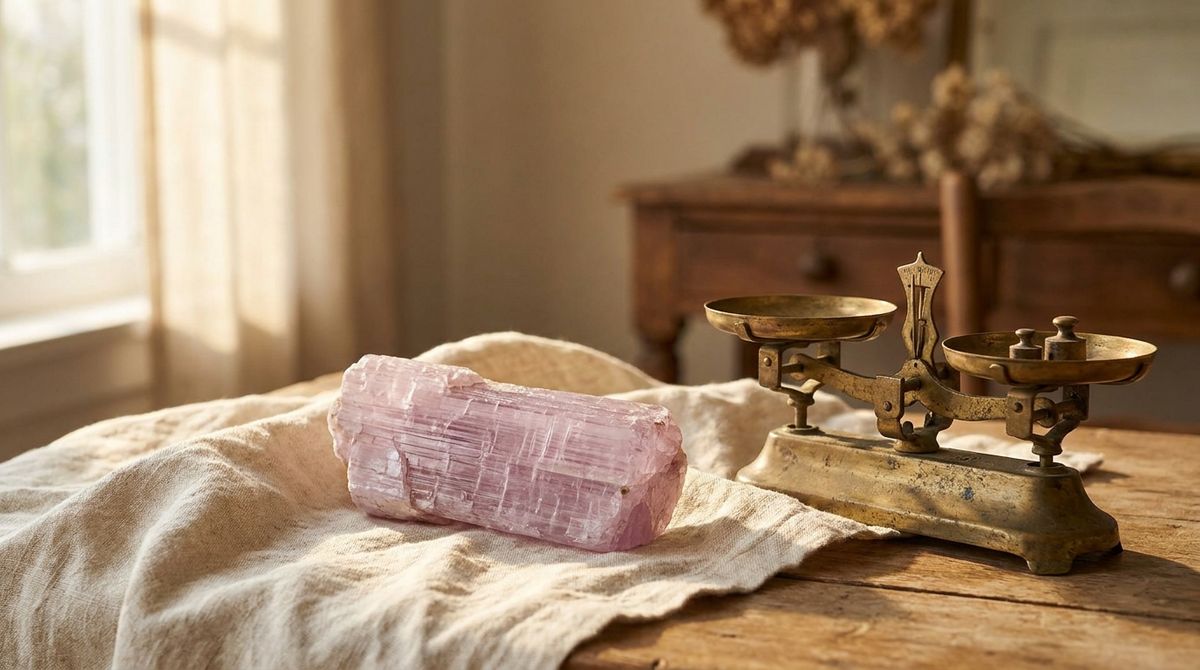
Kunzite is the pink-to-lilac-violet gem variety of spodumene, a lithium aluminum silicate (LiAlSi₂O₆) that forms in lithium-rich pegmatites. The color comes from trace amounts of manganese substituting for aluminum in the crystal structure — the same mineral colored by chromium instead produces green hiddenite, and by iron produces yellow triphane, all three names for the same base mineral wearing a different trace element.
It sits at 6.5 to 7 on the Mohs hardness scale, close to quartz, which sounds durable enough for daily wear. The complication is that kunzite also has two directions of perfect cleavage, meaning the crystal will split cleanly along specific internal planes under the right kind of knock, regardless of how hard the surface itself is. It's also strongly pleochroic — it shows different color intensities depending on the angle it's viewed from, with the deepest color visible looking down the length of the crystal — which is why cutters have to orient the rough carefully before faceting, or risk a finished stone that looks washed out from the face-up angle that matters most.
Discovered in 1902, named in 1903 for the man who identified it
In 1902, pink crystal specimens turned up in the Pala mining district of San Diego County, California, and were sent to George Frederick Kunz, the staff mineralogist at Tiffany & Co. and already the best-known gemologist in the country. Kunz confirmed the crystals were spodumene — but colored in a way no one had described before. Charles Baskerville, a chemistry professor at the University of North Carolina (later City College of New York), formally named the new variety "kunzite" in 1903, in Kunz's honor. It's a rare case of a gemstone named for the scientist who identified it rather than for a place, a color, or a myth.
Where it's mined today
California is kunzite's namesake locality — the Oceanview Mine in the Pala district still produces some — but it's no longer the main commercial source. Most of today's supply comes from Afghanistan, Brazil, and Madagascar. Kunzite crystals tend to grow large with relatively few inclusions; the Smithsonian's mineral collection includes an 880-carat faceted kunzite, and gem-quality rough well over that size has been reported from Brazilian pegmatites.
The color-fading problem
This is the one property every kunzite owner needs to know before the rest of the history matters: both natural and heat-treated kunzite color can fade with prolonged exposure to bright light and heat. Some gemological sources estimate natural kunzite can lose 5 to 15 percent of its color intensity over years of regular light exposure. It isn't an overnight change and normal wear isn't the main risk — a piece left on a sunny windowsill or in a lit display case for months at a time is. Kept in a jewelry box or worn mostly outside direct sun, a kunzite piece holds its color for a very long time; that same piece displayed under a bright window is the one that visibly pales first.
Kunzite vs. hiddenite: same mineral, different trace element
Kunzite and hiddenite are both gem-quality spodumene, distinguished only by which trace element got substituted into the crystal structure during formation: manganese for kunzite's pink-to-violet range, chromium (or vanadium) for hiddenite's green. Hiddenite is the rarer and more expensive of the two at comparable size and clarity — most commercial hiddenite comes from a much smaller number of localities than kunzite does — but the two are close enough in origin that a jeweler explaining one is, in effect, explaining both.
Physical, mental, and metaphysical: what people say about it
Physical: kunzite's 6.5–7 hardness looks durable on paper, but its two perfect cleavage directions make it more prone to splitting under a sharp knock than a ring worn daily can avoid — it suits earrings and pendants, or a protectively set ring worn occasionally, better than an everyday band.
Mental: in crystal-healing traditions, kunzite is described as a stone of calm, associated with easing anxiety and softening a guarded heart. That's a belief-system framing passed down through modern crystal-shop lore, not a documented or measurable effect.
Metaphysical: the same traditions pair kunzite with the heart chakra and, in some (inconsistent) systems, with Scorpio or Taurus — disagreement between sources is typical for a stone whose symbolic meaning was assigned well after, rather than alongside, its actual 120-year history.
How to care for kunzite jewelry
Skip ultrasonic and steam cleaners entirely — both introduce exactly the heat and vibration that risk kunzite's cleavage planes. Clean it with warm water, a little mild soap, and a soft cloth instead. Avoid sudden temperature swings, like going from a cold car straight into a hot shower while wearing it, since thermal shock is what actually triggers a cleavage split, not everyday knocks alone. And because prolonged bright light is the color's real long-term threat, store kunzite in a closed box rather than a sunlit display shelf between wearings — the same personalized keepsake logic applies whether the stone sits in a pendant or a ring: pieces meant to last across years, not seasons, are worth the extra care.
For the broader pattern behind why different stones carry different symbolic meanings — and how much of that is documented history versus modern crystal-shop marketing — different gemstones and what they really mean covers it across dozens of stones, and gemstone color meanings breaks down why pink and violet stones in particular cluster around calm and openness across cultures. If a kunzite piece is going into a ring despite the cleavage risk, how to clean a gemstone ring safely is worth reading first, since ultrasonic and steam cleaning are exactly what this stone can't tolerate.
Frequently Asked Questions
Is kunzite durable enough for everyday jewelry?
It's a mixed case. At 6.5–7 on the Mohs scale it resists surface scratching about as well as quartz, but its two directions of perfect cleavage mean a sharp knock can split it cleanly rather than just chip it. It suits earrings and pendants, or a protectively set ring worn occasionally, better than a ring taking daily knocks.
Does kunzite really fade in sunlight?
Yes — both natural and heat-treated kunzite color can fade with prolonged exposure to bright light and heat, with some estimates putting natural color loss at 5–15% over years of regular exposure. Normal wear isn't the main risk; a piece left on a sunny windowsill or under bright display lighting for months at a time is.
What's the difference between kunzite and hiddenite?
They're the same mineral, spodumene, colored by different trace elements: manganese produces kunzite's pink-to-violet range, chromium (or vanadium) produces hiddenite's green. Hiddenite is the rarer and typically more expensive of the two at comparable size and clarity.
Who is kunzite named after?
George Frederick Kunz, the Tiffany & Co. mineralogist who identified 1902 California crystal specimens as a new, previously undescribed spodumene variety. Chemist Charles Baskerville formally named the gem "kunzite" in his honor in 1903.
Where does kunzite come from?
Afghanistan, Brazil, and Madagascar supply most of today's commercial kunzite. California — specifically the Pala mining district in San Diego County, where it was first identified in 1902 — is still a source but a minor one today.
Kunzite is a strange case among gemstones: a documented, dated discovery instead of a myth, and a color that visibly changes if it's treated carelessly instead of one that just sits there being pretty. That's not a flaw so much as an instruction label — keep it out of direct sun when it's not being worn, skip the ultrasonic cleaner, and the same pink-violet crystal that impressed a Tiffany mineralogist in 1902 stays exactly as striking a century later.