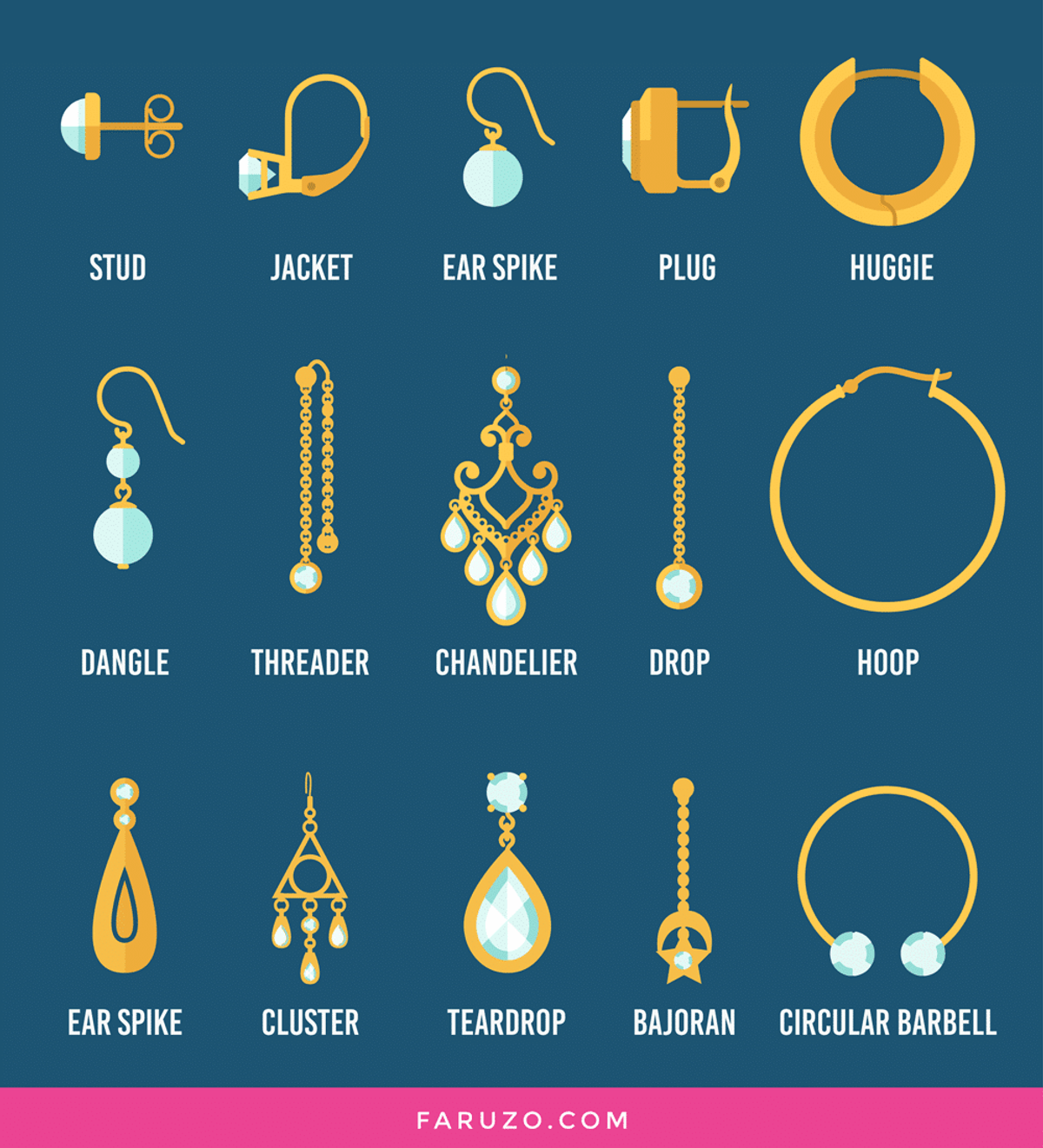
Earrings have been those timeless accessories that add a higher degree to any attire, effortlessly adding charm, elegance, or even a bold statement to your attire. A wide variety of styles can make selecting the right pair somewhat overwhelming. From simple stud earrings to intricate chandeliers, each style has something special to offer your personality and wardrobe. Whether you're exploring classic designs or custom earrings, there's always a perfect option to elevate your look.
To lead you through the maze of earrings, we have put together an extensive guide for the most common types of earrings and how to style them. Whether you need something a little more casual and worn daily or something a bit more appealing to efficiently make a statement, this article will help you find that perfect match.
Table of Contents
1. Stud Earrings 2. Drop Earrings 3. Cluster Earrings 4. Dangle Earrings 5. Hoop Earrings 6. Huggie Earrings 7. Chandelier Earrings 8. Threader Earrings 9. Jacket Earrings 10. Ear Climbers 11. Barbell Earrings 12. Circular Barbell Earrings 13. Plug Earrings 14. Bajoran Earrings 15. Spike Earrings 16. Teardrop Earrings
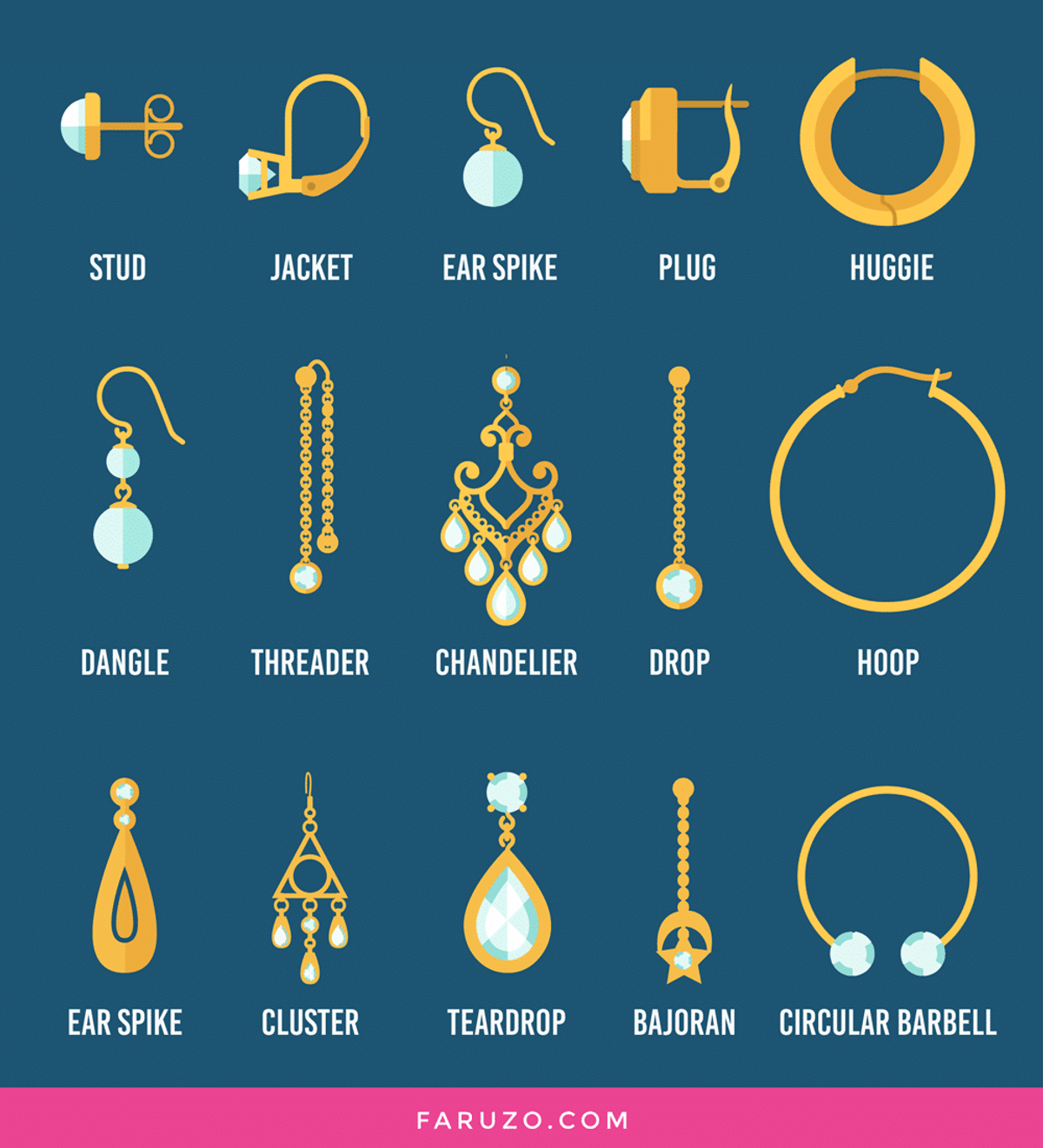
1. Stud Earrings: Simple and Timeless
Stud earrings are an indispensable part of each jewelry collection. Such type is minimalistic, comfortably sitting against the earlobe without dangle or drawing too much attention. It makes them appropriate to wear in casual and formal settings.
- Common Materials: Gold, silver, diamonds, and gemstones.
- Occasions: Suitable for regular wear, office environment, or low-key fashion.
- Styling Tip: Sleek, polished up-dos enhance diamond or pearl studs.
2. Drop Earrings: Elegance in Movement
They are called dropping earrings because they have a "dropped" design right below the lobe, giving more movement and length compared to studs. The subtle dangling effect adds classiness without making an appearance that is very dramatic.
- Available Styles: Simple pearls, simple gemstones, or metal-only designs.
- Best For: Evening events, business meetings, or any occasion that requires subtle elegance.
- Styling Tip: Drop earrings worn with an open neckline or an off-shoulder dress create perfect attention to the neck and collarbones.
3. Cluster Earrings: Statement-Making Sparkle
Cluster earrings are all about drama and intricacy. This is because several gems or stones come together to make one earring, which is compact in look but blindingly dazzling.
- Why Buy Them: They're perfect to put up a statement without going over to large, dangling designs.
- Variations: Cluster earrings can take the form of a stud or drop and generally feature diamonds, pearls, or brightly colored stones.
- Styling Tip: Cluster earrings look great with a monochromatic outfit—the pop of sparkle instantly catches the eye.
4. Dangle Earrings: Bold and Dynamic
While the large majority of people confuse dangle earrings with drop ones, they differ in length and freedom of movement. They may be everything from simple forms to elaborate creations, which dangle well below the earlobe.
- Trendy Designs: Chains, tassels, and other forms of ornate metal works.
- Occasions: Perfect for weddings, parties, or just when one needs that extra something in an outfit.
- Styling Tip: Avoid wearing dangle earrings with heavily patterned outfits; let them be the highlight.
5. Hoop Earrings: The Everyday Circle
The hoop is the most recognisable earring shape there is, and the one most people own in several sizes. A hoop draws a continuous line around the lobe, which flatters almost every face and dresses up or down depending only on diameter and thickness.
Because the shape is so plain, a hoop is also the easiest style to personalise — personalized hoop earrings carry a name or an initial along the curve without losing the outline that makes the shape work.
Common Materials: Gold, sterling silver, gold-plated stainless steel; often set with pavé stones.
Occasions: Daily wear, work, evenings out — the most versatile shape on this list.
Styling Tip: Match the diameter to your face: small huggie-sized hoops read refined, 50mm and up read deliberate. Anything in between tends to read as neither.
6. Huggie Earrings: The Hoop That Stays Put
Huggies are small hoops that close tightly against the lobe rather than swinging from it. Because they sit flush, they survive sleeping, gym bags and jumper collars in a way that larger hoops do not, which is why they have become the default second-piercing earring.
Common Materials: Gold, sterling silver, gold-plated steel; frequently hinged with a snap closure.
Occasions: Constant wear, second and third piercings, anyone who forgets to take earrings out.
Styling Tip: Worn in a stacked ear, keep every huggie in one metal and let size do the varying — mixed metals in a tight cluster look accidental rather than curated.
7. Chandelier Earrings: Tiered and Theatrical
Chandelier earrings cascade in tiers from a single fitting, widening as they fall. They are the most ornamental style here and the least forgiving of competition: worn with a busy neckline they fight it, and worn with a bare one they carry the whole outfit.
Common Materials: Gold and silver settings with crystal, cubic zirconia or gemstone drops.
Occasions: Weddings, black-tie, any occasion where the earrings are meant to be the jewelry.
Styling Tip: Wear them with a high or bare neckline and skip the necklace entirely — chandeliers and a statement necklace cancel each other out.
8. Threader Earrings: A Chain That Passes Through
A threader is a fine chain that slips through the piercing and hangs on both sides, so the length is set by how far you pull it. There is no back and no fixed drop, which makes it the most adjustable style on the list and the easiest to lose in a coat lining.
Common Materials: Fine gold and silver chain, sometimes finished with a small bar or stone.
Occasions: Evening wear, minimal outfits, anyone who wants length without weight.
Styling Tip: Set both sides unevenly on purpose — a longer front and shorter back reads intentional and keeps the chain from swinging into your jaw.
9. Jacket Earrings: Two Pieces, One Piercing
An ear jacket pairs a front stud with a second piece that sits behind the lobe and shows beneath it, so a single piercing carries two elements. Most jackets detach, meaning one purchase gives you a plain stud on weekdays and a fuller silhouette at night.
Common Materials: Gold, silver and plated steel, often with a stone in the front stud.
Occasions: Office to evening transitions, anyone who wants range from one pair.
Styling Tip: Wear the stud alone first to check the post length — a jacket needs a little more post than a plain stud, and a short post makes the back piece tilt forward.
10. Ear Climbers: Following the Curve
Climbers, sometimes called crawlers, run upward along the edge of the lobe instead of hanging from it. They give the impression of several piercings while using only one, and because the weight rests along the ear rather than pulling down, they stay comfortable for long days.
Common Materials: Gold and silver, frequently pavé-set to catch light along the curve.
Occasions: Parties, photographs, anyone curious about a stacked look without new piercings.
Styling Tip: Climbers are directional — a left and a right are not interchangeable, so check the pair matches your ears before wearing them out.
11. Barbell Earrings: The Straight Bar
A barbell is a straight post with a bead threaded onto each end. It belongs to the piercing world more than the fashion one, and it is the standard fitting for cartilage, industrial and tragus placements where a hook or a hanging drop would catch.
Common Materials: Implant-grade titanium and 316L surgical stainless steel; gold for healed piercings.
Occasions: Cartilage, helix, tragus and industrial piercings; healed lobes.
Styling Tip: Buy the gauge and length your piercer specifies rather than by eye — a barbell that is slightly too short presses on the tissue and slows healing.
12. Circular Barbell Earrings: The Horseshoe
A circular barbell is a barbell bent into an open ring, leaving a horseshoe gap between the two beads. It suits placements where a full ring would sit awkwardly, and the gap makes it considerably easier to put in one-handed than a seamless hoop.
Common Materials: Titanium and 316L surgical steel, occasionally gold-plated.
Occasions: Septum, daith, helix and other cartilage placements.
Styling Tip: The beads unscrew in opposite directions on some designs — if one will not turn, try the other before assuming it is stuck.
13. Plug Earrings: Bold and Unconventional
Plug earrings, also known as gauges, are for the truly adventurous. Instead of being placed on the earlobe, these earrings stretch it, creating a hole that the plug fits into.
- Materials: Typically made from wood, acrylic, stainless steel, or silicone for comfort.
- Sizes: Range from subtle small plugs to extreme sizes larger than a golf ball.
- Styling Tip: Combine smaller plugs with other earrings like huggies or studs for a layered look, while larger plugs work as standalone statement pieces.
Cultural Note: Plug earrings hold cultural significance in many societies, such as the Maasai in East Africa and South American tribes, often symbolizing rites of passage or social status.
14. Bajoran Earrings: A Fashion Trend from Science Fiction
Bajoran earrings originated from the Star Trek universe, worn by the fictional Bajoran species. These earrings have since transcended sci-fi to become a unique and trendy style.
- Design: Feature a chain that connects multiple points of the ear, often linking the upper ear to the lobe.
- Occasions: Great for cosplay, themed events, or as a quirky conversation starter.
- Styling Tip: Opt for minimal designs with a delicate chain and subtle adornments for a modern twist.
15. Spike Earrings: Bold and Daring
Spike earrings feature sharp, protruding designs that exude boldness and edginess. They are often associated with goth, punk, or alternative fashion.
- Design Features: Spikes can vary in size and placement, with some designs featuring multiple spikes radiating from a central stud.
- Best For: Individuals looking to add a rebellious touch to their style.
- Styling Tip: Keep outfits and other accessories minimal to let the spikes take center stage.
16. Teardrop Earrings: Elegance in Form
Teardrop earrings are instantly recognizable for their distinctive shape. Often featuring a gemstone or jewel, they dangle elegantly, creating a timeless and sophisticated aesthetic.
- Materials: Commonly crafted with diamonds, sapphires, emeralds, or other precious stones.
- Occasions: Perfect for weddings, galas, or other events where elegance is key.
- Styling Tip: Pair teardrop earrings with a classic updo and an elegant gown to complete the look.
Matching Earring Styles to Face Shapes
When choosing the right earrings, face shape plays a crucial role. While most earrings look good on everyone, certain styles can accentuate your features better than others. Here’s a quick guide:
- Oval Face: Extremely versatile; most styles work well. Best options include studs, hoops, and chandelier earrings. Avoid overly long earrings that may elongate the face further.
- Round Face: Add length and structure with drop earrings, dangles, and teardrops. Avoid large circular hoops that can emphasize the roundness.
- Heart-Shaped Face: Balance a wide forehead and narrow chin with chandelier earrings or teardrops. Avoid studs or ear climbers that draw attention to the upper face.
- Square Face: Soften strong jawlines with hoops, circular barbell earrings, and cluster earrings. Avoid geometric shapes and square studs.
- Long Face: Add width and reduce vertical length with studs, huggies, and cluster earrings. Avoid long, linear earrings like threaders or dangles.
Find Your Perfect Pair
Earrings are more than just jewelry—they are a reflection of personality, style, and mood. From timeless elegance with studs to bold statements with barbell or spike earrings, there’s something for every occasion and individual.
By considering factors like face shape, outfit coordination, and personal preferences, you can build a versatile earring collection that enhances your look effortlessly. Don’t hesitate to experiment with styles and combinations—fashion is all about expressing yourself!
Frequently Asked Questions
What is the difference between drop and dangle earrings?
The two are easy to confuse, but the difference comes down to length and movement. Drop earrings hang just below the earlobe with a subtle, elegant sway, while dangle earrings extend well below the lobe and move much more freely. Drops read as understated and refined; dangles make a bolder, more dynamic statement.
Which type of earring is best for everyday wear?
Stud earrings are the most practical choice for daily wear. They sit flush against the earlobe without dangling or catching on things, and they transition easily from a casual look to the office. A simple gold, silver, diamond, or gemstone stud works with almost any outfit.
What earrings look best on a round face?
For a round face, choose styles that add length and structure, such as drop earrings, dangles, and teardrops. These elongate the face and create balance. It is best to avoid large circular hoops, which tend to emphasize roundness.
Are plug earrings permanent?
Plug earrings, also called gauges, work by gradually stretching the earlobe to create a larger opening that the plug fits into, so the change to your ear is not something that reverses on its own. They are typically made from wood, acrylic, stainless steel, or silicone, and range from small sizes to very large ones. In many cultures, such as the Maasai in East Africa and South American tribes, they also carry deep significance tied to rites of passage or social status.
How do I choose earrings for a heart-shaped face?
A heart-shaped face has a wider forehead and a narrower chin, so the goal is to add fullness toward the jaw. Chandelier earrings and teardrops work beautifully because they widen the lower half of the face and create balance. Steer away from studs and ear climbers, which draw the eye upward toward the already-broader forehead.