
Necklaces are more than accessories. They’re stories draped around our necks—symbols of love, rebellion, culture, and memory. But have you ever stopped to think about what actually holds it all together?
In this guide, we’re lifting the curtain. Whether you’re a casual wearer, DIY jewelry hobbyist, or just plain curious—we’re walking through every piece and part that makes a necklace… well, a necklace.
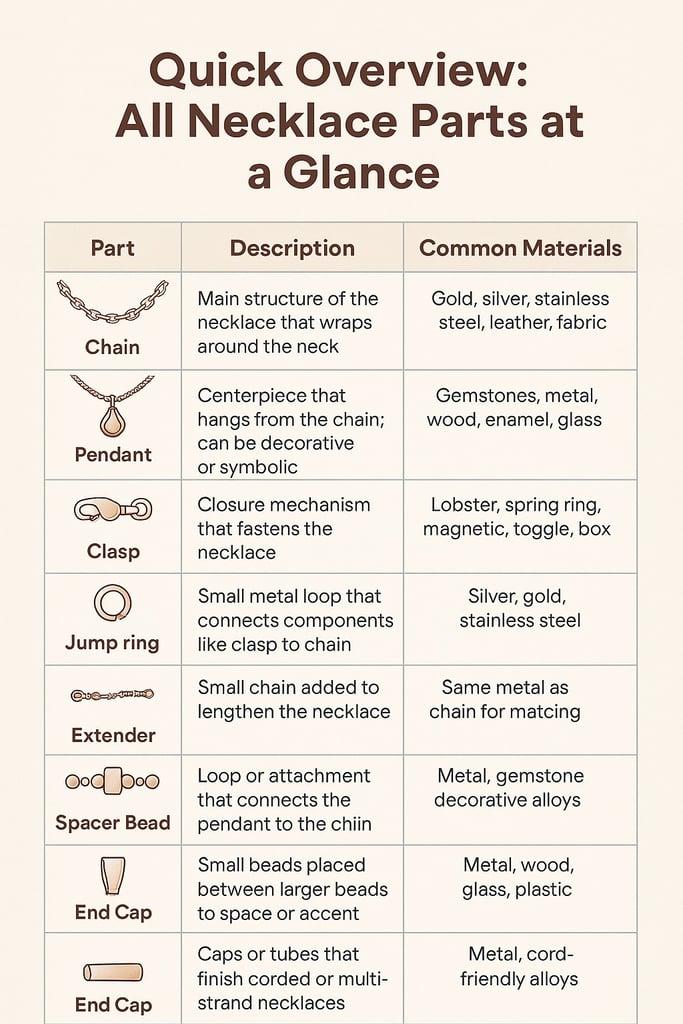
📋 Quick Overview: All Necklace Parts at a Glance
| Part | Description | Common Materials |
|---|---|---|
| Chain | Main structure of the necklace that wraps around the neck | Gold, silver, stainless steel, leather, fabric |
| Pendant | Centerpiece that hangs from the chain; can be decorative or symbolic | Gemstones, metal, wood, enamel, glass |
| Clasp | Closure mechanism that fastens the necklace | Lobster, spring ring, magnetic, toggle, box |
| Jump Ring | Small metal loop that connects components like clasp to chain | Silver, gold, stainless steel |
| Extender | Small chain added to lengthen the necklace | Same metal as chain for match |
| Bail | Loop or attachment that connects the pendant to the chain | Metal, gemstone, decorative alloys |
| Spacer Bead | Small beads placed between larger beads to space or accent | Metal, wood, glass, plastic |
| End Cap | Caps or tubes that finish corded or multi-strand necklaces | Metal, cord-friendly alloys |
Now that you’ve got the big picture, let’s dive into each part individually—and learn why they matter.
💡 Why Necklace Anatomy Matters More Than You Think
You don’t need to be a jeweler to care about the parts of a necklace. Trust me—if you’ve ever had a clasp break mid-party or wrestled with a twisted chain five minutes before a date, you already know how these tiny pieces can make or break your day.
Understanding necklace anatomy helps you:
- Shop smarter — know what you’re paying for.
- Fix pieces instead of tossing them.
- Layer like a style pro.
- Even create your own jewelry with confidence.
🔗 1. The Chain – Your Necklace’s Foundation
If a necklace had a skeleton, the chain would be it. It’s the part that wraps around your neck—sometimes flashy, sometimes subtle—but always holding everything together.
Chains aren’t just functional; they’re expressive. The kind you choose can whisper elegance, shout boldness, or sit quietly behind a dazzling pendant.
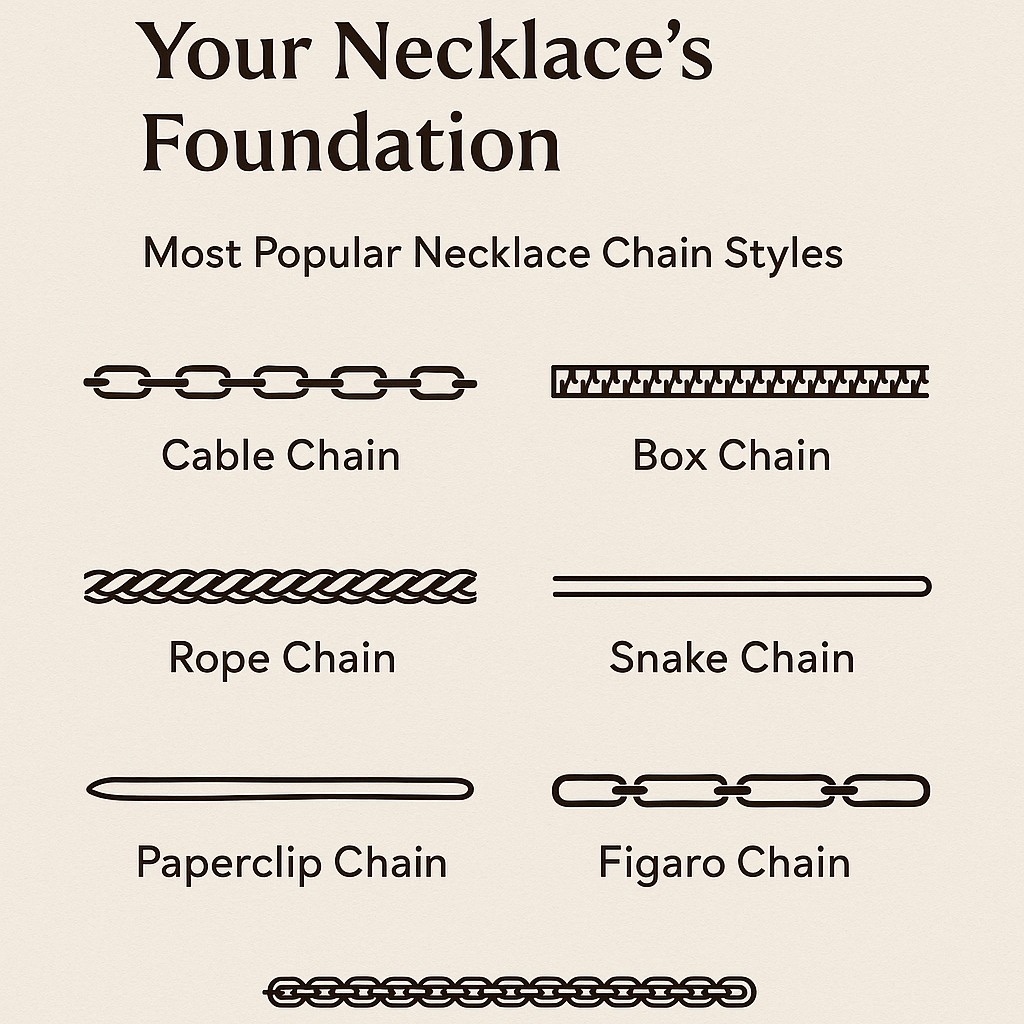
📌 Most Popular Necklace Chain Styles
- Cable Chain: The classic. Uniform round or oval links. You’ll see it everywhere because it works with everything.
- Box Chain: Tiny square links click into a geometric strand. Strong, smooth, and quietly elegant.
- Rope Chain: Think of this as the “braided crown” of necklace styles—interwoven and glamorous.
- Snake Chain: Sleek and seamless. It slithers over your collarbone like liquid metal.
- Paperclip Chain: Elongated, open links—minimalist, edgy, and wildly on-trend.
- Figaro Chain: A rhythm of short and long links—usually three small, one long. Italian, charming, and full of flair.
- Ball Chain: Think tiny beads connected on a thread. Lowkey and a little industrial—often seen in keychains or dog tags.
Pro Tip: The chunkier the pendant, the stronger the chain needs to be. Choose chain gauge (thickness) accordingly, or risk a break under pressure.
“The chain isn’t just the base—it’s the soul of the necklace’s movement and shape.” — @handmadedaydreams
💎 2. The Pendant – The Personality Piece
We’ve all got that one necklace—the one with a pendant that means something. Maybe it’s a birthstone, an engraved bar, a tiny locket with a faded photo inside. That pendant? That’s the personality piece. The statement. The memory holder.
Technically, a pendant is any ornament that hangs from a chain. Emotionally? It’s a whole different story.
✨ Popular Pendant Styles
- Lockets: Hinged pendants that open—perfect for photos, notes, or tiny secrets.
- Charms: Small symbols with big meaning—hearts, animals, initials, moons.
- Bar Pendants: Sleek, minimal, and often engraved with dates or coordinates.
- Gemstone Solitaires: One bold stone. Elegant, timeless.
- Medallions: Big, round, and often stamped or embossed. Makes a statement.
Quick Styling Tip: Pair long pendants with high necklines. For plunging necklines? Try a short pendant or layer multiple pieces for that curated chaos look.
🧲 3. The Clasp – Small but Crucial
Let’s talk about the tiny mechanism that keeps everything from falling off your neck and down a city drain: the clasp. Underestimated? Always. Essential? Without a doubt.
Picking the right clasp isn’t just about function—it’s about comfort, accessibility, and sometimes even arthritis-friendly design.
🧰 Most Common Types of Necklace Clasps
- Lobster Claw Clasp: Named for its shape, this clasp is durable and secure. Great for everyday wear.
- Spring Ring Clasp: A circular clasp with a spring mechanism. Smaller and more delicate. Best for lightweight chains.
- Toggle Clasp: A bar and ring combo. Easy to use and often doubles as a design feature.
- Magnetic Clasp: Two magnets snap together. Perfect for anyone who struggles with fine motor skills—or hates fumbling.
- Box Clasp: A rectangular box with a safety latch. You’ll see this in luxury and vintage jewelry.
- Hook or S-Clasp: A curved hook slips into an eye or loop. Simple, elegant, and secure when properly matched.
📌 Quick FAQ
Q: What clasp is best for a heavy pendant necklace?
A: A lobster claw or box clasp is your safest bet—they’re built for weight and hold up better over time.
🧷 6. Bails – The Unsung Jewelry MVP
Here’s something most people never notice—until it breaks. The bail is that tiny loop or connector that attaches the pendant to the chain. It’s the quiet middleman that lets your pendant hang freely, move naturally, and stay centered.
🔍 Types of Necklace Bails
- Classic Bail: A small fixed loop at the top of a pendant. Simple, visible, and common.
- Hidden Bail: Discreetly attached behind the pendant for a “floating” look.
- Snap-On Bail: Opens and closes like a clasp—ideal for swapping pendants easily.
- Tube Bail: A hollow tube that threads directly onto the chain, often used in slide-style necklaces.
Designers sometimes overlook bails, but a decorative one can elevate a pendant from “nice” to “next-level.” Look for engraved, gemstone-studded, or sculptural designs for that artisan touch.
🎀 7. Spacer Beads & End Caps – The Fine Details
When you’re looking at a beaded or multi-strand necklace, have you noticed the tiny details between the major elements? Those are spacer beads—used to keep things aligned, balanced, and, yes, breathable. Think of them as the white space in design: small, subtle, but essential.
And at the very edge? That’s where end caps come in. These little closures finish off the ends of cords, leather strands, or multiple beaded threads. They’re functional, but when chosen well, they look polished, too.
💫 Common Materials Used
- Sterling silver
- Gold-filled or plated brass
- Copper or antique bronze
- Wood or ceramic (for artisan looks)
- Acrylic or resin (in costume or fashion jewelry)
These finishing touches might not steal the spotlight, but they do keep your necklace looking like a finished piece—not a work-in-progress.
🛠️ How to Care for Necklace Components
Jewelry is emotional. So it’s worth keeping it in good condition. You wouldn’t toss your favorite leather boots on the floor—your necklaces deserve that same TLC.
🧼 Basic Care Tips
- Store necklaces flat or hanging to prevent tangles.
- Keep them away from moisture, sweat, perfumes, and harsh chemicals.
- Use a soft cloth to wipe down chains and pendants after each wear.
- Inspect clasps, bails, and jump rings every couple of months.
✨ Material-Specific Tips
- Silver: Use anti-tarnish pouches. Polish gently with a silver cloth.
- Gold: Mild soap and warm water work fine. Dry immediately.
- Leather: Avoid water completely. Spot clean only.
Bonus Tip: Traveling? Store each necklace in a small zip bag or wrap in tissue to keep chains from tangling.
🔧 DIY Fixes You Can Actually Do
You don’t need to be a metalsmith to do basic repairs. Here are a few quick wins you can manage at home—no torch or anvil required.
🧰 Common DIY Necklace Fixes
- Replacing a Clasp: Use pliers to open the jump ring, swap the clasp, and close it firmly.
- Adding an Extender: Clip on a pre-made extender with a lobster clasp. Done in seconds.
- Fixing a Loose Bail: Gently squeeze it shut using jewelry pliers. Add a drop of clear jewelry glue if needed.
- Untangling Chains: Use baby powder and a sewing needle to loosen tight knots. (Yes, really!)
Investing in a basic jewelry repair kit is a good move. Look for one with chain-nose pliers, jump rings, and extra clasps—it’ll save you more than a few trips to the jeweler.
❓ Frequently Asked Questions
What’s the difference between a pendant and a charm?
A: Great question! Pendants are usually larger and hang from the center of a necklace, while charms are smaller and often worn in multiples—especially on bracelets. But in modern styling, the terms sometimes blend.
Can I add a pendant to any necklace?
A: Technically yes, but check your chain’s thickness and clasp size. You’ll need a bail wide enough to slide over the chain, and sturdy enough to support the pendant’s weight.
Is it bad to wear the same necklace every day?
A: Not at all—as long as you clean and inspect it regularly. Daily wear is common with sentimental pieces. Just be mindful of exposure to sweat, water, or chemicals (like sunscreen or perfume).
Why does my necklace keep flipping or spinning?
A: It’s usually a bail or weight balance issue. Try using a slightly heavier chain, or swap to a pendant with a center-weighted design.
💬 Final Thoughts: Necklaces Are Personal, So Know Yours
Here’s the thing: Jewelry isn’t just decoration. It’s emotional architecture. It tells stories, carries memories, and becomes a part of how you show up in the world. And once you understand the components—the chain, the clasp, the hidden jump rings—it all starts to feel more alive, doesn’t it?
So next time you fasten that chain around your neck, remember: it’s not just a necklace. It’s an entire system working together to carry meaning, elegance, and maybe even a little magic.
Go open that jewelry box. Look closer. You’ll never see your pieces the same way again.
The Style Hub
Learn, Shine, and Stay on Trend.
Gold vs. Silver Jewelry: What Suits Your Skin Tone Best?
Choosing between gold and silver isn’t just about preference—it’s about knowing what enhances your natural
Aug
The History and Symbolism of Charm Necklaces
Charm necklaces aren’t just pretty pieces of jewelry. They’re time capsules. Worn stories. Tiny symbols
Jul
How to Tell If Silver Is Real: The Ultimate Guide to Authenticating Silver
Whether you’re sorting through a box of heirlooms, evaluating a coin collection, or just curious
Jul
Parts of a Necklace: The Ultimate Guide to Every Hidden Detail
Necklaces are more than accessories. They’re stories draped around our necks—symbols of love, rebellion, culture,
Jul
The Broken Jewelry Theory: Hidden Messages in Shattered Trinkets
When Jewelry Breaks, What Is It Trying to Say? It always seems to happen at
Jul
Bangle vs Bracelet vs Cuff: Key Differences
Confused between a bangle, a bracelet, and a cuff? You’re not alone. These three wrist
Jul
Ancient Coin Jewelry: History You Can Wear
A Journey Through Time: What Makes Ancient Coin Jewelry So Alluring? There’s something undeniably captivating
Jul
Does Stainless Steel Turn Green?
Unveiling the Truth Behind Metal Discoloration and How to Prevent It Quick Answer: No, genuine
Jul